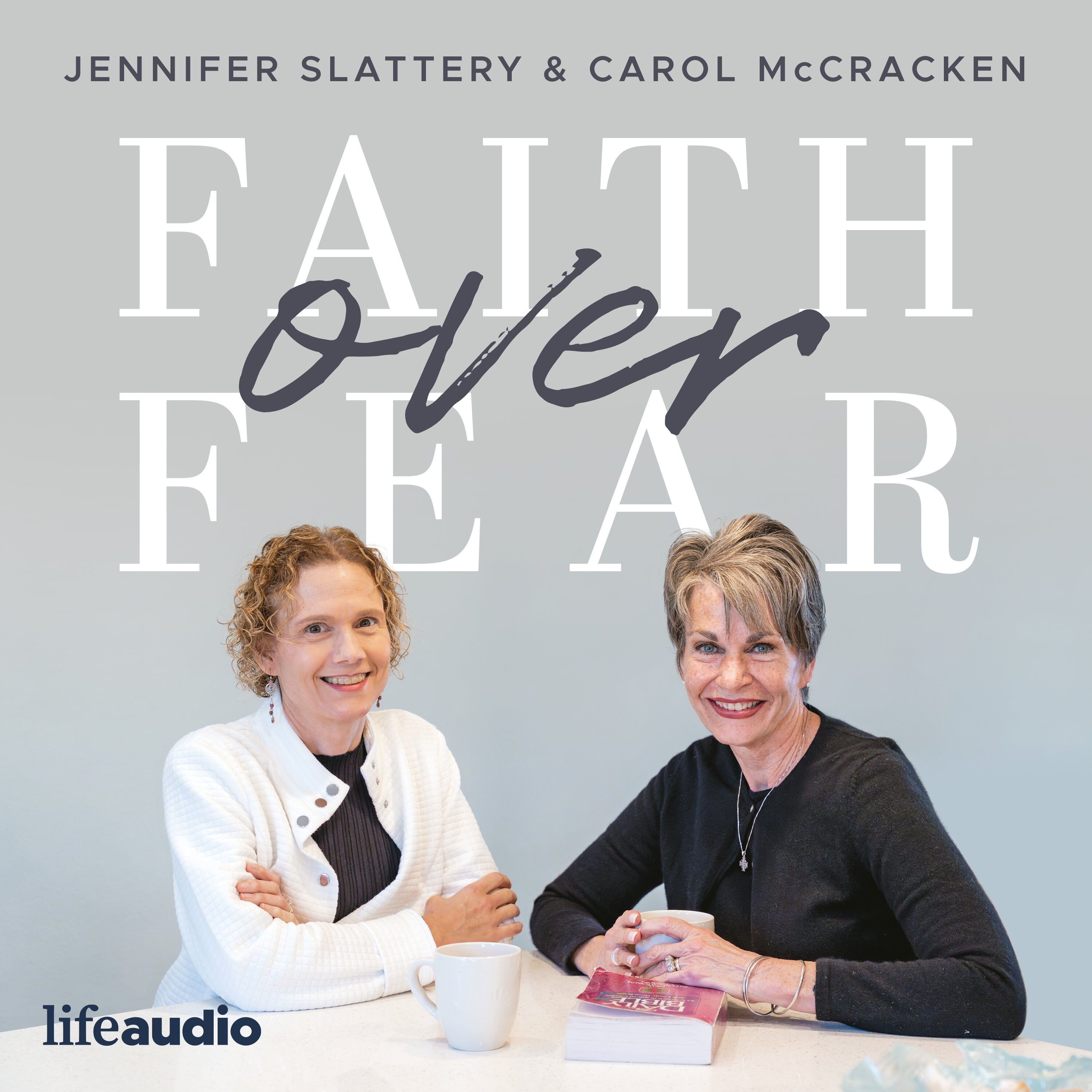
Faith Over Fear - Why Do I Keep Repeating the Same Relational Patterns: Reducing Anxiety by Healing Past Wounds
About this episode
In this honest and hope-filled conversation, Carol sits down with Mary DeMuth to explore how our past quietly shapes the way we show up in relationships—and how God can rewrite those patterns.
Together, they name a powerful lie many listeners carry: My past defines my relationships—I’ll keep repeating it. Early wounds, misunderstandings, disorienting seasons, and environments we didn’t choose often create internal narratives about trust, safety, control, and worth. Over time, those narratives influence how we react, who we let close, and how we protect ourselves. Fear and anxiety frequently grow out of these unresolved relational stories.
Mary shares how reflection becomes the first step toward transformation. By mapping our story—identifying key characters, inciting incidents, pain points, and the “muddled middle”—we begin to notice patterns instead of being ruled by them. Disorientation can become an invitation to find God as our true safety. What once fueled control and self-reliance can instead become a doorway to surrender and healing.
The conversation moves from awareness to action. What does it look like to walk differently? Mary explains how boundaries reduce anxiety, how emotionally safe community fosters healing, and how understanding our story shifts us from reaction to intention. When we recognize how old narratives drive current responses, we can pause, invite God in, and choose new patterns.
The episode closes with a practical next step: notice one relationship pattern you keep repeating, ask what part of your past is shaping it, and invite God into that moment before you respond.
Your past may explain you—but it does not define you. God is still writing your story, and He specializes in redemption, even in the places that feel most stuck. You are not too patterned, too wounded, or too late. You are being restoried.
Resource referenced: Restory Your Life: How Jesus Reframes Your Past, Rewrites Your Present, and Redefines Your Future
Listener Reflective Questions
- Where have you noticed your past quietly shaping how you trust, react, or connect in your current relationships?
- What relational lie have you been believing about yourself that may have formed in an earlier season of pain or misunderstanding?
- When you feel anxious or controlling in a relationship, what deeper fear might be underneath that reaction?
- Who in your life feels emotionally safe—and what makes that environment different from others?
- What repeated pattern keeps surfacing in your relationships, and what part of your story might be driving it?
- If you believed God could truly restory your past, how might you show up differently in one relationship this week?
Connect with Mary DeMuth:
Find Carol McCracken:
Discover more Christian podcasts at lifeaudio.com and inquire about advertising opportunities at lifeaudio.com/contact-us.
Get every episode summarized
Each time LifeAudio publishes, we email you a written briefing from the transcript — the topics, who appeared, and any specific claims, with the ad reads skipped.
Email me new episodesFree for 3 shows. No card needed.
Transcript ready
310 searchable segments. Every word is indexed and playable.
Full transcript
LifeAudio — Faith Over Fear - Why Do I Keep Repeating the Same Relational Patterns: Reducing Anxiety by Healing Past Wounds. Machine-transcribed; use the interactive transcript above to jump the player to any line.
I'm Christi Graham, host of On the Ground with Samaritan's Purse, and I recently interviewed one of our pilots whose plane was hijacked in Africa. I encouraged myself with that reality. That at some point, this is going to end in two hours. It'll end good if I'm on the ground somewhere walking around with the testimony. It'll end great if he pulls the trigger for me. It will end great. That day, Jim, experienced the power of prayer and witnessed just how mighty the name of Jesus is. If you want to hear this full story, tune in at Samaritan's Purse.org slash listen. Life audio. If you're in the slog, you're probably in winter. We think it's a wasted season. There's snow on the ground. There's nothing growing. It's cold, and it seems like it's going to last forever. The sun doesn't come out. But during that time, roots are growing down deep. Welcome to the Faith Over Fear Podcast, where we share powerful truths to quiet anxiety and fear, big and small. I'm Carol McCracken. And if you've ever felt like your past keeps showing up in
your present, especially in your relationships, today's conversation is for you. Many of us can wound misunderstandings, pain, environments that shaped us, and before we realize it, they start shaping how we trust and how we react and how we connect. So here's a lie that we're going to name today. My past defines my relationships. I'll keep repeating it, but here's the truth. God can re-story your past so you can walk into relationships with freedom, wisdom, and new patterns. Today, we're going to talk about how does that actually happen? And today's guest is Mary Demuth again. She's one of my favorites back for a third time, because I love she has to talk about. So for listeners who were shaped by past wounds, would you share a moment when you realized that your past was affecting your relationships and how God maybe began to restore it? I was finding that I kept choosing the friends who tended toward narcissism and they
also, some of them were predatory, and I kept coming to the end of a couple, not all of them, but just a few of them. I would come to the end of those, because when you're in a relationship with someone like that, they're usually as a spectacular end. And I was coming to the end of them and wondering and asking myself the question, why do I keep choosing these people? It doesn't logically make sense, and I'm a smart person, and I can see someone who's that way predatory or narcissistic, pretty much a mile away, but I am drawn to them. Why am I drawn to them? And as I worked through it with the Lord, I realized that they were representing my parents. So one of my parents was very narcissistic, another one was very predatory. And without ever verbalizing a root and thinking about, I was trying to complete my story. If I thought if I could just get a narcissistic predatory or predatory narcissist to love me, I can prove that I'm loveable to my parents who didn't. And once I figured that out, and the Lord helped me to realize, I needed to complete that story with him.
That I am loved and I am cherished and I am adored by him, and I don't need to go out and seek unsafe people to fill that story or to complete that loop. And that has made all the difference in the world. And now my friendships are much more layered and beautiful, and I'm not choosing those hard folks that I chose before that broke my heart. I've learned a lot from that. What began to shift exactly? It was just this fed upness of why I have there been seven of these that have happened. Listeners can ask themselves a question, why does this keep happening to me? Usually you're the common denominator. I didn't like to admit that. It was like, oh, wait, maybe it's me, and it was me having that mirror moment where you look yourself in the mirror and say, okay, I'm obviously making some choices that are not working for me. So now, Lord, help me unpack it. Of course, I had conversations with friends and my husband and all of that to try to figure it out because it was a conundrum for me. When you're in the middle of it, it's probably hard to see. Early experience
is obviously shape us. So how does that fear and anxiety grow from these relational wounds? In my case, for that one, I started to question my own ability to be a friend or inability to make something work that it wasn't working. And so that can mess with our anxiety because then we began to think that we're not good at it. But also, there's that residual anxiety that comes from past difficult relationships, whether it's parental or friend or whatever. Those can be a wound that especially if someone said something pervasive over you, like, you're a terrible friend or we're not a good child or whatever it is, some pervasive thing that's been said, where you have now internalized it and you're stuck there because you believe it. So where does control then enter the picture spiritually? Is this something I thought a lot about? As a younger child, control actually was my friend. And it helped me to navigate a very dysfunctional environment
because I could at least try to control some things. That serves you well when you're in a trauma environment. It does not serve you well as an adult. But the thing that I've learned is as I'm an adult now, that thing that saved me back then is now a detriment. And I can be hyper fixated on control and try to control the people in my life to make them conform to what I want them to be, just so I feel okay. I can work on controlling myself. But when it jumps over to controlling other people or trying to control weird and out of control circumstances, it doesn't work well. Control is really fear-based, isn't it? Yes, I'm afraid so I got to make this work. Okay, you transformed. Yes, trying to transform. Why is reflection important before transformation? Because if I hadn't asked myself the question, why do I keep choosing these mean friends? I'd still be here today and I'd have five mean friends. And then I'd be sad too because they'd
be mean to me. So we have to be willing to ask ourselves hard questions like that. And look at some wreckage and say, I am willing to see if I had a part in this. Now, if these people were mean and they were, they had a part to play too. They were mean. So that's on them. I was not mean, but I was still attracted to the mean people. So why was I doing that? And that's where introspection is important. Asking yourself the question, why am I here? What did they do to bring me here? What did I do to bring me here? What can I learn from this? And how can I reach out to the Lord and ask him to help me in this? Because I even see my own in capability. He had to change me. I couldn't muster it out myself. So you had to slow down. And either you or somebody else had to help you notice patterns. Yeah, my friend Jim talks about how we're all salad dressing and lead someone to read our ingredients because we're on the inside swirling around with all the ingredients. But we need friends and people who love us to call out things in us and not just
negative positive things. I spoke last night at my church and taught Colossians one. And I had a couple of people come up to me who called out nice things in me and said, thank you for that. I really resonated with this. We need that too. And so part of this need of having other people join in and helping us grow is our willingness to be loving and kind to our friends and our family members and calling out good things and difficult things in their lives with love, of course, and with respect. So that sounds like it was a nice, safe environment. How do the unknown environments push us toward God as safety because you lived in what sounds like an unknown environment? Yeah. In some ways, well, now I thank the Lord for my past. I didn't always because it was what caused me to run to him because he was the only safe place. I literally had no other place to go. Sometimes as adults, we try to push against anything that's painful and uncomfortable,
but that's the very thing that causes us to reach. And so I would say, take a moment, instead of pushing that away or trying not to feel it, take a moment to feel it and then reach because that's what it's there for. And it's a gift in a way. It's hard to see it in the moment. You'll see it in retrospect, but it is a gift, particularly when it's yuck feeling. But to your point, if you don't want to sit in it, I mean, you're reaching for God, there's the gift right in there. And I guess that's like, is it self-reliance breaking down? I think you're on to something there because of having to overcome a lot. And I think all of us have that story. We all have to overcome a lot. We've become very resilient and self-reliant. And again, that's a gift in childhood, but it can be a negative in your relationship with God because you're like, I got this God, I'm handling this and you're pushing him away. So I've definitely had to work through that. Sometimes I have to get to the end of myself in my own self-reliant quest about how awesome I
am at handling things. And then I fall down in a mud puddle and I'm like, that was all an illusion. It's so, who shapes our internal narratives? It's both three things. The Lord can do that. And that's why we're called in Romans 12-2 to have this transformation of mind, us our own voices. And then the bully voices, which can be demonic, which can be the bullies in our life, I tend to give more weight to those. And that's where I think spiritual growth comes from retraining our own mind and sifting through what is true about our own voice in our head, which often is quite influenced by the bully voice in our head, untethering all that and finding out what is the truth. And that comes from reading your Bible and reminding yourself that your child of God, your well loved, you've been forgiven, you've been died for, you are sanctified, set free. So the past, though it can shape us, our story can change. And that's the whole context of your book,
which I like so much, which people, if you don't know, she's got a new book. It's called Restory and it's coming out. What? Next week? Yes, March 3rd. It'll be out. Restore your life. And then I always forget the subtell, but I have it right here so I can read it. How Jesus reframes your past, rewrites your present and redefines your future. Oh, there's a good tool right there. Tell us a little bit about safe versus unsafe people. It took me a long time to discern that. This makes it absolutely no sense because of the way I was raised. I should have been freaked out and not walked straight into disasters, but I walked straight in. And so I made the assumption that everything was a safe place only to realize not everything was a safe place. And so part of our growing up is learning to discern who are the safe people in our lives? What are the safe environments? My husband and I recently, fairly recently left a church that had become unsafe. And now we're in a new
church who've been there two years now. And I'm all happy there. And the relationships between the two places is profound, but we were swimming in the unsafe place. And when you're swimming in it, you start to make excuses for it and you dismiss things and you forget your gut and you push things down. But really, you do know it's just that you don't want to make a big change. No one likes change. And that's hard to do. So that's what I've been learning over the past couple of years. Wow. What does an emotionally safe community look like? You just talked about the new church. Well, this is harder to find nowadays because we have siloed ourselves because of social media to only listen to voices that affirm our opinions. And therefore, we don't know how to have conversations with people who differ from us. And in a safe environment, you can have a different political opinion from someone and have a joy-filled discussion that doesn't end with this fight.
We should be able to have conversations and not demonize one another. And so a safe place is being curious. It's people who are curious about you who don't jump to a negative conclusion about you and you don't do the same because they might hold a different opinion from you. And safety really has to do with, I will love you even if you're different from me. And that's in this environment that we live in right now. It's hard to find. Well, and we've forgotten how to disagree. We have. Complete. The maturity of it online. Sometimes I just watch them. Why am I doing this? Why am I being sucked into this? You talked about a process that people go through where I can disagree with you and it's still safe. So there's misunderstanding. And there is a pain point. I hate being misunderstood. I don't know why it really bothers me. Why is the pain of misunderstanding so difficult for some
people? Probably one of my number one pains in life is being misunderstood. And I think it's hard because it indicates that the person doesn't really know us. Because if they really knew us, they wouldn't have misunderstood. Or if they wanted to get to know us, they would have asked us a question before they jumped to their conclusion. This played out with me recently with my pastor. We had a conversation. And in it, he made an assumption. It wasn't a bad thing. It was super small. But I prayed about it. And as well, I really don't want him to misunderstand where I'm coming from here. But I also don't think this is a big deal to blow it out of proportion. And knowing that it'd probably be easier if I wrote it down, I just wrote him a quick text and said, hey, I think you might have misunderstood where I'm coming from here. Let me explain. I'm not trying to be defensive. I just want to let you know. And so then he picked up the phone. He called me immediately. Hey, let's talk about this. We talked it through and we're totally fine. It was a really good exercise of I could have not said anything. And I could have just let it build up forever
and just made this pervasive idea that my pastor misunderstands me. Instead, we worked through it. And it was so easy and not a painful thing. And so I think a lot of us, because especially in the next generation and down, they haven't been trained how to have conflict at all. We have a little more conflict resolution training, but they don't. They avoid it. They're conflict avoidant. But they're going to struggle as any of us are going to struggle if we never talk about things. We have to talk about them. That's community, isn't it? It is. All of us in our different gifts and we're going to misunderstand each other. You got healed with that conversation. Some things were made right. So why does pain either hardness or heal us? I think it depends on our reaching to the Lord. When I start internalizing things and letting them build up and I don't reach for the Lord, then that's when bitterness enters in and that's when I'm not growing. So there's two ways to resolve that. One, sometimes it's just best to go to the Lord first, which is what I did. I
prayed. I said, Lord, today even because I'm willing to let it go and let it slide. But I felt, no, this is important. I need to write about it. And then the second is go to the person. So it's all relational, vertical and horizontal. Now, there's a caveat there. Some people are so unsafe and so punitive that you even going to them would give them fodder to crucify you. So there is that discernment that God gives us. And that's why I was willing to walk away because there's some people I should walk away from. They misunderstood me and they've had a pattern of abuse up into this point. I don't need to reengage without anymore. I need to take care of myself. But again, that's where I gain it from the Lord. He gives me that discernment or maybe it's through the word of God that I'm learning or maybe a neutral friend who helps me. But it's through relationship that we can make that discernment. And we move to a muddled middle as you have in your book where we live in unresolved seasons. What happens to faith when healing isn't linear?
When I met Jesus at 15, I thought that I would be instantly healed. And that would have been so cool if it had happened because I was reading all these stories about Jesus meeting people and then poof, they're healed. Oh, good. All my emotional problems are going to be healed. No, it's been years and years. And I just want to dignify the person who's in the slog of it right now because it can feel like I'm not moving anywhere. My encouragement to them is remember the four seasons. And if you're in the slog, you're probably in winter. And we think it's a wasted season. There's snow on the ground. There's nothing growing. Nothing is happening. It's cold. And it seems like it's going to last forever. The sun doesn't come out. But during that time, roots are growing down deep. And you will be surprised when spring comes because the flowers are going to explode and the fruit is going to happen. But it usually happens after a long winter. And so you might categorize it that way because things take time. And for those of us that don't like waiting, you and me who went to
have it all solved. That makes a lot of sense. So we're going to take a quick little sponsor break. I'm Kristi Graham. Host of On the Ground was Samaritan's Purse. And I recently interviewed one of our pilots whose plane was hijacked in Africa. I encouraged myself with that reality that at some point, this is going to end in two hours. It'll end good if I'm on the ground somewhere walking around with the testimony. It'll end great if he pulls the trigger for me. It will end great. That day, Jim, experienced the power of prayer and witnessed just how mighty the name of Jesus is. If you want to hear this full story, tune in at Samaritan's Purse.org slash listen. If you're struggling with credit card debt, you're not alone. The stress, the interest rates, the endless payments, it can feel like there's no way out. But there is. At Trinity debt management, they have helped thousands of people just like you become debt-free. They work with your creditors to lower your interest rates and consolidate your bills into one affordable monthly payment.
Most of their members have saved thousands and even improved their credit score. You'll get a clear plan, personal support, and the peace of mind that comes with knowing you're finally taking control. Don't wait another day feeling trapped by debt. Call Trinity debt management and be debt-free for keeps at 1-800-793-8548. That's 1-800-793-8548 because you can live a life without debt and Trinity can help you get there. Trinity debt management debt-free for keeps. Welcome back to Faith Over Fear. Before the break, Mary helped us see how our past stories, especially painful or disorienting ones, shake the way that we show up in our relationships today and we talked about fear control and how wounds can quietly drive our patterns and how God meets us right there in the middle of it, not to shame us, but to restore us.
Now let's talk about what it actually looks like to begin walking differently. So how do boundaries help us reduce anxiety? Oh, I love a good boundary. We can overboundary, we can try to make ourselves so safe that no one can get in, right? So we have to be careful. There's a nuance there. But creating boundaries that protect you from ill will and from people who have mal content or mal intent is a really wise idea. And it's also biblical saying, as I look at my own yard, there's a boundary around the yard inside this yard is mine and outside that yard is the public's part of the yard. And so it's important for us to define what we will accept, what we won't accept. And it's part of partnering with the Lord and the story that we want to be living. Good. So why does safe environments with those boundaries create healing? You know, if we are in an environment where we're constantly harmed,
we can never heal. So it's like you have this open wound on your arm and you can almost see the bone. It's that bad. And you have all these contaminants that keep coming in and you wonder, why isn't my arm healing? Because you've left it open and you put bacteria in it. And of course, that wound is going to fester and it's going to get bad. You have to do the right measures of putting biotics on it and covering it and giving it time. What I was learning several years ago, but still very important lesson is I was allowing people into my life that were re-injuring me throwing bacteria in my wound. And so it never healed. And then I got mad at myself like, why can't I heal? Well, that's why because it was reinfected. We, for the sake of them, even, even one of my most profound relationships, for the sake of her, I had to bandage the wound and take a break from her so that the wound would heal. And then I could go back with a healed wound. She could try to throw
some bacteria that way, but it won't matter because the skin is pulled over and it's fine. Safe environments create healing. Okay. So here's a so what moment? What changes when somebody understands their story? For me, in particular, for a long time, I was, what is the point of all this trauma? You know, life. And I was so tired of it. And I couldn't seem to figure out any wise. And I don't know that why is going to be truly answered until the other side. So I hold that intention. But I began to see as I was working through my healing and barely started sharing my story that other people were resonating with it. And my why then became, oh, the why is I'm set free to be an emancipator of others. And then I get to participate in their freedom journey. And there's no greater joy than walking along someone else and helping them to avoid some of your pitfalls
and helping them to experience a freedom that you've experienced. So that's my so what? It's to walk alongside others. And I think that's everybody's so what? Definitely, particularly if you've healed and made it to the other side, people can look at you and go, oh, she did it. And she did it. And she's crazy. And she did it. So surely I can do it. You are my people, Mary. So you're moving from reaction to intention reaction to pro action comes from years of healing. It comes from maturity and the older that you get, you know, in this world that we live in, it doesn't really value people who get older. But as I get older and younger people are seeking me out for advice, they'll say things like, you're so wise. And I'm grateful that they say that because it's hard for me to see that. But it's true. The experience that we gain the older that we are, that's why we're supposed to pour in to the next generation because wisdom is so it's sadly undervalued and it's
pretty rare. But it's a beautiful gift that we receive as we grow in Christ. Have a question, Mary. Can relationships truly be restored? Yes and no. It depends because on Romans 12, the Paul says, as far as it depends on you, be at peace with all men. That gives one side of the equation as much as you can do, do it. If you can reconcile, if you can ask for forgiveness, if you can say, wow, what I did was wrong. I hope you can forgive me. I did something bad and here's some restitution. Whatever it is that you, as far as it depends on you. But restoration of relationship isn't guaranteed because that takes two and it takes the other person also being willing to be humble and ask for forgiveness and all of that. Now some people just don't believe they've ever done anything wrong. So then that's its own problem. You can't change that. But the other thing to look at is you can always have your vertical relationship with the Lord. Okay, by being a repentant person and by asking for forgiveness and you can go 50% the other way toward that
relationship and you just have to wait for them to come the other 50% and it may or may not happen. But I pray for it all the time. I have one friend of mine that I've had for years and years and years and years and I just pray for her all the time that the Lord would bring her to himself. And a lot of times those are people that have walked away from the Lord that we have those broken relationships with. Well, do you think then you can use past awareness from a relationship to navigate new relationships? Yeah, I would hope so. And I think that's what we're all doing. Trying to learn and do better. But you see that, especially in romantic relationships where you date around and you're like, oh, no, not that. Then you think, oh, I didn't like the way I was in that relationship. So I really see that that showed me I need to grow up a bit. And so yeah, of course those past relationships help us to navigate that. You alluded to that in the beginning of the podcast too. When you said, okay, what am I doing? What am I doing? Recognizing a
pattern so that you can navigate new relationships. I see that coming full circle there. Learn something, no matter what, whether or not that relationship resolves, but you can always go forward with the new ones, the healthier ones. Exactly. And that helps bring hope into situations. And a lot of times for me, I've been like a hundred percent friend person. If you are my friend in the third grade, you should still be my friend today, even though we've moved seven times. So I have learned that there are seasons for friendship and relationships. And I was so tenacious about holding onto those relationships that I should have let go of some of them. And then when you let go of some of them, because they were there for a season. And God was good. And there's nothing conflictual about them. But then that opens me up for a new relationship, like leaving an old church and coming to a new church. I now have these new relationships that are fantastic. And I wouldn't have had that capacity earlier. So it's all joy. It's all good. And God is good. And he may even bring those people from the past
back into your life, which he has also done. You never know. You've got to look at it as an adventure and see what's going to happen. So there's power in a restored life. And it seems that telling your story invites community. It should. Yes. It helps people not feel so alone. I had a lady come up to me last night. She goes, thank you for sharing your heart on the stage. I think what she was saying in that is, I don't feel so alone. I'm not the only broken, you know, weird person out there. Nope. I will say it from the stage. I'm a broken, weird person. And you are not alone. There are plenty of us broken, weird people. Yeah, really. Truly. So, okay, Mary, for the listener today, if they've taken everything you've said today, where do you begin? One easy thing to do is to write, I was, I am, I will be statements. You can do that by identifying one of the lies that you believed about yourself. I believed that I was unlovable. But in the I am statement, it's what is true of you today because of the Lord
because of scripture. Well, I am adopted by the king of kings. I am loved. I am his beloved. So, I was unlovable. I am his beloved. And then I will be is that future re-story part of your story. I will be one who shares God's love with people who are brokenhearted. And so, then make that into a mission statement. And that shows you the beautiful transformation that the Lord is actually bringing you on in your journey. That's a great idea. What would you say to somebody? Who feels stuck in their story right now? First, you're normal. We all go through it. Every story has a stuck point. Second, the Lord is not through with you. He is still with you. He is working. It may be a winter season and you may not see it. People from the past have called it the dark night of the soul. A lot of us have those. It's very normal. And then also be willing to spend some quiet moments with God. Take walks, journal, and say, what is it that you're teaching me? What can I learn in this winter environment? What can I press into? What lie have I believed? What
anxiety has overtaken me that I need to relinquish control to you for, Lord? Well, your past, it might explain you, but it doesn't define you. And I think you give us hope because it's like God is still writing our story. And he specializes in redemption, especially in those places that so listeners hear me now, you're not too far gone. You're not too patterned. You're not too late. And you're being restored. So I hope that you hear that loud and clear from two people who have been restored. And I hope that if you like this podcast, if you haven't yet, that you'll subscribe to it so that we can get these messages out to many more people who need to hear them. And remember that we want you to be somebody who God has set free. Have a good day, everybody.
Ever walked away from a conversation thinking, wow, now that was exactly what I needed. Hey, I'm Donna Jones, host of the That's Just What I Needed podcast. Each week we have great conversations about life, faith, and how we can know, love, and follow God in our everyday lives. Listen and follow at lifeaudio.com or on your favorite podcast app. Can't wait for you to join me.
More episodes
More from LifeAudio

Timeless Wisdom with Dennis Prager - Why Moses Was Chosen to Lead | Weekend Tora...
LifeAudio

Your Nightly Scripture - Watching God Make a Way When I Can’t See One (Exodus 14...
LifeAudio

Your Nightly Prayer: Evening Prayers for Christian... - Trusting God with What Y...
LifeAudio

Faith Over Fear - Bonus: Saturday Scripture Reset: When You Feel Unloved By God
LifeAudio