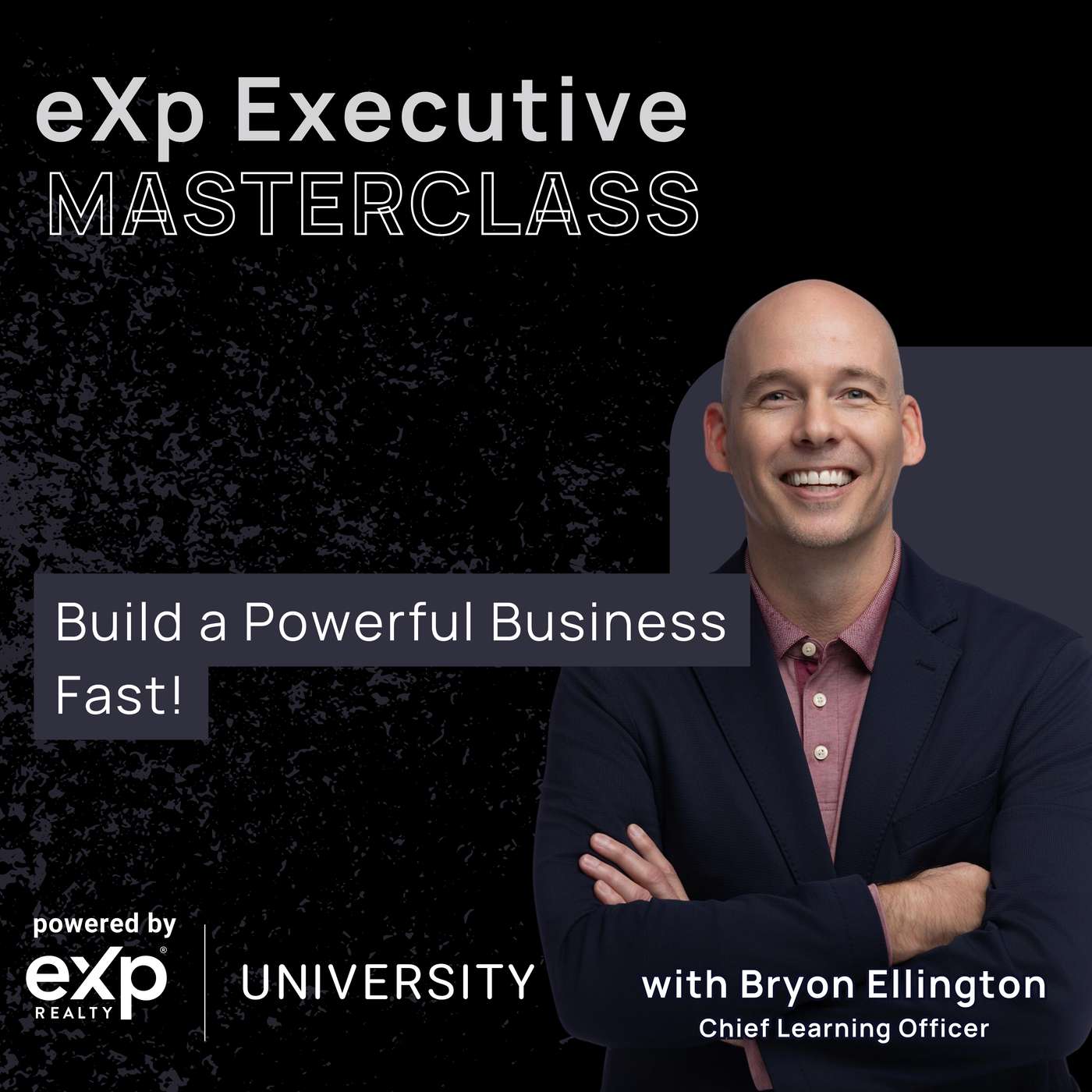
eXp Executive Masterclass: Build a Powerful Business Fast!
About this episode
Are you ready to build a predictable, high-growth real estate career?
In this episode, Bryon Ellington, Chief Learning Officer at eXp Realty, breaks down the operational systems behind achieving 12 deals in 12 months. This conversation explores how agents can move beyond the feast-or-famine cycle and build a consistent, scalable business regardless of market conditions.
Success in today’s landscape requires more than monitoring interest rates. It demands structured systems, disciplined routines, and a professional ownership mindset. Bryon shares how top-performing agents leverage the FastCAP Methodology and the 5112 Daily Productivity System to maintain momentum, increase conversion rates, and stay consistently profitable.
Whether you're building your pipeline, refining your systems, or looking to stabilize production, this episode delivers actionable insights you can immediately apply to your business.
Inside this session, you’ll learn:
✅ The 5112 Rule — a practical daily framework designed to drive production
✅ How to break through the growth plateau where many agents lose momentum
✅ Relationship-based referral scripts that generate business naturally
✅ A data-driven perspective on interest rates and market realities
✅ The importance of tracking metrics, consistency, and long-term strategy
QUICK LINKS & RESOURCES:
🎓 Visit eXp University: https://www.expuniversity.com/
Register for FastCAP: https://www.expuniversity.com/fastcap
Timestamps
0:00 – Strategic Intro
1:36 – High-Performance Scheduling
2:41 – The FastCAP Agenda
3:42 – Professional Mindset
7:02 – The 12-Month Roadmap
8:54 – Industry Exit Rate
10:34 – Interest Rate Context
13:53 – Consistency Framework
15:56 – The 100-Day Sales Cycle
20:44 – Newsletter Strategy
24:50 – Habit Systems
29:23 – Sphere of Influence Math
33:41 – Referral Scripts
44:42 – Tracking Conversion Ratios
46:32 – The 5112 Action Plan
#RealEstateStrategy #AgentProductivity #FastCAP #eXpRealty #RealEstateSystems
Get every episode summarized
Each time eXp Executive Masterclass publishes, we email you a written briefing from the transcript — the topics, who appeared, and any specific claims, with the ad reads skipped.
Email me new episodesFree for 3 shows. No card needed.
Hosts & guests
Transcript ready
1,137 searchable segments. Every word is indexed and playable.
Full transcript
eXp Executive Masterclass — eXp Executive Masterclass: Build a Powerful Business Fast!. Machine-transcribed; use the interactive transcript above to jump the player to any line.
I am your conductor instructor for building a powerful business fast. So a little bit about me. I am a husband of one father of four. I live here in beautiful Austin, Texas. I've been an agent. I've worked for a number of companies within the industry. I was Chief Products Officer, Chief Learning Officer, and COO for Keller Williams. And they're international franchising. I was head of training and coaching for Realogy, now called Anywhere. I was COO and Chief Development Officer for Century 21 today, though. I'm living my passion by being the Chief Learning Officer for EXP Realty. I absolutely love helping entrepreneurs build businesses. And so today's topic is very near and dear to my heart. All right. So let's get into this. As my friend Jess Sims would say, the Peloton Instructor, the hardest part is check done.
You are here. And that's the hardest part. So thanks for joining. The second hardest part, listen, the internet is screaming at you. Your email is on fire. Your phone is blowing up. The kids are screaming in the next room. The iron still plugged in. Let it go. Give yourself the space and the grace to focus on you and building your business so that you can provide you and your loved ones the life and the lifestyle that you want to provide them. So that being said, we're going to talk about boundaries here right off the bat. And what's interesting is this is going to be very germane to helping you build your business. Do you set boundaries? What do your voice mail say? If I were to call it up right now, would it say simply leave a message or would you tell me when I'm going to be returning, when you're going to be returning my phone call? Hi, this is Brian Ellison with the XB Realty. I'll be returning your calls between 12 and 1 and 4 and 5. Thanks so much. Leave your message.
Right? Is there a sign on your door? What does it say? Have you talked with your significant other and any kids that you might have running around the house to let them know, hey, these are my lead generation times. This is when I'm your daddy makes it rain for the family. The world is going to respond to your boundaries, but not until you set them. You have to communicate them and keep communicating them too so that you can focus on you and do the things that you want to do. And I hope today that you're able to tune in and focus because we're going to help you build your business. So Rockefeller said success in business requires training, discipline, and hard work. And so when we talk about building your business fast, that's exactly what we're talking about. So here's our agenda for today. We're going to talk about commitment in our business and what that means. We're talking about owning our business and what that means. We'll go through building your business operation systems. Building from lead generation all the way through past clients and close opportunities as well. And we'll go through all of that together.
Feeding your brain. How are you feeding your brain on a regular basis, both to help you build your business and also to have things to share with your clients? Getting into action and inviting accountability. I'll say this a lot. I don't care what you know. I don't care what you do. I care what you do consistently because that's going to be the difference in your success. Okay, let's jump in. So decide to commit. Now this is an interesting exercise. I can't see any of you out there in YouTube land. And I'm going to ask you to do something. I'm going to ask you if you're in a crowded place, you can say it quietly. If you're not, say it loudly and proudly. Say this to yourself. I will build a highly successful real estate business within the next year. Go ahead. Couple of things. I'm betting some of you didn't even say it because maybe it felt a little awkward, which is interesting, right? Because if I asked you to say your name out loud, nothing awkward about that.
If I asked you to say something that you believe about yourself, nothing awkward about that. But those of you who did say it, I'm betting that several of you might have had that little voice go off in the back of your head, that little negative thought that says, no, you won't. No, you can't. Isn't that interesting? So a couple of things about that. The first is, look, we all have these negative thoughts in the back of our mind. Anytime we strive to do something that's different from what we are and what we do today, we have those negative self doubts. Here's something that I found helpful that I learned. And that is, when you have that negative thought, just simply say this, great, thanks. What an interesting comment. Thanks so much. Other Brian. Thanks so much for that comment. In other words, we're giving it no energy. We're just dismissing it. Listen, if you're eight-year-old, we're to tell you that there's a Grimland in their closet. If you try to argue that there's no such thing as Grimlands and things like that, that
the eight-year-old is going to dig their heels in, right? They're going to tell you, yes, it is. My friend saw it. Well, when we give it energy, our minds work the same way. We dig in on the thoughts that we have. And by just dismissing it and moving on, we can give it less energy and we're less likely to have those negative thoughts in the future. So just dismiss it. Great. Thanks so much. Great comment. I appreciate that. Actually, there's a difference between anxious over thought and daydreaming and that difference is the negativity of the thought. We take the time to have these self-doubt, but do we take the time to have the positive thought about what the positive possibilities could be? For example, if I told you that there was a program that when six weeks could get you on track to doing just this, to building a successful business in one year, and it was based on people who had in their first six months in the industry done two deals, and
in their first 12 months in the industry done 12 deals at least. And we based a training program on that and then modeled out what they had done and could teach that to you, wouldn't that help you overcome those kinds of negative thoughts to know that others have come before you and that you could repeat that pattern? We do. We've done that. So as your chief learning officer at the EXP, please know, I'm never going to put anything in front of you that isn't based on what the very best are doing. So we build a program and I'm going to give you a synopsis of that today to get you started. And then I'm going to advocate at the end that you go take that program. It's part of being with the EXP. There's no additional cost to you. Today, at least, you'll get the blueprint for it so you can start today. So we call that program fast cap, by the way. And that graph is the units and the time of those fast cap agents that we interviewed.
We interviewed them. We studied their business. We studied what they did and we modeled out what they had done. And there were scores of them that we interviewed. And you might be thinking, well, you know, those are unique individuals. A couple of things to make sure that I tell you up front. Number one, we didn't talk to anybody whose spouse or significant other was a builder. All right. We didn't talk to team members who had team leaders feeding them leads. These are individual agents who were doing one Z2Z deals just like you that just got after it. And so the whole question is, what does that mean? And we're going to go through that today. And in terms of these being special individuals, and you know, and results may vary, we just piloted that program and we're about to launch it next week. And here's what happened in the pilot. This is for the reporting agents in that pilot. They did 5.4 buyer and listing appointments per agent during that six week period. And they did 1.9 buyer and lesser listing agreements per person in that six week period
in that six week pilot. The question, what did your last six weeks look like? Did it look like this? If so, awesome, fantastic, and congratulations. And if not, then let me share some of the things with you that we learned from those individuals. So here's the first thing that we learned from these folks. This is an interesting article that came out January from Inman. And it quotes NAR saying that 49% of agents did either 1 or no deals last year in our industry. This is an industry wide, 49% of agents last year did either 1 or no deals. So the question for you, why is that? A lot of agents will say, well, it's the market. It's the interest rates. It's talking with Glenn Sanford recently. He was sharing a camera for this podcast, or somebody he was talking to.
But they asked the question of people who got a cold, why did you get sick? And Glenn was sharing what the person said is how interesting it is about how everybody tends to blame the external factors. This person got me sick, that person got me sick, what were things of that nature? Instead of the things that we can do to make sure that we are healthy and that we stay away from illnesses and things of that nature. So when we talk about things like the market and the interest rates, well, a couple of things. In 2023, there was about 4.09 million home sales. In 2024, by the way, the Sioux Sayers are saying there's probably going to be about 4.1 million home sales in the industry. So I'm going to tell you that the top producers in your market aren't blaming the market for their success. And so I don't think it's right to blame the market for our failures if we're not living up to our goals.
The other thing about interest rates. Yes, when you compare it to 2021 in the Lala land, Fixie Dust Times of 2.99% and things of that nature. Yeah, 7% seems high, but just historical context. The actual 50-year historical mortgage rate average is about 7.77. And we're well below that. I looked yesterday at 7.08. So we're well below average in terms of mortgage rate. It just feels high compared to the Lala land we experienced in our recent past. Quick question. Does your sphere of influence into your current working clients understand what that staff that I just shared with you? That we are below historical interest rates in terms of our mortgage. So now is a time to buy in a great time at that, comparatively speaking. So question for you. If it's not those things, then what is it? Well, success in life starts with the decision.
It starts with the decision. And when we talk to our agents in the program, we talk about four decisions that we ask them to make. So I'm going to actually share that. I'm going to ask you to make these four decisions in your business as well to be successful. And here's the first one. Decide to be a real estate business owner, not a salesperson. Now look, nothing wrong with being a salesperson, but that's not what you are. You are an independent contractor. Now if you're with the XP or whatever broker you're with, you signed an ICA. You are an independent business owner. And do you act like that? Here's what's interesting. A lot of us get into this business kind of like one foot in, one foot out. We see how we're portrayed in the media sometimes. And that bending, slapping yourself in the face over and over again in American beauty. I will solve this house today. The Simpsons and other negative sitcom portrayals of us as realtors. Let me just tell you this.
All of us, we all dreamt when we were little kids that we were going to make a difference in people's lives. I bet you did too. And I'm betting like me, that daydream probably involved either a cape and spandex or maybe a stethoscope and a microscope curing cancer. I bet you didn't think that I'm going to grow up and I'm going to help people on a home, create a family, create wealth for themselves, create literally their space in this world. And yet that's exactly what we do as realtors. You're in a noble profession and be proud of that fact and be a real estate business owner. The second thing I'm going to ask you to commit to is decide to be great. Listen, I'm not going to define your level of success, whether that's 10 homes, 100 homes, 200 homes, that's up to you. That's not what I'm talking about here when I say great. What I mean is this is your profession, this is your spirit, this is your hobby, this is your passion. And if you think of yourself like Michael Jordan or LeBron James, nobody is going to step on the court and outdo them.
That's their mentality. Likewise, when it comes to your professionalism as a real estate agent, nobody should outdo you in terms of professionalism. And that's about deciding to be great and then doing the things that it takes like getting into training and things of that nature. Number three, and this is really important. Decide to commit to consistency of effort. So Churchill had this great quote. He said, continuous effort, not strength nor intelligence, is the key to unlocking our potential. Whether you read talent is overrated or mastery by Leonard or any of the others, I think Malcolm Gladwell's was the outliers. All of them say the same thing. It's consistency of effort over time that wins. So when you look at your efforts, if you're only leading generating when you need a lead and then stopping, you're going to have inconsistent results in your business, they are related your efforts and your results.
And so what we focus on is really making sure on a consistent regular basis that today's business is never interfering with finding tomorrow's right. We are making that time. We are making that effort. And listen, we're human. We're going to have things happen in our life, all that kind of thing. And yet it can't be the thing that takes us off track. It's OK to have an emergency one day, but then get right back to it the next and don't let up. The fourth thing, decide to commit to a plan. And that plan, by the way, should include the consistency that we just talked about. It should also include training. I know that self-serving, the training guy saying you should be training, but really we're going to talk about why that's so important because I guarantee you a lot of you have this fear of not being valuable to the people that you reach out to of being annoying. Training is a big part of making sure that you're not.
It's also a big part of evolving your business and staying current and consistent with the best practices in the industry. OK, so once we make these commitments, now let's talk about owning our business and really what that ownership means. So here's the real estate sales cycle. And really when you think of it, our sales cycle is made up of two big components. One is the lead generation cycle, the time it takes to generate a lead, cultivate and convert it, and then the contract closed cycle. Once we start working with a client, how long does it take us to find a home for them at their buyer or market and sell their property and get to close. Now, our tells us that's about 100 days. Now, cash offers and all that will change that, of course, but on the average for your usual normal transactions, we're talking about 100 days. So here's a question.
December 7th, 2024. What do you want that data to look like? That's 100 days from today, by the way. December 7th, 2024. I know, where did the year go? But what do you want that data to look like? Honestly, do you want to be going to our man? When's my next check coming? Or do you want to be going to the closing table at your title company or whatever it is that you do in your state? For me, what I want for you is for you to have a closing that day, the next day, the day after that. I want your Christmas, your Hanukkah, your Kwanzaa, whatever gift giving celebrations you might do in the winter time. I want that to be the kinds of gifts you want to be getting in giving to your folks, right? And that starts with doing the things today that make those things happen later on. This is one of the biggest lessons that we have as an industry. There's a lot of us who today are regretting the us of 100 days ago. The person 100 days ago who said, it's all right, we'll get to that tomorrow, right?
And so making sure that we respect that sales cycle and that we're being consistent. And this is the other lesson that we learn from our most successful agents. For a lot of agents, we follow this sort of real estate rollercoaster, where we generate a lead because we don't have any business. We finally get somebody who's ready willing to be able to work with us and we focus on that. We put that egg in our basket, we sit on it, we keep it warm until it hatches. And finally, we get a commission, Jeff, and then what? Whoops, I'm unemployed because I don't have any more leads in the pipeline. Rinse and repeat over and over and over again. So what we found was different from our most successful agents when we really looked at their businesses was three major things. One is consistency. They literally followed a plan to make sure that on a regular basis, they were doing the activities that would lead to the results so that they weren't constantly in that feast or famine cycle. The other is skill. Look at it like this, your conversion rates today should not be your conversion rates tomorrow.
Through training, through practice, through role playing with partners, making sure that you are learning from your past mistakes and opportunities. Your conversion rates will improve over time with your skill. So make sure that you're getting into training that's effective at scaling you up. And by the way, today is a very skilled based market. So if you're not in training, especially with all the adaptations that have come through because of the NARS settlement, I'd highly recommend you to do that. I mentioned Holly's session earlier. That's great. Go on our YouTube channel after this. There's a ton of videos on there that we've been producing for you to make sure that you were ready starting all the way back in March. The last one is scale. And we're going to talk about this when we talk about your sphere of influence because really real estate is a numbers game. And in playing the percentages out, knowing what your percentages are, knowing how big your sphere of influence needs to be and what that means in terms of prospecting versus marketing activities in your business,
it's going to be very important. What's interesting about this is that 100 a cycle, eat again, cash offers and things like that aside, you're not going to have a whole lot of influence. The mortgage and lending process is what it is. The contract closed processes is fairly rigid. What's not rigid is that lead generation cycle. The time it takes you to find and convert a lead. And I'm not just talking sequentially. Can you keep doing it to where they start stacking up on one another to where your pipeline gets full? And then you can decide, do I want to grow a team and really go big with this? Or do I want to refer that business out and just take a referral fee from it? That's all up to you. But if you want stability and success, that's what it takes. Speaking of success, this is the concept of the plateau of latent potential. And it's associated value of disappointment. As I call it, the value of death. It's the death of ideas for a lot of us.
And the thing that comes to mind every time I think about this is the newsletter. The proverbial newsletter in the real estate industry. I can't tell you how many newsletters that I got from a particular agent. By the way, I'm a connoisseur of real estate marketing. So I pay attention to this stuff. But I get a newsletter and I'm like, okay, we got a player in the neighborhood. Let's see what they got. And then three months later, what happens? Well, I'm guessing what happened is that agent didn't see immediate results because the net effect to me was that newsletter stopped coming. Whatever lead generation efforts we make, we need to give it proper time for it to take effect. The problem that happens is that we're so focused on getting now business to make sure we're feeding ourselves and our loved ones. Is there something's not generating now results? Man, we really didn't just start moving on mentally and otherwise. And so there's a balance that needs to happen in terms of the time commitment that we give things. And we can do that. We can be a friend to ourselves if we're balancing things like marketing
for tomorrow's business with prospecting for today's business. We'll talk a little bit about what that means as well. The other thing is building the right habits. So look, I would love it if all of you were to go call the FISBOs in your area. Again, use the do not call this TCPAA, follow those regulations. I would love it though if you were to make calling expireds and FISBOs. Maybe geographic farming, do 20 cool calls a day in your geographic. I love all that. By the way, I'd love it if you didn't. I'd love it if you did open houses or YouTube. Whatever it takes, I don't care how you generate contacts with people to talk about real estate. What I care about is that you generate contacts with people to talk about real estate. I had this great conversation with a friend of mine, Shannon Maxwell, and we're going to put out the interview. Shannon's an icon agent with us in Tennessee. And she plays this online game. Now, she does a tremendous amount of business for her and her team.
She has a great agent agent referral basis as well. But one of the lead generation sources, I guess you'd call it, is this video game where in it, you can capture people's castle and they have to buy them back from you or fight them back. And she's pretty good to, apparently, you don't want to be fighting her. Well, she's gotten 12 deals off of this video games by making her opponents give her a real estate referral if they want their castle back. Now, is that something I'm recommending to you as a lead generation strategy? Probably not. Works for her though. The point is, whatever you do, whatever your passions are, hobbies are making it a point to build in the habits of generating conversations, generating new contacts that you can talk to and help add value to in real estate. And really, it's about making sure that we're consistent. And so how do we do this? Well, there's a great book called Atomic Habits. And I'm a big fan of this book.
And in it, Claire talks about the idea of how you reinforce good habits and how you break bad habits. Here's the challenge. And think about the bad habits that we as humans have, right? We can talk about chocolate cake. We can talk about drinking alcohol. We can talk about smoking cigarettes. They all have similar things in common. And that is short term that gives us a reward, right? The taste of chocolate cake, the nicotine fix, the dopamine hit of alcohol, all short term rewards. And the negative side effects don't come for later. The cancer, the liver cirrhosis, the weight from the chocolate cakes, they don't show up for later. Well, that's why bad habits can be so hard to break. The conversal of that, the inverse of that is true for good habits, right? So if you think about going to the gym,
well, it's work, it's effort, it's exertion. It can be painful to go work out and let alone making the time to go work out. That's all short term sacrifice. And the rewards don't show up for a while. It's an accumulative award that takes time to get to, which is why, by the way, when you go to a gym on January 7th, it's empty because people didn't see the result from that first week. And then therefore, they are discouraged from going back and they quit the gym. So the key then is making sure that with your short term reward system for your good habits, that it's in line with what you're doing. So for example, in that fast gap program, one of the things we ask people to do is to pick up a short term reward. Could be Netflix binge watching, whatever your favorite show is over the weekend. If you do the things that you wanna do, could be taking your spouse out to eat, could be whatever a reward is for you.
But reinforcing those short term activities that are gonna lead to the results for our good habits is key. All right, let's talk a little bit about building your business operations systems. And I wanna give you some ideas about how we can go about generating some leads for ourselves to get ourselves in business. So in a weird way, these circles in the real estate sales cycles, really do represent our business operation systems. And so weird thing to think about, right? But if you think about it, your lead generation systems, what are they? Your lead cultivation systems, what are those? Everything up to the client for life systems should be systematized systems within our business. Not winging it. Unfortunately, a lot of us in the common expression fake it to you make it. We winging it, and over time through winging it, we develop systems. And along the way, we lose a lot of opportunities for business. Now, those of you with EXP, you have all of this.
The question is, are you tailoring it to your business and to your clientele? Over the six weeks period in that fast gap program, we focus on building those business operation systems so people are ready to go. One of the things about having great business operation systems too is the confidence. When you've done these kinds of things, picking up the phone to offer value to people doesn't intimidate you anymore because you've got the systems you're ready for the business that will come from that. One of the biggest systems that you're going to develop is your lead generation and lead cultivation systems. This is how we get business. When we talk about this, what we're going to ask you to do is pick a few prospecting and marketing sources to add into your business just a couple of times. You don't have to add them all in and we'll talk about how you do that. But the whole idea is that Nartel says that for every hundred people who are in that sort of home buyer,
home seller economic range and time of life, for every hundred people that you know like that, about eight are going to transact this year. Here's the thing. One is you don't know who. Two is you don't know when. And three, you don't know if they're going to use you or not and in fact, a number of them will not. So the question is how many will and again, consistency, skill and scale, you can influence that. What I mean is, you know, with skill and consistency, you can influence how many of that eight do business with you. Now, if you're thinking it's going to be all eight, sorry, it's not going to be, it's going to be some fraction. If you get one of those eight, you're doing a lot better than most real estate agents. But let's just use that, that math real quick. So one out of a hundred people that you know are going to do business and do it with you this year. Well, okay, that means that if your goal is to do 20 deals this year,
well, you better have 2,000 people in your sphere of influence and you'd better be consistently touching them so that when they are ready, they raise their hand or call you or you're in conversation with them and you know. And there's the trick. Now, I'm betting most of you, who especially who are newer, don't have 2,000 people in your database yet. So this is where those marketing, prospecting sources that are adding to your sphere over time come up. And that's also where we want to be focusing on lead generation efforts that are going to generate now business, which is why you hear so many people pushing agents to go talk to expires and physbos in the first part of their business because those aren't now sellers. You know that they're ready. And don't care if you do physbos or expires or not. They're a great source of business, but that's not the point. The point is to have prospecting and marketing sources that generate both now business and also generate future business that we can put into our database so that we can market to them
and connect with them. The question is, what does your lead cultivation conversion systems look like? Because you're going to meet people who are immediate and you better have some sort of lead conversion systems that enables you to really ramp up your communication with them in a few weeks period so that you can convert them to your client. And you better have some sort of lead cultivation system that's automated that doesn't rely upon your willpower that day in order to stay in touch with people over time so that when they are ready to think of you and reach out or you're in communication with them, one of the biggest sources of leads for the agents that we've studied is their sphere of influence, all right? A well communicated to sphere influence. It's difficult to break through the noise out there and also too it can be intimidating for us to reach out to the people we know and ask for their business and ask for referrals. So I'm going to try to help you with some scripting and some things. The first thing I'd share with you is,
if you want to break through the noise, it means communicating across multiple channels. Video, using things like bomb bombs that are just a phone call or a text. A handwritten note, man, that goes a long way in this day and age. Social media engagement, are you going on? Are you both engaging with people in their DMs and things of that nature and also too? Are you creating content that's engaging to them? I'm not talking about buying them a Cartier watch or anything like that. Just little things, a friend of mine used to send dog visits, another friend of mine used to send stamps back when they were 25 cents. Just cheap ways of reaching out, providing value, catching people's attention and letting them know that you're here to help serve them. Also too providing industry insight. Look, we are in the business of communicating information to our database and to our clients. And so how meaningfully and how purposefully are you doing that? And what are you doing when a consistent basis
to gather that information, to analyze and interpret it and then share that out? The other thing is asking for the business and this is where a lot of people struggle. And I can't tell you how many training programs I've done where we have people do calls in the class and there's at least one agent who breaks down. I've had agents go to tears about calling their sphere and asking for business and when I ask why are you so upset by it and they say, these are the people that I love. I don't want to annoy them and I say the same thing every time. I don't want you to annoy them either. Put the fall down then until you can figure out a way to add value instead of annoying. So I want to give you a thought about how to ask for referrals from your sphere and also ask for their business in a way that it's not, we're not asking a favor, we're not troubling them for a referral, we're not impositioning them. Ted Lassel, if you're not familiar, funny show. There's this great scene in there where he introduces
two people and he says, hey, congrats. You both just met a cool person. We love connecting cool people, right? Think about it. I struggle with painters. I've struggled with law and people. When you find somebody who's awesome, don't you tell your friends about it? Don't you tell your neighbors about it? I know I did. My neighbors ask me about it when they see the results sometimes, but I always share. I had a guy, Fernando, who was an amazing painter. I think I might have put Fernando's kids through college without many people. I shared him with because he was reliable and good. Same is true for you and learning how to ask for that is super important. So let me give you really quickly four scripts. I'm going to go quick, but you can always go back and watch the YouTube and get these down if you like them. Here's one script. So, hey, Bob, my goal is to help 20 families this year find their dream home. Who do you know at work, school, hobby sport, and getting them to focus on a particular area so that they get really clear on the people involved? So, who do you know at work that needs and fights on real estate?
Now, if you're providing value to people, that's a great script to get them to think about. Who else you can provide this to? I'm going further. Hey, Bob, I'm trying to grow my real estate practice and I would really prefer to work with cool people with their real estate needs. Any advice you could share? People love to share advice. Whether it's good or bad, it's up to you to decide that they love to share advice. So, any advice you could share? And by the way, know any cool people that I could help? It's an easy dialogue, isn't it? Maybe you provide neighborhood stats or CMAs part of your circle prospecting or to your sphere through your CRM. Just a quick question to the folks that you're talking to about those stats. Hey, which neighbors of yours want to know the prices of home selling and heritage and neighborhood? Easy dialogue, not begging a favor. We're not asking anything of them other than just who else can I share amazing information with? One final one, this is after offering to connect them with a great vendor to help with a repair or whatever. I think you're going to love their service.
Speaking of, you know anyone I can help with real estate advice. Well, for those moments where you're adding value to simply say, who else could I add this value to? Instead of, hey, I really need you to help me build my business by giving me all your friends and in positioning yourself, right? Hope that helps you. The sphere of influence is one thing, but like we just said, the numbers, games tell us that we got to add to that over time. And there's a variety of different ways. This is not an exhaustive list of either prospecting sources or marketing sources. I mentioned Shen and Maxwell, right? That you can get as creative as you want to get. One of the things I would say to you is look for complementary, from each generation sources. What do I mean by that? If you're going to do geographic farming, say you want to do direct males for just listed just solds or home stats in the area, great. What open houses can you do? What open houses can you do?
Even if you don't have listings in inventory, you can still do open houses in the neighborhood. You just have to go and call listing agents. EXP has amazing listing agents. A lot of them would love for you to hold their open. Speaking of which, tomorrow, I'm going to actually be interviewing Smitha Singh on the big agent meeting. And she's going to be sharing about open houses. She is a top agent with listings in inventory. And yet she still calls other listing agents to hold their houses open. She's actually going to share a script. So there's a teaser for you to join us tomorrow. If you're going to do geographic farms in open houses, do circle prospecting. To me, the only reason to do an open house is to circle prospect personally. Now I know a lot of agents like Smitha who do an amazing job marketing the open houses and that's how she gets additional clients. But I interviewed Joanne Richens and Jeremy Davis last week on big agent meeting and they were talking about their circle prospecting techniques and scripts. It's so easy to leverage an open house to go out and meet the neighbors and get other listings for yourself in that neighborhood.
Above all else, pick something that you're going to work consistently over time. And then combine the prospecting and marketing to find both now business to support your needs today in the short term. And then also, too, in terms of marketing and building your business for tomorrow in the long term. So I talked about league cultivation and league conversion campaigns. Here's some ideas for you about that. As you're growing your sphere of influence through these various prospecting and marketing sources, you're going to be meeting both people with immediate needs and future needs. The question is, what are you doing to make sure that you convert them to your working clients instead of somebody else's working clients? There are some great ideas on here of some value ads that you can add. Get into training. There's a ton of other things that you can be doing. I am constantly learning about the cool things people are doing to add value through their league cultivation and the conversion systems. One of the things I'd say, if you're not using a CRM today,
start, start first off. And one of the great things about a CRM is that you can take these cultivation and conversion systems and automate some parts of it. The emails, some systems like you to automate text messages, so on and so forth. The thing I'd encourage you to do is if you've never done this, start with a generic campaign. Start with a generic cultivation, a generic conversion system. And then as you develop your prospecting sources, your niches, your geographic farm, things like that, then you can start tailoring campaigns to meet the kinds of clients that you're meeting. Be relevant and add value to them in particular. Your league cultivation campaign for your geographic farm is going to look different than your league cultivation campaign for people you met through social media or people you met through other league generation efforts, your PTA clubs, I had a friend who was her daughter
was a cutting horse rider, and she would work the stands at the cutting horse competitions. Her league cultivation system looked a lot different for that than her other sources. Whatever it is, whatever your source is, my friend Nali says, you want to be the mayor of your tribe, whether it's geographic farm or it's a demographic that you're talking about, be the mayor, be a connector, provide information, provide value to them. And we talked a little bit about your toolkit. Here's some things that I would recommend, a daily planner first off that's going to hold you accountable to blocking out the time that you need to block out. And then, again, communicating that blocked out time to the people around you and your world. A great CRM. You're with the XP, so you have KV Core, and that not only means your CRM, but also your CMA Builder. That CMA Builder is a huge tool for you, not just an understanding market, but an also creating value in your league generation. And we'll talk about that in a second. So these three tools, I think, are just fundamental.
Now, there's a ton of others that you would really want to explore as a real estate agent, but these three in particular start with those. Getting to action, getting to training, rather not education, kind of spilled the beans a little bit about what I mean by that, right? So the difference between training and education me as education is information that you consume. Training is what you do with that information. So here's a sample calendar or something that I'd really recommend you adopt over the next six weeks or so. Now, this is the calendar from that class I was talking about, FASCAP. You don't have to go to that class if you don't want to, but this is a good model for what I mean. Space repetition over time or your absorbing information through training classes and you're also getting into action and putting it into implementation in your business, right? Build training into your calendar. The purpose will about going to training that solves your challenges and ensures up your deficiencies in your business.
As you go through training, don't try to implement 21 things in your business. Implement one to two things at a time as you're going through, right? And make sure that you're really mastering the things that you're implementing. Build in community. That's a weird thing to say, but real estate can be a lonely game. Sales in general can be a lonely game. So make sure that you're building that community into your schedule as well. Go to masterminds here in Austin, Texas. My friend Elizabeth Riley runs the aha club, right? A monthly meeting where the agents come together and feed off from another, share great ideas, learn from one another, ask great questions. Make sure that that's part of your regimen. Make sure that's part of your plan. Here's an example of some training topics areas that you can focus on over the next six weeks. If you're not gonna go to this program, that's fine. But where are you going to focus? If you are a newer agent, here's what I'd recommend. Focus first on lead generation. Then focus on what to do once you get the lead, right?
Because if you go learn how to do a listing presentation today, but you don't have a listing appointment for six months from now, you're gonna be hard pressed to remember what you learned. And you're gonna have to go back and learn it again, over and over again anyways. So mind as well, start where you need to start and focus, which for me is getting out there, generating leads, generating conversations and starting to cultivate them so that you've built in that time ramp that you need. We talked about this. This is another thing that we do in that fast cap program. We call it tribe Fridays. Every Friday we get together. Everybody shares in accountability with one another. Hey, this is what I said I was gonna do. This is what I did. We have a leader board. We also have top agents come in who are masters of whatever we've learned that week. So for example, during the pilot in week five, we had Tina Carl come in and talk about buyers and talk about a master of buyers. She and her buyer specials, Miniko, are just phenomenal. But are you learning from great agents? Are you plugging in and sharing community
with other agents who are in similar situations? James Clears said in Atomic Habits that we imitate the close to the powerful and the mini and the close to powerful and the mini, easy for me to say. And this is essentially what your mom told you, right? Jim Rones, quote about you are the accumulation of the five people you hang around with the most. You just stole that from your mom. So get around people who are in similar situations to you and who are like-minded in terms of they want to solve their challenges and they want to go forward and they want to be successful. This, now Leo Preha or CEO is actually gonna do a session on this for a master class. I'm excited about it. It's really cool. I got a preview yesterday. So I'm not gonna go too far into this. But we do have an online disk assessment for you for free. If you're not familiar with profile, you can go on and take it to see what kind of disk profile you are. I'd highly recommend going and doing that before Leo's master class in a couple of weeks.
And if you hit a supplement workplace afterward, we'll get to that link to make sure that you can do that. Okay, get into action. Here's where the rubber meets the rope. So I'm gonna caution you by saying your goals will dictate your level of activity. In that FASCAP program, we give the participants in that program access to CSU. If you're not familiar, CSU is an accountability and tracking tool. Also has a phenomenal CRM piece to it. In that tool, you can tell CSU, hey, I wanna make this much money and here's the details about average sales price, average commission, all that. The CSU will spit out. Again, they track metrics across a large swath of real estate agents who are successful in this business. They have really good, accurate conversion rate information. So they'll tell you, okay, well, if you wanna make this much, that means you need this many closings, that means you need this many contracts, that means you need this many appointments, and you need this many daily contacts in your business.
Well, whatever that number is, I would go and explore that very quickly, right? And if you don't have a tool like CSU, get into FASCAP, we'll give it to you there, or hit me up in workplace, I'll give you a calculator that you can use. Once you know that number, though, here's the question. How many of you went into a gym for the first time and started bench pressing 200 pounds for the first time? Not many, right? That's a very rare human specimen. For most of us, we start with a bar and then we build up from there. It seems true for activity level in our business, for those people who try to start all gum hoe with all the gusto in the world, trying to do 50 contacts a day at the start, they burn out pretty quickly. So in FASCAP, we take a different approach, and I'm going to share this with you because I want you to think about this and what this means for you and your metrics and your numbers. So we actually asked them to set a minimum, we call it DPAs, daily productivity activities.
And it's 5-1-1-2, five real talks. These are specifically tailored real estate conversations where you're talking about real estate, asking for business, asking for referral, setting expectations for next contact with the people that you talk with. So we say set a minimum of five. Now we ramp up to that and I'll get to that in a second. Five real talks, one CMA, one home preview, and two follow-ups. The follow-ups could be with active leads, active clients, or people in your sphere that you promise things to. One home preview, one CMA. Why? Two reasons, first is market knowledge. When you do these activities, you are going to get clients. You're going to get buyers who want to ask you, well, what do you think the offer should be? And you're going to need to be able to consult them on market goings-ons so that they know how to create a great offer. Same with your sellers, too. They're going to ask you what the price of the home should be and you're going to want to be able to consult with them. You're going to want to know not only the macro economics
of the market through your MLS. You're going to want to know the micro by going on home tours and understanding inventory in your area. What do upgrades look like? What are base level builds look like in your area? And you'll get that through your home previews. The second thing you'll get from doing previews and CMAs is fodder for your lead generation. Remember, we talked about the idea of I don't want to annoy people. I don't want you to either, but nobody's going to be annoyed when you're sharing with them what the value of one of the biggest assets that they own is doing from a month-to-month basis. Nobody's going to be offended by that. They're going to really appreciate that. And it gives you a great opening to go knock on doors, to go make your calls, and offer that kind of value to the people you know and the people you don't. Real talks. So ramping up to the five, here's what we do in Fast Capital. Here's what I'm going to recommend you do as well. If you've not made call calls before or if you tried but stopped, it can be intimidating for a lot of folks.
So first is go get great scripts. By the way, go to the EXP University script library. There's a ton of them there, right? Whether you're door knocking, you're call calling, again, quality and C, T-C-P-A, it's not paranoia if they're out to get you and they are out to get you. Whatever you decide to do, when it comes to real talks, what we suggest is first, start small. So instead of doing five a day, just do one a day the first week. I mean, if you're not doing anything, do one a day the first week. Now, if you're ready to do five a day, God bless and get accurate. If you're ready to do 10 a day, awesome, go do it. Let's start with one a day. And I jokingly say this, but I'm not joking. Go call grandma. Go call auntie. Go call your best friend. Call somebody you love. Because A, you're going to get into the habit of making the calls. You're going to actually start practicing your scripts. And here's something fun to see. Grandma has friends. Grandma has drinking buddies who have homes that need to sell. And she'll tell you about Cindy Down the Street who's thinking about selling. Where your auntie will tell you about their best friend at work
who's just talking about buying a new home the other day. You will get deals that come from your family and your friends and those trusted around you. Also to what's going to happen is we're going to ramp up. So we'll start with one a day, our first week. We're going to go to two a day, our second week. Well, here's the hermit test for you. If you're like me, by the end of your second or third week, you're going to be at the edges of your friendship group. I'm one of those people who have a very select group of friends smaller than your eye personality type might have. But tighten it, right? But I'm going to exceed that count by the end of the third week. And now I'm going to be in the people who I know I'm acquainted with, but we don't talk on a regular basis in things that nature. Now we're going to tell why both of us right now. We're getting out there and we're doing the things that we should be doing. And then the next week will ramp up and the next week will ramp up until we get to whatever our activity goal level is in order to reach our results goal level. Makes sense? Start small, add. Again, walk slowly forward.
Just never backwards. Also, too, during the next several weeks, if you're ramping up your business, I'm going to highly encourage you to think about money makers. This is what we call those business operation system builds that you want to do. And you may already have a listing presentation. My question would be, is it the best it could be? Over the next several weeks, and again, I'll go quickly through this. So you can go back and you can screenshot this. But these are some of the activities that we have our fast cap agents going through during that 18 session program, building out those business operations systems. And we give them the proven strategies and techniques that the people that we've studied have given us. Whatever you do, make sure that you're building these business operation systems consistently and going back and refining them over time as well. The other thing I'd share with you as well is once you've done these types of things, get with the people who can help you make sure
that they're the best it can be, whether it's in training programs, or through inviting accountability into your world. Now, this is a four-letter word. I know people here accountability, they think getting bludgeoned over the head to death, I'm not talking about that. I'm talking about positive pro-active accountability, never anything that makes you feel less than because you didn't do everything you said you would do. But somebody in your world who's going to help you get to where you want to go. In fast cap, we have the tribe, the actual students in the class, and we facilitate that. But we also ask them to reach out to a few different people. In EXP, you have a sponsor, hopefully. That's a person who's invested in your success. If you're a newer agent with EXP, we give you a mentor. It's part of being with us. You get access to mentorship. And then you have, if you're a team member, your team leader who can act as that sort of mentor and guide for you as well, bring that accountability. In the program, actually, we have even people
who have mentors and team leaders in the sponsors. We actually have them go and get running partners and people who are in a similar situation to you who are going through the experience that you're going through as a meaningful connection. Whoever that is in your world, think about a few things. Texting them every day, whether it's at the beginning of your lead generation session for the day to let them know, hey, I'm following through them, what I said I was going to do, or if it's at the end to say, hey, I did what I said I was going to do and here are the results. Or both, great, if you can do both, ask questions. Share your successes with them. Hey, I did my three hours today. And oh, by the way, I got an appointment for next week. Share your vulnerabilities. I did my lead gen, and I might have gotten an appointment yesterday, but I didn't set anything today. And I feel really bad about that. I wish I had done better. Lift each other up. Share inspirational quotes of one another. Even if it's just sending funny memes or whatever
to make sure that you guys are connecting and having that community find somebody that you can run alongside within succeed with. And bring accountability with numbers. So you should be setting goals for yourself or these activities that we're going to do on a regular basis. Share what your goals were and then share what your results are. Work with one another, set reward systems with one another, set accountability and maybe even consequences. You have to write a check to the opposing political party. Do you get to write a check to your favorite charity if you don't do the things that you're saying that you're going to do? Whatever the case might be. All right, let's get you into action. So as we wind down here, here's what I want to share with you. Get into action with these things. First commit to a training program and an activity plan and then share it with somebody who will hold you accountable. Identify your running partner. Consolidate your contacts into a database system and then start working it.
Get a CMA tool and start building your market knowledge as well as the things that you can offer value to the people that you're communicating with. Take that free disk assessment, figure out who you are and also start to look for who others are and then go take Leo's master class in a couple of weeks so he can teach you all about that. All right, here's the thing. We want you to succeed and we are here for you. Your goals are in front of you. Good, get after it. Implement some of the things that we've been talking about today. Please let us know how we can help and we will see you hopefully in FastCap starting next Wednesday. All right, I'm not seeing any questions in the chat. I'm going to give it just one quick second. See if we have any chat questions. Thinking I stunned you into silence. That's a good thing. All right. Well, if there's anything we can do for you, please let us know. Otherwise, we will see you next Thursday at 3 p.m. and until then, get after it and good luck.
More episodes
More from eXp Executive Masterclass

eXp Executive Masterclass: 2 Ways To Close A Buyer
eXp Executive Masterclass

eXp Executive Masterclass: 2 Pillars of Real Estate Success
eXp Executive Masterclass

eXp Executive Masterclass: Master Human-Centric Growth
eXp Executive Masterclass

eXp Executive Masterclass: Price Reductions with Russ Laggan
eXp Executive Masterclass