Loading...
About this Episode
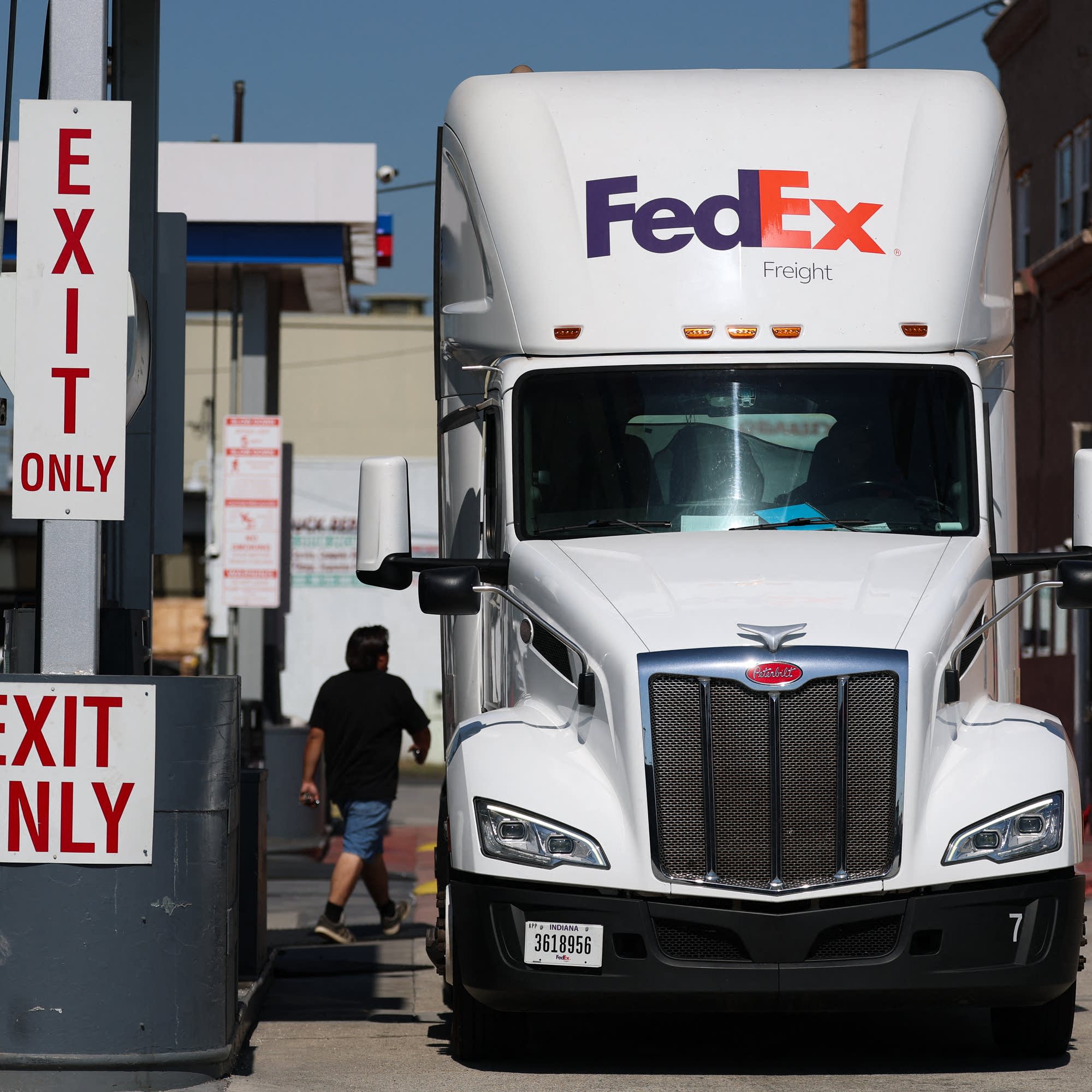
The average cost of a gallon of diesel was $5.68 on Wednesday — just 13 cents shy of a record high. Tariffs and ongoing wars are both to blame. But so is a seasonal upswing that happens every fall. In this episode, why diesel prices are likely going to get even steeper before they cool off. Plus: A computer model helps make the case for fewer mandated parking spots in city construction projects, Uber wants to shrink its middle management, and Alaska families celebrate dipnetting season.
Every story has an economic angle. Want some in your inbox? Subscribe to our daily or weekly newsletter.
Marketplace is more than a radio show. Check out our original reporting and financial literacy content at marketplace.org — and consider making an investment in our future.
Read the stories in today’s episode:
- Why high diesel prices are coming at a particularly bad time
- What it takes to reopen 19 months after a wildfire
- Uber lays off 10% of their workforce to make the company "simpler and faster"
- To spur more housing construction, Denver changed its parking rules
- Male loneliness epidemic? Try economic loneliness epidemic
- In Alaska, dipnetting for salmon is about more than what’s caught
Hosts & Guests

Transcript
On the program today, not the debt market, not the labor market.
Let's see what else is out there.
Oh, yeah.
Inflation.
From American public media.
This is Marketplace.
In Los Angeles, I'm Kai Rizdal.
It is Wednesday today, the second day of September good, as it always is to have you along, everybody.
There's a concept in economics known as the velocity of money.
Literally, how quickly money changes hands out there.
A useful indicator of how lively I guess any given economy is.
We today here on this program are going to introduce a related but not officially recognized corollary.
The velocity of prices, the vessel of choice, being diesel fuel.
Yesterday, $5.63 a gallon today at a nickel, $5.68.
The highest national average since President Trump started his war with Iran.
Just 13 cents off the highest recorded price ever.
And if we all needed yet another lesson that timing is everything.
Tariffs and wars aside, diesel prices usually do have a seasonal upswing in the fall.
Marketplaces, Caitlin Tan gets us going.
I took the family dodge diesel pick up to the gas station in Pinedale, Wyoming this morning.
I'm seeing diesel prices here today.
$5.75. Yikes.
Okay, let's see what it costs.
Okay, grand total.
$191.11.
Almost 200 bucks.
And even if you drive a gas vehicle, gas body analyst Patrick DeHon says diesel was still involved.
And the cars were driving.
Don't get to the car dealerships without a semi-truck using diesel.
Same for your apples and carrots and bread.
A diesel tractor tilts up the crops.
That truck brings them to a processing center.
You know, then a distribution center and then the grocery store.
And University of Tennessee's Thomas Goldsby says companies often pass down those high diesel prices to consumers.
Ultimately, they're looking to make sure that they cover their cost and can maybe make a dime here and there.
And diesel prices likely haven't topped out.
Fall brings surging demand for harvesting crops.
Plus cooler weather means heating homes and is Alan Schaefer with the nonprofit engine technology forum points out.
Home heating will comes out of the same distal it fuel pool that diesel does.
Combine those seasonal demands with current global politics.
Well, you guessed it.
Even higher diesel prices.
I'm Caitlin Tan from Marketplace.
How about head fill up Wall Street,
Dailow bounce back in equities and hey, look,
I made it three minutes into the program and I'll say in the word bonds.
We'll have the details when we do the numbers.
You know how when you've only met somebody a couple of three times over like a year and a half,
you kind of forget some of the details.
Wait, you grew up beard. Did you always have a beard?
I always had a beard.
You always had a beard?
I've been a while since I've seen you.
How are you?
Good, how are you?
Good. Maybe just a little bushy or is that the deal?
Well, that could be a little bushy.
A little bit bushy.
That's Jimmy Orlandini. He's the owner of Althadina Hardware.
We've been talking to him since his business burned down in the Eaton fire back in January of 2025.
Today, we're about a 15 minute drive from where his old store used to be.
We're in a hardware store.
Yes, we are.
Come on, man.
We are in Arnold's hardware store.
How did this come to pass?
It's been a long haul.
It has been a long haul back in the end of the year last year.
One of my, well, one of our mutual salesmen's mine and Arnold's, the guy that owned Arnold's at the time.
He said, you know, I know you're having a hard time finding somewhere,
but you might want to talk to Basil that owns Arnold's frontier hardware.
I think he wants to retire.
Music to your ears, right?
Well, I was very reluctant because I knew Basil, I knew of Basil,
and I was like, I don't think he's ready to retire.
He's a little bit younger.
But I made the phone call and he's like, let me think about it, but I've been kind of leaning that way.
And here we are, and it worked out.
You bought the business, you bought the property it's on.
Yes.
Right?
Yes, I'm basically just keeping digging.
Basically, well, we'll get to the financing in a minute.
Basically, turnkey, right?
I mean, you haven't closed the day since you took off your clothes.
Nope.
That's great.
That's really great.
You put your house online to buy this place, didn't you?
Yeah.
Are you not terrified?
Absolutely.
Yeah.
But it's hardware, and it's what we know.
Everybody needs hardware, right?
Yeah.
And this is a great store.
It's a great community store, just like Al Tadina.
Yeah.
I mean, Al Tadina hardware was Al Tadina.
Right.
Arnold's is an institution in Sarah Madre, and the people of Sarah Madre,
ecstatic that see it keep going.
Right?
Yeah.
Under the same name.
Family business, it's a thing, right?
Yeah.
You're 15 minutes ish from the old place?
Yeah.
You're going to open up back up there when you get there.
Yeah.
When we get back.
When we get back.
And keep this place, and reopen in Al Tadina.
And just get around back and forth?
Yep.
Wow.
Wow.
Employees.
You're old employees, and then the employees of this place.
I mean, you have a slight dilemma there, right?
It was a little bit part of one of the, you know, part of the agreement with Basil was to
retain most of his employees, which I ended up retaining all of his employees.
And as well, bringing back a few of the Al Tadina employees.
I have some still waiting in the wind.
As we get busier, and we'll get into the remodel of the store, we'll need more help.
Yeah.
We are not far from Al Tadina.
You see people come and say, Jimmy, here we are.
Absolutely.
Yeah.
We've for the first couple of weeks, it was people walking in and doing the double take.
Like, what are you doing here?
That's cool.
Now that it's out on social media, and we've done, we did kind of a hello goodbye party for Basil's retirement.
And it's coming in now more and more out to you and people are coming in.
Yeah.
Are you surprised it took you this long to find a place?
Because Arnold's has been here for decades and decades and decades.
It's still kind of hard for me to think that I didn't find a temporary spot in Al Tadina,
which I really thought, oh yeah, but we talked about that.
Yeah.
Right.
It was so expensive, right?
Yeah.
I mean, the rates were just through the roof.
Through the roof.
Yeah.
But you know, all good things happened to people that way, right?
This, I mean, this was, it felt just, this was the right thing.
Look, look, look, is meant, right?
Yeah.
Yeah.
It was just, this was the right thing.
Yeah.
Thanks so much.
I really appreciate it.
Of course.
That thing, Jimmy, said about this being a local hardware store, it's true.
Jimmy, yes, I call Costa.
I've been coming here since I was 30.
All right.
I'm glad to see you.
So you're the current owner.
Yes, sir.
I know basil on the whole game.
Yes, very good.
Uber announced today it's cutting 10% of its workforce comes to about 3,300 jobs.
CEO, Dara Cosmarshahi, he said he wants to create a simpler, leaner organization with,
in particular, fewer layers of management.
So we decided today is the day to let all those middle managers out there shine.
Marketplace is Stephanie Hughes got the assignment.
In a workplace, you've got what organizational psychologist Bob Sutton calls grease people and gunk people.
When you've got the wrong middle managers in the wrong places, they can gum up the works.
Sutton, who's a professor emeritus at Stanford, says the idea with cutting management layers
is you get rid of the people who slow things down and battle with others for power.
But sometimes it can be hard to know the unappreciated invisible work that middle managers do.
Like making sure the handoffs work.
Actually, knowing who to go to to gossip to get things done.
Sutton says this is part of a larger trend.
Let go of some managers, give others bigger teams.
According to a Gallup review of US workplaces, the average team has 12 people.
That's about 50% larger than back in 2013.
But Sutton says you can end up with teams that are too big.
What happens is that the boss gets overloaded.
They become a bottleneck. It becomes frustrating.
And more decisions can end up with the big boss, says Julia Dar, with Boston Consulting Group.
Instead of decision making moving down, closer to the frontline, things move up towards the CEO.
Dar says that shrinking an organization's size doesn't necessarily save money long term.
In order for it to make sense, companies have to figure out exactly how all the work, visible and invisible is going to get done.
If you don't, you will make a temporary shift in the cost base.
But you might equally add that back in terms of contractors, new hires in the subsequent years.
Dar says fewer workers aspire to be middle managers now.
And that's a problem because today's middle managers are tomorrow's leaders.
But as one of my bosses said to me today, it can be lonely in the middle.
I'm Stephanie Hughes from Marketplace.
We are short, depending on who you talk to, give or take 4 million housing units in this economy.
To fix that, a lot of cities are looking at zoning and building codes.
And they often well-intentioned restrictions that can slow or prevent a whole lot of building.
Among those restrictions, parking.
Rules dating back to the 50s and 60s in some cities when cars were very much more king,
dictate that new apartment buildings provide a certain number of parking spaces.
But times and cities change and those rules might not really be needed anymore.
Marketplace's Amy Scott has that one.
I'm driving through Denver's River North Art District with Stefan Chavez-Norgard.
He's an assistant professor of public policy at the University of Denver.
Rhino, as it's called, is a former industrial area now filled with art galleries, craft breweries, and bougie shops and restaurants.
When you see a shake shack, that's when you know there's some gentrification for sure.
Oh, there's a Rivian dealer.
There you go.
There's also a lot of new apartment buildings with amenities like rooftop decks, fitness centers, and private parking.
And a lot of these projects are the exact kinds of projects that can benefit from changes to the parking rules.
Until a year ago, Denver required that most apartment buildings provide at least one parking spot per unit.
But last August, the city council voted to eliminate those requirements in an effort to spur more housing.
A single parking spot can add as much as $50,000 to the cost of construction.
It also leaves less space for housing.
In a study published before the vote, Chavez-Norgard and a colleague estimated the change could add up to 460 more housing units per year, almost 13%.
We like to think we provided a sort of data-driven resource for city council as they made that decision.
It's not a total game changer, but that adds up over time.
To make that case, Chavez-Norgard used a tool called the Housing Policy Simulator, developed by Turner Labs.
That's a non-profit that promotes housing affordability.
On a Zoom call, Turner's Alex Casey shows me how it works.
Let's see, a share screen here.
All right. Are you seeing this large map?
The map shows all the parcels in Denver with a bunch of different variables users can tweak.
Height restrictions, setbacks from the street, permitting fees, local economic conditions, and yes, parking requirements.
What we built with our tool here is essentially a sandbox for policy makers to get a sense about how these change in policy conditions impact the likelihood of being in the city.
So far, the simulator covers more than 20 cities in California, Arizona, and Virginia with more in the works.
In Denver, it's too soon to know how the parking change will play out in the real world.
Chavez-Norgard says he's heard from developers who still plan to build parking because residents and often the investors backing a project wanted.
But as an example of the potential impact, he takes me to a housing project built a few years ago in the nearby five points neighborhood.
Before Denver abolished parking minimums for all buildings, the city had relaxed requirements for affordable housing projects, like this one.
You know, one thing you'll notice about this parcel is that it's sort of this oddly shaped small triangular lot.
Which made it difficult and expensive to provide parking. There's a light rail stop just steps away, but as we're talking, a resident of the building comes home after a day of work, and points out that the city suspended light rail service for maintenance until next year.
And that's something the simulator can't really predict.
Quentin Thornton, who has an injured leg, says he now has to catch the bus a block and a half away.
Because I have a car, but I don't park it over here because it's not really enough sometimes.
He's hoping they turn the small vacant lot next door into parking. In Denver, I'm Amy Scott for Marketplace.
Coming up.
You like fishing and I like fishing and you like fishing. First though, let's do the numbers.
Foundelstrow's up to 95 today, just shy of 610%, 53,061, and Azdak added 118 points just over 410%.
Close to 26,217, the S&P 500 up 35 points. Just shy of a half percent, 7666.
Those layoffs at Uber, the middle management job Stephanie Hughes was telling us about.
They helped that ride, healing surface to send 1 and 610s of 1% today, rival lift.
Accelerated almost 3 and a half percent. Bond rose yield on the 10 year T-Node down 4.7 to 8% for the record.
That is 1-100th of a percentage point from yesterday. You're listening to Marketplace.
This is Marketplace. I'm Kai Rizdal.
There is, as you might have heard, a loneliness epidemic in this country.
Male loneliness specifically. There have been articles and op-eds and podcasts and academic studies.
All about the idea that men have trouble maintaining relationships.
I saw an article in sleep the other day though, suggesting the loneliness gender divide.
Might not be as relevant as the loneliness economic divide.
Nick Kepler had the byline on that piece. Nick, thanks for coming on the program.
Thank you for having me. Just to be really clear here, the common perception is that the loneliness thing is a male thing.
But in reality, you're the guy who crunched the data. It's not gender so much as it is socioeconomic status, right?
That's correct. All the big signifiers of loneliness.
Men and women are about equal. If you go down into some of the data, there are some signs that men are a bit more pessimistic about being lonely.
But in the really big measurements, do you feel lonely? How many close friends do you have? How much time do you spend alone?
There's not much of a gender difference.
But socioeconomic status is a good predictor of loneliness.
In fact, you can even keep track of how much income will buy you a few extra hours with other people per day.
In a really big survey, people making less than 25,000 a year spent about six and a half hours alone.
And people who are earning 100,000 or more spent about three hours alone.
That socioeconomic status is, you know, we all sort of know empirically what that means.
But it literally drives the choices that people make to be alone.
I want you to tell me about this guy, Dan, that you talk about in this piece.
Sure. Dan is a guy from Massachusetts who I talked to.
He was in his early 20s when the pandemic started.
And then his friend group sort of tapered off.
He's going to community college. He's still doing some online courses.
But most of his income comes from being a home health aid.
It's a growing profession for people who don't have a college degree.
And it's one of many low income professions that are now very solitary.
You don't really have any co-workers.
That's the same for people who do Uber or Lyft or DoorDash.
A lot of people like Dan are finding themselves in jobs that just don't allow co-workers.
Like you might have had if you worked the assembly line a few decades ago.
You mentioned college. College also is a supercharger of relationships.
And those in this economy who cannot or don't go to college, they then suffer accordingly.
Yeah. One researcher to describe it as a supercharger.
You go there and you meet friends who last for a very long time.
Also the kind of jobs that do require a college degree.
Accountants, journalists, researchers, just those kind of white collar jobs.
And those you're expected to network, you're expected to form relationships with other people in the profession.
I know most of my good friends are journalists or former journalists.
And that's just not as true for people working low income jobs.
You mentioned this in the piece. We are 20 what five, six years out now from Robert Putnam.
And that book he wrote, Bullying Alone.
Which it doesn't seem like it's gotten any better.
Yeah. By every measure mode of loneliness things have gotten worse since that book came out in 2000.
The total population who said they do not have a single close friend.
And one of the larger studies quite droopled.
And those who counted ten or more close friends shrank from 33 to 13%.
And this is just the last few decades.
Is economic mobility the only answer here?
Right? Those at the top end of the income spectrum are okay.
Those at the lower end aren't.
And we have to get them up somehow to make this social challenge get better.
So some of the researchers I spoke to talked about reinvesting in those social connectors that don't cost anything.
You know, civic groups, volunteer organizations.
I'm always hesitant to recommend change in personal behavior.
But something that people who are feeling lonely should know is that ironically they're part of a very large group.
A lot of people feel lonely and there's social reasons for that.
So the people who are thinking about reaching out to are thinking it must be them.
It might not be. It's just the way society has structured.
So don't think you're weird or there's something about you that's keeping people away.
Nick Kepler is peace and slate.
It's a good one. It's depressing, but it's a good one. It's called America's Loneliness Trip.
Nick, thanks a lot. I appreciate your time.
Thank you, Kai.
Hey, did you hear the one about the economist who went fishing?
Dip netting, technically big nets on the end of long handles.
Here's the Aval White from Alaska Public Media.
Kevin Barry is Chess Tye in the Kenai River when a salmon jerks his dip net.
There we go. On the beach boys.
As Barry drags a hoof-shape net connected to a long pole, his sons Augustine Milton grab a thick piece of driftwood.
Give it a bump right on the head, hard. See, when you put your finger in the gills, you're ripping out.
It's the first fish of the day.
You guys stay with that. I'll be back with another one.
In addition to being a dip netter, Barry is chair of the economics department at the University of Alaska Anchorage.
He's currently working to understand how much a dip netting trip is worth to Alaskans.
But how do you calculate that? Barry says you can look at the cost of travel, along with what people gave up to make it happen,
like taking time off of work or for going another summer activity.
I think every Alaskan out there has the same experience of panicking, summer is getting close to over.
And we all have like four different things on any given day we'd like to do.
And so all of those things are real costs.
And we can think about them as an opportunity cost of going to dip net.
Dip netting in Alaska typically wraps up in early August.
It's only open to residents, so it sort of feels like a holiday only Alaskans can celebrate.
Barry's research is a work in progress, and he's not ready to share exact numbers yet.
But he estimates that dip netting on the Kienai River is worth a lot to Alaskans.
Several hundred dollars more to a household than what they actually spend on each summer.
With gear, time, and travel costs factored in, Barry says buying Samo would be about the same cost as catching it yourself.
The real value he says is in the experience.
There's all sorts of action of people pulling them in, processing, watching their kids, trying to take care of their camp and everything else.
It's just such a chaotic scene that for me it's like a very Alaskan experience.
I tied it very much to the place here.
Richard Lusco feels the same, who drove more than 150 miles to fish today and says being surrounded by other Alaskans makes the trek worthwhile.
Plus, he says doing it yourself has added benefits.
I know how it's processed. I know when it's caught, I know it's blood right after it's caught.
I know how it's going into everything, you know.
Lusco has caught ten Samoons so far.
It's a fraction of the 25 each permit holder can catch, plus an extra 10 for each household member.
Meanwhile, Barry only caught two fish during our three hour trip.
Still, his sons say they're having a blast.
He's a fun assad, ever.
He likes fishing and I like fishing.
But Barry says it's not about the fish.
It was my middle son's first time.
Get to show him how we catch fish and how you start to process them is incredibly valuable.
So when we talk about this surplus, it's baking in all those memories that entire experience together.
It's not just the fish you walk away with.
Dip netting the Kienai River is a uniquely Alaskan experience.
And Barry says it's one he hopes his boys remember.
In Kienai, Alaska, I'm Ava White from Marketplace.
This final note on the way out today in which capitalism sometimes provides things we maybe don't need.
I saw this in Bloomberg that Kowshi, the not uncontroversial betting platform, is going to ask regular leaders for permission to offer oil futures contracts.
Specifically, futures contracts that never expire and that trade 24-7 think for just a second about all the oil volatility we've seen since the president's war started.
You can see how this might turn out.
You know, Portland.
Our media production team includes Brian Allison, John Fokie, Montana Johnson, Drew Jostet, Gary O'Keefe, and Charlton.
Thorpe Alex Simpson is the manager of media production.
And I'm Kai Rizdal, we will.
Say it tomorrow, everybody.
This is APM.
I'm Lee Hawkins, host of Must Be the Money, a podcast for Marketplace.
Each week I speak with inspiring entrepreneurs and business leaders about their lived experiences.
And they share tangible insights to help guide your path to success.
Here from icons like Angelica Nwandu, Van Lathan, Angela Yee, Matt Barnes, and more about how to seize opportunity, manage money, and meet challenges with resilience.
Listen to Must Be the Money, wherever you get your podcasts.


