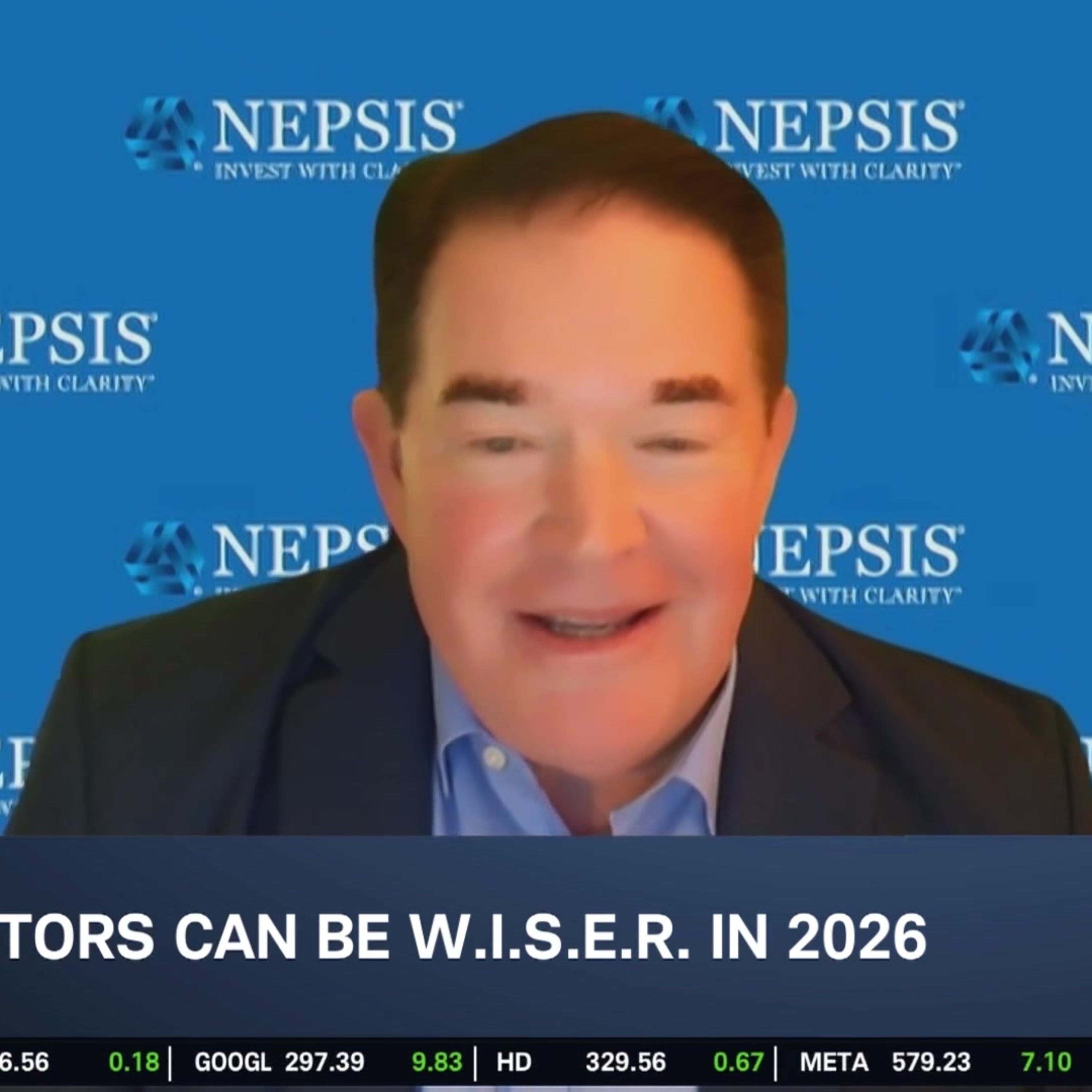
About this episode
Chuck Etzweiler outlines what investors should expect as the midterm cycle approaches, highlighting policy‑driven volatility, healthcare’s defensive appeal, and the long‑term momentum behind reshoring and electrification. He explains why semiconductors, manufacturing, and power‑grid infrastructure could anchor portfolios through the next decade.
======== Schwab Network ========
Empowering every investor and trader, every market day.
Options involve risks and are not suitable for all investors. Before trading, read the Options Disclosure Document. http://bit.ly/2v9tH6D
Subscribe to the Market Minute newsletter - https://schwabnetwork.com/subscribe
Download the iOS app - https://apps.apple.com/us/app/schwab-network/id1460719185
Download the Amazon Fire Tv App - https://www.amazon.com/TD-Ameritrade-Network/dp/B07KRD76C7
Watch on Sling - https://watch.sling.com/1/asset/191928615bd8d47686f94682aefaa007/watch
Watch on Vizio - https://www.vizio.com/en/watchfreeplus-explore
Watch on DistroTV - https://www.distro.tv/live/schwab-network/
Follow us on X – https://twitter.com/schwabnetwork
Follow us on Facebook – https://www.facebook.com/schwabnetwork
Follow us on LinkedIn - https://www.linkedin.com/company/schwab-network/
About Schwab Network - https://schwabnetwork.com/about
Interactive timestamps
Jump to segmentGet every episode summarized
Each time Schwab Network publishes, we email you a written briefing from the transcript — the topics, who appeared, and any specific claims, with the ad reads skipped.
Email me new episodesFree for 3 shows. No card needed.
Hosts & guests
Transcript ready
79 searchable segments. Every word is indexed and playable.
Full transcript
Schwab Network — Etzweiler: Midterm Volatility and Long‑Term Opportunity. Machine-transcribed; use the interactive transcript above to jump the player to any line.
0:00Welcome back to Market on Clothes. I'm Jenny Horn, alongside Sam Vodas. And now for the first last seven years, nepsis has been developing an annual acronym to describe its economic outlook. And this year's acronym, Wiser. So to tell us more, let's welcome in Chuck Etsweiler, head of research at nepsis. Thank you so much for being with us today, Chuck. And as you frame 2026 as Wiser, starting with some of the Washington field volatility, how should investors be thinking about positioning and what could be seen as a chopier political backdrop? Thank you, Jenny and Sam, for having me. Certainly, be more than happy to. Seeking wisdom, I think, is the first part that we came into this year. This is the second year of a president's term. It's obviously a midterm election year. And the thought was, what's going back in history and see what actually happens? 125 years of data. 1901, Theodore Roosevelt was president. You look at year two. Historically, it's flat. Years one in four average between eight and ten. Year three is double what the average is because of what happened
1:05in year two. So we came into this year expecting volatility. It's also, by the way, the fourth year falling three consecutive years of the S&P having a greater return of 10% or more, the fourth year tends to be volatile. It ends up historically at an eight percent return. But we looked at both of these metrics and we thought, okay, let's just alert our investors to kind of think of the year as being one that would be a very choppy. In addition to that, I may add, and strategists did great work on this. Going back to 1973, healthcare, the sector tends to actually perform admirably. You could make the case, hey, it's a defensive sector. We're going to buy pharmaceutical drugs. We're going to go see our physician, if in need, regardless of what the stock market does. But also, it's a political football. We know that both red and blue one are votes as we move out to November 3rd.
2:08Healthcare, at least if you look at Medicare, the program's still very popular. And both sides of the I-10APs, a healthcare company. So it's one of our overweights here. It's a silver lining to the portfolio. But definitely the W, as it was in 2022, if you recall, was a year filled with consternation. Now, the good news is that once we look out to the latter half of the year, specifically the crossover between September and October, what you tend to see is the market anticipate the results of the election. And, Jenny, if you've got to go back, think about this, to 1938, FDR was in office, right? We had Germany taking hold of Austria moving in, then to Poland, ultimately, occupying France. As the last time, the year, which measured from November 3rd to 26th, out to 27, was negative. That's nearly 90 years ago. So again, caution here. Certainly,
3:10we did not anticipate the intervention in Iran. And you've spoken a lot about that over the last week. But even if this is resolved, we still see a little more volatility here as we walk out to the back half of the year. Chuck, I love Wiser. It's a great acronym. And I'm glad that you only took us back to 1973. I had a guest on earlier who took me back to the Dutch tulip bubble of the 1600 which was just too far of a stretch in my mind. But I'm just wondering, you know, with these acronyms that you come up with to sort of describe your economic outlooks, what has been your track record then? I mean, obviously given what we're now seeing and how hard it is for some investors to see the forest through the trees with some of the things that you're talking about. Well, certainly Sam, a great question here. Maybe I'll harken back to 2022. Our acronym was weight spelled W-A-I-T. Again, kind of warning investors, hey, look, there's going to be volatility.
4:16The W was Washington, DC. The A, if you recall, the aggressive Fed. Remember, the Powell-led chair, Chair Powell-led Fed, excuse me, raised rates seven times in 2022 to ward off the I, which was inflation, which peaked at 9 percent in June of that year. But we told our investors, what are we waiting for? Well, it was the technological revolution that was hopefully going to be launched at some time in 2022. And it was in November with the launch of chat GBT, kind of this public-private partnership. It was kind of off to the races. We began to, as we had previously, kept our overweight in technology, but focused in on semiconductor processing chips and the cohort, the Nvidia cohort, as we call it. And that worked itself all the way up till last year. So, last year's acronym was Power. Again, a double meaning. We moved into, we think, the second phase of this automation revolution, where companies that generate power, whether from electricity or
5:24other means, whether it's energy-related businesses, the P was productivity. The O was on ecology, where we felt as though we could look at companies that were involved in therapeutics to eradicate cancer. The W was the world alliance that maybe international stocks could pick up the pace. The E and the R were the same. Electrification are reassuring. They've been themes for the last two years. We think they're mega trends that transcend politics, which you're hard to find anything that Red and Blue agree with in our world today. But they both have passed legislation to either expand the grid, bring businesses back to the United States, or foreign direct investment. So, so knock on wood, Sam. I think we've done a fairly decent job here. We're not trying to predict the future. We're just trying to give our clients an understanding as where the portfolios are positioned with the annual acronym. Okay, you mentioned some of, of course, the electrification pushes. But on reassuring, how durable is the U.S. manufacturing
6:26and infrastructure trend if growth slows or say policy priorities shift as they do tend to do an in real time? Yeah, thank you for that, Jenny. It's an excellent question. And we hinge this. Actually, the R and the reassuring has been our acronym three years in a row. It was four FOUR back in 2024. And if you recall, the previous administration, the Biden administration with, certainly we'll call it Bicycle Partisan Support. The Chips Act was passed, the IRA, the IAJA. For the most part, what we'll call it bipartisan support. Yeah, that's a big linchpin here. We think about the $53 billion in that Chips Act, Intel was a recipient of it. Certainly Taiwan semiconductor, right? For those maybe who are listening that live in the valley area of Phoenix, the humongous foundry that's being built there. So your question is spot on. If policy were to change, that may pivot. We don't see that as happening. We see kind of a renaissance
7:29as businesses come back in this post-COVID era. We all know we lived in that air of globalization for nearly 20 to 30 years. Post Berlin won't wall falling in 1989. This probably as a track of 20 to 30 years, we're banking on the reassuring and electrification themes as mega trends that continue onward really into the 2030s. All right. Well, thank you so much. Too much check. Chuck That's why I lure head of research at nepsis for all of that breakdown today.
More episodes
More from Schwab Network

JNJ Balances Growth, Patent Transitions, and Legal Overhangs
Schwab Network

nCino (NCNO) CEO on Earnings, AI in Banking & Overcoming "SaaS-pocalypse"
Schwab Network

The Big 3: NET, TWLO, ASTS
Schwab Network

Tie Lasater on Inflation Floors, Energy Risk, and Private Credit Stress
Schwab Network