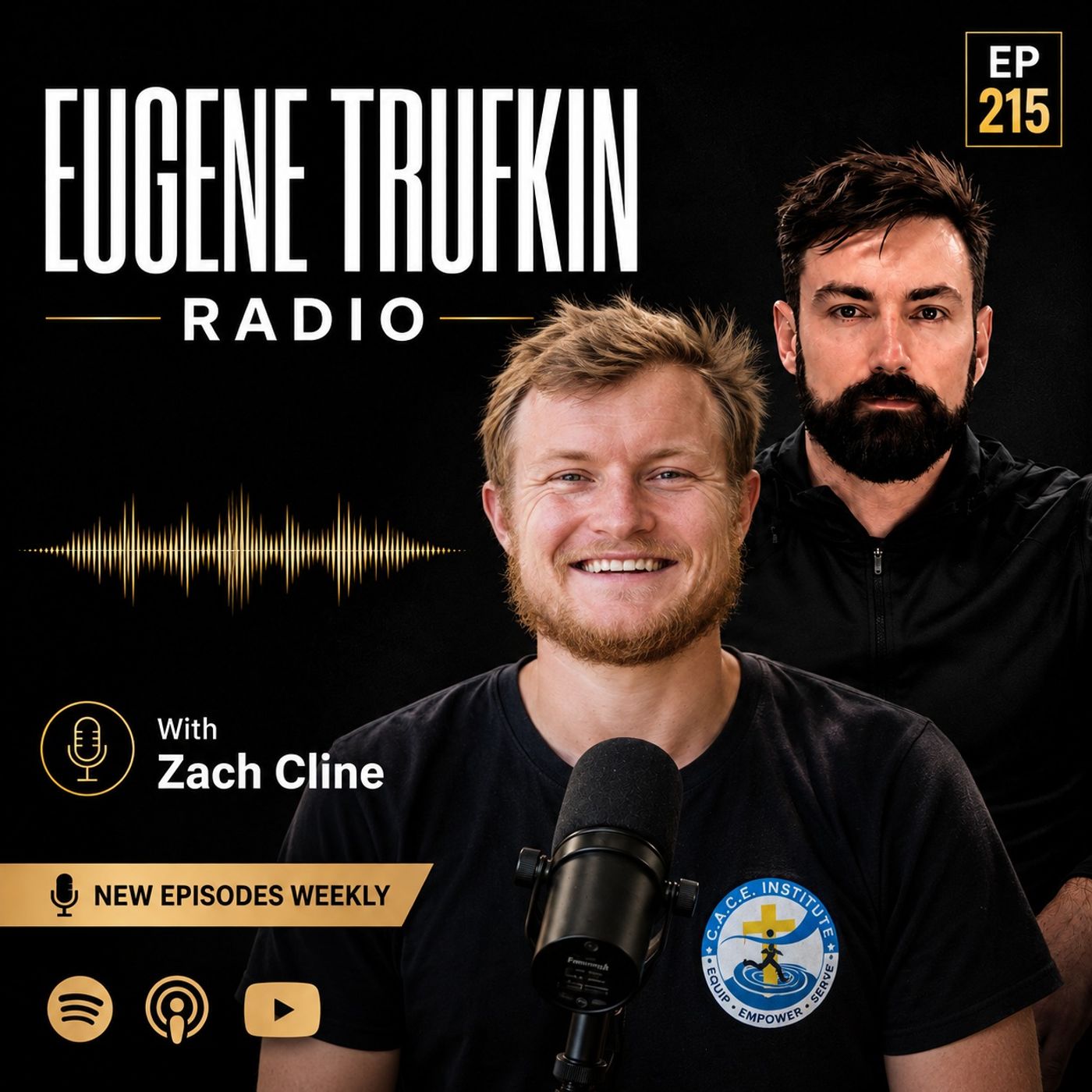
About this episode
Get every episode summarized
Each time Eugene Trufkin Radio publishes, we email you a written briefing from the transcript — the topics, who appeared, and any specific claims, with the ad reads skipped.
Email me new episodesFree for 3 shows. No card needed.
Hosts & guests
Transcript ready
937 searchable segments. Every word is indexed and playable.
Full transcript
Eugene Trufkin Radio — Episode 215 - Zach Cline. Machine-transcribed; use the interactive transcript above to jump the player to any line.
Hey, what's going on everyone? So I'm going to usually do my lives on Facebook, but kind of trying to kind of mix it up a little bit to keep things interesting. And also doing it on Friday instead of Saturday. So I'm going to be actually catching up with a good friend. Zach, what is up man? Okay, can you say it? See you here. Vanya, Cagdela, doge, new video. Okay, what's Zach's act? See. Zach, apologies man. I haven't done an Instagram live in a while. Probably should have researched this. I forgot how to add people on here. I usually do them on Facebook. Give me a sec. I will figure it out though in like two seconds. Go live. Okay, cool.
Hey, Lissie, could you see you man? Great name, by the way. Hey, Zach, what's up man? Hey, there we go. I'm like, I usually, you know, like when you're on use a platform for a while, you kind of knew the features, but then like three months later you log in and you're like, man, I freaking forgot how to add people on this thing because every platform is like slightly different. So, yes, yeah, 100%. I think it's been a few years since I've done an Instagram live. So, yeah, so I'll let you take over man, but it's good to catch up. I know I haven't seen you in freaking Adder El probably like a long time at this point. Yeah, yeah, it's been a few years. I think the last time we talked was I miss two or something like that. I think, yeah, then it must have been on this like seven years already dude. Yeah, but I wanted to catch up with you and kind of sucks that we didn't keep in better touch. I know we kind of message each other here and there. I still keep in touch with like Jerry, Jator, Kevin and a couple of other people from institute, but I just wanted to catch up with you over a live might as well just do an episode in the meantime and be more productive with it.
And this year I've been focusing on kind of like stages of change, you know, I know people that I'm not going to know, I know people that come to us are usually in the second stage, you know, they're, they're problem aware, but they may not have the right tools to to solve their health issues or, you know, they may be in a state of ambivalence. They know I have they have an issue and they have the right tools, but for some reason, they just kind of stay stuck in that second stage of change. But I actually don't want to focus on that category because it's already like a very small minority of, you know, people that are problem aware and that they're looking for tools and kind of reach out to us or already kind of like talking to a small minority of people. I want to ask you the difficult question of ask a few people this question already on what's the challenge to all health care providers, you know, that 90% of people that are stuck in the in the first stage of change, meaning the problem unaware.
You know, and it's like a huge percentage of the population we're looking at. You know, now nine out of 10 Americans are metabolically sick, you know, 70% are like obese 90% or either obese or overweight or tremendous some people, tremendous amount of people are on medical drugs as well. And it's not completely their fault. Of course, there are some people that are like okay with living that way, but it's just, you know, the poor education system around health care or how to even live like a human being. And then also like a sick care health care practice that kind of tailors to like it's your genetics or it's age. There's nothing you can do about it, except take medical drugs and have surgeries and inject yourself needles for the rest of your life, etc, etc. So I just wanted your perspective on, you know, how can you get, you know, that 90% of the population that's stuck in that first stage of being problem unaware to at least be like consciously aware of like, hey, this is it normal, you know, this is a normal would be so overweight has nothing to do with your genetics or your age.
It's not normal to be on all these medical drugs or even like socially acceptable things like it's not normal to sit behind a computer for eight to 10 hours a day also, you know, but people do that like all the time. So I'll let you take over. I know it's a broad question. We'll know it as the conversation goes on. But what's your take and how do we, how do we, because it kind of like feel bad because a lot of them are great people and they may honestly look for honest answers, but they're definitely not going to get it. And at the symptom management sick care pill pushing health care system that's available to the bulk majority of Americans these days. Yeah, well, I mean, yeah, you're absolutely right. Like our health care system is definitely very poor considering the amount of money that we have flowing through our economy and in our country as a whole, but it kind of points out the kind of function of pain. Right. So any any kind of disease or illness or pain that people have like there's a purpose before it and oftentimes it's a catalyst for growth and somebody who doesn't even have the awareness that they're even, you know, sick, you know, those are people that are almost like there's something brewing inside of them that, you know, if something doesn't change it will eventually lead to problems and it usually starts off as symptoms.
As you know, people get tired, people get achy, they don't feel as good as they used to and and that's those are little whispers that are, you know, essentially saying to you, hey, something something's off, but they're quite easy to ignore, especially in our society, it's very, you know, it's very go, go, go, you know, it's not like we live in, you know, some village and or unless you live in some village in like South America somewhere where, you know, you don't have any rent or you don't have any, you know, your bills are quite. You know, your bills are quite low, but there's really no money around anyway. You know, most people are, you know, I can't remember the exact statistic, but I think it's a very high number of people that are like one paycheck away from bankruptcy. And when you think about that, so many people are living their lives through basically just survival mode and that's really difficult for some people and you know, when you're so focused on just surviving, it's very easy to. Ignore those little whispers of, you know, my back hurts or you know, I'm not getting enough sleep and it becomes very easy to reach for something like coffee or.
You know, medical drugs or whatever it may be just to give you that little boost, but and the problem start rising when that goes on for a long time and then people can live like that for a surprisingly long amount of time. I mean, I can't tell you how many, you know, old grannies from where I'm from, which is in the southern part of the United States. You know, you hear stories all the time of little old ladies who've been smoking cigarettes since they were 12 and they've never had any issues. And you know, this is wild, you know, or they've lived in that that state of, hey, things don't feel good, but they just get used to it, but they never get hit with a disease or anything like that. But that's kind of far between a lot of people, there's so many collective stresses in our, you know, in our modern society that, you know, usually within, you know, 10 or 15 years, I mean, the rate of disease nowadays is people are getting sicker and sicker, but they're also getting sicker younger.
So that timeframe of, you know, you might start getting, you might start noticing those early symptoms when you're a teenager, you know, even a kid, but you may not really get that disease diagnosis until your 30s, 40s, 50s, 60s. But that number is dropping. I mean, the, like you were saying, the level of chronic disease, especially in children nowadays is, that's what's alarming is that, you know, it's basically telling us that all of these toxins in our environment, in factors that cause illness and small amounts is so drastic nowadays that, you know, people are, people are sick out of the womb nowadays. And it's just, yeah, it's just wild, but just to kind of round it about, you know, disease and illness are just, you know, they're, they're, they're teachers for people. And, you know, you can, you can ignore the tiredness and the symptoms for a long time, but that disease is just a, it's, it's, it's your soul basically knocking on the door saying something's wrong for, you know, it's, it just gets louder and louder.
And that's all it is that a disease diagnosis is basically just, you know, paint something's really wrong. You should pay attention to this because this is like a diagnosable thing now. And that's usually when people, you know, really start to wake up. That's kind of, you know, that's, that's kind of the function of it as I see it. But, yeah, I hope that, you know, hope they gave you a little bit of my perspective on it and how I see it. But, you know, feel free to elaborate further if you want. Yeah, I mean, it would be good to get your perspective. I find one challenging thing is because like pathology or various sorts, where there would be mental or physical has been normalized so much in American culture. But that's actually one of the things that keeps people stuck in that stage one of being problem unaware. Because they could be like, you know, 20% body fat, which actually looks very skinny compared to the average male now because the average male is at 28% body fat, like 25% and over is obese for the male category.
And 20% is overweight. So like a male that's 20% body fat looks like super paper thin now compared to the average American. So to them, they're like, well, I don't have a problem like because they're looking over the central nervous system likes to mirror what's in front of it. You know, so when they're like on one prescription medication and overweight, but they're co-worker is obese and on poor prescription medications, they're like, well, I'm not doing that bad. There's nothing wrong. And it's because now I'm 14 and I'm not 10 any longer jokingly, you know, older. Yeah. So I feel like that's one of the things that keeps people stuck often because I'm sure you get this quite a bit as well. Like some people come in and they're like, well, I need to lose like 10 pounds. And you look at them, they're like, no, you need to lose like 50 pounds and then look at your HHQ scores and then look at your blood work and then look at all this and you sleep like two hours a day. But in their minds, I they're like, they just need this little teeny fix. They don't really understand the level of pathology they've no one realized in their life because they've been living it living in that.
Like kind of frame of mind for so long. And most likely even their parents were the same way, which is how, which is where they got their belief system from. Yeah, to make that acceptable, you know, it's pretty amazing, you know, and your parents in your environment play a big role in it, you know, especially early on. But it is pretty amazing how people don't know how to feel good, you know, so they like people work and then they and then they usually just distract themselves until the next time they have to work. And you know, a lot of people don't make time for for things that they enjoy anymore. So over time, people even just simply lose the sight of what it feels to me or what it needs to feel good. Even if it's just a sliver of their day. But yeah, yeah, it's it is pretty amazing. Like you're saying, just the kind of normalcy that is now I wouldn't call it normal, but it's common. Yeah, for sure.
Yeah, yeah, I think, you know, it's if people don't have something bigger than themselves that they're willing to make a change for, they'll be in that in that zone for as long as possible. And the worst it gets is the more it wakes them up to something needs to change here. And if people don't get that signal, they'll just keep getting worse until they're 55 and they die of colon cancer, you know, and when they could have lived 85. And a lot of times that's because people just they don't have they don't have something that's bigger than the disease themselves. They don't have something that's driving them towards. And the purpose that's that's worth changing for. So, so you know, if you if you if you work a job that's just okay, you know, I think if you ask most Americans, you know, if they like their job, you know, most people are, you know, they don't dislike themselves enough to do jobs that they purely, purely despise because you know, you can you can change that.
And so, you know, if you're a person who is going to live in, they kind of live in neutral. The job is okay. What I do for a living is okay. What I do every single day is okay. There's goods and bags, but it's it's not like it's something that's, you know, lighting them up and making them really, you know, excited and, you know, you can also get a situation where someone is okay would just work in a job that's okay. And they're not going to live in a job that's worth a while. So they have a family. The job pays them well, and they can, you know, live their dreams in other ways with their family outside of outside their job. So they, you know, they're they're okay, which is being okay in their job because they're like, hey, this allows me to actually live my dream. That's when you can run into issues because it's like no matter where you look, you know, it's it's like man, everything's just, yeah, you know, it's just okay. And that's how you get in that state of just like, you know, heard Paul call it flat land where you're just.
Just do not you're not going in you're not moving anywhere, but you're not you're not really moving backwards, but you just kind of stuck in the same zone and, you know, over time, man, that can just be so draining on a person. And, you know, as you know, you end up with all kinds of all kinds of issues from that. Yeah, oftentimes I, you probably took that one, two, three, four overcoming obesity addiction and disease. I've got the exact name. I think it was a prerequisite for HLC three. I forgot the exact name. The duty. That was actually one of my favorite. I think it's like a correspondence course. If we were to, because of course, I forgot exactly. It's been so many years. But that really shined a lot of light on people's, you know, disconnect or lack of clarity and their core values. And how it leads to various maladaptive behaviors over the years, you know, like poor lifestyle and nutritional choices, which lead to various issues down the line, kind of highlights kind of what you said just having no purpose, nothing in alignment with what you're interested in. Then what's the purpose of kind of like taking care of yourself?
I feel that is the part as well, but then also you're surrounded by people that are exactly in the same kind of limbo state. You know, so it's like it kind of normalizes being okay with that, you know. And then I also found when people get stuck in situations or jobs, they don't want to be in. It's kind of like very common for the central nervous system to start dissociating by reframing like the negatives into the positive some way. And it's kind of keep them stuck even more like, oh, I don't like necessarily enjoy this job, but it's like nice paycheck every two weeks or like the nice health insurance or whatever, you know, or just whatever makes it. I guess tolerable enough to continue to stay there and they kind of like acts as a quicksand because then you create more reframes upon those reframes and then it's like a mirror in the mirror in the mirror. You forget even where the original mirror was, you know, right. And then people kind of get stuck in there, but I also feel I don't know your take on here, but I also feel like one thing that gets people stuck for a long time is.
Obviously the majority of the people aren't going to once they have something come up like high blood pressure or digestive issues or they're overweight. Like they're not going to go to you. They're going to go to their local family physician, you know. Which is like, oh, you have high blood pressure. Yeah. Okay, hypertension, too much tension. Let's not deal with that. Let's not worry about how you're working 70 hours a week at your job. I'm sure that has nothing to do with your high blood pressure or the fact that you have a toxic work environment and not using movement as medicine or anything. I just put you on blood pressure meds. And I feel like the sick care industry keeps people stuck in that step stage one. You know what I mean, if further cements them in that first stage. And it's, it's, you know, I don't, I think I think a lot of health care workers are doing what they think is the right thing. In some ways, there is a, there is a very solid place for the health care system. But as a general rule of thumb, that's what you just described is done purposefully.
It's mainly for profit. Most of these drug companies, a lot of these executives know that their drugs are not actually healing anyone. And you know, there, there are, they, they, they will justify certain cases where a person's symptoms get better to basically just get, hey, this is okay for everybody if you have this problem. But they, they, they all know in some way that, hey, this is not the long term solution. But they're not going to tell you that because they'd rather just take the paycheck and go home and buy another, you know, buy another house, buy another plot of land, buy whatever it is they want to buy. And it's, it's, it's pretty devious. Honestly, luckily though, you know, that's changing. I feel, I feel most people nowadays are becoming a lot more aware of alternative health practices. And you know, we, I mean, the fact that RFK junior is the HHS director is like, it's still mind blowing me. I think of it every day. I'm like, I can't believe this is like a real thing.
And like, you know, you have an actual person in here that's coming in and standing up to, you know, congressional committees and standing up to, you know, people basically can just pastoring and asking questions and trying to tear down constantly. And he just comes back with straight facts and goes, hey, these things aren't actually helping you. All these studies are done. They're flawed and they're done by the medical companies. But if you actually look at independent real research, you find that these things don't work. But here's what does, you know, it's, as you know, it's real food, you know, it's, it's real sleep. It's doing stuff that makes you, you know, motivated and excited each day. And, you know, it's, it's good movement, you know, it's moving your body. I think, you know, I was on a, on a spirit gym call with Paul yesterday. And I think he was saying something along the lines of 90 plus percent of people on the planet are sedentary. They don't, they have no exercise routine. So just to add to your list of stats at the beginning, there's another one. You got nine out of 10 people that don't, they don't even go for a walk every day.
The only thing they're doing is walking in the toilet, walking in the fridge, walking in their car, walking from their car to their office, walking back. And then just do that reverse. But when you look at how much, you know, movement that really realistically is for the needs of a human body, it's quite low. And so you just end up, that's just another thing that ends up, you know, messing people up as they just get stagnant. And, you know, it's, it's, it's, it's, it's a good thing that, that these things are starting to change. I think more people are starting to become aware of real quality, you know, real quality meat, real quality food. And the value of, you know, certain supplements and alternative, you know, even medical care. And just getting outside and, you know, getting in the sun. And even, you know, our generation is, you know, they kind of take it a little too far. But our generation has learned from the previous generation and gone, hey, you know, maybe this anxiety is coming from the fact that, you know, when I was, you know, when I was growing up, I, you know, I didn't have space for my needs.
And so I need to, I need to look at what my needs really are and process those needs. So you have more people go into therapy than ever. You know, more people looking into their problems and going, you know, there's got to be a different solution than all this crap. And I think it's, I think it's great. You know, people, people always, you know, talk about COVID and how horrible the situation that was, which, you know, we don't have to die in that. We probably hold, do a whole thing on that nonsense. You can go in any direction you want. No, this isn't the Disney channel. You can say what everyone else, I'm so shit, man. But, but no, no, but, but what I mean is, you know, with everything like COVID, there's a, there's a plus side to COVID too. You know, every, every dark shadow has a function of enhancing light. And with COVID, I mean, that's a pretty dark shadow that went through the whole planet. But what it did was it woke so many people up. So many people that were like, nah, take the vaccine, wear a mask like I'll trust the government. They all, a lot of people really started going and sometimes some it took years to feel like they were going to be in a state of emergency. But as a general rule of thumb, a lot of people went holy crap. I can't trust this anymore. There's got to be something different. And, you know, so for me, I'm always looking at what's the, you know, the flip of the coin. There's the odd thing that I can't trust anymore.
So I'm just a government. They all, a lot of people really started going and sometimes some it took years to figure out. But as a general rule of thumb, a lot of people went holy crap. I can't trust this anymore. There's got to be something different. And, you know, so for me, I'm always looking at what's the, you know, the flip of the coin. There's the obvious negatives. You know, we all lived through that. But there's the, there's the flip of that where there's these kind of hidden positives of that and that a lot of people woke up and went, something's got changed. And, you know, you know, RFK when he was running for president, man, he had a lot of support. He had a lot more support than media was was showing. And, you know, when he, when he went to endorse Trump, a lot of people became aware of him that kind of wrote him off as a cook and went, you know, the guy that I'm voting for is into this guy. You know, let's see what he's about. And you start listening to what he has to say and you go, wow, he's got a lot of good things to say. There's a lot of great stuff here. And then that I'm just using RFK is an example because he's probably one of the most prominent alternative health figures in the world right now. And all that does is bring attention to people like you and me that are preaching, hey, eat real stuff. You know, you don't need to go to a doctor for every little thing. There's real natural ways of, of, of, of
dealing with these issues. And there's now there's proven studies, you know, because I'm sure you know you that you can sometimes people need authority figures and people like you and me they'll they'll just they'll just go, you know, you're not, you know, you're just a coach or whatever. But if you have somebody that's the director of the whole health and human services going, hey, there's science behind this now, you know, somebody's left brain people they'll go, huh, there is science behind it. So maybe that maybe what my coach was doing. And I was telling me was actually right even though you waved the same studies in their face that that RFK is saying, but. But yeah, I think I think as a general rule of thumb, and I think we live in a time where things are really changing and there's so much crazy stuff going on the world, but to me, I see that all as a catalyst and it really just boils down to what people want to choose for themselves. So if you if you choose to keep your head in the sand, that's what you're going to end up with. But if you if you choose something alternative, if you look alternatively, you know, and you want to go, hey, this doesn't seem right. I want to do something about this. There's more options than ever.
And there's more people out there than ever that are trying to make good changes. So I kind of see it as like, you know, there's there's two sides of the coin in both polarities are really intense right now. You know, there's just whether anyway you split it, if you look at any opposites in the world, chances are there probably as charters as they've ever been in, you know, in my lifetime. You know, left and right politics. I mean, that's that's just a simple one, but. Yeah, but I think ultimately what it does is just it just promotes change and. You know, if more and more people start realizing, hey, there's there's positives is this thing and we can actually do something about this huge enormous problem of disease and obesity and, you know, sickness and we can do it in a way that actually supports the environment supports ourselves. And ultimately will probably support our economy and, you know, other things. You know, I think it's just a good thing, you know, it just it just means there's more availability and as that momentum builds, then, you know, who knows 10 years from now, we might be looking back at this and going, holy crap, there's a lot that's been changed, you know, and it might not have happened overnight, but wow, I can't believe, you know, we don't have, we don't have sodium benzoy and all of our food anymore.
We don't have, we don't have, you know, they're trying to get rid of glyphosate and all these other things and, you know, it's like all these things that we've been pushing for for years and talking about for years, as you know, like some of those things are changing and that would be. I think, I think years from now we're going to look back and go, hey, you know, a lot of things really did get done, but at the same time, we're probably, there's probably going to be just as much resistance of. Hey, that glyphosate's not that bad for you or, you know, grass bed isn't any different than grain fed or, you know, you can get away with five hours of sleep a night and coffee or, you know, you can, you know, it's just a job, well, you know, it's just a career, you know, suck it up that kind of thing. I think a lot of the, there's going to be feed, there's going to be pushback, but you know, those things are just catalyst for growth and as long as people stay, you know, in the right path and go, hey, you know, I get what you're saying, but. I know this is accurate, so i'm just going to keep putting out what I think is the truth, I think ultimately it's going to prevail just people just need to keep keep driving in it.
Yeah, and I mean you covered quite a bit it's funny with, I think Bobby Kennedy, I don't follow the news or exactly like what he's doing. He gets a lot of criticism, especially from some people like I don't like online like doctor Terry Simpson he's like, you know, I think obesity doctors are so silly like 99% or so incompetently like moronic and just kind of puturing people and giving them like medical drug dealers basically for the most part they know. No absolutely nothing about health and the funny thing is is like most obesity doctors need to take a gel you want to lose weight i'm like dude you moron this is like so easy to do you know what I mean you can't even do that and you're preaching that you're like an obesity doctor and. Etc, etc, etc, but it's funny like all these like PhDs and mds criticizing Bobby although he's been in the ag space or like environmental space ready for like 20 or 30 years I don't know his resume exactly so he's probably more of an industry expert that they actually are in terms of policy creation on an national level. But they're like criticizing them and stuff of that sort of like dude look morons like all these an army of PhDs m and ds have been in charge of policies for ready 50 60 years and Americans are literally now mentally and physically the sickest humans in all of human history like literally all of human history.
Even most health professionals themselves are like mentally and physically sick beyond belief medically drug data their mind and somehow they're going to teach their under siblings like how to actually be healthy on my dude you guys like no literally like like talking heads like no literally zero application have zero application ability. The typical testimonial in like an mds office is like before the md their obese miserable in full of disease after the md their obese miserable full of disease now on two medical junks you know what the hell. But yet an army of people still have been duped and are totally being taken advantage of by this sick care industry and I spoke to a bunch of doctors you know about like hey you know you know i'm going to assessment when you first meet someone even if they're relatively healthy maybe they got like a few issues fear in there you need to spend like at least like two to three hours with the person to really kind of get to know their backstory of how they ended up where they are.
And then usually just have at least a few once a week meet ups for a few weeks to a few months ideally you know I found usually 68 months to be the best in terms of rewiring a belief system that led to certain pathologies sometimes you need even longer you know maybe 12 months so you don't feel rushed but my point being is the average person gets like five minutes you know what I mean and then a diagnosis is made and usually just like literally a pill is prescribed and i'm like well you know. Like why do you guys do this and because they're generally kind of at least at the intellectual level like fairly smart you know and you know at least at the academic level. And you know I got people saying different things but basically it comes down to like most doctors just think their patients are too impulsive and dumb to change you know what I mean and I think yeah I think that's that's a good reference point because it's the patient's responsibility to prove them wrong you know it's like your health care provider things are different.
So that's why they give you these medical drugs and hopes are giving you like one to two years of more life you know I mean I think the average statin user has like in terms of a lifespan of using statins has like three to four percent less chance of having cardiovascular issue arise versus someone that doesn't usually you know what I mean right yeah. So I just think like these patients are totally being taken advantage of and if you see like the average medical drug users seems like the more medical drugs they are the worst they look and feel. Oh yeah. I thought like how's that how's anything working like how has had people like not see this they've been totally brainwashed to just think why K you know I just need to be on medical medical drugs and it's too bad because these are really good people with families and they're totally totally being taken advantage of like 100%. Yeah. Being taken advantage of. Yeah. You hit the nail in the head and saying that it's the patient's responsibility right and that that word you know it means so much in terms of a person's health and where they you know where they move forward in their life and you know what we have in order country I know you're from the Ukraine right.
Yeah. When did you move here? 95. Okay how old are you? 10. Okay so you had a you had a period of life where you grew up in a different you know society different schooling system people in our society are inundated from the get go. Our entire education system is basically taught to people teach people you know what to think and not how to think. And you know sure we can you can you can dive into the history of the Rockefellers and all that thing and how they set up you know the education system and how that you know how they're responsible for basically the entire medical system. But the whole point of them forming their education system was essentially create factor workers is create obedience and so from a very young age children are they they learn to outsource their own. Intelligence their own thinking their own feelings and and put them aside.
Basically to to be obedient to be subsurban and it's not always cases you know I'm not not at every public school because there are great teachers at public schools are great curriculum's at public schools. So in general rule of thumb they're not they're not treating children like like individual unique beings that have their own path in life it's kind of cookie cutter you know you can pick your classes and things but as a general rule of thumb they're just trying to usher you in the college which is trying to usher you into the corporate world. If you're the kind of person that is naturally inclined to do something different than that path you're going to you're going to be a fish and wrong fish bowl as an example and and what happens is people's spirits get broken down through the through the education system but it's not just the education system I forgot you know I forgot what exact percentage of it is but the number of people that are in the field.
The number of people that are in organized religion in our country is quite high too I mean our entire country is formed on basically European Christianity there's a lot of mix of weird free Mason stuff in there too but most people weren't doing that most people were you know Protestant and that kind of thing but it's a pretty high number of people in our country that are part of organized religion and I'm not against you know organized religion but it does have a tendency of outsourcing. You know your viewpoint on the world to something that's external so people are constantly externally externalizing themselves and going you know I can make you know there's a change they need to make they're they're looking for God or a lot to do it for them and and and praying but they're not moving their feet and so there's there's a basically what I'm saying is is people in our country from a very early age or. They're never taught to be fully adults for themselves and you know some people just simply don't know how to take responsibility for themselves they just don't know how every way they look it's people that are sick don't know how to exercise don't know how to eat don't know how to move everyone's got problems and it went when everyone around you has problems and has no idea what to do with it you're not going to know either and I think that's that's part of the root issue with this is.
People people need to learn how to have to take responsibility for themselves and they'll take responsibility for everything else but themselves you know they'll take on full responsibility at work they'll take on full responsibility within their family but they won't take full on responsibility for what they think how they feel how they move and not realizing that the source of all their stresses is them and their choices and I'm sure as you know working with people that that's ultimately the task is to be able to do it. At least at least personally that I've done with is is basically teaching people how to be responsible for themselves and break through the idea that you know that they can't do it on their own they don't have the power to do it and when you when people start to get empowered again that's usually when people start going you know I can do this you know I can go to bed earlier I can eat better quality food I can meditate I can do all these things that you know get me to where I want to be.
But unfortunately man everywhere you look it's just like externalization of self everywhere you know even what you're saying with you know medical drugs it's it's I'll take something outside of me and that will fix me it's constant this doctor is going to fix me someone something outside of me is going to fix me without looking within and when when people can flip that scope and go hey you know I'm more powerful that I think my mind's more powerful than I think my body's more powerful than I think my intentions are more powerful than I think that's really what helps people change and I you know just to allude the stages of healing that you're saying is some people get to that point where they get so frustrated that they go everything I'm doing outside of me is not working I got to I got to go within and you know those are usually the people that change really quickly because they go I'm you know I'm sure you've had plenty of people like this they come in they go I'm jacked up and I know of it and I know what you do I've heard about what you do and I know what you do I heard that I'm not going to do it and I know that I'm not going to do it.
You do and you know I want to learn and soak it up like a sponge and those people usually do pretty well they usually change pretty quickly but as you know the vast majority of the people that you get in they don't know they barely even know that they have a problem so they're still in the they're still in that kind of child archetype mindset of everything's outside of me and this is just new because I'm so disconnected for myself that I can't I can't even identify how I feel I just know this something's wrong. And yeah so yeah so that's those are the people that you're going to work with but ultimately in my own experience that's getting people to that point where they can go you know hey I am more powerful than I think that's that's more the work you know anybody can you know figure out grass bed stakes better for you or you know it's it's you know it's very simple to have nutrition advice because how many people have you had that you know come in and they tried everything.
You know they eat and they are they're eating organic food they're you know they're they're they're trying to exercise they're stretching they're doing all these different things and they tried everything in the tool belt but it's still not working and nine times that 10 it's it's that person is still in some way trying to look for something outside of them to to make the change you know and and you know luckily the stuff we usually recommend right with with good diet and all these things usually those things. They help tremendously and they see results but some people don't some people no matter what stuff you offer them it doesn't work and you just you need to keep it simple and it's it's a it's a it's a psychological it's a mental thing. Yeah I think kind of in between the lines where you're mentioning is kind of summarized is like it's critically important to meet the problem at its correct level. You know and because if you don't the problem persists is that simple you know you mean if your problem is in the thinking and emotional dimension that's where it needs to be met it could be supplemented at the biological level is of course if you're like very overweight you're very inflamed all 12 systems are all over the place if you're on a bunch of medical drugs that throws off your biochemistry as well.
All that needs to be addressed because that affects your mental state you know not in a positive way never in a positive way but yeah I mean it's critically important you got to meet the problem at its correct level you know so like if I'm you know even with antidepressants you know I'm surprised in terms of you mentioning people losing their you know power to be able to create change on their own I'm surprised like probably 90% of people 90% of people 90% of people are in the same way. 95% of people that are on SSRI's for depression they still truly believe like it's literally solely a chemical imbalance in their brain that's leading to their depression that's what they're told to by their psychiatrist their family physician. It's that theory has been disproven so long ago but I'm surprised like how many people believe that and then when you talk to them about you mentioned like oh I've tried everything you hear that often but then when you talk about like what have you tried actually tried it's so abysmally like you know that's not the same thing. I'm not really like either poor execution or the method is just complete like what do you try oh I've gone to a psychiatrist for 10 years for my depression okay what do you guys do oh well they put me on SSRI's and then we chat about you know reframing the condition self from one way to another oh cool like the person's like overweight very sick and psych oh did you guys you know discuss you know like depression is typically like a sip of coffee.
It's typically like a symptom of unmet needs for prolonged periods of time anger turned in words it's highly correlated with digestive issues as well since various neurotransmitters 90% of serotonin is created in the guy it's also a symptom of just not even using a human body like you mentioned everyone's just sitting all day you know what I mean. Oh no we never even talked about any of that stuff you know and like one guy talked about he's like well what's making me really depressed is just 300 pounds and I look huge you know and I'm like oh did you guys bring this up in therapy no I'm like man you've been seeing the psychiatrist for five years and he's like well he wants to put me on anti depressions I'm like well you know you just mentioned to me the one thing that seems to be causing you hardship is just. You're heavy frame which is understandable you know like did you guys bring this up at all it's like no so when you mentioned like I tried everything I kind of like when I hear that I'm like well let's have a conversation and see like what everything sounds like you know right yeah and usually it's kind of like once you're like well no wonder you're not getting literally any results the method he used freaking suck or the execution was just a bismill terrible you know yeah if I had a dollar for every time a person told me oh my diet's pretty clean yeah.
Yeah like you nine out of ten Americans right now are metabolically sick but everyone in their grandmother thinks they have a PhD in nutrition you know yeah yeah exactly and you're all this stuff is great man because it points out how powerful a holistic approach is because it's it's never just one thing or the other you know it's like it's all that you know everything you listen off a minute ago all those things can play role you know so you approach it from purely a psychological level. You might be missing out on a huge number of factors that can be causing this problem you know if you just approach it from a dietary level you could be missing a huge number factors that are creating this problem. So any way to look and that's kind of the beauty of what we do right is that you know where we're trained and practiced and being able to look at different things and you know okay you know it's as persons diet actually seems pretty decent, but they're not drinking water.
And we both know, even 1% dehydration can cause chronic psychological issues. Okay, so this person's working on their minds. Maybe they're diets right and they're going to see a therapist or a coach or somebody like that that's helping them, but they're just constantly fatigued. It's like, it could be something literally very simple as, oh, this person is just drinking two glasses of water a day, but they need, you know, three liters with some minerals. And they add that and all of a sudden it's like, that's the missing link. And sometimes it can be that simple. It's usually, you can get a little complex at times, but sometimes it's that simple. That's the beauty of what we do is we're able to look at it from, you know, kind of the ground up top to bottom, but also bottom to top and go, where in this spectrum is just off? And we have the assessment tools to be able to look at it and go, okay, these things seem normal. These things seem okay, but there's something here.
And when you lay it in, the more you assess people and the more you get to know them and work with them as a client, you know, people will completely forget to put stuff on assessments and things like that. And you won't find out major factors until, you know, months into the work. And so it's, you know, kind of back to your point with, with, you know, doctors not spending that much time. It's like, how do you, how can you possibly know? You can't, you can't possibly know all these factors in such a short period of time. But, you know, you know, you could have a, like I said, you have a factor that pops up months later that you go, oh my gosh, I had no idea that was a thing. I didn't even think to ask. It wasn't even on the form, but we tried all these things, but there's still a roadblock. And it's like, oh, this one thing that puts all the puzzle pieces together and now things work more smoothly. But yeah, it's, you know, it's, it's a beautiful thing to be a holistic health practitioner nowadays and help people in their journey because it's, you know, it's never a one-stop shot man. People, you know, people think, oh, I overcame this disease and that's just it.
No, you get, you have the rest of your life to live. You know, these are principles that will carry you through the rest of your life. So you know, you might have, you know, you might have back pain or something and then, you know, realize, you know, man, I'm in tolerant of gluten or something like that or I'm stressed at work or stressed in my relationship or whatever. And you might implement these principles and the back pain resolves and you know, wow, I feel better. But if you don't continue growing off of those, off of what you learned and continue implementing it eventually that back pain might come back. And it's, it's one of those things where life is a constant growth process, especially if you look at it that way, if you listen to the lessons and grow from them. But you can also choose to do the opposite, which is what a lot of people are doing now, but mostly unconsciously. They mostly just have no idea that there's even a problem like you've been saying. Yeah. Yeah. And I also found, um, finding way back, I tend to do this and I have kind of a bad habit of rewinding way back.
You mentioned COVID kind of woke some people up. We'll woke a few people up. I don't know if it did. I think it just made like the 10% that were kind of already awake, kind of more resistant to, uh, like the incompetency of the government in a lot of ways and also just the medical drug dealing establishment. And then the other 90% are just like totally medically drugged out of their mind still and just look terrible and feel terrible. And then kind of like create an echo chamber with other people that look and feel terrible. And it creates a sense of normally, so you don't even see anything wrong, but they just like freaking look awful. It's totally obvious from the outside. But, um, one thing I feel and I kind of lost a little bit of respect. I used to be like a huge psychology fan. I like can't stand like academic psychology anymore. Um, because I refer to it as industrial psychology. Now psychology's psychotherapy.
It's all about like, um, saying with medicine. It's all about, you know, how could we get you to plug into industry and stay plugged in? Oh, you have anxiety at work? Cool. Okay. Um, let's just work on your anxiety so you can work more hours and you can make more friends and you can make more money. You know, so more and more, you know, let's work on that depression so you can have more and more partners, you know, what I mean, and more of this and more of that. Or like, you know, like we mentioned with the blood pressure. Oh, you got high blood pressure. Don't worry about, um, your 60 hours a week of work, which is totally unnatural, you know, especially if you're sedentary. Let's just put your own blood pressure meds just to deep you plugged into society, you know, what I mean. And kind of rewind you back to what you mentioned. Psychology started, um, in philosophy, you know, it was like the first psychologist were like philosophers. And the whole concept was just to, um, find out who you are. And that's it. And psychology like has nothing to do with that anymore.
It's just all like revolving around the condition itself. Never being identified with your essence or witness, you know what I mean. And then learning how to re reframe the negatives and positives of your condition symptoms and weird distorted way that hasn't even worked for the psychologist that's teaching it. Um, because I, I don't know if you've ever gone to psychology or psychiatry conferences. I've gone to a few, uh, and it's usually kind of like the most disintegrated and sick people you'll ever meet in your life, you know. Yeah. Yeah. And, and, and, and, and, and know a lot of psychologists are, you know, like you were saying, they're, they're, they're people that are trying to work on themselves. So they usually get into psychology because they had some sort of issue and psychology is what helped them or, you know, they have a, a family environment where they're constantly having to solve the emotional and mental problems of the, of the parents or the siblings or whatever. And they, they have to go all like, I, like, I, I can't. The only way to rationalize this is through the mind. So I have to study the mind in order to understand what's really going on.
Um, but a lot of times they, they'll miss just the basic, you know, fact that the mind of the body or interconnected. So it can get quite heavy really quick. And I totally get what you're saying with the, with the, with the industrialization of psychology, it's a, you know, it's just kind of like anything. Um, you know, the more you get it out there, it can quickly become a thing where, hey, how we just make money off this. And as soon as you, as soon as you, you know, there's like a, there's a tight road between doing what you love and making money. And, you know, I'm sure, you know, people love to do psychology. But as soon as you start dipping off of the, I'm only doing this for money kind of thing. And you start to lose the passion for what really creates change. Then, um, yeah, you can, that's how you end up with the whole system. But that's, that is kind of the issue with, with major psychology nowadays. It's not integrated in anything else. It's, I mean, you're lucky to find a psychologist that, that knows anything other than psychology. Yeah. I'll, I'll argue, I'll go to step further and just say you're lucky to find a healthcare
professional that's actually healthy themselves. Yeah. You know, the US. I love to do the, um, I always love doing the, the test of, you know, look at the person you're, you know, that you're receiving advice from. And would you want to be like that person? So if you're going to a personal trainer and you don't, and the guy doesn't even look that great, you know, they better either have a hell of great results or, you know, who knows what you're going to get, right? Because if that person is not doing it for themselves, then you don't, you know, you don't know what you're in for. But it's the same thing with anything else. It's like you said, like overweight nutritionist, sick psychologist, you know, sick doctors. If your doctor sick, you know, that, that should be a news flash that, hey, maybe that's not going to work out, work out for you because it doesn't seem to be working out for that guy. But again, it's back to the, the normalcy of disease, you know, um, where are you, where are you living at now, Eugene?
Most of the year outside of Austin. Oh, okay. I didn't know you're in the area. Oh, were you living Austin? Oh, really? Yeah. I had no idea you're in there. Yeah, I was actually, um, I don't know, I might go down Austin this weekend or maybe next weekend. So I'll get in touch. I'll let you know, I kind of like, I still live my superhermet lifestyle. That's cool. And I'm kind of like in a very wooded area. So it's like, I'm outside. Basically, it feels like I'm camping 24 or 7. It's kind of hard to leave it, you know, but I kind of forced myself once a month to go back into the matrix of San Antonio or Austin, just to kind of go say, hi, do a few friends here and there, you know, yeah, I was going to say Austin is a, fortunately Austin is actually a place where there's a lot of people that are into this stuff and they're, they're pretty hip to it. Now, the practical application of it is still ongoing for a lot of people, but, but as a general rule of thumb, man, there's, there's a lot of people in this city that are very into their health and very into just trying to find an integral way of living their life.
And it's great, but for people that live and, you know, like, I don't know, probably New York City comes to mind or like, you know, middle of nowhere, Michigan or like, you know, just your average US city, man, you go in there and there's, there's not a health food store for hours. And you go, I'm supposed to be buying organic food, but, man, when I go to the store, the only organic food they have is a couple apples and some lettuce. And it's like, man, how do you even, how do you even make do with that? Again, fortunately enough, that's, that's changing, man. Like my, my folks live out in, they live on the coast of North Carolina in kind of a smaller town. And, you know, they, they have grocery stores there, obviously, but they don't have any real like health food stores. But even in the chain grocery stores that you go into, there's organic food products, there's organic produce. And I know you can probably argue they're not the greatest quality organics, but it's, it's, it's better than just stuff that's straight up sprayed with glyphosate and, you
know, has all these additives. And at least you can, there's, there's more and more options. And I think part of that is because companies are realizing that it sells because people buy them. And there's a market out there for, the market's growing, but, um, yeah, it's, like I said, it's, it's, it's definitely not at a point where, you know, everyone's like something needs to change, but to your true point earlier, but I do think there are more people as a general whole that are starting to wake up. Again, it's, you know, I don't know the exact percentage of it. If you took a poll or whatever, but, um, you know, they're, they're, they're talking about this stuff on CNN. You know, you flip on CNN, you'll hear them talking about, you know, RFK1 colon. It's like, okay, that's a little tiny thing. You know, to us, that's like, God, finally, you know, that's one little baby thing, but those little baby things start to add up. And when people start going, Hey, you know, food dyes are, food dyes are bad for me. I had no idea what else is bad for me.
And they flip over their food and they go, Holy crap, I don't know what, I had no idea what this means. Half these ingredients I can't even pronounce. Are these bad for me? And then, you know, you're a quick Google search away from, you know, what does sodium bends away due to the human brain? Holy crap. And what's the difference between, I keep seeing organic. What's the, what's the difference between organic and regular? Huh, that's interesting. Glyphosate, what is that? I've been hearing that in the news, too. What is that? Glyphosate, holy crap, they got sued for how much and lost? Billions, oh my, there must be something here. Man, really a quick article on it. You find the right person, you know, someone that searches up something on Glyphosate and they might find something you wrote and they go, Holy smokes, I had no idea. I had no idea. And then they switch. And that, there might be one person, but, you know, it's like, it's like the old boot is saying of, you know, it only takes one flame, the light of a million candles, you know, you do the work and somebody else lights their phones.
And then you have no idea what kind of person you can come across. You know, you might influence somebody that it can influence a million people, but yet no idea at the time. Yeah. And sorry, sorry, but those people like the other candles and, you know, eventually it's like exponential growth. So it starts off as something small, even with time, doesn't look that big. You fast forward just a couple of, you know, a couple years or a couple of decades or, you know, even a couple of generations and all of a sudden you're looking up at, you know, straight up in terms of how many, you know, what kind of change is made. So it's definitely not the time to stop, you know, telling people this stuff, but, you know, I think, I think, you know, I think it is, I think it is changing as a whole, at least at least I believe it, but maybe it's just because I live in Austin and people are like that. But I do think, I do think there are, there are changes being made. It's just, you know, to people like you and me, it's like, it's like a snail space. You know, it's like, God, just fix it already.
It's not that hard. Just makes some laws, makes some changes, but it does, you know, we live in such a monster here in the US, you know, the government moves at, it takes forever the government to do anything productive. So the fact that even these changes are being made is great. So, you know, I hope I'm looking forward to, you know, what things look like in a few years and, you know, even, even amongst those, but to all the points that you've been making, this stuff is going to require work. You can't just lay down and go, it's going to happen. You know, you got to keep saying, hey, there's problems here. Yeah. I mean, it's kind of almost comical that you have to like try to convince people that there's a problem. Like, it's like, you're fucking eyes. Just like, dude, it's like the weekend. It's like literally go outside, literally anywhere in America, 9 out of 10 people you run to are full of like obesity, misery, medical, drug dependence and disease. Like 9 out of 10, not like 1 out of 10, 9 out of 10.
And it's like somehow you have to like, it's so silly, they have to like tell people this is normal. Oh, my goodness. Come on. Yeah. I don't have to explain this, man. Yeah. Well, it all goes, again, it all goes back to the person's dream too, man. A lot of people are just in a days, man. They're not looking at what the heck they want in life. You know, it's like how many people are in the back of their mind are sitting there going, man, I wish I could just be a professional mountain climber. That's what I want to do all day with my life. I wish I could just quit this job, but they just shove that into a box, don't acknowledge it at all. And they just carry on and you're like, man, you're keeping so much of yourself away from yourself. Like, no wonder you have a disease, man. You must be enormously anxious because your body and your soul want to go do something that lights you up and you're just keeping it in a box. And as long as they're keeping that stuff in a box, it's like they're not going to be
willing to make any kind of, they're not going to be aware. They're just going to be stuck in flat land all the time. Yeah. Yeah. Everything else, you know, you got all these factors we've been talking about that it just opens you up. It's like in a shamanic view, whenever they're so lost or whenever there's a loss of self. So let's say the person that wants to climb mountains for a living, but you know, just has this idea in their head that that's not possible. And then they just shove that part away from themself. They're actually losing a part of their selves. And as long as that part is gone, what happens is it opens the door for other things to come in. So if you think about it, let's say that's half of their being. So like, you know, half of their light showing the other half is dim. And there's emptiness there. And what happens when there's that emptiness is other things come into the, come into play and it opens you up to things that you don't want. So like, you know, medical drugs, alcohol, all the things that make people sick, you know,
if they're not living fully for themselves, they're, they're missing something. And when they're missing something, other things can take its place. And they won't even realize it. So a lot of times when people come in, they're dealing with a lot of that stuff. They're dealing with, you know, you might be looking at the symptoms of all these things, but what you're looking at is actually they're filling the void in themselves with all these other things. And when you get that person, that light back again, it's like, there's no room for all that other crap. Because they're just like, I'm too busy feeling awesome doing the thing that I want to do and who love to do and what I'm, you know, feel like I'm here to do. Yeah. And then those people become a lot easier catalyst for real change. There's a lot more willing to go, you know, because they have to enter it for it. You know, it's there, they're, they're like, you know, before there, if you're in a, if you're in a flat land in a day, you just don't even care. You're, you're just like, I know I need to make that change, but I just can't seem to summon the willpower to do it.
When that lights fill again, they're just like, oh, all I got to do is, you know, shop for a couple different things and do these things and that'll help my joint aches. And then I'll be able to have mountain hike full long with no pain and, you know, do good. It's like they're way more likely to do it. But as long as they're in flat land, it's just like, you know, it's like, it's like trying to drag somebody that's, it's like trying to grab a limp person that's just like, ugh, just there's no motivation there at all. They can't get their legs going at all. Yeah. And I find I want to ask you one question, but I find what keeps people stuck to in that step one is typically all these symptoms manifest at the biological level, obviously, you know? And oftentimes there are distraction too to creating real change, you know, like I have, yeah, like I have symptom A. It's not because I'm unhappy. I just need to focus on symptom A and they do it and maybe it resolves a year or two later. But then symptom B arises and they spend like two years on symptom B and they're just chasing one symptom after another and they're not meeting the problem.
It's correct level. You know what I mean? And a lot of, I would say honestly, if we can all chronic metabolic health issues like high blood pressure, high triglycerides, cholesterol, resting blood glucose, body fat, low testosterone, whatever are all symptoms, basically a story gap in life, a disconnect from their true self that leads to various maladaptive behaviors combined with just abysmally poor health education. Yeah. I know everyone thinks they're master nutritionists and exercise science, but dude, 90% of Americans are now metabolically sick and to be metabolically healthy is so easy. It's like the ABCs of health. So if you can't even know the ABCs, you're like, man, this person has serious, serious, serious foundational issues in their education on how to live like a human being. Yeah. Yeah. I mean, you're absolutely right, dude, 100%. I mean, that's like, you know, it's, it's like, it's goes back to, you know, it was joking
about how many people they said, oh my god, it's healthy and then you look at it. But it is, it is actually the most simple thing in the world to be healthy. It's like, I feel like everyone knows inherently what to do to be healthy. Eat right, exercise, go to bed on time. Like those are things that everyone knows from a young age that like, that's the right thing to do. But the steps to actually get there get super money, you know, it's like you and I know, you know, it's like, okay, I'm going to start, I'm going to start eating health there and then they go in the grocery store, but they don't know that even the chicken that's labeled as organic being fed soy and corn and they're being kept in pins and it says free range. But, you know, you don't know that they're actually kept inside for most of the day and they get like an hour of outdoor access. So they're like, oh, and then in a little tiny thing at the bottom of the bag, it says, out limited outdoor access only. And you might not read that and you go, that is that mean.
But if you went to the farm, you'd go, oh, they're indoors literally most of the day, but they get an hour on this little patio out back and that's free range chicken and it's organic. But, oh, what does vegetarian fed mean? I had no idea. But what it means is they're getting fed grains and all kinds of crap. That's just one example of many problems that prevent people from actually getting to that thing. They might know this the right thing and they might even be motivated to do it. But then, like you said, they don't have the education and I think that's, I think that's a lot of where we come in is there's a lot of, there's a lot of these things that, dude, I mean, I remember taking an HLC one and it was like, holy crap, dude, that is everything is fucking poison, man. Everywhere you look, even if you think you're healthy, everywhere you look, there's something in it that's jacked up. I mean, you could even be eating healthy, but there's all these things about microplastics now and how those are affecting everything and it's like, man, I'm going to be eating healthy. But I also might be getting doused with microplastics and you don't want to get too neurotic
about it and stress out of it because that can cause other problems if you're too obsessed with your health, but it's like damn, it's like, give people a shot. It would be nice if it was much easier to get healthy. People would just go their average grocery store and everything's grass bed. There's no BS grains, the cows are taking care of, the chickens are taking care of, there's variety, there's nothing sprayed, it would be nice because people go, I am motivated to get healthy, but now I actually can't. I don't have to jump through a million hoops and take a course and hire a coach with all these steps and I've got to learn all this new stuff. It's like already inherit to people, which is just, it's sad and I think that's one of the big kind of goliaths. I think that our industry is kind of up against is the ag system, the food system, and the pharma system, and those things are just constantly selling things that hurt people and then paying an astronomical amount of money to basically brainwash people and put propaganda
out there that their stuff's fine. If you do anything else, you're a nut, which is like, what are you talking about? How can you look at a grass bed cow that's treated right, that's raised on proper pasture, that's not sprayed, and tell me that's the same meat as one that's grown in a feedlot in February. You can't tell me, they're not the same thing, but people go, it's just beef. There's no difference. The studies show, there's no difference. But if you just took the time to actually try each one for yourself without even looking at studies that show that grass bed, beef is better and healthy, just ignoring all that, if you just tried it, you'd see for yourself that there's absolutely an enormous difference. You don't even have to eat it, just look at the damn meat. It's obvious. One of them looks like what meat's supposed to look like. The other one looks like meat with extra shit. If you look at that, that extra shit might not be good for me if I'm eating this every single day. It's kind of on you.
You got eyes, make good judgment calls. Yeah. The saddest part of Zach is when you try to maybe tell this to a Veece person or a couple of medical drugs, they see you as the villain oftentimes. They defend the medical doctor that keeps them all medically drugged out of their freaking mind. But I'm like, man, just kind of like look at yourself in the mirror. This isn't what mentally well human being looks like. Yeah. You know what I mean? Something I've learned through my years doing this and having, going through different pain processes myself and having disease in the family and things, some people just aren't meant to get healthy, man. Like some people's life path, like if you see it in a perspective of a, we're spiritual beings living in human experience and this isn't the only go-round and there's multiple rounds and it's truly infinite. There's really no stop and end. And this is just one big opportunity to explore yourself.
A person that gets to a disease and the grand scheme of things, that disease ultimately might be what teaches them to grow over the course of many lifetimes. And you know, you can run your head into a wall trying to help a person that has a disease and they don't listen to you and you go, oh man, like that person, that person's going to be sick. Well, that might be their path. They might not, that they may never grow out of a certain phase of development in that lifetime and the disease is actually there to teach them how to do that. And so there's just some people that just are not meant to get healthy. No matter what you do, no matter how hard you try, they're just not meant to get healthy. And it's like you're a person that, you know, you tell them these things and they go, oh, they start to master as you. Well, it's like, that's your fault. That's not on me. It's not that what I'm telling you is not the truth. It's just your choices are what's creating that. And if you're not in the space, if you're not ready for it, eventually you might be.
So this person might go through a couple of lifetimes of dealing with the same problems. They keep just running their head and do all. They're like, man, everything's great except for the fact that I'm 350 damn pounds every single time I come back. Eventually they might go, okay, I got to make a change. It is me, huh? Maybe I should have paid attention to Eugene. Maybe I should have listened to Eugene and actually taken his advice. But when we just look at it from the perspective of, hey, there's only one go round. And this is the only life you get, which is true for who you are now. But if you look at it as, hey, maybe this is, there's stuff that happens after and there's stuff that happens before and they're all connected with each other at the same time. This disease might be the best thing that ever happened to this person. And it might look like shit right now, but ultimately, this might be what they actually need to grow from. So it sucks, but there's just some people that you just gotta go, I'm not helping them.
It doesn't matter who they are. It doesn't matter how hard you try it. I'm not helping them. And for me, I just like to find the people that are actually motivated to change. I remember Matt Walden was, I think he's got a good, pretty good process that he goes through where on his intake forms, like verbatim, and asks, are you hoping that I'm gonna do the work for you or are you willing to do the work and what you're willing is? And if they put anything below like a seven out of 10, he doesn't work with them. Because he knows like, it's not gonna work. It's just gonna be me talking them and them not making any changes. And they're just gonna pay a bunch of money to get pretty much nowhere. And it's like, there's probably a lot of people out there that are like that. But when you find the right people, it's pretty amazing. I'm sure you've had clients that, they're like tens out of tens on that. And they come in and they're just like a sponge man. They're just like, let me know what I need to do. And you tell them and they're like, let's go, let's get it.
And those people always get that so much faster. Mm-hmm. Yeah, I find there's this one saying, I forgot exactly which Italian mob movie came from. But it was like an Italian mob boss and he's like, you can't pick someone up that doesn't want to get it from the floor. Yeah. Because you're gonna get tired holding them and they're gonna fall back down anyway. Yeah. And I mean, so it doesn't work that way. But yeah, I mean, Matt's the man. Because he's like, I don't want to lose my hair. You know, and he's right, man. Those people are like, luckily, maybe it's like one out of every 20 people that come into me or like that. They just kind of like, don't change. But luckily, also, I've never had anyone, one person blame me in the 20 year career. And ironically, the person's name is Eugene. You know, it's like my internal client. It's colonized, you know, or my internal critic externalized. Yeah. Finally. Yeah. Is that even that guy looking in the mirror? Yeah. I'm like, dude, it's like my internal critic has like actually morphed into a real life person and is now.
No, no. Yeah, but luckily, they just kind of like, hey, you know, I thought I was ready, but I'm not ready. And sometimes they return like a year or two later and it's actually a way better experience. Yeah. So those people are my one thing that kind of sucks in terms of how it impacts you. I'm going to go back to your kind of COVID story is unfortunately. If the if the bulk majority of people have normalized kind of mental and physical illness and medical jump dependence in times of national emergencies, they will force you into their belief system such as what almost happened during COVID, you know, people were trying to. You know, force you to get a COVID shot, which would if you're pro for it, not pro for it, whatever, that's up to you. But I'm just saying it's kind of like they're forced people are trying to force you to do it. And sick people can't make healthy decisions or they wouldn't be sick to begin with a be my experience. I don't know how your experience was I went to.
Big bear and lived in the woods, right when COVID hit for like eight months before I moved to Texas, you know. And I was like just documenting my journey. I wasn't even telling people like don't get a vaccine, get a vaccine, whatever. I just like this is just what I'm doing didn't get sick. Actually made gains. I ordered my meats from like a Z grass raised beef and five bar beef calm, you know, had a delivered there. Had some kettlebells that are friend loaned me, you know, I was using those for my workouts. There's like freaking badass. And I'm like, man, would run down to the river and take a dip in there and then run back, you know, five days a week. And dude, people were like, they're like, you're being irresponsible. It's like a healthcare professional vice-Freddy. And like you look at their profile, they like look like the Michigan man or that purple thing from like McDonald's, you know that. We'd be toy grimace. You know, come on, man. Like how freaking completely abysmally lost can you be that are like, oh,
your people are following you and you're being responsible by being this way and spreading this message. And I just like on their profile, it's like grimace from McDonald's, you know, yeah, that's man, that's brainwashing one on one. That's how you know, that's how you know you're getting brain washes. There when someone's brainwashes when they talk to you, they say the same things as everybody else. And it comes in sounding like a like a sound bite instead of an authentic point of view. But yeah, yeah, COVID, 100% the number of people that just straightened up and just went, yes, yes, sir, I'll take the shot. A lot of times that that and you know, it's it's to your point. It's very sad because you're right. When people when people are sick, man, it's it, you know, they they may want to change, but it's like, they don't even feel like they can. They don't even have the energy for it. And no matter what you tell them, it's like they don't even have the energy to think for themselves. And again, that opens up the door for bullshitters.
Medical drug is medical drug dealers. 100% for all through this. Basically cartel to come in and say, hey, you either got to take this or you're going to kill grandma. And for someone like that, they can't decipher between, you know, the truth and reality. They can't recite decipher between courage and fear. And they'll just, you know, when anybody gets afraid, they always go back at least one step and their psychosocial development. So you might be somebody that's a warrior, for example, and standing up for something. But if you get afraid, you'll jump back to the to being a child. And you can easily become dependent on people because that's just what happens. And when people are sick, they're already probably within the child. Archetype for the most part being dependent on others in a lot of ways. Doesn't mean they're whole beings like that, but as a general rule of thumb in terms of their health. Yeah. But when you have fear like that, you get a immediate compliance with people like that, often times.
And that's what's so important about like a about being a warrior, being in the warrior archetype, the king archetype. And moving on from being dependent on others in a way that keeps you in a bottle, you know, standing up for yourself and fighting for something that you believe in. I mean, where would we be right now if there was nobody out there during a COVID going, hey, this is a bunch of horseshit. And you can, you can treat any of your symptoms with Ivermectin or, you know, endosol or, you know, whatever the treatments were. You know, with real health and, you know, when you look into this, actually, they're misconstruing these statistics so that it's blatantly false information that they're telling you and they're literally just telling you this to scare you. It's literally a psychological operation. And if we didn't have people doing that research during that time, who the hell knows where we'd be at right now.
I mean, the number of people that stood up and went, fuck you, I'm not taking anything you give me because you're full of shit and all your stuff's lies and I can prove it and it's been proven already. Yeah, the number of people that were preaching that was enough to get us by, but ultimately it boils down to choice, man. And do you have the courage to stand up against some kind of quote unquote authority figure telling you this is what's needed. I mean, the fucking president of the United States came out during Christmas time during COVID and said, for all you unvaccinated people, you're looking for a winter of severe illness and death. And you're going to kill everybody else basically. I'm just paraphrasing, but the fact that you have the president of the United States coming out and basically categorizing a group of people and calling them dangers to society and they're all going to die because you're not taking this unproven medical. Product that's a level of insanity that I have. I mean, I watch 9 11 in the whole global war on terror my whole childhood and saw that nonsense.
And this was like a thousand times crazier than that because that's this is like this is affecting the whole planet. You're having you're having people in a positions of authority literally shut down the world so that they can inoculate people with the experimental vaccine so that these companies can make an insane amount of money. And they can set up systems for further control later on and all that stuff was documented and you can look into it. But the number of people that were actively going, hey, man, like, you mean you mean the studies that you did on this were super flawed and you have no evidence that this actually works, but you're claiming it's 100% effective. The number of people that just went, I guess I'll just have to take it. That's somebody that's not standing up for something that they believe in that they're just allowing other external sources to guide their own decision making. And in many ways that's the role of a child, but as soon as you implement fear, it's, you know, and there's all the tactics. Hey, you got a grandparent.
You're going to hurt your grandparents. You might not give a shit about your health and your family. The rest of your family might be like, I'm healthy, I'm fine. But if you have a grandparent that you really care about and they're real weak and frail. All the sudden it's like, man, I might kill grandma. So maybe I should go get this vaccine. But that's how they get you. They brainwash you and they use all kinds of fear tactics. And then, you know, sure enough, you might end up with some kind of side effect. You know, it's it's a wild thing, man, that the whole COVID things a wild thing. But, you know, ultimately what it's doing is it's it's just a test, man. It's pointing out where am I? Where am I not standing up for what I believe in? Even though I know something's not true or I feel it in my gut. If I can't access that feeling of my gut, well, good luck. You're probably just going to end up being in the child mindset to begin with and you probably can end up taking something that you later regret. But if you if you can't access that, that's how you make real change because if you don't have that villain, you know, think of it like a like a comic book, right?
There's always a villain for a hero. And if there if there's no villain, the hero has nothing to battle back against. And so if COVID was basically just one big villain hero storyline and the people that went, hey, that's a villain. Those are the people that stood up and went, nah, I'm not doing this is BS and people around that learn. I mean, I mean, I know several people that, you know, post it online all the time about, you know, hey, what's the truth about? This stuff and they got so much flat, but they also got a number of people to go, thank you for telling the truth. I had no idea. And I wouldn't have known unless you said something. And that's because they became the hero in their in their personal myth as as you will and stood up against tyranny and the villain or the dark force of the story. And that's that's needed more, you know, and like you and I've been going on for a while. But like you said, it's hard to get people in that when they're when they're sick to begin with.
It's it becomes more and more difficult. So it's a there's a lot of different variables going on in a person's path to heal. But, you know, ultimately, you know, it's if they can find something that they're willing to stand up for, you know, that's that's what's going to fight back against this this crap, you know, you got to be able to look at the world and say, hey, this is bullshit. Farmers bullshit, eggs bullshit, big food bullshit. There's problems here. Look, they're documented and you know, speak out against it and start teaching people stuff and enough people, you know, will listen. Yeah, one thing during COVID that I wish I would have seen is people be as passionate about solving their metabolic, you know, obesity and medical drug dependence issues as they were about getting the vaccine. You know, I'm like, man, if they even have like a small 1% of that passion towards actually being healthy. That would be so amazing. I'm like, where's all that passion when you've seen, you know, now 900,000 Americans are dying from hard disease every year.
Where's the outcry in the passion to solving that issue, you know, or 600,000 are dying from like one out of every two Americans developed cancer. Yeah, half die from it. And it's very clear now, you know, but pretty much most cancers are just due to poor lifestyle and nutritional choices, not like your freaking genetics, you know, or, you know, 125,000 dying from just type two diabetes. That's so easy to not become a type two diabetic, but it gets ridiculous, you know, where's the passion to solving these issues. It goes back to where COVID did was reinforced what already people didn't want to do. And that's what you've been talking about. Look in the mirror and admit that they are the source of pretty much all their problems. You know what I mean. And no, it's not you. Here's a vaccine. No, it's not you. Here's a medical drug. You know what I mean. And it reinforced that psychology and people that spoke about it kind of reminded them that no, it is you.
Like you're causing your own problems, but that's actually amazing because if you're doing it to yourself, you can stop freaking any time. Yeah, it's a beauty of it. Yeah. Yeah. I think that's what was happening under kind of the table. You know what I mean under the psyche. Well, it's just unearthed the root of what we've been talking about this whole time and that, and that, you know, if a person is in this in this place of personal development, they're you know, they're not going to be willing to make changes in the COVID, which is. Didn't exploiting that it was just an exploitation of all that. It's like, oh, we can get away with it because we know we can and then the people. The people that that that are in this position, those are easy targets. It's the other ones that we got to worry about, but luckily it's not there's not enough of them to really overt overtake. You know, the rest of the people because the rest of the people are most likely just going to be like, ah, it's not that big of a deal. And that's where, you know, brainwashing techniques and things like that. Come in.
But there's a reason you don't see this on the news every single day. Again, it's changing. I mean, again, like that's why I just by bringing up R.F.K. Because he's the first person in my lifetime. That's an actual public figure that actually makes a difference that. It's driving for the same things that we're driving for. And he's actually do it. He's they're actually making changes. I mean, I know something is little. I was used to dies as an example, but you know, within the last, you know, couple of months they they banned food dies. And they came out on, you know, if you turn on any new station, it was on regular news stations, which is amazing. But unless if he wasn't doing that, you would you wouldn't hear a freaking peep about the news. You might hear on some local channels. Hey, study show that food dies are bad for you. But it's in one ear and out the other people forget about. They might see it and go, huh, I didn't know that. I didn't know that food study that food dies maybe linked to X and X problem. Okay, maybe maybe I should do that. But if it only comes on once or twice, they're not going to remember it and they're not going to make a change. But, you know,
if you see stuff on the news, which most people get a lot of their information, your average person gets their information from basic news sites and. Even like friends on Facebook and things like that, but most of the people that are reposting stuff are just regurgitating the same information, but. You know, I call them industry parrots. Yeah, I got it from Dave Murphy that phrase. Yeah, so if you're able to if you're able to. See on the news, man, hey, food dies are really bad for you and they're covering it constantly. People will listen to that, but there's a reason you don't see that stuff there all the time, at least in the past, like I said, better now because RFK is actually doing something about it and they need to something to talk about. So now that people are talking about it, at least, which is great. But, but prior to even, you know, a couple of years ago, again, all this stuff is just flash headlines that go one place, you know, you're not having people out there. Every single day talking about ringing the bell going, hey, 900,000, you know, heart disease deaths a year that's that's like homeless as much as World War two, the like the entirety of World War two a year.
And actually only well, not only it's quite a big number, but like 240,000 US soldiers lost their lives in all of World War two in both theaters. Like over like a four or five year period, but here you have 900,000 Americans dying every single year. That's in yeah, every single year, imagine like the negative ripple effect it has on the economy with losing that many taxpayers, you know what I mean? As well. Seriously. And nothing, you know what I mean? Where's the passion? I want to see the same level of passion you had for getting a shot to fixing all your metabolic health and obesity and medical joke dependence issues. It's time to stop living like a mentally unwell person and start to live like a sustainable human being again. Yeah. Well, fortunately, like I said, you know, I do, I do think that people are, it's happening slowly, but I do, I do think that the catalyst for changes is occurring.
And more and more, you know, as we, you know, as we move through time, you know, and this kind of works just so important, and because if you're if if you're not out there ringing the bell, who's going to be doing that? You know, if you're not out there actively helping people and teaching people this stuff like it's not going to spread. So it's it's really important to take stuff that, you know, you've learned it. I'm just saying you as as a general rule of thumb. To anything that you learned that helps improve the state of world improve that health of people and you know builds people towards, you know, more unity and more integrated lives. That's stuff that's stuff that's probably the most important thing that we can do as humanity right now because most of the other stuff's outside of your everyday persons control. I mean, your average person's not making decisions on, you know, where we go to war or where we spend our tax dollars on. I mean, you people think, oh, I just vote for this representative and, you know, that makes changes, but oftentimes it doesn't, you know, it always starts at a at a ground level and real changes only happen.
When one enough people wake up to something and go, hey, we're we're demanding this. I mean, that's how pretty much every major civilization has been overthrown in some way as there's just major collapse. And, you know, unless the population rises up and goes, no, this needs to change like things will crumble very quickly. And so it's more important now than ever for people to go, hey, you know, there's there's a way that you can live your life to the fullest and the information's out there, the truth's out there and it just takes a little bit of work and time and, you know, fortunately, you know, the more people that change and grow, it'll just be easier and easier and easier. I'd love to see, you know, I don't know what you're, I don't know what like your overarching dream for your whole life is, but I would love to see, you know, if I die when I'm 90, I would love to see by the time that I'm, you know, an old old man, I'd love to look at the world and go, man, there's, you know, all that bullshit that I dealt with when I was younger and all the disease and misery and suffering and stuff that we saw.
A lot of that's been alleviated and yeah, I think there's always going to be suffering, I think that's just part of, you know, being human is there's going to be pain because it helps to balance out love, but, you know, I think, I think when you look at it, I would love to look back and see, hey, man, you know, remember how 900,000 people were dying a year from heart disease, well, that's not a problem anymore. Now the biggest problem we got to deal with is, you know, our relationship with the alien federation across the galaxy or something like that, you know what I mean? And, you know, they're, they're not being as nice as they could be, you know, that kind of thing, but, you know, whatever, however life turns out 60 years from now, but, it, it would be great to look and go, hey, man, all these problems that we're talking about have been solved. And it starts with it starts with each one of us, you know, starts with individuals making a difference and talking about the stuff we're talking about. Yeah, and the good thing is is there's so much power over to change like changing your own health. It's a good start, you know what I mean?
And a lot of people think it's like expensive. It's actually way more expensive to be obese and sick. Like last time I looked it up, it's like a 250 pound frame, like a 250 pound frame. Mail frame to maintain in the US costs about three to four thousand a year in addition to normal food expenses. Yeah, as compared to a normal, normal body weight. And then when it's, when it's 300 pounds and over it jumps up even more, it's like five to six thousand dollars a year, more in addition to food expenses. Because a lot of people think they can kind of become obese eating healthy, but it's like no, it requires a tremendous amount of money, time and effort. And in process food, which is very expensive and liquid calories, eating out, all that stuff super expensive. It's not cheap to maintain an overweight and obese body at all. Very, very expensive. And a lot of people are totally even unaware of that. You know, they're like, well, it's so expensive to be healthy. I'm like, no, man, let's look at the numbers. It's actually way cheaper.
And it's just indirectly also way less costly for a myriad of reasons, you know, for sure. I mean, I don't remember when exactly you did this, but I remember you posted one time. I think you did a cost analysis. Broke down the cost of like being sick versus being healthy. And I think you went through the cost of groceries for your average person and then your cost of groceries for, you know, healthy food. And it was and it came out to be. I think it was, you know, less expensive for being healthy. And that's not to mention the fact that when you eat high quality food, you eat less. You don't need as much. Yeah, you know, like you said, you know, once you get started on that train of junk food, man, that that food's designed to keep you hooked, man. And it's, it's not. I remember candy bars used to be like, do you pay like 50 cents and get like a snickers this big. But, you know, I haven't looked at candy prices nowadays, but I'm pretty sure the last time I looked, I was like, this snickers bar is the same amount of money as like one of these go macro bars. You see in Whole Foods that are basically healthier candy bars, but it's like if you're going to pick one like do that one. And it's, it's like, damn near the same cost. Why would you not even, you know, pick that. But again, it's habits and access and education and everything we've been talking about.
Yeah, yeah. Well, Zach, I got I got to get going here. Man, it's already been like two hours. Holy shit. Okay. Zach, it was good to catch up. I'll let you know. I'll let you know next time I'm in Austin. I think you're nearby for some reason. I thought you were like a North Carolina or something. Well, that's where I'm from. I'm lived here for like, yeah, let's six years now. Yeah. Okay. Okay. Cool. Yeah. But I'll let you know next time I'm in the area. And thanks is good to catch up either way. And I'll do a better job at staying in touch. I have these like herment lifestyle habits. Yeah, please do. No, I'm similar. I'm just I live a similar lifestyle, probably just a little closer to Austin than you. Like we live in a, we live in a neighborhood that's very secluded and kind of out nature and quiet. But we're just a hop away from, you know, getting on the highway to go to downtown. But yeah, we're kind of home bodies around here too. So I get I get what you mean. So yeah, I didn't even know you're here. So yeah, next time you around, let me know.
Okay. Zach, just give me one sec. I am one time I totally messed up and didn't save this. I'm actually screen recording, just in case it happens again. But, let's see, give me one second. No questions. Okay, well, I screen recorded it anyways. Hopefully it saves to the real. But I'll upload it on the other platforms. Okay, Zach. Sure. Okay. Have a good weekend. Awesome. Yeah, you too. Oh, I see you have, I'd say you have bent off in the back. I just noticed it. Yeah. Yeah, I got a little spirit guys going on. Yeah. Okay, cool. Well, I don't have a good one. Have a good one. Bye. Yeah.
Hey, what up, be John. Just finished a live man trying to figure out how to save it to make sure I don't delete on accident. Okay. Well. Okay. Yep. I usually do these on Facebook, but I just wanted to kind of mix it up a little bit today. So.
Mhm. Not. Does something. Okay.
More episodes
More from Eugene Trufkin Radio

Episode 214 - Fat Loss Myths in 2026 - Eugene Trufkin
Eugene Trufkin Radio

Episode 213 - Dr. Jason Hawrelak
Eugene Trufkin Radio

Episode 212 - Life After Ozempic - Eugene Trufkin
Eugene Trufkin Radio

Episode 211: Wes Roth
Eugene Trufkin Radio