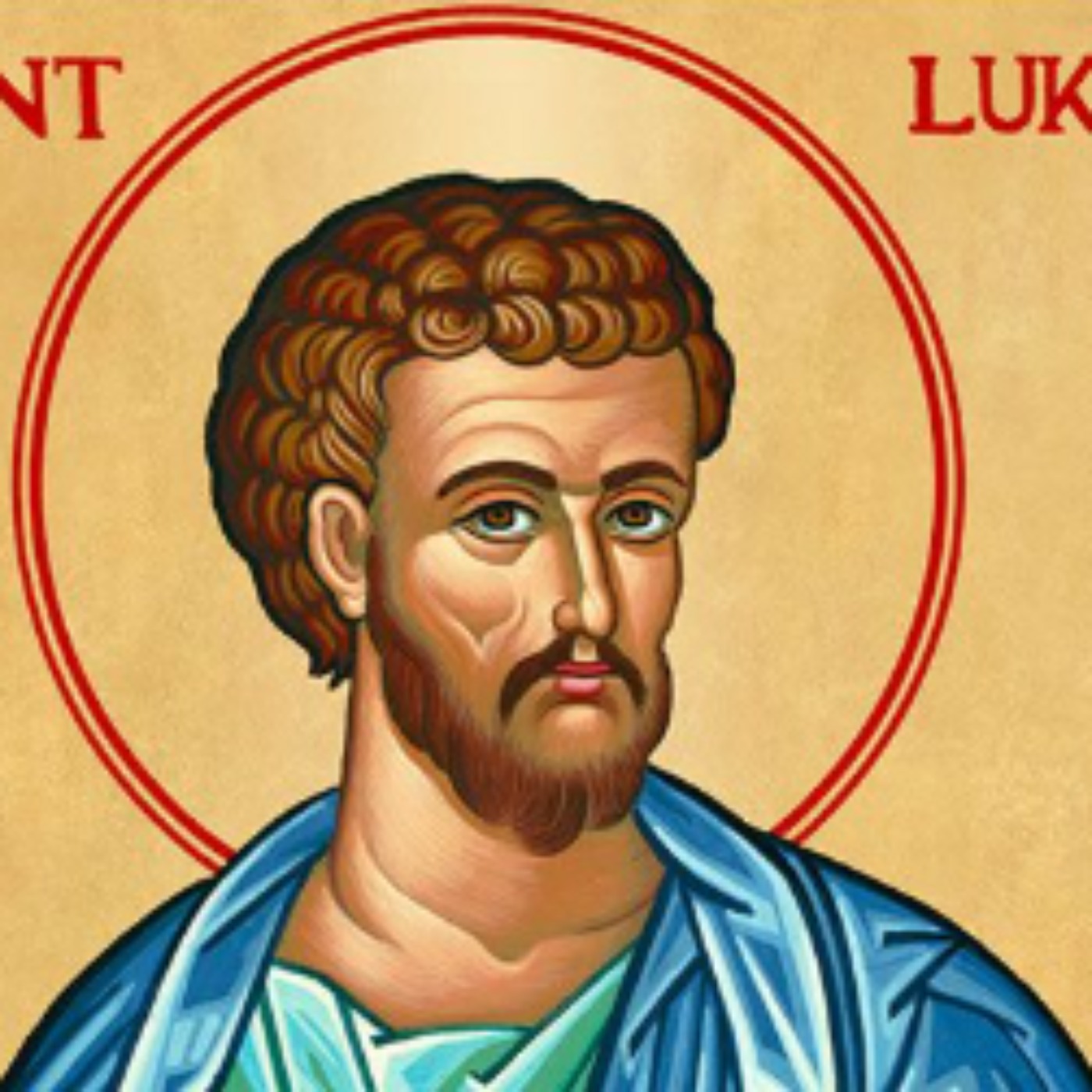
About this episode
This episode is a chapter out of my coming book, "Being Saints: The Unheralded Heroes of the Early Church."
It is recast from my other podcast, "Godly Passion, Holy Flame"
If you enjoyed the episode, be sure to check out other unsung heroes in the links below!
- John Mark - (https://shows.acast.com/godlypassionholyflame/episodes/john-marks-story-1st-cent-ad)
- Timothy - (https://shows.acast.com/godlypassionholyflame/episodes/timothy-a-short-biography)
- Epaphroditus - (https://shows.acast.com/godlypassionholyflame/episodes/epaphroditus-an-unlikely-warrior)
And while you're at it, be sure to send me a note at [email protected].
I'd love to hear from you!
Hosted on Acast. See acast.com/privacy for more information.
Get every episode summarized
Each time Project: Philippians publishes, we email you a written briefing from the transcript — the topics, who appeared, and any specific claims, with the ad reads skipped.
Email me new episodesFree for 3 shows. No card needed.
Hosts & guests
Transcript ready
452 searchable segments. Every word is indexed and playable.
Full transcript
Project: Philippians — Episode #119a - The Loyal Yokefellow (Phil 4:3). Machine-transcribed; use the interactive transcript above to jump the player to any line.
Hey friends, welcome back to Project Philippians. Listen, I've got something kind of different for you today that I wanted to share with you. This is something I've been working on for quite some time now. Some of you know that I've been writing a book on the unheralded heroes of the first century early church. And I just finished chapter four. And so today I want to read it to you. And you might be wondering why I'm choosing to do this on Project Philippians. Well, as a matter of fact, the individual that I highlight in this chapter just happens to make something of a cameo appearance in the next verse of Philippians that we're going to study. So you can consider this a bit of an interruption to our normal study. But I hope you can come to appreciate a man that I have come to love and admire more than I ever had before. So you ready? Let's go. Who first shared the gospel with you? Do you know they were reliable? Can you vouch for their character? And what about the person who told them or the ones before that? Have
you ever thought about the centuries-long chain of messengers stretching back to the origin of it all? At the other end of that chain stands a group of eyewitnesses who proclaimed first hand accounts of gospel events. They delivered their testimonies to presumably faithful servants who passed it along to others who continued the chain until it finally reached your ears and changed your life. But how do we know that those early generations got it right? That the genuine story was passed along reliably. It is not irreverent to ask such questions. We wouldn't be the first to ask them. In fact, the same pointed questions arose within decades of Christ's death. They were asked by people with discerning minds who didn't want to be taken in by yet more mythology. Theophilus was one man from the first century who had heard the stories of Jesus and seemed eager to know if he could believe. He was a wealthy man judging from his royal title, and his story clues suggest he recruited a researcher to investigate the rumors. Of course, he would need
a trustworthy detective, someone of known character and scholastic training who could be counted on as reliable arbiter of truth. Now, we know little else about theophilus himself, but the scholar he trusted produced a research paper that has survived to this day. You can read it for yourself. This 2000 year old document begins with a dedication to the patron who apparently sponsored the effort. It reads, many have undertaken to draw up an account of the things that have been fulfilled among us, just as they were handed down to us by those who from the first were eye witnesses and servants of the word. With this in mind, since I myself have carefully investigated everything from the beginning, I too decided to write an orderly account for you, most excellent Theophilus, so that you may know the certainty of the things you have been taught. You may recognize these remarks as the opening words of the third gospel in the New Testament. Indeed, we are now there among the first links in that golden chain of gospel preservation, one of the very first messengers. So, of course, we must ask, what do we know about him? And more
to the point, how do we know he got it right? To answer that, we must first know his identity. Who was this trusted researcher anyway? It turns out that's not an easy question. The book he wrote was originally anonymous. The author didn't sign his name. Over the centuries, it became known as the gospel according to Luke, but how do we know that's correct? For that, we must conduct some historic detective work of our own. We'll need to examine the internal evidence, clues from scripture, and external evidence, other ancient writings. Beginning with scripture, our first lead comes from another document, found two books after the third gospel. The book of Acts opens like this. In my former book Theophilus, I wrote about all that Jesus began to do and to teach until the day he was taken up to heaven. Acts 1-1. There is our most important clue. Another dedication to Theophilus, proof that Acts is actually the sequel of the third gospel. Whoever it was who wrote one was the author of both.
Notably, this places the author among the most prolific writers in all of scripture. His two book series contains more words than any other writers of the Bible except Moses and Jeremiah. More words than Isaiah, more than Ezekiel or Daniel, more even than the Apostle Paul himself. This unnamed author wrote more than a quarter of the New Testament writings, a remarkable feat, particularly given the arduous effort to hand compose any long document in the first century. Unfortunately, for our purposes, however, Acts itself is also anonymous, so our detective work is not yet done. Thankfully, though, while he didn't reveal his identity directly, he did, in fact, leave another clue near the end of Acts. It's a clue so subtle, in fact, that casual readers will miss it. It's hidden in an element of grammar. Here's an example from Acts 16. Paul and his companions traveled throughout the region of Fridgia and Galatia. They passed by Messiah and went down to Troas. During the night, Paul had a vision, after which we got ready at once to leave from Macedonia, concluding that God had called us to preach the gospel to them.
Acts 16, 6 to 10. Did you catch it? Notice the pronouns. In the first 15 chapters of Acts, the author wrote in the third person, they and them, etc. But right here, in the middle of this particular story, he switched to the first person. He said, after Paul had seen the vision we got ready at once to leave, concluding that God had called us to preach the gospel. Verse 10. Moreover, the author continued to scatter the so-called WE passages throughout the remainder of the book, as if to point out in a humble, unobtrusive way that these were the occasions when he was joining the story. Norman Rockwell was a 20th century artist famous for his life-like paintings, that seemed more like home-spun stories. His art was widely loved, but many never noticed one amusing habit. Rockwell loved painting himself into many of these scenes. Look carefully, and you'll find his face, hidden in the crowd perhaps, or mischievously peaking in from the corner
of the canvas. I suppose it was just his humble way to say that he too lived in the world he painted. I like to think the author of Acts was doing something similar in these inconspicuous references, almost as if he too was peaking out of the scroll and winking at his readers. In so doing, he was authenticating these particular stories as an eyewitness to them. But, providentially, he was also giving historians a crucial key to unlock his actual identity. To follow this logic, we simply need to line up potential candidates. Who was it that accompanied Paul during the latter years of his ministry? And nearly a dozen such associates are named in the book of Acts itself, but they must be ruled out given the author's preference not to name himself. Paul's own letters also name several of his co-workers, men such as Timothy, Titus, Mark, Demis, and Philemon, among many others. But most of these candidates are ruled out by being named also in Acts. By process of elimination, we can reduce the list to just a
small handful of contenders. One final clue becomes a linchpin. The final weak passage in the book of Acts extends into the last chapter of the book, and it Paul's last reported imprisonment, indicating that the author of Acts was with Paul to the end. With that in mind, consider these words which Paul wrote to Timothy in his final epistle. Do your best to come to me quickly for questions has gone to Galatia and Titus to Dalmatia. Only Luke is with me. The second Timothy for 9 through 11. Surprisingly, and Paul's last surviving letter, we learned that all his other companions had gone their way, and his only remaining associate was a man named Luke. Could this be our elusive author? That indeed is where the internal evidence leads us, a compelling case, though not conclusive. But when we turn to the external evidence, however, all doubt is removed. Exam in all the writings of the early church fathers, and you will find that
every writer who mentions the author by name agrees. There is no exception. They all attribute the third gospel and Acts to Luke. This is particularly noteworthy given their insistence on the Apostolic authority for all canonical books. If anyone was going to guess or fabricate the author's identity, Luke, a non-apossal under relative nobody in the first century, would not have been on their list. This is about as close to an open and shut case that you'll find in ancient research. Luke is then an obscure and relatively unknown historical character, and a very unlikely candidate indeed, as we shall soon see. So if Luke is the author, our next question is what do we know about his character? Why was he of all people selected to write one of the gospel accounts of our Savior and the sacred history of the early church? Well, to the question, what do we know about the answer from scripture seems to be not much. He's mentioned by name only three times in the Bible,
and each reference is a little more than a brief comment at the end of Paul's letters. This is fewer mentions than Aristarchus or Ticacus. You probably haven't even heard of. There's hardly enough material in these three verses to compile a proper author's blurb on the back cover of one of Luke's books. But these verses are a start, so let's dive in and see what they reveal. Philemon 124 is the slimmest reference of the three. In it, Luke is named at the tail end of the list of four or five of Paul's fellow workers. You'll recall that the epistle to Philemon is a short book with just a few words of encouragement and a brief request for a favor. And at the end, Paul signs off with a quick glance around the table. Epaphrus, my fellow prisoner sends greetings, and so to Mark, Aristarchus, Demus, and Luke, my fellow workers. Philemon 1, 23 and 24. Luke here is just one of the fellows standing behind Paul waving his greeting in the final shot. He's the one of the corner shadows, last on the list, like one least noticed.
If this says anything about him, it tells us that he's not the type of man to seek the limelight. The shadowy man in this picture bears the unmistakable mark of a humble servant. At the end of Colossians, we find a similar scene in Paul's final remarks. Here again, Luke is mentioned second to last on a long list of well-wishers and co-workers, but now a few other details they can as well. Luke, the beloved physician, greets you as does Demus, Colossian 414. The first word here that grips us is the emotion-filled epithet beloved. Sometimes translated dearly loved, this word is derived from the Greek word agape. It is a word that Paul reserves for his closest companions and dearest friends. Luke is obviously very special in Paul's heart. The reasons for this deep affection will become eminently clear further into our study. There's a second intriguing detail in this first. Paul calls him a physician. Luke was a medical doctor. This reveals his professional background, and it also
highlights his scholarly credentials. Greco-Roman physicians were often highly trained practitioners steeped in the medical knowledge of the Hippocratic tradition. Not just a provincial medic, Luke was likely a learned academic. Furthermore, we see here a glimpse of the likely dual role that Luke played on Paul's team. His therapeutic and medicinal skills would have been highly valued on the rugged terrain of Paul's travels. It appears Luke was, in effect, history's first medical missionary. Now, before we leave this Colossian's passage, one final detail deserves a closer look. As already noted, this first comes at the end of a long list of Paul's colleagues. What is interesting about this list, however, is that Paul segments it into two distinct groups. After naming the first three, Aristotle's Mark and Justice, Paul explains, these are the only Jews among my co-workers, Colossians 4-11. Luke's name follows later, in the second half of the list. If this distinction is as intentional as it appears,
it indicates something remarkable. Luke was a Gentile. As such, he would have been the only non-Semitic author in the entire Bible. How extraordinary that the God of Israel would select an uncircumcised Gentile dog to record forever the gospel of Israel's Messiah. We turn now to the final scriptural reference that mentions Luke by name. It's found in one of Paul's last recorded statements. Writing to Timothy, he says, Luke alone is with me. Get Mark and bring him with you, for he is very useful to me for ministry. And when you come, bring the books and the parchedments. Second Timothy 4, 11 and 13. Two things stand out here. First, as was mentioned earlier, we see the distinctive longevity of Luke's relationship to Paul. Faithful to the end. Luke's companionship must have been precious to the imprisoned apostle, particularly given Paul's subsequent remark that his other supporters all deserted him at his first defense. Second Timothy 4, 16.
But another curious detail in this passage is the connection of Luke's name with that of Mark, and most strikingly, with a collection of Paul's books and parchedments. What notes were compiled on those pages? Mark, of course, would become the author of the second gospel. Could it be that the soon-departing apostle was using his final days on earth to prepare his most resolute disciples for the epic role in documenting the origins of Christianity? Oh, what conversations they must have had. So we have now read every surviving reference from the first century mentioning Luke by name. Very slender collection indeed. And nevertheless, the striking portrait has already begun to emerge of a quiet but diligent man committed to serving both the Lord and his apostle. Our path turns next to the hints about Luke's story and character that can be gleaned from his own personal writings. As noted above, his prodigious volumes, though anonymous, provide ample material,
but we will need to sift them carefully to isolate the salient and clues. Together, these clues will flesh out our composite sketch and will reveal three defining dimensions of Luke's character. He was an earnest seeker, an eminent scholar, and an enduring servant. One, earnest seeker. Our trail begins where Paul's trail nearly ended, and one of the most remote locations in northwest Asia Minor, modern day Turkey. The spirit of God had led Paul and two others on a baffling journey to an apparent dead end, Troas. Maroon there in the upper left corner of the continent with no prospects for ministry and no clear plan from God, their confusion must have been considerable, but a prophetic midnight vision would change all that. Suddenly their call became clear. They were to bore the next ship crossing the Aegean Sea to Europe, the heart of the Greco-Roman world. And as noted previously, it is precisely here that Luke painted himself onto the canvas. He says, and when Paul had seen the vision
immediately, we sought to go into Macedonia, concluding that God had called us to preach the gospel to them. Acts 1610. Somewhere on the streets of Troas, the apostle and the physician crossed paths. No details were recorded. Was it a random encounter in the market or a medical station? Was Luke already a believer when they met? Some ancient traditions suggest Luke grew up in Antioch, the same city that Paul's team had originally been sent from. So maybe this was a reunion with a fellow Christian pilgrim from their hometown. All we know for sure is that Paul entered this town with two teammates and left with three. Something about this chance meeting in Troas had permanently altered the trajectory of Dr. Luke's life. Somehow, he realized that his services as a medical provider would never again be the primary purpose of his life. With apparent eagerness, he packed his bags and joined the small company of pioneering missionaries. We haven't time to trace all of Luke's travels with Paul, although we will return to them briefly later. Suffice to say that his itinerary, as reconstructed from the wee passages,
would include years right next to Paul and with a newly planted churches, especially Philippi. Could Luke have possibly known what a grand adventure he had embarked upon, and could he know how that adventure might provide answers to questions long buried in his heart? I was discussing the resurrection with an open-minded skeptic. I pinned my argument on the eyewitness testimonies mentioned in 1 Corinthians 15, where Paul reports that the risen savior once appeared to over 500 people. The keystone in this argument was Paul's claim that most of those people were still alive at the time of his writing. My thoughtful friend pondered that claim for a moment and then posed this perceptive question. If that's true, he asked, wouldn't you expect some of the people that Paul was addressing to make the journey to Jerusalem to interview the so-called witnesses? Is there any record of that ever happening? At first,
that question made me pause. It had never occurred to me before. But suddenly, the answer flashing to my head, I looked at him with excitement and exclaimed, you're absolutely right with a great question. And as a matter of fact, we know of just such a journey. We actually had the first hand record of at least one man who did exactly that, traveled with Paul from the European Peninsula all the way back to Jerusalem, a journey of over a thousand miles, where he personally found and interviewed some of those very eyewitnesses. And the result of his journalistic endeavor is recorded in a pair of books that this man personally authored and that had been preserved for two thousand years. These books, of course, are the gospel according to Luke and the acts of the apostles. Now, to be fair, we don't know for sure if Paul's statement to the Corinthians was the actual spark behind Luke's journey, but a simple reconstruction of the timeline makes it plausible. We know from the Wee sections and acts that soon after writing that Corinthian letter, Paul set sail for Jerusalem, with Luke right at his side. With the days of their arrival, Paul
was arrested and spent two years in a Judean prison. We know also from Acts that Luke was with Paul immediately before and after that imprisonment. Now, we're not told what Luke did during those two years, but it is quite likely that he used that very time there in the land of James and the elders to finally satisfy all his unanswered questions. This was the perfect opportunity to explore the land where Jesus walked, to become acquainted with those who from the beginning were eyewitnesses and servants of the word, to track them down and question them and write down their stories. In short, this was his chance to do exactly what he says he did, having investigated everything carefully from the beginning to write it out for you in an orderly sequence, most excellent Theophilus, Luke 1, 2, and 3. So whether Luke made this thousand mile journey to satisfy his own curiosity, or whether he felt called by God to investigate these world-shaping stories, we don't know. But this much we can say with confidence. The third and fifth books of the New Testament exist as they do because of certain adventurous physician determined in his heart to seek the truth
wherever it led him, because he was an earnest seeker who wanted to know with full assurance the things he had been told. Luke 1, 4. 2. Eminent Scholar Of course, while curiosity is commendable, it is not by itself sufficient, even the most well-intentioned seekers can get their facts wrong. If a storyteller wants to provide full assurance of their accuracy, they need more than curiosity, they need credibility. We can be thankful, therefore, that when the Lord tapped Luke to be one of his biographers, he didn't just choose an inquisitive tourist. He selected a man who would come to be known as one of the finest scholars in the ancient world. To appreciate this, we need look no further than the writings Luke authored, and our first demonstration of this comes in the opening words of his gospel. Luke's introductory verses have been compared to the writings of the most highly regarded authors
of antiquity. His rhetorical command of the classical Greek language is among the finest of New Testament authors, and immediately reveals him to be a highly educated writer. But it's not just his literary skills on display in this introduction. We also get an unprecedented glimpse into his process. Many Christians today have a misconception when it comes to the inspiration of scripture. We sometimes get the notion that the Bible somehow just dropped out of heaven and landed effortlessly into the laps of the holy scribes of old. But when we examine the writings closely, especially those of Luke, we see something more. We see the dog-eared records of a tenacious truth-seeker and his hard-fought battle to ascertain the objective authenticity of the claims he was recording. Now, describing the composition process like this doesn't diminish the role of the Holy Spirit and carrying the author along and inspiring every word on the page, we're simply affirming that the words didn't come by simplistic dictation from God. This is truth throughout the Bible. The Holy Spirit's work to
produce the scriptures was always inextricably intertwined with the devout efforts of the human authors themselves. Nowhere is this more evident than in the introduction to Luke's gospel. For here we find the most explicit description anywhere in the Bible of the process by which it was composed. When we read this preamble of Luke's two-volume history, we find extensive evidence of the determination and fortitude that characterized his authorship. These writings must not be thought of as just mystical scriptures. They are, in fact, in journalistic research papers painstakingly assembled by a man who earnestly wanted to know the truth and wasn't willing to settle for crazy claims or sappy stories. Here are the marks of a careful scholar at work. As we read his prologue again, note how Luke emphasizes the meticulous precision he employed throughout the entire documentation process. In as much as many have undertaken to compile and account to the events that have been fulfilled among us, just as they were handed down to us by those
who from the beginning were eyewitnesses and servants of the word. It seemed fitting for me as well, since I have investigated everything carefully from the beginning, to write an orderly account for you, most excellent theophilus, so that you may know with full assurance the things you have been taught. Luke 1, 1 to 4. Allow me to peel back some of these words to highlight just how scholarly and trustworthy they reveal Luke to be. 1, while he admits to not being an original eyewitness, something a forger may well have claimed, he does affirm that he had direct access to such witnesses, and as he points out, there were many. And he wasn't relying on oral interviews alone. He also refers to a large collection of written material that he surely scoured with rigor. When he calls the eyewitnesses servants of the Lord, he uses a term reserved for the official caretakers of the sacred scrolls of Scripture, Luke 420. Similarly, the term for handed down was used elsewhere for the
formal transmission of essential doctrines and apostolic decrees. Clearly, Luke understood the solemn stewardship with which he was entrusted. He recognized the divine origin and hallowed consecration of the materials he handled, and he knew the sacred duty to record them would require the very utmost of his skills. But he also knew the critical importance of getting it right. There is no room here for casual hearsay or rumors, hence the urgency for consulting the words and writings of actual eyewitnesses. Verse 3 is filled with words reinforcing this notion. He says he investigated everything carefully from the beginning. The word for investigated refers to long and careful observation and scrutiny, employing no doubt the observation and diagnostic skills he learned in medical school. And he says he applied that level of analysis to everything, every aspect and every detail of
every story. And he did so carefully a word that would be more accurately translated with rigorous precision. It was a word he used elsewhere to describe the scrutiny employed in Pharisees' schools or apostolic training in judicial inquiries. Finally, he studied from the beginning, because a scholar of his stature could not be satisfied without tracing the story back to its very inception. This explains why he is the only biographer to recount not only the birth of the Messiah, but even the conception of the Messiah's forerunner. Even Luke's decision to write these books is notable. The first words of verse 3 are sometimes translated it seemed good or fitting for me. And although that translation may accurately reflect the humility of his decision, it diminishes the solemnity of it. The verb Luke used here is found in the Greek Old Testament of royal and civic decrees. And it's used in acts itself of authoritative apostolic decisions. Luke didn't
just take on this project because he thought it would be a good idea. This word indicates a decision stemming from careful prayer and solemn deliberation before God in his apostolic representatives. In his understated way, Luke is proclaiming to theophilus and the world his conviction that his skills and scholarship are being employed entirely at the pleasure and will of the Lord Almighty alone. And before we leave this magisterial prologue, we must reflect on Luke's driving objective in all this. In the final phrase, he reveals the reason he exerted such rigorous effort to document these stories. He tells us this orderly account was compiled so that we, along with theophilus, might have full assurance in the things we have been taught. That word for assurance was a term from judicial proceedings. It meant confident, legally binding certainty. Luke knew how essential it would be for our faith to rest on unshakable historic grounds. And so he offers, as it were,
a notarized document to provide absolute assurance to the stories we learned in Sunday school. He wasn't parading the prowess of a scholarship. His only concern was to use his scholastic training to the best of his ability that he might remove every possible obstacle to bold faith in the gospel of Jesus Christ. Now, it's important to note that Luke's scholastic credentials have not always been acknowledged by academics. In the 19th century, for example, a scholastic movement, known as higher criticism, convinced many historians that the New Testament books were written long after the events they described. One influential school in Germany argued that Luke's writings in particular were a product of the second century, reflecting theology and legend more than reliable history. Among the scholars shaped by this academic climate was the Scottish archaeologist, Sir William Ramsey. As he set out to investigate the archaeology of Asia Minor, the modern day Turkey, Ramsey expected his research to confirm the prevailing skepticism, but remarkably, across years of
painstaking field research and dig after dig, he found Luke's historical reliability to be corroborated rather than undermined. Luke's precise knowledge of first century realities, terminology, geography, locally varying political titles, shifting provincial boundaries at regional customs. These all convinced Ramsey that Luke was unquestionably a first century historian. But not just that. Ramsey calls him in his books a historian of the first rank. Ramsey's research fundamentally reshaped scholarly discussion of Acts, and established Luke as one of the most historically reliable writers of antiquity. A judgment still widely accepted among historians to this day. And Ramsey was not alone. He was influenced by the investigative work of a fellow Scottish scholar named James Smith. In the 1840s, Smith, an accomplished yacht spend with extensive knowledge of the Mediterranean, dedicated years of his life to examine the Count of Paul's ship journey that was recorded in detail by Luke in Acts 27. Smith prepared with extensive research on
ancient ship construction, Roman navigation techniques, and Mediterranean weather patterns. Armed with that knowledge, he meticulously retraced the routes described by Luke, studying the wind, occurrence of the Mediterranean, and the geology and geography of each port. Smith's research convinced him that Luke's account was written with precise nautical accuracy. The technical precision of the terminology used in this maritime narrative, accurate in every detail, but not written in the style of a professional semen, could only have been written, Smith concluded, by an eyewitness who had personally experienced the very storm he described. Marley, because of Smith's research, Luke's account is still considered today one of our most reliable sources of information about ancient seafaring. Now, this is even more remarkable considering the conditions in which Luke recorded the precise details of this nautical account. Luke, who accompanied Paul in this particular voyage, as indicated by the wheeling language in Acts, was experiencing an epic two-week storm that left the ship's veteran sailors terrified and fearing for their lives. In the midst of that
tempest, with virtually no hope for survival other than Paul's prophetic assurance, Luke calmly and dutifully chronicled every detail. His later account reads like excerpts taken straight from his own field notes. Surrounded by a life-threatening storm, Luke recorded the events with the unwavering confidence of a man who knows that he has been called by God. Here is a man who clearly understood the importance of his role as scholar and journalist, not only of the incidental details, but also of the larger history he was helping to record. He was a man determined to be a trustworthy historian, bearing faithful witness to the story that mattered more to him than his own survival. The gospel of the Lord Jesus Christ and the rise of his church. Luke was indeed a historian and scholar of the first rank. A man perfectly suited to forge one of the very first links in that ancient golden chain of gospel transmission. Three, enduring servant. The problem with writing a glowing tribute to
a man like Luke is that he almost certainly would not have wanted such a commendation. As heroic and monumental as his achievements may appear to us, the self-portrait he left behind is of a man who preferred to stay anonymous. He wanted no spotlight, unless it was to direct it toward the Lord and his apostolic heroes. Luke's life goal was not to shine. It was to serve. I imagine it was this servant-hearted character and humble faithfulness that endeared him most to Paul. But while Paul had many supporters and friends from a lifetime of missionary travels, none of his companions and associates proved as loyal as Luke. To see evidence of this, we return again to those non-descript self-references in the book of Acts, the Wee passages. As mentioned before, these sections are scattered throughout the final chapters of Acts. Careful readers will count exactly four of them in chapter 16, 20, 21, and 27 to 28. But Jarparide readers will notice something else. Most of the gaps between those sections, the portions where the Wee and us terminologies missing, those are not indicators
of Luke's absence. On the contrary, those so-called gaps are written in the third person only because Luke's narrative there is focused specifically on Paul, his transcribed sermons or court appearances, for example. But the fact that the Wee sections bookend all of those stories indicates that Luke was indeed right there, still with him taking notes all along. In fact, remarkably, and with only one main exception, one we will return to in a moment, from the time Luke joined Paul's missionary team, he hardly ever left his side again. Luke was with him in Philippi. On the day Paul was beaten mercilessly and thrown in the Roman dungeon. Luke was with him on the shore of Meletus when the tearfully fusions knelt before Paul and a heart-wrenching farewell. Luke joined the voices of the believers in Caesarea pleading with Paul to reconsider his perilous Jerusalem travel plans. And, according to Paul's own words, Luke was there at the closing curtain. After the apostles' other colleagues had all deserted him during his final trials before Caesar, he was with Paul to the end. And please bear
in mind, he didn't have to be. He didn't have to accompany Paul into the hot bed of Jerusalem, but he came. He didn't have to stay with Paul during the years of Paul's imprisonment, but he stayed. He didn't have to board the prisoner's ship with Paul on their way to Roman incarceration, but he walked up the plank right behind him. He could have disembarked at the last dry port before that ship sailed into a perilous storm, but if Paul was staying aboard, so was Luke, because that is the type of man Luke was, a man who sticks around in the storms, a friend who remains close, a faithful enduring servant. As you read the biography that Luke wrote about the apostle, it's hard to escape the impression that Paul was Luke's hero. A man Luke was willing to stay with and serve to the death. And you can be sure that Paul was deeply indebted to him as a result. It's no wonder he called Luke his beloved physician. In fact, although we have already examined all the references in which Luke has mentioned by name, there are, in fact, two remaining verses where he is not named, but which
may contain subtle clues of Paul's profound love for him nonetheless. In 2 Corinthians 8, Paul is speaking of a worldwide fundraiser for Jewish Christians in Jerusalem. Paul wants to send Titus to the Corinthian church to receive their generous offerings for this cost, but to ensure that their gifts will be securely delivered to Jerusalem, he has arranged to send another ambassador to accompany the gift-bearing entourage as an official delegate from Corinth. Paul praises this delegate, but he does not name him. The implication, however, is that the man is from Macedonia, where both Paul and Luke were residing when Paul wrote this letter. Could Luke have been that unnamed delegate? Possibly. What we know for sure is that Paul assembled seven other delegates for this distinguished company, each representing a different region of the world. The names of each one are listed in Acts 20, verse 4. The curious thing about that list, however, is that Corinth and the Corinthian delegate are not named. If it was Luke in that role, as many scholars
believe, it would be just like him to leave his own name off the list out of characteristic modesty. Assuming that's true, the most remarkable thing is the accolade that Paul honors him with to the Corinthians. Paul calls him the brother who is praised by all the churches for his service to the gospel. 2 Corinthians 818. Praise by all the churches. What a commendation. The sterling, worldwide reputation of this modest man preceded him, and he didn't even have to be named. Another conspicuous reference is found in Paul's letter to the Philippians. In chapter 4, Paul is addressing a troublesome rift that is emerged in this otherwise loving church. There appears to be a unity-threatening disagreement between two prominent leaders in the congregation. Paul lovingly urges them to make amends, but then he solicits the help of an impartial mediator in the cause of their reconciliation. This piecebroker is not named. Paul simply and enigmatically refers to him with the following words. I plead with Yodia and I plead with
Sintiki to agree with each other in the Lord. Yes, and I ask you, loyal Yoke fellow, help these women who contended at my side in the cause of the gospel. Philippians 4, 2 and 3. Bible scholars have speculated for centuries about the identity of this loyal Yoke fellow. Some have suggested it might be Luke. What evidence might point to this conclusion? Recall from the Wee passages in Acts that Luke was rarely separated from Paul in the latter half of the book. One main exception, however, occurs immediately after the mission stop in Philippi. When Paul leaves that city, Luke's self-referential language stops, and it doesn't resume for three more chapters when Paul returns to Philippi some six years later. Luke was apparently left behind in that city, and stationed as Paul's direct representative until he could return. And so, faithful servant that he was, Luke invested six years of ministry in that fledgling Philippian church. Flash forward a decade or so when Paul is in prison writing a thank you note to the
Philippians for a gift that they had recently sent him. Now, we know from Paul's other prison epistles that Luke was typically on hand during his incarceration, but in this letter he's not mentioned. What might explain his absence? One hypothesis notes that Paul had recently dispatched someone to inform the Philippians that the courier who had brought their gift had become gravely ill. Philippians 226. We're not told who made the thousand mile trip to deliver this sad news, but Pastor Luke would have been an obvious choice. If true, this would have put Luke in Philippi when Paul's letter to them arrived. And if he was indeed there on hand, for that reason, or some other, then who else would Paul reach out to to assist in this church-threatening conflict that weighed so heavily on Paul's heart? Who could Paul trust to know these people well enough and to love them deeply enough to help them through this crisis? And who else could Paul speak to in this enigmatic way
without directly naming him yet confident that his identity would be known to all? Who else but the oft-anonymous servant who had poured six years of his life and heart into the church that Paul loved? Who else but Luke? If we have pieced this history together correctly, and some prominent scholars agree that it's plausible, then this simple two-word appellation gives us a beautiful glimpse into Paul's heart towards Luke. He uses the endearing moniker, Loyal Yoke Fellow, sometimes translated true companion. The term Yoke Fellow is a vivid word picture, designating two plow animals linked together, working hard to pull in the same direction. What a delightful way for Paul to single out the man a Gentile no less, who in all the world has proven himself faithful and dependable and loyally connected to Paul's own heart. A finer tribute can hardly be imagined, coming from a man as devoted to the gospel as the
possible. Well, our journey with this unexpected hero has led us across thousands of miles of imperial roads and across deadly seas. It has landed us in European outposts and behind rowing bars, and along all these dusty paths we have become acquainted with a remarkable man, a man with the spirit of a seeker, the mind of a scholar, and the heart of a servant. We see a man who, just like the eyewitnesses he commended in his verse versus, was indeed a true servant of the word. And of course, it is for this treasure that we owe him our greatest debt. For while four gospel evangelists recorded our Lord's biography. Have you ever noticed how many details of Christ's life and death were only revealed by Luke? How many stories he preserved that we may otherwise have never known? It was Luke alone who told us of the angels' visit to Mary and Mary's hymn to God. Only Luke records John's worship in the womb, the angelic worship in
Bethlehem, and the shepherd's worship at the manger. Only in Luke do we see Simeon and Anna gushing over baby Jesus, or the Jerusalem scribes gaping at his twelve-year-old wisdom. And without Luke, so many other iconic stories may have been lost to history. That first miraculous catch of fish and Peter's humble conversion. The thankfulness of the one Samaritan leper and the transformation of Zacchaeus the tax collector. The sinful woman who anointed Jesus' feet and the devoted woman who provided his funds. The Lord's tender visit with Mary and Martha and his tender tears wept over Jerusalem. And think of the parables. If it weren't for Luke's pen, we wouldn't know of the good Samaritan or the prodigal son, the persistent widow or the friend at midnight, the Pharisee and the tax collector or the rich man in Lazarus. We also owe many precious details of our Savior's final days to Luke's hand. The blood Jesus sweat into the githesemony, the ear he healed in the garden, and the trial he stood before Herod. The repentance of the thief and the reply
of the Lord today you will be with me in paradise. The Savior's final prayers father forgive them and father into your hands I commit my spirit. And after Christ's resurrection, Luke gives us the roadside conversation near Emmaus, the lakeside breakfast of broil fish, and the hilltop view of Christ's ascension. Oh, but Luke's gospel is just the half of it. Without his journalistic book of acts, how would we have known about the birth of the church? We'd know nothing of the gift of the Holy Spirit on Pentecost or the miraculous growth of early disciples. No word of Stephen or Philip or Barnabas or a dozen other early evangelistic heroes and martyrs. We would have none of Peter's explosive sermons or of Paul's extraordinary conversion or the miraculous spread of the gospel across two continents. It is by Luke alone that we know how Jesus commanded his followers to witness from Jerusalem and Samaria to the ends of the earth and how against all odds they actually did so, bringing the gospel to Rome. Oh, how indebted we are for the sublime and glorious history
that may have been hidden until heaven had not God graciously preserved it through the hands of his faithful servant Luke. He was a man. We can admire and emulate. He was a man who dedicated his life and career to serve the Apostle Paul, to serve the offaless, to serve the Lord Jesus, and by his inquisitive and trustworthy scholarship to become a gracious and heroic servant to us all. Hey friends, if you enjoyed this historical study, be sure to check out the show notes to find links to some of my other biographical sketches of unsung heroes of the early church. There you're going to find studies about Mark and Timothy and the paraphroneditis and hopefully more to come, so be sure to check it out. Lessons, my friends. Go live like the saint that God made you to be.
More episodes
More from Project: Philippians

Episode #118: Living in Harmony (Phil 4:2)
Project: Philippians
Episode #117: "Thusly" (Phil 4:1c)
Project: Philippians
Episode #116 - Stand Firm (Phil 4:1b)
Project: Philippians
Episode #115: Inspired Love (Phil 4:1a)
Project: Philippians