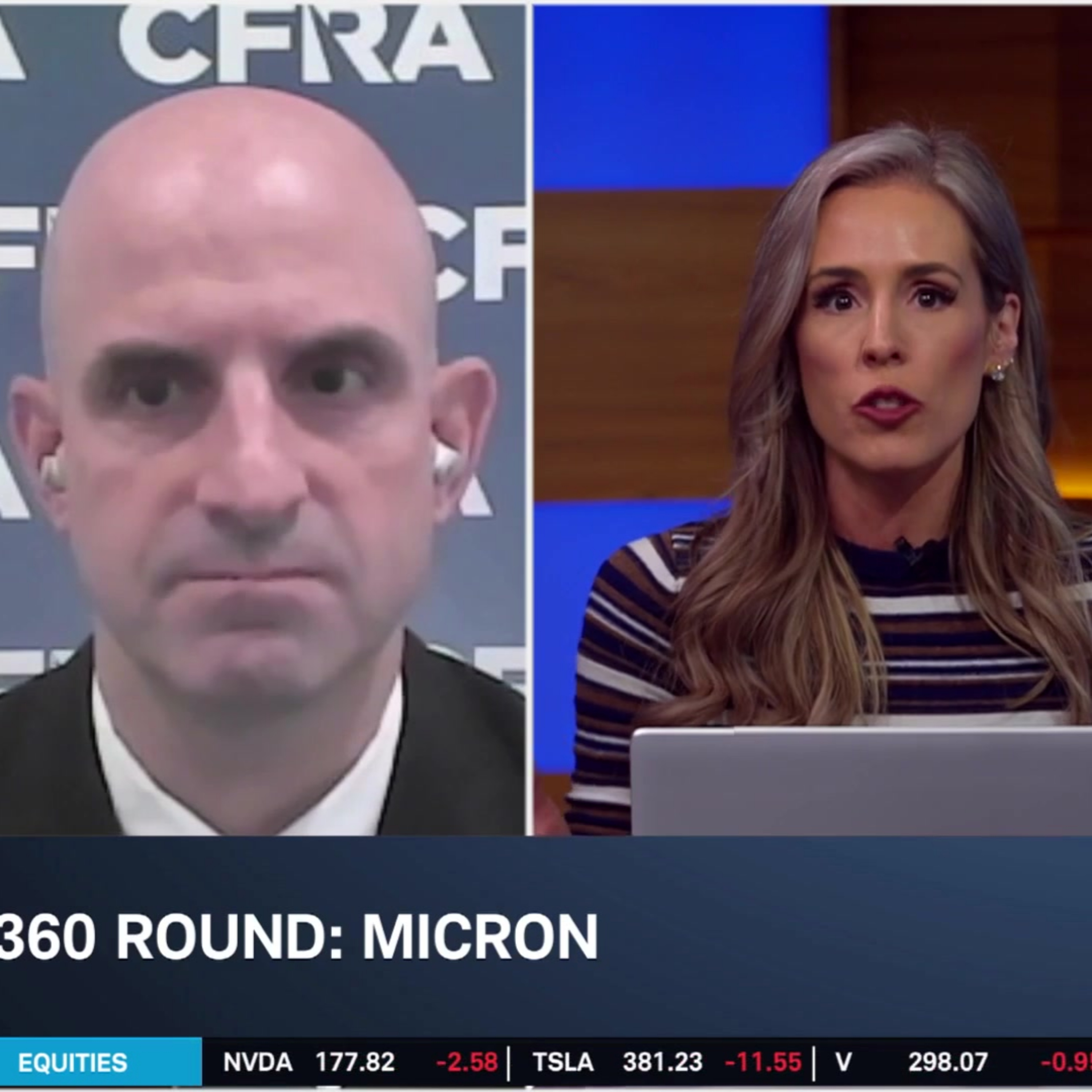
Earnings Tailwinds v. Supply Headwinds: MU's Complicated Path Ahead
About this episode
Micron's (MU) pricing is the company's strongest asset, says Angelo Zino with CFRA. He points to the company's stellar earnings and guidance to back his thesis. Stephen Sopko notes memory supply constraints serving as a key roadblock for the Micron's future growth. Angelo and Stephen offer insights into how the AI-tied company can boost tailwinds and counter headwinds.
======== Schwab Network ========
Empowering every investor and trader, every market day.
Options involve risks and are not suitable for all investors. Before trading, read the Options Disclosure Document. http://bit.ly/2v9tH6D
Subscribe to the Market Minute newsletter - https://schwabnetwork.com/subscribe
Download the iOS app - https://apps.apple.com/us/app/schwab-network/id1460719185
Download the Amazon Fire Tv App - https://www.amazon.com/TD-Ameritrade-Network/dp/B07KRD76C7
Watch on Sling - https://watch.sling.com/1/asset/191928615bd8d47686f94682aefaa007/watch
Watch on Vizio - https://www.vizio.com/en/watchfreeplus-explore
Watch on DistroTV - https://www.distro.tv/live/schwab-network/
Follow us on X – https://twitter.com/schwabnetwork
Follow us on Facebook – https://www.facebook.com/schwabnetwork
Follow us on LinkedIn - https://www.linkedin.com/company/schwab-network/
About Schwab Network - https://schwabnetwork.com/about
Get every episode summarized
Each time Schwab Network publishes, we email you a written briefing from the transcript — the topics, who appeared, and any specific claims, with the ad reads skipped.
Email me new episodesFree for 3 shows. No card needed.
Transcript ready
97 searchable segments. Every word is indexed and playable.
Full transcript
Schwab Network — Earnings Tailwinds v. Supply Headwinds: MU's Complicated Path Ahead. Machine-transcribed; use the interactive transcript above to jump the player to any line.
It's time now for the 360 round to discuss micron. The company saw a big earnings being with overall revenue growth up nearly 200 percent. So joining us now to break down these results and perhaps some of these spots they still need to address because we're seeing obviously some downward pressure today. I'd like to welcome in Steven Sopco, semiconductors and deep tech industry analysts at the Hyperframe Research in Angel of Zeno, Senior Equity Analyst at CFRA Research. Thank you both for being here. We know micron delivered overwhelmingly so, a really strong set of results. And so, Angelo, we'll start first with your perspective. What do you believe is the single most important driver behind the recent earnings power for micron? Oh, it's definitely pricing. I mean, you kind of look at why you're seeing these type of year of your gains, even sequential gains. I mean, it's all about pricing. Both on the D-Ram and the downside of things, and really when you look at the epicenter, the crux of the issue right now, it has all to do with the high bandwidth memory space.
What these hyperscalers doing in terms of orders, and that's clearly trickling down across the entire ecosystem. But for all intents purposes, it's all about pricing. That's really driving the upside revisions here to microns numbers, and that's clearly driving upside to the margins, not the 80% gross margins got it here for the make order. But just, you know, I think what investors clearly are scared about at this point in time is the sustainability. Obviously, the pricing hike, the sustainability of where we are, the margin trajectory here. Okay, it's sustainability. I do think it's still a pretty looming question, Mark, and so, Stephen, what do you feel though is micron's biggest constraint at the moment and how critical is the new capacity that's expected over the coming two years? I think this is a company that is selling every product it can possibly make. And so, the key constraint is how many of those products you can make. The pricing power is fantastic, the demand signals are really positive.
The challenge is being able to turn out enough of that quality high bandwidth memory and the expensive server memory that's needed in order for AI to work at all. And as AI becomes more complex, as we move from generative AI towards agentech AI, you need more and more of that extremely high speed memory. And that is difficult memory to make. It uses a lot more wafers than other types of memory. So, microns made some pretty bold bets lately, getting out of their lower margin consumer business last year, really focusing on this AI space. And we can see it in the results. That's been the benefit for them. The key constraint now is making enough and getting it into the hands of the invidias of the world and the hyperscalers of the world who use it like crazy. Yeah, and continuing on with that, because I do think high bandwidth memory has, I mean, clearly become a very core part of this story. And so, Angelo, how is microns going to continue to keep its high bandwidth memory edge over
its peers? Does this becomes more and more of a sought after space, frankly? Yeah, I mean, and to Steven's point, listen, I think microns done a fantastic job in terms of pivoting here and moving towards a high bandwidth memory space. You actually look at how the revenue is constituted these days. It's about 80% now towards the actual DRAM market, so they've really done a really good job shifting towards higher quality type offerings within high bandwidth memory. I think you look at the space, there's three key players, right? You've got SK, you've got microns, and you've got Samsung. SK was really kind of the first, you know, had that kind of lead advantage. And then you really had microns come on, and now you've got Samsung also coming on strong here. I think all are going to be very strong players within the high bandwidth memory space. I think when you look at the investments that microns is making, they're being very aggressive. I think that's a good thing, but in the same respect, you want to make sure that that cat backs numbers don't get too out of hand, because a big crux to the story here over the
next three years is when you start looking at the valuation of the stock, you look at the margins, which may not be sustainable, might be over the next six to nine months, but long-term, you want to make sure that the free cash flow potential is going to be there. Okay, so Steven, microns has said essentially that they are selling everything that they can build, which is a good thing, but how important then are the Idaho and New York Fabs in easing some of the supply tightness and continuing to strengthen microns, really strategic position and going forward? Well, I think the point is well made. They are spending a lot of money building out that capacity, and that's fantastic. It's needed. It's two parts. It's building the chips and it's packaging the chips together. Those are the two critical elements. So when we look at that repatriation of production capacity, it's absolutely essential. And microns has historically been a fairly conservative company, so they don't tend to splash out money unless they absolutely have to. And I think the investments, not only in Idaho and New York, they've got limited investment
in Virginia. I think that's a part of what we're going to be seeing with the American 250 mindset that's coming up right now. It's that ability to produce, I think their goals to produce somewhat like 40% of the DRAM here in the US in the next decade or so. So I think those are important investments. The key is demand continuing. And what we see is the need for that high bandwidth memory. A CFL asked me the other day, what is all this memory being used for? Because historically, we would shift need to cheaper types of memory. And that's happening right now, companies like Dell and HPE and even Embidia itself. So you don't use less memory. You just use less expensive memory. The thing that's driving it right now is that short term memory that HI needs to listen to what you asked and then respond. I think about it and the way I explain it is when you're having a conversation, what you just asked me, I need to keep in my short-term memory while I'm thinking about how to respond to you. And the longer the conversation, the more I
need to keep in that short-term memory, that's a great way to think about what's driving this demand for short-term memory. The more complex AI gets, the more complex conversations it has, the more of this memory it's going to need. Okay, and I think that was a great analogy, and I think it explains so well what we're seeing and why we're seeing such unprecedented demand. Unfortunately, not big reflected in share price today, but still a pretty stellar rapport all things considered. So I appreciate you both, Steven Sopco, some I could up during a deep tech industry analyst at Hyperframe Research. And Angela Zeno, Senior Equity Analyst at CFRA Research.
More episodes
More from Schwab Network

JNJ Balances Growth, Patent Transitions, and Legal Overhangs
Schwab Network

nCino (NCNO) CEO on Earnings, AI in Banking & Overcoming "SaaS-pocalypse"
Schwab Network

The Big 3: NET, TWLO, ASTS
Schwab Network

Tie Lasater on Inflation Floors, Energy Risk, and Private Credit Stress
Schwab Network