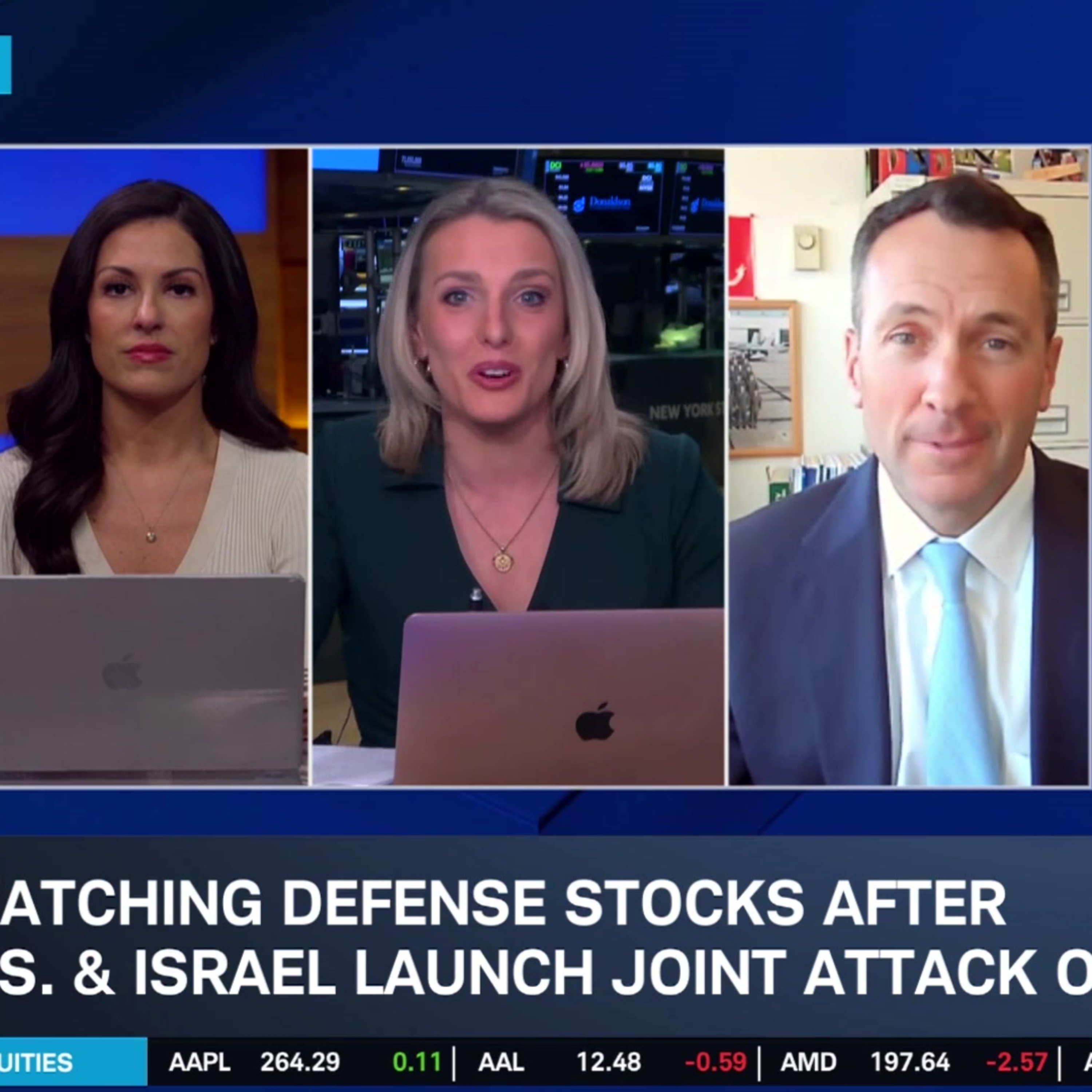
About this episode
Tony Bancroft thinks “there’s quite a bit more spending needed” in the defense sector to replenish the supplies used over the weekend. He expects defense budgets to increase around the world, creating a long-term tailwind. He highlights some smaller players in the defense space as well as the major companies like Lockheed Martin (LMT), RTX (RTX) and more. Tony looks at the whole supply chain and the boost in production rates by many companies.
======== Schwab Network ========
Empowering every investor and trader, every market day.
Options involve risks and are not suitable for all investors. Before trading, read the Options Disclosure Document. http://bit.ly/2v9tH6D
Subscribe to the Market Minute newsletter - https://schwabnetwork.com/subscribe
Download the iOS app - https://apps.apple.com/us/app/schwab-network/id1460719185
Download the Amazon Fire Tv App - https://www.amazon.com/TD-Ameritrade-Network/dp/B07KRD76C7
Watch on Sling - https://watch.sling.com/1/asset/191928615bd8d47686f94682aefaa007/watch
Watch on Vizio - https://www.vizio.com/en/watchfreeplus-explore
Watch on DistroTV - https://www.distro.tv/live/schwab-network/
Follow us on X – https://twitter.com/schwabnetwork
Follow us on Facebook – https://www.facebook.com/schwabnetwork
Follow us on LinkedIn - https://www.linkedin.com/company/schwab-network/
About Schwab Network - https://schwabnetwork.com/about
Interactive timestamps
Jump to segmentGet every episode summarized
Each time Schwab Network publishes, we email you a written briefing from the transcript — the topics, who appeared, and any specific claims, with the ad reads skipped.
Email me new episodesFree for 3 shows. No card needed.
Transcript ready
94 searchable segments. Every word is indexed and playable.
Full transcript
Schwab Network — Defense Spending Expected to Ramp Long-Term. Machine-transcribed; use the interactive transcript above to jump the player to any line.
0:00We're back here on Market Unclothes. I'm Marley Kaden, the Longside San Vodis. Let's turn our attention now to the defense sectors. Welcome in our next guest, Tony Bancroff, Fortfolio Manager at Cabelli Commercial Aerospace and Defense ETF. Tony, thanks for being with us. Great to have you back on the show. You would love to start with the reaction that we're seeing in the defense stocks in response to this ongoing situation in the Middle East, seeing big moves to the upside in Northrop in a race on RTX and L3 Harris. Do you think the markets are correctly pricing these moves in? We've already seen such a run-up in these names already this year. Yeah, it's great to be back on Marley and Sam. You know, I think the reality is that there's going to be quite a bit more spending needed in order to resupply the weapon systems that have expended over the weekend and today. And it's probably going to continue with the amount of the barrage of of, you know, ballistic missiles that Iran has been launching, you know, they're going to have to replenish these supplies. And then, you know, they've already talked about increasing production rates,
1:03tripling, quadrupling over the next, you know, several years. So all things being equal, you know, the primes and the suppliers of them are going to be probably spending quite a bit more. You're going to see defense budgets likely increasing. And if you saw the $1.5 trillion defense budget, even a fraction of that, I mean, a minor fraction of that is a material increase to the already, you know, unprecedented $1 trillion defense budget. So I think it's pretty well, you know, set for probably longer term spending from here. Okay, so a ton of hardware has obviously been utilized to pull off what the U.S. has done, not just in Iran over the weekend, but Venezuela. Remember, that was only just a couple of months ago. Can you believe it? We're not even done with Q1 yet. Oh, my goodness, Tony. Okay. So as you're saying, the production needs to be stepped up. As we replenish a lot of this stuff, the spending needs to be there. Right. We're all seeing these companies moving in tandem today. But do they continue to move in sync? Or who is more likely to benefit from some of that upside?
2:06Yeah, you know, our ability to commercial aerospace and defense ETF ticker GKAD is, you know, number one, active non-leverant aerospace and defense ETF this year, by about 18 percent. You know, it holds a lot of the large names that we're talking about. The Rheon's, you know, Lockheed Martin's, L3 Harris. And then some of the smaller suppliers companies that we probably don't know as much about, but are just as, you know, just as important to these weapons systems, a company called Albany International, which is a small aerospace and defense supplier. They make, they make actually sandblades for jet engines. But on top of that, they make, they do sort of a 3D weave composite, and they make materials for missile systems as well. So these are, you know, very expendable, you know, products they make. And there's going to be a probably high demand going forward on a lot of these weapons systems. So with that high demand, what are we looking at in terms of our replenishment cycle here?
3:08And also, is the U.S. defense industrial base currently capable of meeting ramping fast enough to meet the potential demand if this does become a longer duration conflict? Yeah, you know, Marley, it was a great question. You've heard a lot about missile math. I mean, right now, you know, there's thousands likely of Iranian ballistic missiles, intermediate and short range ballistic missiles. They've obviously been using sort of the barrage, a game plan, a tactic or a saturation, trying to just inundate our defense system. So, you know, we've been launching a lot of very expensive, much more expensive interceptors like Patriot, Fad, amongst others. And that's probably going to continue, I assume, what the regime's been doing. Their game plan of, you know, attacking Gulf States, along with, you know, Israeli bases in the U.S. It's probably going to continue. And it's really is definitely a, it's material to what our supply is probably right now. So, you're going to have to replenish that.
4:12That's going to continue. And they've already announced, you know, multiple programs. You would you name it from L3 Harris. Is there a rocket line to Raytheon, to Lockheed. They've talked about, you know, quadrupling missile production. So, you're going to see rates go up point a bit. But yeah, it's definitely, it's a serious thing right now. And I think that's why the U.S. is so focused on increasing those rates. So, away from the pure plays, Tony, what about the defense exposed type names? I mean, I was having a fascinating chat on Friday with Aether Technologies, which is in the business of LIDAR and some of the GPS challenge areas for defense companies. Also, I'm just thinking of Palantir and some of those cybersecurity stocks, which are obviously rallying today, perhaps on some of that linkage there. Just talk us through how you're thinking about some of the adjacent names as well. You know, I, as, as also a good point, Sam, I think the reality is that the defense tax is sort of up and coming, you know, non-traditional primes
5:17have seen a lot of growth. And they're getting a lot of funding. They're getting a lot of this, you know, non-traditional programmatic funding that the primes are usually benefit from. And they're tapping into it. But the reality is the pie is bigger, right? So, you know, on a trillion dollar budget, it just, it is by order of magnitude. They're just going to need more suppliers like the end rolls of the world. And they're going to need more defense tax to make things more, you know, cost-effective. And more, you know, you need a higher ROI and a lot of these weapon systems. And if you can have better targeting, better intel, you know, better, you know, using AI to improve efficiencies, it's just going to make, it's going to be a more more creative weapon. Let's call it that. And that's probably how things are going to go. You can see a lot of these joint venture partnerships. Yeah. And Tony, as we think about positioning here in this space and in this current environment right now, with all of the geopolitical risk and the uncertainty tied to the duration right now, how do you think about positioning among prime
6:20versus suppliers and which companies have the most visibility into backlogs? And what should you be looking for? Yeah, I think you want to look at anything that has to do with kinetics. I think I think complex weapons programs, I think like F-35, and you've seen the effectiveness of that weapon system, obviously the B-2, extremely effective. There's a new one coming, the B-21, that's, you know, that just essentially got an increase in the amount of orders there. So I think you're going to see those guys, and I think you'll see even the drone makers of the world, you know, you'll see companies like Kratos and Air Environment increase their production rates and getting more contracts. But I think the sweet spot is really going to be around missile production rocket engine production and in complex weapons systems. Well, Tony, we appreciate you bringing
7:23your expertise to us to help us take a closer look at the defense space today. Lieutenant Colonel Tony Bangkok from the Gabbelli Commercial Aerospace and Defense ETF. Thanks again for being with us.
More episodes
More from Schwab Network

JNJ Balances Growth, Patent Transitions, and Legal Overhangs
Schwab Network

nCino (NCNO) CEO on Earnings, AI in Banking & Overcoming "SaaS-pocalypse"
Schwab Network

The Big 3: NET, TWLO, ASTS
Schwab Network

Tie Lasater on Inflation Floors, Energy Risk, and Private Credit Stress
Schwab Network