About this episode
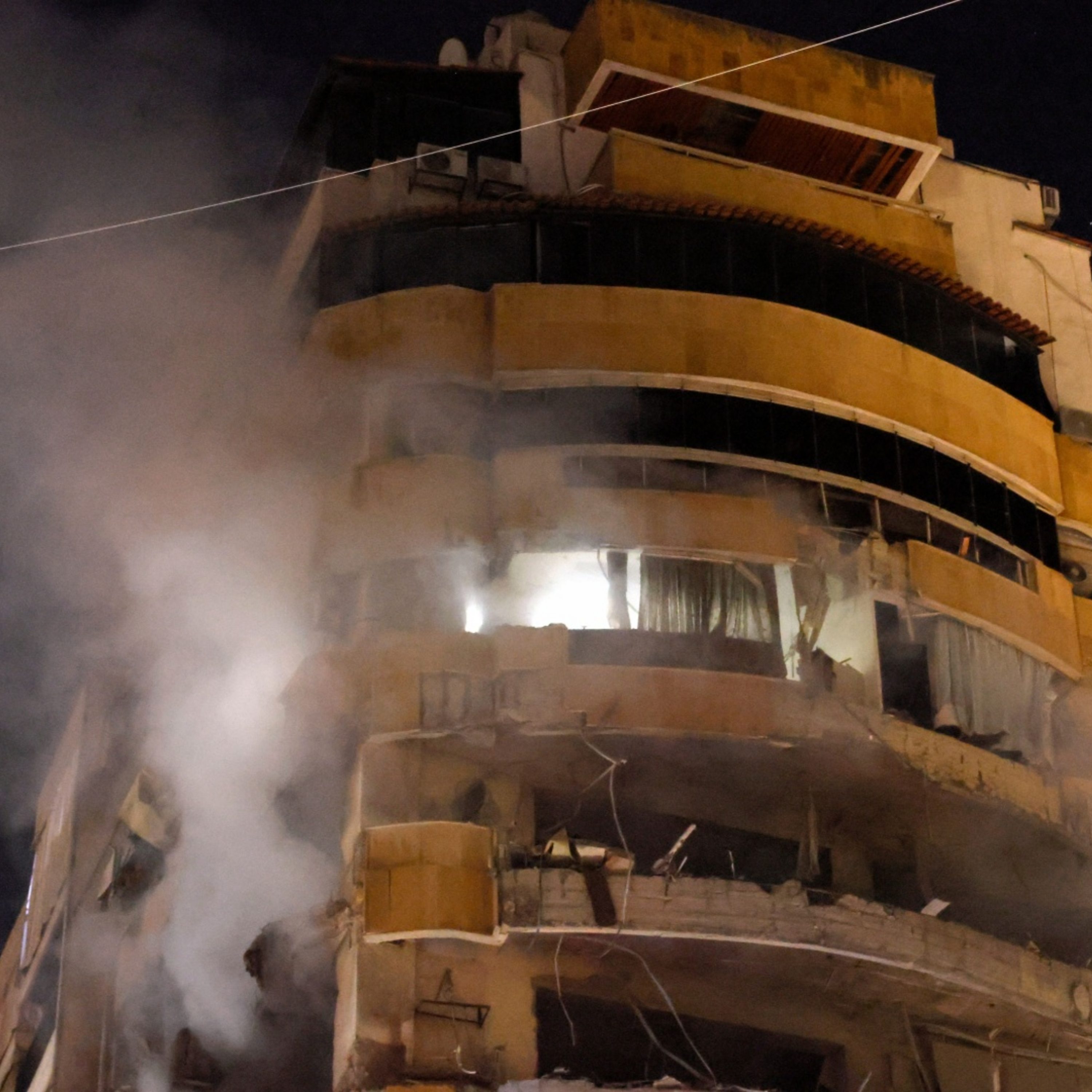
Israel has launched a series of deadly strikes in central Beirut and ordered mass evacuations in southern Lebanon, as it ramps up its air and ground offensive against the Iran-backed group Hezbollah. About a million people are estimated to have been forced from their homes in Lebanon since war resumed two weeks ago. The BBC speaks to citizens in a Lebanese border town who have refused to evacuate, as the offensive fuels fears of a prolonged occupation.
Also: Iran vows to avenge the death of its security chief, Ali Larijani, who was killed in an Israeli strike. We hear from people in Iran, living in fear of both US-Israeli strikes and the Islamic regime. Senegal's AFCON victory is handed to Morocco after a review of the football team's behaviour in January's final. A US judge has ordered the Trump administration reinstate the jobs of more than a thousand employees of Voice of America and allow the government-funded outlet to resume global broadcasting. We look back at the life of Shigeaki Mori, a prominent survivor of the Hiroshima atomic bomb. Sri Lanka introduces a four day work week amid fuel shortages. And just how lonely are sharks - researchers say bull sharks in Fiji have "best friends".
The Global News Podcast brings you the breaking news you need to hear, as it happens. Listen for the latest headlines and current affairs from around the world. Politics, economics, climate, business, technology, health – we cover it all with expert analysis and insight. Get the news that matters, delivered twice a day on weekdays and daily at weekends, plus special bonus episodes reacting to urgent breaking stories. Follow or subscribe now and never miss a moment. Get in touch: [email protected]
Get every episode summarized
Each time Global News Podcast publishes, we email you a written briefing from the transcript — the topics, who appeared, and any specific claims, with the ad reads skipped.
Email me new episodesFree for 3 shows. No card needed.
Hosts & guests

Transcript ready
283 searchable segments. Every word is indexed and playable.
Full transcript
Global News Podcast — Deadly Israeli strikes hit central Beirut. Machine-transcribed; use the interactive transcript above to jump the player to any line.
Hello, I'm Ankara Desai and in the early hours of Wednesday the 18th of March, these are our main stories. Israel strikes Central Beirut as it escalates its war against Hezbollah across Lebanon. Iran vows to avenge the death of its powerful security chief Ali Larijani who was killed in an Israeli strike. El Surin Fubil Senegal have been stripped of their Africa Cup of Nations title in favor of Morocco after a review of their players conduct in the final. Also in this podcast we look back on the life of a Japanese survivor of the Hiroshima atomic bombing Shigayaki Mori who died at the age of 88 and we dive into the world of the animals who were known to have a tough reputation but who are much better at making friends than first thought. The late Sharks had much higher social connectivity and either younger individuals or the kind of older adults. We explore the social networks of Sharks.
We begin this podcast with a look at one of the countries worst affected by the US Israel war with Iran. In Lebanon more than one million people have been displaced as Israel shows no sign of letting up in its military campaign against the Iran-backed militia group Hezbollah. The local officials say two Israeli strikes on central Beirut overnight have killed at least six people with dozens injured. The Lebanese government says around 900 people have now been killed in Israel's military campaign against Hezbollah. More than 100,000 are thought to be staying in temporary shelters. Jeremy Conjuk is president of the humanitarian organization Refugees International. He says the situation is becoming critical. It has gotten catastrophically bad very very fast. To put that million people in context that's about one and every six people in Lebanon. It's the equivalent of tens of millions of people in the United States being displaced in the course
of a few weeks. Many of them are fleeing mandatory evacuation orders imposed by the Israeli military. The implicit threat there is if you don't evacuate these areas we will consider you a target. That is not lawful under the laws of war. You can't just designate an area for widespread indiscriminate attack but that's the clear implication. And we've seen this in Gaza. We're seeing the sorts of tactics now being applied to Lebanon that the idea of applied in Gaza. And in fact some senior Israeli military officials have been drawing that explicit parallel talking about doing to Lebanon what they did two parts of Gaza. In Lebanon right now there are about a million Syrian and Palestinian refugees who are dependent on the UN for their services. The USS Cutoff funding to those entities. So those refugees are not able to get the kind of healthcare and treatment if they are injured in a bombing. Where do they go to get treatment? They are not supported by the Lebanese national health system. Food, medical treatment, all the sort of things that we rely on shelter. None of that is where it needs to be. And I think the world already is very stretched.
If we see a massive new wave of displacement come out of the Iran war there's simply no capacity to handle that right now. Israel says it strikes targets that a link to Hezbollah in response to rocket fire towards Israel and issues evacuation orders ahead of any military action. And those orders have now been extended to vast ways of southern Lebanon including the city of Teir where we're a Davis has sent this report where he spoke to residents who are refusing to leave. This is Teir in southern Lebanon normally a thriving Mediterranean port city where fishing and tourism are key industries. But it's only 10 miles or 19 kilometers from the Israeli border. It has been targeted repeatedly in this conflict and thousands of people have already left. It used to be really crowded in this neighborhood. A lot of families lived here.
Well that's Nefe Adib she's walking alone on these deserted streets in Teir. She says she can't afford to leave despite the bomb damage everywhere because of the cost of leaving and also she's responsible for nine people. My neighbor's house got hit while the family was having a food. The shrapnel then hit my house but I have nowhere else to go. I don't have enough money for rent. I have to fix my house. My parents are in their 90s. My husband is disabled. My grandchildren are young. I'm obligated to stay here. I've been also speaking to a baker who lives around the corner from this bombsite. His business is also badly damaged. But again he's got no options. He can't leave. His business is here. He said his family elsewhere for safety but he's really angry that the fight has been brought here. I won't leave. How do I leave? I never left my home from 1978 until now. I've never left.
I'm against war but Israel is hitting civilians. If they want to have a war with his wallah, have a war with his wallah? Why target civilians? Well here in Tehr which is the biggest city in southern Lebanon, Israel has been bombing quite intensively, specifically against his wallah's business targets. This is a branch of the Corvd al-Hasan bank which Israel accuses his Hezbollah of using to fund terror activities. But George's business was next door. He sells water. He's had to send his family further north but he says he's remaining here because he needs to keep his business running. No there is no safety here. The door is and the window door is bombed and I'm working. I have family. I want to leave in peace. The George is trying to keep his business going, filling up his truck with water bottles but one thing he's having to do is remove the roof from his van and the direct orders from the
Israelis. Obviously the implication is there that anybody with a roof on their van, the Israelis turn at once inside and it could be a target for an Israeli air strike. Are you going to stay here? I have to work here because nobody helped me in money. So I'm working to save money, to give it to my family. And you will stay here even if I'm here, I don't move. Only if they said they want to destroy this, they will warn us so I have to go. But I hope there is no war anymore. A tear is known for being one of the commercial hubs of southern Lebanon. These streets apart from the odd moped and the odd person trying to shop in the corner shop is completely empty. Obviously thousands of people have left it but the long-term impact on the economy of tear and the rest of Lebanon is difficult to assess. We're a Davies reporting. Iran and its militia allies meanwhile have carried out a series of air strikes which they say are in revenge
for the death of one of the Islamic regime's most powerful figures, the security chief Ali Ladijani. I was after the Israelis had announced his death in a targeted strike. Iranian state confirmed the killing. The Iranian army chief Amir Hatami has threatened Israel and the US with a decisive response. The Israeli authorities said two people were killed on the outskirts of Tel Aviv after being hit by shrapnel from an Iranian missile. And Gulf states including Qatar and Kuwait said they intercepted the latest barrage of Iranian missiles with his assessment of what Ali Ladijani's death means for Iran's leadership. Here's our international editor Jeremy Bowen. This is part of Israel's mission. It's very clearly explicitly stated war aim to try to destroy the regime of the Islamic Republic of Iran by wiping out its leadership as well as its military capacity. Now what kind of man was Mr. Ladijani? Well he has effectively been the guy who's been
running the war. So very central figure. The center of the regime for 40 years. He's been there his brothers or also a senior people seen as a pragmatist over the years but a regime insider with the clout if eventually a deal was put on the table to end the war. The clout perhaps to make that sort of deal. Now if he's replaced by somebody who's much more of a hard line and maybe someone from inside the IOGC then he might be rather less pragmatic and want to fight it out to the end. So look let's quick look at where we are at the moment. Donald Trump's anger at his allies is palpable harsh words about NATO. It shows the bind that he's in. Does he declare victory? Can he declare victory and go home? Hard politically. Does he escalate? Talk of going for the Iran in all facilities on Carg Island. That brings its own dangers of Iran hitting back at Gulf Arab oil
installations at Arabia, the United Arab Emirates. So for Donald Trump no easy options, no good ones and if anything the indicators are pointing to more escalation coming from his side. Jeremy Bowen. As we record this podcast attacks on Iran have been continuing with the US military saying it struck sights along Iran's coastline near the straits of Hormuz. In Iran itself, human rights groups estimate that more than 1300 civilians have been killed in the country since the war began. No independent reporting is allowed from within Iran but the BBC has been able to obtain interviews giving an insight into the experiences of people living through the conflict. Fego Keen reports. The barking dogs are the first warning of approaching aircraft than the ominous percussion of bombing. But what it like to live in the wartime city? We've heard
from two residents who've given frank accounts. Those who speak out risk, arrest, torture and possibly execution. We've changed names and voices to protect their identities. Iran, a business woman spoke of her experience. Do you know what the difference is between our sky and the sky of the rest of the world? They sleep under the stars at night and we sleep under rockets. Both skies give light but different kinds of light. I fear for my tomorrow. Today I survive somehow. But how will I get through tomorrow? Will I even live tomorrow? The official narrative portrays a defiant and united people. But away from the choreographed demonstrations in the quiet of people's homes, there is another reality. Ali is a young man who seen the streets near his home fill with armed security. People he accuses of stealing the city he
loves. Ali opposes the government, but the war has created conflicting emotions. Now, after almost two weeks, when I see my relatives, I see both hope and fear for the future. Fear that the skies of your country are controlled by enemy forces. But at the same time, there is always a hope in people's hearts. It's not that we're supporting America or Israel, but hoping simply that for one moment something might happen that ends the current Iranian regime. The citizens of the 6,000-year-old city live in fear, fear of bombs and of the regime and its torturers. For many, Tehran has become a trap from which there's no easy or immediate prospect of escape. Fergokin reporting. And we have more and more the security chiefs death and who's now in charge on our YouTube channel. Search for BBC News on YouTube and you'll find Global News podcast in the podcast section. This is a new story available every weekday. Now, let's take you back to
January. After some wild parties on the streets of Dakar, we're talking dancing, flares and a lot of football shirts being waived overheads after Senegal won the Africa Cup of Nations. Except now the result has been overturned. The host of that tournament, Morocco, who Senegal beat in the final two months ago, have been awarded the title. Because at one point, Senegal left the pitch in a remarkable protest over a penalty decision. BBC Sports John Bennett was commentating on the game in the stadium and told me more. It was one of the most astonishing matches I've ever seen, one of the most astonishing finals in major tournament history. So the drama started when Senegal had a goal disallowed near the end of the game. Then in injury time, Morocco get a corner. There's contact between a Senegal defender and Morocco's star player, Brahim Diaz in the penalty area. The referee doesn't give a penalty, but eventually he goes over to the screen, the VAR screen on the side of
the pitch. And he gives a penalty. Then there's chaos and Senegal fans try to get onto the pitch. And this is the key bit. The Senegal manager tells his players to leave the field in protest. And they leave the field for around 16 minutes. Eventually, thanks to Senegal's legendary player, Sadia Manay, he convinces them to come back onto the pitch. Morocco have this penalty. Brahim Diaz takes it. It's an awful penalty. Chips it basically to the Senegal keeper, awful penalty. And then the game goes to extra time. Senegal win it with a brilliant goal. They are African champions, but now that has all changed. It's all been overturned. And suddenly, Morocco, a couple of months later, have been declared African champions. It seems pretty unprecedented. Have you ever heard of anything quite like this in world football and learn African football? It is astonishing, because 10 days after the final, there was a ruling from the Confederation of African Football, their disciplinary body. There were fines worth more than $1 million handed out to both
teams. Combined, that is $1 million. And several players were punished. But Morocco appealed, because they felt they'd been unfairly treated. And that appeals board has now overturned the result. They declared a 3-0 win for Morocco. And it all comes down to the rule book. If you go into the rule book, it states that if a team refuses to play or leaves the field before the end of regulation time, without the referees permission, they'll be considered the loser and eliminated from the competition. So Morocco have pointed to the rule book here, and the appeals board have backed them up and awarded Morocco the victory. This isn't a great look for the competition, isn't a great look for the continent really. Could we see some serious fractures when it comes to Afconner? That is a great question. You think about the World Cup coming up, which Senegal and Morocco are both taking part in. You think about when the next Africa Cup of Nations will be, what if these two teams meet? It really is an unprecedented situation. There will be fury from the Senegalese football authorities about this. And of course, relief from the Morocco authorities. They've
released a statement that the Moroccan Football Federation, they say they wish to recall that its approach has never been to challenge the sporting performance of the teams involved in this competition, but solely to request the application of the competition's regulations. So again, they point to the rule book and they say the rule book wasn't followed properly, and now they say two months later it has been followed properly. John Bennett reporting and Senegal's Football Association now say they will appeal what they consider an unjust Afcon ruling. So it's a calm in this podcast. I'm here from 4.30 in the morning. I don't know whether the children have eaten in the morning or not. The amount of fuel isn't enough. At least with this, there is some control. As the ripple effect of the conflict in the mid-least is felt around the world, we're in Sri Lanka, which is put in a four-day working week to try to save fuel.
You're listening to the Global News Podcast. Voice of America was set up by the U.S. during the Second World War to counter Nazi propaganda and went on to become a global outlet for impartial news. But it was pulled off the air a year ago when the Trump administration targeted the federally funded broadcaster accusing it of being radical. Now a U.S. judge has ordered the government to allow VOA to resume broadcasting and to reinstate the jobs of more than a thousand journalists. On North America correspondent Peter Boes told me about the U-turn. Donald Trump has been a long-time critic of Voice of America. He was particularly critical of what in effect was an editorial firewall at the service that prevented the U.S. government from intervening in its coverage. It's editorial coverage. Last year he appointed Carrie Lake, who's a former television news presenter and an unsuccessful Senate candidate at the last election from Arizona. She was appointed to run the agency which operates Voice of America,
and she implemented some pretty widespread cuts that in effect took the service off the air. And as you say more than a thousand people put on paid leave, three of those employees filed a lawsuit seeking to reverse her decisions. And then 10 days ago a judge ruled that she had been unlawfully appointed by Donald Trump that she was never nominated by the president for the position she wasn't confirmed by the Senate as the court implies she should have been. Now in the last few hours the judges ordered that the employees be brought back to work and that they put a plan in place by next week to resume the service's international broadcasts. What could be the possible reaction to this another possible appeal from the other side? And what does this say about the state of press freedom in the states right now? Well reaction from those employees who took the legal action they have in fact released a statement saying that they're they're welcoming the judges ruling, they're eager to begin,
they say repairing the damage Carrie Lake has inflicted on the agency and their colleagues and they want to return to as they put it their congressional mandate and to rebuild the trust of the global audience that they say they've been unable to serve for the past year. In terms of a government response that Trump administration has already said that it plans to appeal the judges previous ruling that Carrie Lake's appointment was unlawful. Peter Bose, the surge in all prices and the wider disruption to global trade caused by the US Israel war with Iran is being felt far beyond the Middle East. Asia has been hit hard and many countries have introduced belt tightening measures to conserve fuel. For example, Thailand has cracked down on the use of air conditioning and elevators in offices. Bangladesh has brought forward Ramadan holidays at universities and people in Myanmar can now only drive on alternate days depending on their license plate number. Sri Lanka has become the latest country to introduce a
four-day work week starting today and that received a mix reviews from these tuk-tuk drivers who've been queuing for hours at a petrol station. I'm here from 4.30 in the morning. I don't know whether the children have eaten in the morning or not. They wouldn't have been able to go to school today. What's the solution? The amount of fuel isn't enough, but at least with this there is some control, so that is a good thing. Ahelan Gathergama is an economist at Sri Lanka's University of Jaffna. He told us more about the government's response. Sri Lanka is facing fuel shortages. We just introduced a QR code in other words rationing petrol and diesel for all vehicles and soon after the government has announced that every Wednesday will be a public holiday for state employees, for schools and universities and they've also recommended that the private sector also follows suit. If you look at Sri Lanka's economy, our biggest import cost is fuel and two big foreign
exchange earners, one is tourism and the other is foreign remittances and mainly of people working in the Middle East, over a million people out of our 22 million population work in the Middle East. So we're also going to be short of foreign exchange and the tourism sector is already being affected with all the cancellation of flights. It's affecting us on all fronts, so there's also a lot of anxiety among the people because Sri Lanka has gone through a repeated crisis, the COVID-19 crisis, then a major economic crisis from which we haven't recovered and just last November one of the worst cyclones hits Sri Lanka and now the fuel crisis. So our labor has already been disrupted, but in another sense it's also true that Sri Lanka, if you look at our labor laws, people are expected to work anywhere between 40 to 48 hours a week and this might be one way in which
the regularity of work might be reduced and it might be something that perhaps even stays into the future. Dr Ahilan Kairagama, 10 years ago, the world witnessed an emotional moment when on a trip to Japan, Barack Obama embraced a survivor of the Hiroshima atomic bombing, Shingayaki Mori. It was a point and a reminder of the devastation and suffering caused by nuclear weapons. Mr Mori, who's now died at the age of 88, spent many years working towards reconciliation between Japan and the United States. Daniel Mann looks back at his life. On the 6th of August 1945, the world was changed forever in a single blinding flash when America dropped the atomic bomb on Hiroshima to force the surrender of Japan and bring an end to the Second World War. It's estimated that between 60 and 80,000 people were killed instantly. Radiation poisoning killed tens of thousands more in the months afterwards. But Shigayaki Mori, who was eight at the time, survived. The blast threw him into a river. He remembered that when a
badly wounded woman asked him where she could find a hospital, he ran away. I was still a child with no power to help. And a documentary film, this is what he said of that day. I was inside the mushroom cloud. I remember this most vividly. It was pitch black. Gradually, the pitch black that surrounded me started clearing. And I was able to see all around. That was the moment the full horror of the ravages of war hit me. Shigayaki Mori recounted similar memories just before meeting Barack Obama in 2016. The survivor cried as he was held by the first serving president of the United States to visit Hiroshima. It was an historic gesture accompanied by this message from President Obama. We're not bound by genetic code to repeat the mistakes of the past. We can learn. We can choose. We can tell our children a different story.
One that describes a common humanity. One that makes war less likely. Thanks to Shigayaki Mori, the names of 12 US prisoners of war who were being held in Hiroshima when the bomb was dropped, are commemorated on a plaque in the city. Some people in Japan considered the atomic bombings of Hiroshima and Nagasaki a war crime. Shigayaki Mori wanted to show there was no hatred of America. He told the BBC that his reconciliation work had been lonely. But on the seventh anniversary of the attacks, he said that everybody talks about peace, but doing this is what peace is about. Daniel Mann with that report. It can be easier to imagine some animals having friends more than others, and sharks traditionally have been thought of as loners. But a new study into ball sharks suggests that might not be the case, and in fact, they have rich and complex social lives. Researchers analyzed six years of underwater observations from the shark reef marine reserve in Fiji. Although this is a protected area where the animals are hand-fed during dives,
they're confident it'll give us an insight into what happens in the wild. One of the authors, Dr. David Jacobi from Lancaster University, spoke to my colleague, Leylenathu. This study capitalized on nearly 150 hours of underwater footage and observation, tracking social lives about 184 sharks. It showed that they had these active social preferences, and that sex was really important in predicting these associations, but also at a much finer scale, size was also crucial in determining the outcomes of social interactions. When sharks met with one another, how they might engage and communicate with one another. There also that males had much more social connections than females as well, which is another surprising finding. I think what was really interesting about this particularly was the longevity of the data. So over six years, tracking social lives and looking at how they developed through time was really interesting. What we found was that the middle-aged sharks had much higher social
connectivity than either the younger individuals or the older adults, which I guess mirrors perhaps something we see in our own societies where we're in our social prime around middle-aged, perhaps. Is it wrong for us to think about sharks as solitary creatures? Do they spend their time in groups normally? Well, we don't know. This is what's so exciting about this study, because once they move offshore, we have very little idea quite often of how they're engaging with each other. There's a few tracking studies, but it's very difficult to get data back animals that range very widely. So it's interesting to have a site that is one of the world's longest running eco-toys and dive sites in the world, and to be able to spend time watching very closely what's going on in the lead-off at Natasha and Marosi has spent countless hours underwater watching these individuals, and she knows them all like the back of her hand, so it's been really insightful. Dr David Jackaby speaking to Leylyn Athoo.
And that's all from us for now. If you want to get in touch, you can email us at globalpodcast at BBC.co.uk, and you can also find us on X at BBC World Service, use the hashtag globalnewspod. And don't forget our sister podcast. It's called the global story, which goes in depth and beyond the headlines on one big story. This edition of the globalnewspodcast was mixed by Rebecca Miller, and the producers were Muzaffa Shakir and Stephanie Zakreson. The editor is Karen Martin, and I'm on good aside. Until next time, goodbye.
More episodes
More from Global News Podcast

AI scientist quits Anthropic over risk to humanity
Global News Podcast

Israel hits back at sanctions on settlers
Global News Podcast

UK sanctions Israeli settlements in occupied West Bank
Global News Podcast

West Bank parents fear after settler attacks on school
Global News Podcast