About this episode
1 in 36 children in the US have Autism Spectrum Disorder, but did you know that 20-30% have a known genetic cause for their condition? Read more about how, for the first time, parents can use Orchid’s whole genome sequencing to screen their embryos for these genetic variations, and mitigate their baby’s risk of disease. Check them out at orchidhealth.com, and use code RAZIB when signing up to skip the waitlist.
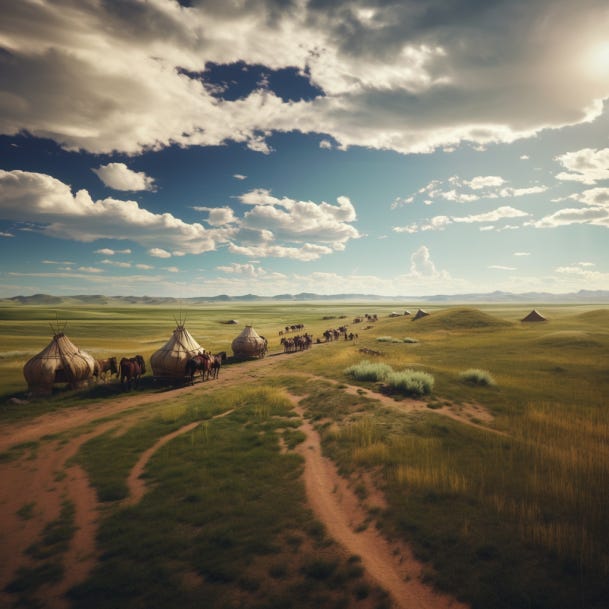
Today, Razib revisits The Horse, the Wheel, and Language with David Anthony, emeritus professor at Hartwick College and collaborator with David Reich’s ancient DNA research group at Harvard University. Anthony and Razib survey the last two years in terms of questions regarding the domestication of the horse, the spread of the wheel, and Yamnaya steppe herders' language; subjects of his 2007 book. They also discuss the exponential growth in our understanding of the paleodemography of Bronze Age Eurasian nomads since 2015’s publication of Massive migration from the steppe was a source for Indo-European languages in Europe, a study for which Anthony provided many of the samples.
Razib asks Anthony how his understanding of the rise of Indo-Europeans has or has not changed, in the wake of new data and novel interpretations over the last two years. Anthony reiterates the broad outlines he has been proposing for decades: the Yamnaya nomads of the Bronze-Age Eurasian steppe were the proto-Indo-Europeans, full stop. He also addresses those who argue for the Corded Ware culture of East-Central Europe being considered a sister, as opposed to a daughter, culture of the Yamnaya. Anthony points out that analysts in Reich’s group have discovered individuals who are apparent relatives between the Yamnaya and Corded Ware, indicative of a close and tight bond. Like the Danish archaeologist Kristian Kristiansen, Anthony believes that the pastoralist people who invaded Northern Europe 5,000 years ago should be thought of as fundamentally Yamnaya. He also addresses those skeptical of Yamnaya origins, positing perhaps some discomfort with the idea that modern people descend from warlike nomadic groups.
Finally, Razib presses Anthony about new theories regarding more detailed structure of early Indo-European migrations. Does he accept the contention that most Indo-European groups descend from the Corded Ware, while Armenians, Greeks, Tocharians and Illyrians descend from the Yamnaya directly? What more elements to the narrative are going to be added beyond the broad assertion that the Yamnaya were the proto-Indo-Europeans?
Related podcasts: David Anthony: the origin of Indo-Europeans, Thomas Olander: the origin and spread of Indo-European languages, James P. Mallory: finding the Indo-Europeans and Kristian Kristiansen: the birth of Northern Europe.
Selected publications:
* The genetic history of the Southern Arc: A bridge between West Asia and Europe
* Population genomics of bronze age Eurasia
* Massive migration from the steppe was a source for Indo-European languages in Europe
* The origins and spread of domestic horses from the Western Eurasian steppes
* Language trees with sampled ancestors support a hybrid model for the origin of Indo-European languages
Get every episode summarized
Each time Razib Khan's Unsupervised Learning publishes, we email you a written briefing from the transcript — the topics, who appeared, and any specific claims, with the ad reads skipped.
Email me new episodesFree for 3 shows. No card needed.
Hosts & guests

No transcript yet
This episode has not been transcribed. Request it and it moves to the front of the queue.
More episodes
More from Razib Khan's Unsupervised Learning

Kyle Orton: Muslims before Islam
Razib Khan's Unsupervised Learning

Gabriel Rossman: the late marvelous Dr. Arday and the state of sociology
Razib Khan's Unsupervised Learning

Monologue: Jason Arday, Nathan Cofnas and the wages of DEI
Razib Khan's Unsupervised Learning

Nikolai Yakovenko: the wages of the Hugging Face hack
Razib Khan's Unsupervised Learning