Loading...
About this Episode
TGS and Lingthusiasm join forces to think through all the things that can go wrong when you give a grifter too much power over indigenous languages.
Guest
Our guest Lauren Gawne is an Associate Professor of Linguistics at La Trobe University and the co-host of Lingthusiasm. Follow Lingthusiasm on Bluesky and Instagram, or join their Patreon.
Sensitive Themes & Topics
Genocide, racism and racial violence
Credits
- Host & Executive Producer: Claire E. Aubin. Find her on Twitter @ceaubin and Bluesky ceaubin, or check out her website.
- Editor: Julia Schifini. Check out her website.
- Music: Marshall Dean Williams
- Multitude: multitude.productions
Want double the episodes, all ad-free, and other exclusive perks? Join the TGS Patreon.
Shop our bookshelf - The Hater’s Library - here.
Find Us Online
- Website: thisguysucked.com
- Instagram: instagram.com/thisguysucked
- Bluesky: @thisguysucked.com
- Twitter: twitter.com/thisguysucked
Want to become a sponsor of This Guy Sucked? Head over to https://multitude.productions/ads
See Privacy Policy at https://art19.com/privacy and California Privacy Notice at https://art19.com/privacy#do-not-sell-my-info.
Hosts & Guests
Transcript
A list of sensitive themes and topics included in this episode can be found in the episode description.
Welcome to this guy sucked, the show where we prove that it's never too late to have haters
and you can't libel the dead. I'm your host Dr. Claire Aubin and I'm a historian, writer,
and most importantly, certified hater. On this show, we talk about people from throughout history with legacies that need a little updating.
Whether it's because of their politics, their behavior, or their impact on society and culture, these guys actually kind of sucked.
And we bring in a new scholar every week to tell us why. But today, we are here to do a super special mashup collaborative episode thing.
Yeah, who are you? What are we doing? Hi, Claire. My name is Lauren. I am a co-host of Lingthusiasm, a podcast that is enthusiastic about linguistics.
This is really fun for me because normally we just do yay enthusiasm and like hating is a new vibe for me. So let's see how it goes.
Yeah, I mean, I think we try to be enthusiastic about the hating a little bit in the sense that like we're doing it for justice, right?
Like the goal is we're not just being mean. We're doing it to try to rewrite someone's history back into the historical narrative or to try to sort of be clear about harms that are caused by people that we in some way or another hold up as good or useful or important.
We'll just like to make sure that the record is balanced.
As long as it's pedagogically informed and academically rigorous hating, it sounds great. It sure is. And the way I do that is by having other people who are experts on to tell me the stuff.
Before we started, we wanted to make some acknowledgments, though, and I'll let you take this away.
Thanks, Claire. I want to acknowledge that this recording is taking place for me on the lands of the Rundrie people of the Kulin nation.
Those lands were never seated and the Kulin peoples live across the area that we now know as Melbourne and it's out of surrounds today.
I want to pay my respects to any indigenous people listening to be completely honest, you can look at the content notes for this episode.
It's going to involve a lot of like colonizer bullshit. So just as a heads up on that, my acknowledgement to any other indigenous people who have been subjected to colonization who are listening to this episode as well, because man, these people are maniacs.
I do also want to let you know that like almost all of the story has nothing to do with Melbourne or Victoria or Kulin country.
A lot of what we're talking about today has taken place in Western Australia and a lot in South Australia and the Northern Territory.
And that's important because Australia is incredibly diverse in terms of indigenous peoples and their cultures and their languages.
It is the longest continuing culture in the world. We have records back to 60,000 years ago and at the time of settlers arriving and white people coming to Australia, there were over 400 distinct language groups.
So an incredibly diverse country. I'm going to be talking about a different part of it to where I'm from today.
And this is a very important thing. We don't always do things like land acknowledgments on the show, but it is a very important thing for particularly the person that we're talking about.
So there is a particular approach being taken here that we wanted to make sure we were like really thoughtful about from the jump so that you know that we're thinking about these things as we're making it.
I'm trying to be a little bit better at least on my show. I think you guys do this better than we do, but I'm trying to be better on TGS about being more open about the back end and how we approach and think about and formulate the show.
I think you guys do a really excellent job with that. And I encourage everyone listening to this if you want the opposite side of this coin and enthusiasm and really really thoughtful scholarship to go listen to the enthusiasm because they're really great.
And I'm very excited about this episode because I have been listening to Lauren's show and got you a show for a while. So it's really cool to get to do this.
Well, I'm really excited because doing this let me know about your show. And I've since been listening and I love academically informed content. I'm not a historian as you've correctly identified for me. I am a linguist and I'm not even a linguist who mostly works in Australia.
A lot of my research is either with English or other languages or a lot of my work has been with Tibetan languages in Nepal, which is a whole other historical and social context.
But this person I want to talk about today, should we get into it?
Yeah, please.
She's pretty wild. I came to her in there are some academics who just finish a PhD and wander straight into a research fellowship or a tenure track job.
Not me.
I can hear in your laughter, Claire, but that was not you.
I was working at a store.
It took me about a year, a year and a half to get my first research fellowship.
And in that year and a half, I've had these colleagues who kept trying to find work for me, but they were always these like, I've got 40 hours of research project here.
I've got one day as a research officer and I'm so grateful to all of those colleagues for keeping me employed and housed.
Shout out to them in this great period of uncertainty.
And one of these colleagues was Nick T. Berger at the University of Melbourne, who was like, I have this big project.
I've got these pages and pages of PDFs I've just scanned.
And I need as many people as I can to help me check that the scans look okay, that everything's there, that they're properly labeled and named.
And these are over 20,000 pages of handwritten manuscripts and 4,000 pages of typed word lists.
And these were all this massive survey of indigenous languages of western southern and central Australia that were collected in the early 1900s.
And they were collected by or kind of managed by this lady named Daisy Bates.
And it was just like, what is this project and what was this woman doing in the early 1900s?
This is an astonishing amount of data, all of these indigenous languages.
For some of these languages, that's the only record we have left of them.
And it was just astonishing. I'd never heard of Daisy Bates.
I didn't know this massive collection of data existed.
It had just sat in the National Library of Australia for years. People knew it was there.
But until Nick had this big project to digitize it in a project called digital Daisy Bates, it had just sat there.
Uh-huh. Probably should at this point say, if the name Daisy Bates rings a bell and you're American, we're talking about different daisies.
Oh yeah, to be clear, there are two Daisy Bates when you Google Daisy Bates.
We're not talking about the civil rights activist. We're not, she rocks.
Okay, because I was just like, I don't know if she sucks. I don't have time to go down that rabbit hole. She sings great.
Yeah, on this show, I think I'm happy to come out and say we're openly pro desegregation of Arkansas school.
In the mid-century American period, we like integration and we like Daisy Bates.
So good Daisy Bates.
But the one that we're talking about is not that one. That one was not moonlighting as an Irish Australian linguist.
Very busy Irish Australian linguist 50 years earlier. Yes.
Also, we haven't gotten there quite yet, but it's going to my previous thesis that I have engaged with a little bit on the show, which is that white people in Australia in the late 19th early 20th century were up to some stuff across the board.
We will talk a little bit about why the social context permitted in infecting courage, that kind of behavior.
I probably sound terrible now, because I'm just like this amazing collection.
Some of the only recorded information we have about some of these languages and some speakers.
She also spent 30 years living in the desert and living alongside, especially the Nungal community in the middle of South Australia,
literally giving them her own food, the clothes that she had.
At this point, I always feel like I'm kind of losing the plot a little bit where it's just like,
is this really a guy who sucks?
Just like coming on here to hate on Mother Teresa energy.
At one point when I was kind of preparing for this, because I did this work well over a decade ago now, and I was like, maybe she's not that bad.
Maybe I just made up that I thought she was terrible.
And then I went back and was like, no, no, it's fine. We can talk about her. She was pretty terrible.
I mean, I've got some crazy news for you, which is that Mother Teresa also kind of bad as it turns out.
Okay, great, great. I should have seen that coming.
Wild news. Everyone on this show turns out to be a little bit bad.
But this is part of it, actually. And so I'm glad that you brought that up early.
That part of it is like the contributions are why we know about people,
often the methods by which they make those contributions or the other people in their lives,
or the way they position themselves while making those contributions,
don't necessarily take away from the contributions themselves.
But they need to be added into the record when we think about how all of this knowledge is generated.
And who is at the center of its generation is actually quite important to understanding the story of that knowledge.
When we think about Daisy Bates, if people are not familiar with her,
which many people will be most Australians even.
I think she had a real moment in like the 1970s.
And since then, she's just being kind of for good reason, actually, just let me.
She was born in 1859 in Ireland.
The problem with detangling her history is that there's a lot of like, she was born Margaret Dwyer.
By the time she came to Australia, she was Daisy May or Dwyer.
Her Wikipedia page is a thing of beauty because it tells her story as she tells it.
And then down the bottom, there's a whole section of like where the bullshit is.
Yeah.
Thank you to the Wikipedia editor who did that.
I'm just going to tell a version of her story and not worry too much about the inconsistencies
because I used to think they were important that she was like such a liar.
And I actually don't think it's that important anymore.
I mean, it also kind of goes to something we talk about on the show a lot,
which is that part of the difficulty of understanding people's legacies
is that they engage in these myth-making practices while they're alive.
Oh, she was so good at that.
So part of the difficulty is the fact that their legacy is in part self-made.
Yeah.
So yeah, it's totally okay to be like, we're going to go with what we've got.
But who knows if it's real.
Yeah.
So at age 23 and like the 1880s, she lies and says she's 21.
So she can meet the criteria for this Irish people come to Australia for free
because they're trying to bring over all these working class white people
to create the white Australia that they think should be created.
She works in Queensland and New South Wales as a governance.
While she's there, she's like gets married three different times.
Sure.
Never divorces, which apparently was pretty common.
Like people would just get married again because divorce was so hard to come by.
Sure.
So she marries her first marriage.
And for Australians, this will be wild.
This is like the surprise crossover you did not expect.
In 1884, she marries break him a rant who is a kind of mythologized Australian hero poet
who actually did war crimes in the ball war and was one of the last Australians
to be executed by the British.
Sure.
Absolutely.
That guy sucks for sure.
Yeah.
But they got married briefly.
He didn't pay for the marriage license and like shirked off on her.
So that marriage ended.
And then in 1885, she marries Jack Bates, hence Daisy Bates.
At some point that marriage isn't going well because she like expected a lot of him.
And he was just a dude driving horses and driving cattle and would disappear.
Classic Australian stuff.
Just classic, classic Australian stuff.
At some point, they're like not really together and an old flame named on a sea bagel hole comes to Sydney.
Sorry.
And yeah, yeah, yeah, for real, his name is bagel hole.
For a long time, I was really distressed that that marriage didn't survive.
And it wasn't known as the bagel hole collection.
She could have been Daisy bagel hole.
She could have been Daisy bagel hole.
It appears that like he's a guy she knew from Ireland, maybe.
And he was in Sydney because he was working on the ships.
And they like kind of had a relationship for a while.
Daisy burnt all of her correspondence and all of her diaries shortly before her death.
So piecing all of this together and whether she felt like any of these marriages were like more real
or if she was just.
This was just the way one kind of led a more casually promiscuous life in the 1880s.
It's very hard to say.
But she was definitely a bigamist.
Trigamist, I guess.
Trigamist. Trigamist.
Polygamist.
Sure.
She's apparently like a very charming megaflow.
Yeah.
Everyone talks about her being very charismatic.
I think that charisma links through to her later life.
Yeah.
With Jack, she had a son.
She didn't seem that into being a mom apparently.
She had a baby.
And she's like, well, no one told me that was going to hurt.
And like moral sex for the rest of her life, according to her narrative.
Look, I'm saying I get it.
Yeah.
Yeah.
I have not given birth.
But I understand the implications of this.
And I get if that's what someone chooses to do afterwards.
Yeah.
If you don't have a hands up on that, like, golly golly, she didn't seem that into her son.
She like sent him off to boarding school and to live with her extended family.
Like, he doesn't appear at the story that much.
I think it's an oversimplification to just be like, she wasn't maternal.
There was something wrong with her.
But like, she really didn't seem to be into parenting.
In the 1890s, like, it in 94.
So like her son was like primary school age.
Her relationship wasn't working out.
She went to London.
She was like, I have to go home.
I'm feeling homesick.
And became a Fleet Street journalist for a while.
She was working on this like a newspaper about psychics and mediums.
And she's like, daughter fam.
Look, she and I agree on.
She doesn't seem to be super into the world.
Like, she seems like quite a rationalist.
Yeah.
But she gets this really great apprenticeship in journalism.
And writing for public audiences.
And then this is where the relationship between reality and not reality becomes a lot harder to pin down.
In 1899, she comes back to Australia.
She comes to Perth, which is on the west coast of Australia.
Saying that she has a commission from the times of London to write a story about how indigenous Australians are being ill-treated.
This does not appear to be true.
It's possible that she talks to someone at the time.
She said, sure, you can send a letter to the editor if you want.
And then by the time she got to Australia,
this has evolved into a full-blown story.
From here on out, she starts talking about Jack as her late husband.
He is not dead.
She's just like, sure.
I've mentally divorced him. He's dead to me.
I can't just uncoupling.
Isn't that what people were calling that for a little while?
The Gwyneth Posh.
Yeah.
It's like a very powerful manifestation of...
She's like, no.
He's my late husband.
Another tune to get mentioned again in her lifetime.
Wow.
In fact, it wasn't until, like, historians started looking in the 1970s that they put together the, like, break him around.
Story.
Ah, sorry.
She's very circumspect about her life unless it suits her story.
She's like a great self-publicist.
We're going to see that a lot for the rest of this.
Hello, everybody. It's Claire.
If you're hearing me, that means you're currently listening to the free version of our show.
Because we're trying to make accessible, engaging history independently and sustainably,
we switch off between free weeks and Patreon weeks.
So if you're a fan of public history made by actual experts, and it's in the budget for you, consider supporting our Patreon.
It's only one tier, which means everyone who subscribes gets access to the same perks across the board.
For the price of a pint of beer, you'll get access to a new episode every week instead of just the bi-weekly free ones,
and they'll all be ad-free for you.
You'll also get access to the full episode archive, bonus content, early access to merch,
and lots of other fun Patreon exclusives to sweeten the deal.
Just head over to patreon.com, slash this guy sucked, or follow the link in our episode description to sign up.
So what is the context of what Australia, what, like, settler and indigenous relationships,
what is this looking like at this moment when she comes back and is like, I'm here to do my, to write.
So in 1899, Australia is two years off becoming a federated Commonwealth,
where we still have the British head of state as our head of state.
And we have a governor general who likes acts for the king.
It's so cringe to even say it out.
I lived in New Zealand for a year, and I still do not understand what the deal is over there.
Technically, the king is not meant to interfere in the running of Australia,
but like there was some extreme bullshit in the 1970s,
where some dudes who sucked definitely had some royal interference in our government.
So we are a couple of years off being federated.
The West, a little bit like the US, I guess, where like the East Coast was,
the colonies were established there first, and then white occupation.
It didn't quite go across the country because across the country right in the middle,
there's like a great big bit known as the nullable, because there is null,
arbor, no trees.
It's just very hard to impose a western way of living on that part of Australia.
So there were some train lines that were built to get people east to west,
but in general, kind of sea travel was the way to get around the country.
They created a whole new legal illusion to allow white people to feel okay about occupying Australia.
So they invented this thing called Teranolius, where they're like,
there aren't people living here, and when everyone was like,
what about all those people living here?
They were like, they're not people, people,
because they're not doing the kind of agriculture or house building that we do.
So because they're different, they're not right.
And that would just allow us to take the land,
because by using it in like a good European way.
And that wasn't overturned as a legal framework until the second half of the 20th century,
like well into the 1980s.
Yeah.
If I'm thinking about my understanding of Teranolius,
it's a way of thinking that a land that is uncultivated in the concept of like western cultivation of land
is therefore unoccupied land.
And so it really relates or ties the relationship of peoples to their use of space.
And this is something we see repeatedly in history,
but it's a really immensely harmful thing,
because it enables you to say some people aren't people,
or like you've said, they're not people in the right way.
And you get this doctrine that allows people to be treated closer to animals,
or just features of a landscape which you are now trying to cultivate,
rather than human beings with rights and dignity and desires and agency.
Yeah.
And like the economic part of me wants to well actually them with like,
there are really great examples of very elaborate, like aquaculture.
Of course.
Like eel traps and Bruce Pasco has done a lot of work on like traditional grain farming
that doesn't look anything like western grain farming,
because they're very different grains.
But like it wasn't about proving that they were really occupying the land,
because that wasn't the point.
Yeah.
The point was to create this nonsense framework.
Yeah.
What happens when you push back against that is implicitly you are saying that there is something of worth
that you need to argue with to begin with, right?
To be like, well, they are actually occupying the land in the European way.
We don't need to acknowledge the argument in the first place.
Indigenous Australians weren't even counted as people.
Yeah.
Until 1967 when we had a referendum.
So they couldn't get passports.
They couldn't vote.
They couldn't do all the things that everyone else living in the country could.
And so when I say Daisy Bates was outraged about how they were being treated,
there was like this straight up abuse and neglect.
There were also a lot of Aboriginal people essentially in slavery adjacent conditions.
They were working for people where they wouldn't really be being paid.
So there were lots of really dire circumstances.
If not that she wanted them to be able to live rich and free lives,
is that she straight up thought and wrote in her book,
like this is a dying race and we are just being nice to them
while what she saw is the inevitable played out.
And so her work in the 1910s and the 1900s,
with it seems like the government was already sending out this survey for people
to collect words from different languages.
Like it was already being sent out to pastoralists and police stations.
But it seems like she was the one who collated it all and would often
say, this is the one bit that I find really relatable about her.
She'd get these surveys back and she's like, this person did a terrible job.
Like they're missing a whole bunch of words.
This is sloppy work.
And she'd like travel around Western Australia,
pinning people down, finishing the forms, collecting data for herself,
to build this really comprehensive.
I mean, relatively comprehensive.
It would actually just be better if we had let people continue to speak their languages.
But then again, the like self aggrandizing and the strong personal narrative
where she would talk about being able to speak over 100 different languages.
And it's just like, hi, I'm skeptical.
Yeah, I don't know about that.
Especially because part of this is she's sort of a self-styled anthropologist,
self-styled linguist person.
And it's not to say that one can't learn lots of things without like specific
extensive training.
In her defense anthropology didn't actually like super technically exist,
certainly in Australia.
And certainly not in a way that women were allowed into that academic community.
There's a really great book by Eleanor Hogan,
where she talks a little bit about the ethnomeneer of this era.
And it really ties into this like empire nonsense
where people were just trying to collect everything for the empire.
And that included people and their customs and their languages.
So she was really a person of her time.
The fact that it was a little bit odd that she was a woman.
Normally this was men doing this work.
After that time with the Western Australian government,
she moved to Udella, which no one's ever heard of it.
It's literally not a place anymore.
It was like a stop on the train line across from east to west.
And she lived there for over 16 years with the Anungu people
who kind of lived near the sightings because their way of life
had been completely disrupted by the train bringing Western practices,
bringing in Western foods that upset their natural ecology,
draining the water soak that was nearby.
So there wasn't fresh water that people could access easily.
And then you had this train that kind of brought these people through
for them to trade with.
And so by 1919, she's like, you know, 50s.
She's there until her 70s.
People start them like bringing her in for care and heading out.
She kind of leaves again and she never really settles down.
Well into her 80s.
Eleanor Hogan has this amazing book,
it's one of the more recent publications about Daisy Bates.
Where she looks at her relationship with a traveling journalist named Ernestine Hill
who seems pretty cool.
She was kind of traveling around in the 1930s.
She came to Udalla to talk to Daisy Bates
and kind of published a couple of articles about Daisy Bates' time
in the desert, in that community.
A thing she regrets is that she published the story
that Daisy Bates had about cannibalism among indigenous Australians,
which like, again, I kind of thought like,
oh, maybe she just said that one time.
But no, she like went on about it all the time.
Sure.
Which is not only unsubstantiated, but like seems pretty actively refuted
by evidence at the time.
Like this is why I think Daisy Bates sucks specifically
because lots of people weren't great.
But lots of people at the time were just like,
we don't think this is true.
There was very little evidence.
One time she like sent some bones to the South Australia Museum
and they're like, this is a cat.
We sent just cats like chill lady.
But this narrative of cannibal natives is like such a classic bullshit trope.
There's a really great book by Larissa Barrett,
who's a indigenous lawyer and scholar,
looking at this narrative of cannibalism
in a different context in Queensland.
But I think it's part of this recurring trope
of using it to make other cultures scarier and othering them.
Yeah, absolutely.
We have lots of examples of this actually, like particularly in spaces
where there's like rapid colonial expansion.
We see cannibalism being used.
For example, in our Christopher Columbus episode,
we talk about cannibalism as this trope
that's being used against people in the Americas.
And what's actually happening in these spaces
is more often we see much more intense violence
and things like torture coming from the colonizing side
against the indigenous people.
The things that they're being accused of doing more often
are closer to things that are being done to them in this moment.
And it's a way, I think you're totally right,
of othering people and saying, well,
they're doing something we find unconscionable
in order to distract from the fact that we are in fact
doing something unconscionable to them, right?
Yeah.
It's just like such a bingo con.
Yeah, I mean, it really is.
Also, everything you've said about Daisy Bates so far
reminds me of an episode that I highly recommend people listen to
actually in conjunction with this,
which was with Rian and Garth Jones
on late 19th, early 20th century orientalists
in places like Iran and Iraq,
where they're doing the same thing.
They're like, oh, we're paying attention to the art,
to the language.
We're translating their poetry
to show that they are this backwards place
and we're taking this
and we're sending it back to the imperial court.
We're sending it back to like the governments that we work for
or the journals that we work for
in these cases, the UK, at this point,
or Ireland, where we're sending this back there
in order to then justify actually
the actions that are being taken in these spaces,
these incredibly violent things that are happening there.
There's one of these women named Gertrude Bell in Iran
who's doing almost the same thing that Daisy Bates is doing,
which I find fascinating that they're both women
who are like, okay, well, I'm going to go far away from home
where I can be this thing that I couldn't necessarily be
back there and be a girl boss in the wild.
And Gertrude Bell, for example,
was doing the same thing in Iran,
where she's like, well, I live out in the desert
with these people
and I really understand their way of life.
And you're like...
And I think it's really important that they are women
for this narrative.
So she was given a most excellent order
of the British Empire as CBE in 1934
for this incredibly paternalistic,
but like it's the maternal spin of like this woman
in the desert looking after her.
She talks about her native.
Yes.
She's a term they got used at the time
that doesn't get used in Australia as much.
And like the thing I haven't stressed enough possibly
is whatever image you've had of her,
you have to...
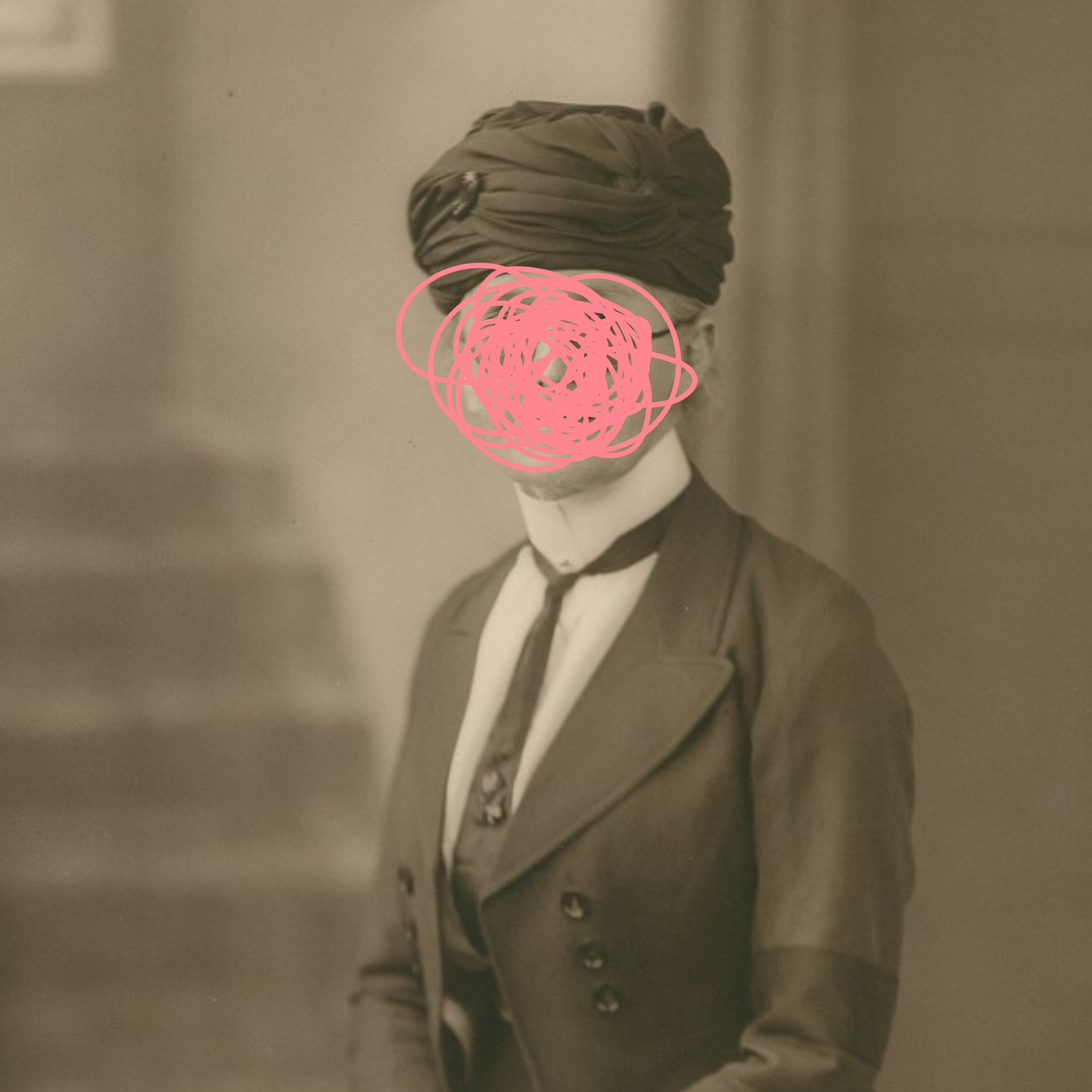
She's actually this like incredibly tiny woman
dressed as Mary Poppins.
Like she's in full Edwardian governess.
Gear and she never gives this up.
And I think like she really understood
the power of the personal brand
before celebrity was a thing.
And like clearly an incredibly strong
and resilient woman,
like out in incredibly hot,
arid conditions,
in full Edwardian border corset.
Like that was not comfortable.
But there was something really compelling
to two people about this woman
and this like tension between
this incredibly edge of civilization
as it was conceptualized place,
but while completely from another era
and completely refined and all this decorum.
And you're able to be photographed,
for example, in this case,
like around people who are dressed
for the environment that they're in
and be able to be like,
look at how civilized I am,
look at who I am,
especially this maternal feeling
that I have towards them,
not my own son,
but these people that I have.
And she talked about like just her presence
would be a civilizing influence.
Oh God.
Wow, what a mindset.
Yeah, for sure.
And I think that's visible
when you look into some of these things
in the research I did ahead of time.
I was thinking about this dying race thing
that you brought up earlier,
this idea that like her research
follows this narrative
that assumes these indigenous cultures
are sort of inevitably disappearing.
Like this is an inevitable disappearance.
And she's doing this like pastoral thing
to help them as they are in cultural hospice.
Right?
Where she's like,
the most I can do is catalog all of this
and look at how wonderful I am for doing that
and how much I love you for that.
Instead of being like,
ah, this is a living, evolving society
that I can help to thrive and grow
and you know, work against.
And we've just stuck a like giant stick
in the gears of this society.
Like we've completely ruptured it
and then we're surprised
that it's a ruptured society.
Wow.
You'd be like,
this thing's society is dying.
Who knows what killed that?
You know, which is just wild.
Like is a wild formulation for this.
In 1939, she publishes her book
called The Passing of the Aborigines.
Just in case you weren't entirely sure
that she thought this was a doomed society.
And not a word we're using that much anymore.
Am I right?
Because some of these things different across countries
and spaces, right?
I don't think we're using that word, right?
Aboriginal.
Aboriginal.
Yes.
Are pretty like different groups
have different preferences.
There's a bunch of sub preferences.
We also distinguished the Torres Strait Islands
right up the top of Queensland.
Some groups will prefer, like,
Kuri is a very New South Wales Victoria term.
We sometimes talk about First Nations.
I know that's a very North American way
of talking about things.
But no, Aborigines.
It has a real 1938 vibe to it.
It does.
Especially because it starts usually with the beforehand.
Anything we say like the race.
Yeah.
We have a lot of often.
It's just worth flagging.
Like she's a big fan of removing children
who had Aboriginal mother and a white father
from their family context.
A process that happened for many, many decades in Australia
and is a major intergenerational trauma
that we now refer to as the stolen generations.
Sure.
And she would like alert the authorities
to these children who she felt needed to be taken away
from their families.
I was going to ask what you meant by her
being like a fan or a proponent of this.
And I thought you were going to say like,
oh, she was like, no, she was like, let's call the police.
That's wild.
I'm sorry.
That's like so far beyond what I thought you were going to say.
I'm not laughing like, haha, I'm laughing like that's appalling.
Absolutely valid shock response to that behavior.
It has the vibe of being like, ah, there's someone in the attic.
Let's call the Gestapo.
And I study Nazi.
So that's like where my brain is immediately going.
But like, this is a type of a person, right?
Who like thinks they're doing something for a good reason
but the thing they're doing is just abjectly terrible
and pretty much anyone can see that.
Also, just another sub thread of why this guy sucks
is Eleanor Hogan's book is all about this relationship
between Daisy Bates and Ernestine Hill,
who wrote those initial articles with her.
Daisy Bates had been publishing a newspapers
that's how she had supported herself
while living in Udella and all these other remote places.
Her prose was becoming increasingly not of the era.
She was this like 75 year old Victorian lady.
And so Ernestine wrote those couple of articles with her.
And then essentially co-wrote the book with her,
which started as a series of newspaper articles,
became the whole book.
And Daisy Bates just gives her no credit.
She refers to her briefly at some point as her typist.
The academic, the scholar in me is even,
I don't like this woman at all.
I already know.
No, but she just had this like absolute sense of self-importance.
Yeah.
And like Ernestine Hill, very famous in Australia
in the early 20th century for her prose.
And like, it is horrific book in terms of content.
But there's like quite a bit that's quite well written.
It is very engaging and it's rollicking.
And he was like, oh, that does.
That makes complete sense.
Like that explains why that book was so well regarded.
It was considered a bestseller.
It was continuous.
Like pretty much basically in print until the mid 1970s.
My copy is from a reprint in 1966.
And she not only responded to,
but actively fed in the public imagination,
this narrative that still absolutely harms Australia's
understanding of itself until today.
And I think, like, I haven't really thought about Daisy
in the decade or so since I last did a little bit of work on her.
And as I said, I don't necessarily research in Australia.
But now that I work in Australia and I teach in Australia
and for me, returning to this story
is part of an ongoing process I'm trying to engage in
in educating myself, doing better by my discipline
and by my students to understand the historical context
of Australia and drawing a line directly between
the kind of narratives Daisy Bates engaged in
and the kind of things that especially non-recent migrants
and non-indigenous Australians need to really unpack.
Like we still have massively high rates of Indigenous incarceration.
The stolen generations is considered historical,
but we still take a massive number of children
out of their family context into the foster home system every year.
That's still just perpetuating this kind of attitude towards
Indigenous Australians.
So I've been thinking about the best moment to bring this up.
And when you talked about her not properly crediting
one of her collaborators, I have a question about like linguistics
in general and how the field works in relation to her.
When I was doing research, I started to kind of feel
like the way that Daisy Bates is talking about people
who she is ostensibly working with or getting information from.
She's treating them like subjects and informants
rather than as collaborators in this project that she's working on.
Oh, absolutely.
It does the field now do a better job, do you think,
of crediting the people that you're learning from
as sort of collaborators in your learning?
Is that more normal?
Yeah, there's definitely a lot to reflect on in Daisy Bates work,
like not only in my understanding of like Australia's colonial history,
but also in like linguistic colonial history.
My summary would be that individuals are better at thinking about their relationship
with people that they're working with as a field.
I think we generally would love to see more
and try to encourage more people to work with their own languages
to like change that power relationship.
But institutionally, I think institutions are just so slow moving.
It's hard to always necessarily have that play out
in a more fully arranged form, if that makes sense.
So like, I think individuals are better at crediting,
making people visible, not always.
I had this project with colleagues where we looked at
the genre of descriptive grammar writing.
This is where you write about the full grammar of a language,
not just wordless like Daisy Bates did.
It's like even 10, 20 years ago, a shocking number of grammars were written
where it's like, I don't know the names of the people you spoke to.
And that feels like what?
That feels like a bit of a problem.
Like there were some grammars where we were like,
does it count that they talk about some people in the acknowledgments?
Uh-huh.
As like making visible the work those people did?
No.
This is so wild to me because like our fields are so different obviously.
Like in many different respects.
Yeah.
But you could not get away with that in history.
I like the whole thing is the source.
The whole thing in history is who is saying something.
I think the PhD grammars we looked at were doing better.
Uh-huh.
Like I think the genre moved so slowly
and the researchers are doing better.
The other thing that I think really has caused me to reflect a lot in this narrative
is that the field that I work in, which is documenting and describing languages,
we talk about it a lot as endangered language documentation.
And there's been this whole reckoning in the last,
kind of since I've been a graduate student.
So in the last 15 years,
there's been this reckoning with what does it mean when we're calling these languages endangered?
Because it is this encroachment of larger languages, you know,
English being the obvious global example.
But in China,
it's Mandarin in Nepal where I work.
It's Napali is the language of state education.
And so these languages are endangered.
The problem is that we have this incentive as academics trying to fund
the work that we're doing of talking up the endangerment and how
we never talk about what is endangering them.
Yeah, I was going to say that sounds like the passive voice to me, right?
Even imperiled is better than endangered in my mind.
Because it endangered to me is like the way we talk about species or something
where like some environmental change has just happened rather than this being
not a naturally occurring phenomenon and instead an utterly man-made one.
And so the economic and the social incentives,
if you're trying to do work that's important,
you still end up in this trap of talking about or exoticizing, you know,
this language.
And there's maybe an unfair stereotype of a bit of a like,
well, how many speakers does your language have?
My language.
Like the language I work with,
and you know, the my language is just like the same vibes as Daisy Bates as like my native.
I was going to say, yeah.
And so the really difficult thing about reading about Daisy Bates,
like just absolutely really problematic discourses,
but it's still discourses we are trying to unpack and step away from even today.
I've got my usual quick mid-episode shout out to tell you about
another multitude show I think you might enjoy listening to.
If you like history, which I assume you do because you're here,
that suggests you're the kind of person who's into bizarre and esoteric lore
about people doing inexplicable things for equally inexplicable reasons.
What if I told you there was a video game series that was basically just
many, many hours of that exact same thing,
which has been leaving people saying,
what the hell for the last 23 years?
What if I told you there was a podcast about that video game?
Simple and clean is a show where host Misha Stanton and Mayana Baron talk about
Kingdom Hearts, a little video game franchise about really big feelings.
Join them every week as they discuss the plot,
characters, world-building, music, fashion,
and societal impact of a thing that by all means probably shouldn't even exist.
Never heard of Kingdom Hearts? That's okay.
They're here to break it down for you, explain why they love it,
and hopefully to convince you that it deserves a place in your heart, too.
In each episode, Mayana and Misha attempt to unravel
how this deceptively expansive video game series has touched
an entire generation of deeply earnest weirdos like themselves,
and also me.
They put out new episodes every Sunday,
so go check out Simple and Clean wherever you listen to podcasts.
If there's anything this show proves again and again,
it's that some historical figures could probably have done
with a visit to a psychiatrist.
Lucky for you, talk-i-at-tree exists now.
If you've been stuck on a six-month waitlist for a psychiatrist
or are bouncing between online mental health sites
trying to find medication support,
talk-i-at-tree was built for you.
It's virtual psychiatry that actually fits your life and your insurance.
Talk-i-at-tree is a 100% online psychiatry practice
that provides comprehensive evaluations, diagnoses,
and ongoing medication management for conditions like anxiety, depression,
PTSD, insomnia, and more.
Unlike therapy-only apps, talk-i-at-tree is psychiatry.
That means you're seeing a medical provider
who can diagnose mental health conditions
and prescribe medication when it's appropriate.
All of their 600-plus clinicians are in network with major insurers
so you can use your existing insurance instead of paying monthly subscriptions
or out-of-network fees.
You'll meet with an experienced licensed psychiatrist
who takes the time to understand what's going on,
builds a personalized treatment plan,
and can prescribe medication when it's right for you.
Your care stays consistent and evidence-based.
More than 300,000 patients have already found
high-quality psychiatric care through talk-i-at-tree.
Head to talk-i-at-tree.com slash TGS
and complete the short assessment to get matched
with an in-network psychiatrist in just a few minutes.
That's talk-i-at-tree.com slash TGS to get matched in minutes.
There's so much here that I find fascinating
in that how well do you feel like Australia has reckoned
with this really awful path?
My feeling on America is bad.
Reckoning with this bad.
And so I am curious what your view on how Australia has dealt with this
and how this has helped to shape Australia's understanding of itself.
Like what your feelings regarding these things are,
or how you're reading them as someone who is thinking
through a lot of this stuff,
even not from a scholarly perspective,
but just from like thinking and teaching in this space.
The data that I will bring to this is that in 2023,
our government brought forward a national referendum.
We don't do these very often.
We wanted to change the constitution to include
an indigenous voice to parliament.
And this was framed as a way of actually listening to indigenous people
letting them lead policy that related to indigenous Australians.
Indigenous Australians make up about 4% of the Australian population,
but the majority of larger indigenous communities
are still in remote South Australian Northern Territory
in Western Australia.
And this indigenous voice referendum was supposed to be a way to provide
structural acknowledgement of indigenous Australians.
And due to kind of a confluence of conservative media
and conservative politicians campaigning against this idea,
but also I think because a lot of Australians
haven't acknowledged this history,
the referendum was voted down pretty much 60-40 across Australia.
What?
Yeah.
I'm saying what as though that's not what would happen in the US right now too.
What would we do here?
This is a classic case of Australia, New Zealand, Canada and the US
have a lot of overlap in history.
It's very interesting that I feel like each of us pointed the other.
And we're like, you're doing better, right?
You can't do anything.
You can't do anything.
Yeah.
And so often when I talk with North American colleagues,
they're like, but you guys have got it sorted out, right?
And it's just like, ugh, I wish.
You know, what is funny is when I was living in New Zealand,
it was always like, well, Australia's worse.
Like when they would be like, oh, we have some problems.
You should look at what they're doing in Australia.
Yeah.
So it worked for the New Zealand government when I was working there.
Yeah.
And so it was funny because there it was the opposite where they were like,
well, at least we're not Australia.
I'm happy, like, I'm happy to give New Zealand that for sure.
So that's what's happening on a national level.
It just created this massive flashpoint for people to be really racist
overtly, publicly.
So what a lot of Indigenous Australians have asked for.
And like, I couldn't find a single person saying anything nice
about Daisy Bates, who was Indigenous.
They're possibly out there.
I'm sure she had some personal relationships.
But in terms of what Indigenous Australians want,
again, this is not everyone.
But we have something called the Uluru Statement from the Heart from 2017,
in which they lay out very clearly the challenges Indigenous Australians
are facing the rich diversity of Indigenous culture,
but also that what they are asking for is truth telling, treaty, and a voice.
And I think in some ways putting that referendum for a voice ahead of
the truth telling really didn't help because a lot of people
aren't receptive to the truth at this time.
In Victoria, we have gone through a truth telling process
with the Europe Justice Commission in which our premier stood up
and was just like, oh, I didn't quite realize that those massacres
happened or the effect that this has all has just like, oh, this is, you know,
this is progress.
And from the work from the Europe Justice Commission,
a treaty was signed in 2025 in Victoria,
which is a step towards the formation of a voice that is framed
around a mutually shared set of agreements and expectations.
So things are happening, but this panicious narrative,
I mean, I was just listening to a podcast episode the other day with
Sue Anhunter, who's our new national commissioner for Aboriginal and Torres Strait Islander children.
And she was just like, our kids are still really dehumanized.
And I was just like, oh, why?
Absolutely a direct line between what Daisy Bates was doing
and the challenges that Sue Anhunter articulates.
And you just like, oh, so much work still to be done.
Yeah, I mean, even the word voice, I find very interesting here in this context
like thinking about Daisy Bates and the idea of like, we want a voice, right?
Because there's also this person who's going around being like, well, actually
what we can do is erase the people who speak the words that I'm collecting, right?
We can just divorce the words from the people who use them
or the grammar from the people who use it, et cetera.
And we can separate these and we can preserve just the word
and not the voice that speaks it, right?
Not the person as a collaborator, they're an informant, they don't have a voice.
I just find just the word voice really interesting in this context too,
because even being like, well, we want not just to say, but representation
when we get to say something or ask for something, we want actual representation.
I find fascinating.
And the fact that it's still like, no, like, you should be represented in some way,
but you aren't the person who gets to represent you.
Fits with Daisy Bates approach to all of this.
Because I was also finding things like within her personal narrative, right?
Like she's saying that the Indigenous people she's working with,
she's saying that they're calling her grandmother
and that they have this like, sweet, familial relationship to her.
Which is probably because she was just handing them foodstuffs that they needed.
Well, also, like, maybe it's a situation where like every old lady
who's hanging out with you is grief.
You know, like the way that I would call anybody an anti or something here.
There's something here where she's also like, ah, they see me as their mother
and I can impose this thing on them and I can take away their voice
and I can control their language.
Like all of this creates a world view that I don't think is gone.
It sounds like from what you're saying.
Yeah. She definitely had like in the 1960s and 70s.
There was a lot of repressing some of her more eccentric behavior
and there was like a less complicated story about her.
A lot of the early response to her work in the 1960s and the 1970s.
Obviously her time spent in Udala with the Anungu people
was central to the hero myth and the media narrative.
And a lot of the response was really positive.
Like Elizabeth Salter's 1971 biography.
You probably get the vibe of the hero myth
from the fact that it's called the Great White Queen of the Never Never.
Okay. That's wild.
And there were like plays.
There's like paintings.
Like she is kind of mythologized because she's so iconic in this long black skirt
and this rigid jacket and she wears this like hat and veil.
She had this umbrella that she used every work because it was so sunny.
She's got a CBE.
She's basically like the Queen.
And you know that she wore it all the time.
Yeah.
And just like I think she was definitely not motivated by religious feeling.
But like Empire was the religion.
Yeah, absolutely.
And then Julia Blackburn's 2012 book called Daisy Bates in the Desert
is a, I would say fascinating choice to try a first person
biographical account.
And given hell hard, I find it to get into the head of Daisy Bates.
I would personally not try that.
Yeah. I mean, so I found this Smithsonian article where they talk about
these people who Daisy meets and they say in this Blackburn book
that they are naked, smiling and glistening in the sunshine.
And something about that to me is smack so incredibly much of this
Orientalist worldview.
Like part of why I'm thinking about this is because I taught Orientalism
in my class on Thursday.
So it's the most recent thing that I've taught in class.
Yeah.
But it's one of those things that whenever I teach my students like once
you understand this, you're going to start seeing it everywhere.
Yeah.
It's everywhere.
And I think what's fascinating and many other people have made this argument
much better than me.
There is no untangling of this imperial Orientalist thing in the east
in terms of like spaces like the Middle East and the same gaze within
the Australian context because they're still saying there is some far away
static, unchanging, even dying because they're unchanging.
Yeah.
Race that are beautiful and they're more naked than us.
They're more free, they're more primitive than us.
And it gets like re inscribed over and over and over again.
And then someone can write a book, you know, decades later and still
do the same thing without realizing that what's animating it is this
view of this like unchanging barbaric east, basically,
or this island other nation.
It's so wild to me that you could write that like not that long ago
and still be doing it, basically.
Yeah.
And I think like there's something really hard to get your head around
with Daisy Bates, what you like, promiscuous, polygamous,
like, and then there's like prim and proper.
Yeah.
But like just motivated by her own self interest.
Yeah.
Whatever she wants to do, she can do basically.
Yeah.
This is so fascinating.
And I feel like it's one of these episodes where I emerge being like,
I'm going to be thinking about this for a while afterwards, right?
Because like, it really does have some resonances.
Yeah.
With present cultures that I, like some episodes, I'm like,
yeah, obvious draw line, whatever.
And other episodes, I'm like, oh, this one's going to stick with me
and it's going to be one where I notice it a bunch after this.
Yeah.
And when you were like, who do you want to talk about?
And I was like, oh, all these years later, like, she's still with me.
Well, hopefully this will help you to feel like you have said your piece on this and been like,
I want to go on the record and say that this woman has been haunting me.
Yeah.
And I don't like, no, no, it's time for me to look like it's been really good to revisit her
and my complicated feelings about her and about white ladies blundering into places
that they do not need to be.
Yeah.
And again, this is one where we can say someone did useful, interesting scholarship.
I think they did it the wrong way.
And it's had some, some of the other stuff they were doing while conducting this study
had really bad long term negative effects.
And so it's good to be able to complicate things in that way.
Like we should be doing this in public, which is the point of this podcast.
And you can visit the digital Daisy Bates project.
You can see all those beautiful pages and pages of manuscripts.
And the way that the website has been set up, it is set up as a map
so that you can bring up a particular word and see what that word was in each of the Indigenous languages geographically.
Or you can look at a particular language or the words of a particular speaker.
And it's just such a great digital humanities project in bringing
90 archive boxes full of thousands and thousands of pages of manuscript
into something that we can interact with as a living collection today.
And we'll make sure to link that below for people
because it's important that people are still using this scholarship
but that they're engaging with it with a critical view.
Like we want this to still be used.
Please go look at it and please check it out and do some exploration
but also when you're doing it.
Think about like where and how these things are being produced
and who gets named and not named in their production.
Like that's what we want.
Yeah. And why are these the only records that we have
of some of these languages and some of these vacues?
Mm-hmm. Definitely.
I think this is a good place to end now that we've given people a little bit of a call to action.
Thank you so much for this.
I'm so happy that we are able to make this happen and have this conversation
and it's given me a lot to think about.
Thanks, Claire.
This has been more fun and cheaper than therapy.
That ain't usually it.
It's fun to know.
This isn't going to go out as a collaborative post on Patreon
for people who are listening on our respective feeds elsewhere.
It will be there too.
But both of our podcasts will be linked everywhere below.
If anybody wants to check out Lawrence or from Lawrence Show,
if they want to check out mine.
And thank you to everyone who's listening to this.
And remember, if you encounter someone in Australia in history
in the end of the 19th, beginning of the 20th century,
you should be suspicious.
Get the full story.
Get the full story.
Thanks for tuning into this episode of This Guy Sucked,
a member of the multitude podcast collective.
This episode was hosted by me, Dr. Claire Aubin,
featuring special guest professor Lauren Gone of Thinkthusiasm,
and edited by Spaghetti, Ravioli, Linguini, Julia Shafini.
All of our theme music was written and produced by The Man in My Vence,
Marshall Dean Williams.
If you'd like to support the show and get access to all episodes,
including two extra episodes per month,
and access to our full archive of episodes,
you can subscribe on Apple Podcasts or to our Patreon at Patreon.com.
Slash this guy sucked.
See you next week.
Music
Verbo makes it easy to claim your dream summer spot
with early booking deals from homes with pools to poolside loungers.
When you book a verbo, you don't have to reserve any loungers.
They're all yours.
All you have to do is book early.
Or book with Verbo.


