Crude Oil's $100 "Psychological Level" & Commodity "Domino Effect"
About this episode
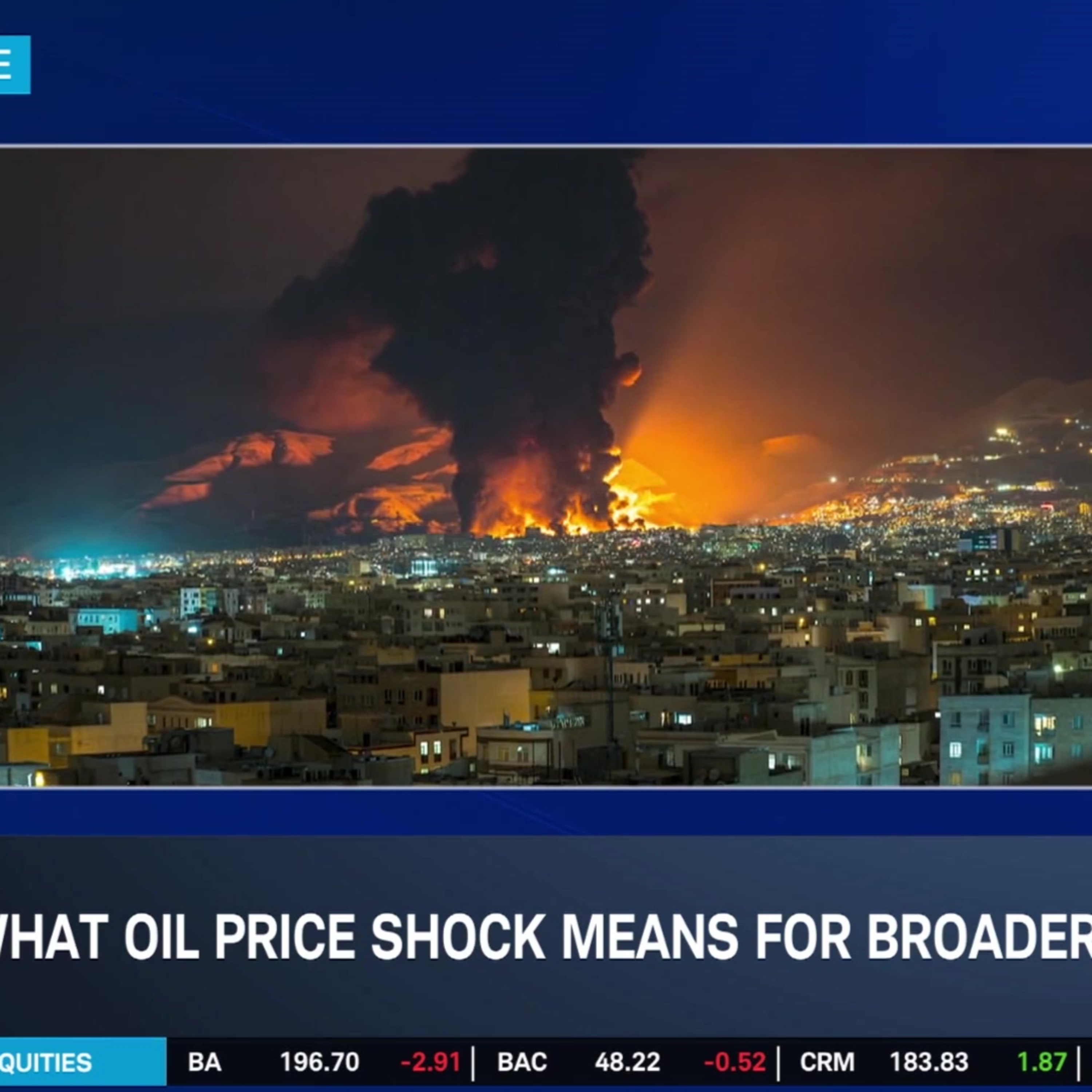
Michele Schneider warns investors to brace for more crude oil volatility and keep one eye on the $100 mark. She says a break above that metric can signal greater long-term risks. Mish explains the "domino effect" Americans will feel as pricing pressures continue, from the gas pump to the grocery store. The current market doesn't come without opportunities, with Mish pointing to natural gas and ETFs in energy and agriculture. She later explains why she's still bullish in the crypto space.
======== Schwab Network ========
Empowering every investor and trader, every market day.
Options involve risks and are not suitable for all investors. Before trading, read the Options Disclosure Document. http://bit.ly/2v9tH6D
Subscribe to the Market Minute newsletter - https://schwabnetwork.com/subscribe
Download the iOS app - https://apps.apple.com/us/app/schwab-network/id1460719185
Download the Amazon Fire Tv App - https://www.amazon.com/TD-Ameritrade-Network/dp/B07KRD76C7
Watch on Sling - https://watch.sling.com/1/asset/191928615bd8d47686f94682aefaa007/watch
Watch on Vizio - https://www.vizio.com/en/watchfreeplus-explore
Watch on DistroTV - https://www.distro.tv/live/schwab-network/
Follow us on X – https://twitter.com/schwabnetwork
Follow us on Facebook – https://www.facebook.com/schwabnetwork
Follow us on LinkedIn - https://www.linkedin.com/company/schwab-network/
About Schwab Network - https://schwabnetwork.com/about
Get every episode summarized
Each time Schwab Network publishes, we email you a written briefing from the transcript — the topics, who appeared, and any specific claims, with the ad reads skipped.
Email me new episodesFree for 3 shows. No card needed.
Hosts & guests

Transcript ready
224 searchable segments. Every word is indexed and playable.
Full transcript
Schwab Network — Crude Oil's $100 "Psychological Level" & Commodity "Domino Effect". Machine-transcribed; use the interactive transcript above to jump the player to any line.
Back to market on close here on Schwab Network. I'm Marley Caden-Sambottis is joining me from the New York Stock Exchange. But let's bring in another voice into the conversation right now. Joining us now, me Schneider, the Chief Strategist at Market, Gage. Meesh, great to have you with us. You know, obviously looking at the price of oil right now, we are ticking considerably higher today up close to 5% right now in terms of oil prices. Really seeing these volatile swings on every headline coming out from us, from Iran, from Israel, from any Middle Eastern country, how are you looking at oil right now and what levels specifically are you focused on? Well, clearly, I think that oil started its rally long before the war started, when it broke over $60 a barrel and everybody was still bearish. So let's begin with that. There was already underpinnings of supply issues, refineries not necessarily going to refine any more oil. Drilling wasn't exactly happening. So we already started with somewhat of a deficit.
So now here we are at $95 a barrel, if we're looking at WTI. However, there is a psychological level at $100. And we've been able to only pierce it once, and now it's been under it and it's ranging. I'd say between 88 and 100 is kind of the range, which is kind of wide. But then again, we've been volatile, so you have to give it that kind of room. So essentially, I think you gotta keep it simple and follow the price. If it breaks out over 100, whether we've seen more headlines of escalation or not, I would say that that probably is singling that things are going to only get worse in terms of oil prices going higher, and I would probably look to buy it there, or like I said, a decent dip closer to around $88.90. Right here, we're smack there in the middle. I think it makes it difficult to decide. Hi, Ms. Hitsam, so nice to have you on the program and long time no speak. I am just wondering as we try to assess exactly how long this is going to drag out for how high prices could go and how long they stay there.
We've got the OECD that's now modeling higher forecast for inflation. It's more than double the Fed's target. So I'm just wondering is everybody sits here and tries to figure out where that could potentially lead to some demand destruction. What corners of the market do you look out for as far as inflation barometers to give you some sort of indication? Great to see you, Sam. And also nice to meet you, Marley. I don't think we've met before. Well, essentially, we have to look at it as a domino effect and that what happens with increasing oil prices, it also then of course, we've already heard about the impact on fertilizer, the impact on freight costs with diesel, the impact on food prices as a result. So we're starting to look beyond that and that's where these calls for higher inflation come from. So for example, if you just look at food, although wheat, corn, and soybeans has all gone up in price since this war has started, I find the most interesting to watch in the food area
is sugar and that's because sugar actually measures more of a social unrest and the reason for that is because people reach for sugar A because it's cheaper and B because it's somewhat of a comfort food. So it's an interesting little way to take a look and see how much this impact of oil prices start to not only affect the consumers wallet, but their mood in general. And so that's where sugar comes in. Outside of that, of course, I think really, you have to be looking at some of the other energy areas that haven't necessarily kept up. For me, natural gas is the most interesting because it's still so cheap. And Misha, I'm looking through notes here and you've flagged everything. Inflation, stagflation, shrinkflation, recession, even you put all the buzzwords in there which of those are you concerned about? What's your base case here? Well, my base case is that we've actually been in stagflation before the war, maybe for the last couple of years.
If you take tech and AI growth out of the equation and you just look around at the US economy, particularly if you're looking at the consumer and transportation and the small caps, hasn't really grown very much, sort of stagnating. And now, of course, with AI and tech having some troubles, that's why all of a sudden people are saying stagflation. I think we've already been there. So what happens after? We could go into a hyperinflation, but generally, particularly when you have these sort of geopolitical risks, the stagflation becomes a speed bump to recession. And that's why I put them all there because kind of, throw your dart right now. You can make a case for everything, but looking forward where we going next. And that's where recession now is starting to get more and more of a buzz if this continues for too long. Mitch, I always love your anecdotes and that one about sugar is very telling, very interesting. I'm just wondering when you look across other hard assets and commodities right now, I was having a really good conversation with Larry MacDonald at the program yesterday
about this migration of capital out of paper assets into that part of the market. And there's so many factors as to what is driving that. And that's why everyone's calling it a commodity bull market. So how are you thinking about that if you want to get exposure? Do you go the pure commodity or do you go to the commodity linked equities where you're getting obviously the reward from the commodity price as well as the productivity, driven earnings and the corporate gains as well? Well, this is really slow upon looking at companies because if they start to have to charge higher prices as a result of the raw materials costing more money, that may not necessarily be good for the bottom line. The real winner in terms of companies lately has, of course, been the oil companies because they were doing well when the oil prices were cheap because they were in drilling and they just had a lot of cash and they're doing better now that oil prices are more expensive. So I wouldn't look at that. I would look more in my say companies, I mean outside of oil, I would look more at the actual hard asset.
So I kind of looked around the board. So like I said, natural gas looks really cheap, but if you take a look at DBA, which is an ETF, and I like things that cover a lot of different areas, it's soft and it's agricultural. It made a big move already, and now today it's up even more over 27. So that is kind of an area now where if it holds over this 26, 80, 27 level, we can see a lot higher, especially as I said before, if the war continues and the oil prices continue have an impact or that domino effect. And then outside of that, I'm looking at some of the softs here, outside of sugar, coffee looks like it's basing, but coffee would not be a reliable commodity to buy in this environment. It would be more winter in Brazil, we get some sort of freeze. And then of course outside of that, there is a lot of prediction for many hurricanes this year. So then you have to look at things that might be disrupted further from that. And that's where corn and soybeans potentially can come in as well. So it's an interesting board all around.
If you want to just get overall exposure, look at some of the commodity indexes. They are also really flying high here. And Misha, I'd love to get your thoughts on crypto while we have you. I was just talking to my last guest about the crypto backed mortgages that you can now use through Fannie Mae. And we've seen crypto at least Bitcoin. You'll be pretty range bound of late sort of trapped in this size, sideways movement. What's your outlook here for crypto? You know, I'm going to give Sam another anecdote here. I always say that crypto doesn't know what it wants to be when it grows up, because it's only 22 years old, right? So I think what's happening right now is we're seeing signs of where it's going to be as an impact for the economy. And that will be like we're seeing that with mortgage back. Obviously, digital currency becoming stronger and stronger. The fact that it's not controlled by any government, the decentralization has become more attractive as we're starting to see more signs of the risk of the petrodollar going away, right? So essentially, I think it's starting to realize itself
as not only an alternative currency, but also as an alternative if you are suspicious in any way of fiat or government policy. So right now, we're in a range, just like everything else or mostly everything else. And I think 64 would be probably my shelf at this point, it's trading around 68. If you can get back over 75, I'm still very bullish. And I'm also bullish Ethereum, which I think is holding up extremely well, trading still over 2040 areas somewhat pivotal. If we can get that over 2200, I think, up we go. All right, I don't know, Mish, kids and sugar. That's a terrifying combination. For sure. We're going to have to leave it there. Sorry, we've run out of time, but it's been such a pleasure talking to you. And I'm going to hop on the bandwagon here with Sam and Sam, also a big fan of the anecdotes. So we look forward to having you back. That's me, Schneider from MarketGauge.com.
More episodes
More from Schwab Network

JNJ Balances Growth, Patent Transitions, and Legal Overhangs
Schwab Network

nCino (NCNO) CEO on Earnings, AI in Banking & Overcoming "SaaS-pocalypse"
Schwab Network

The Big 3: NET, TWLO, ASTS
Schwab Network

Tie Lasater on Inflation Floors, Energy Risk, and Private Credit Stress
Schwab Network