Loading...
educationJul 10, 202624:39pending
Course 39 - NodeJS Security Pentesting and Exploitation | Episode 4: Manual and Automated Code Review Essentials
About this episode
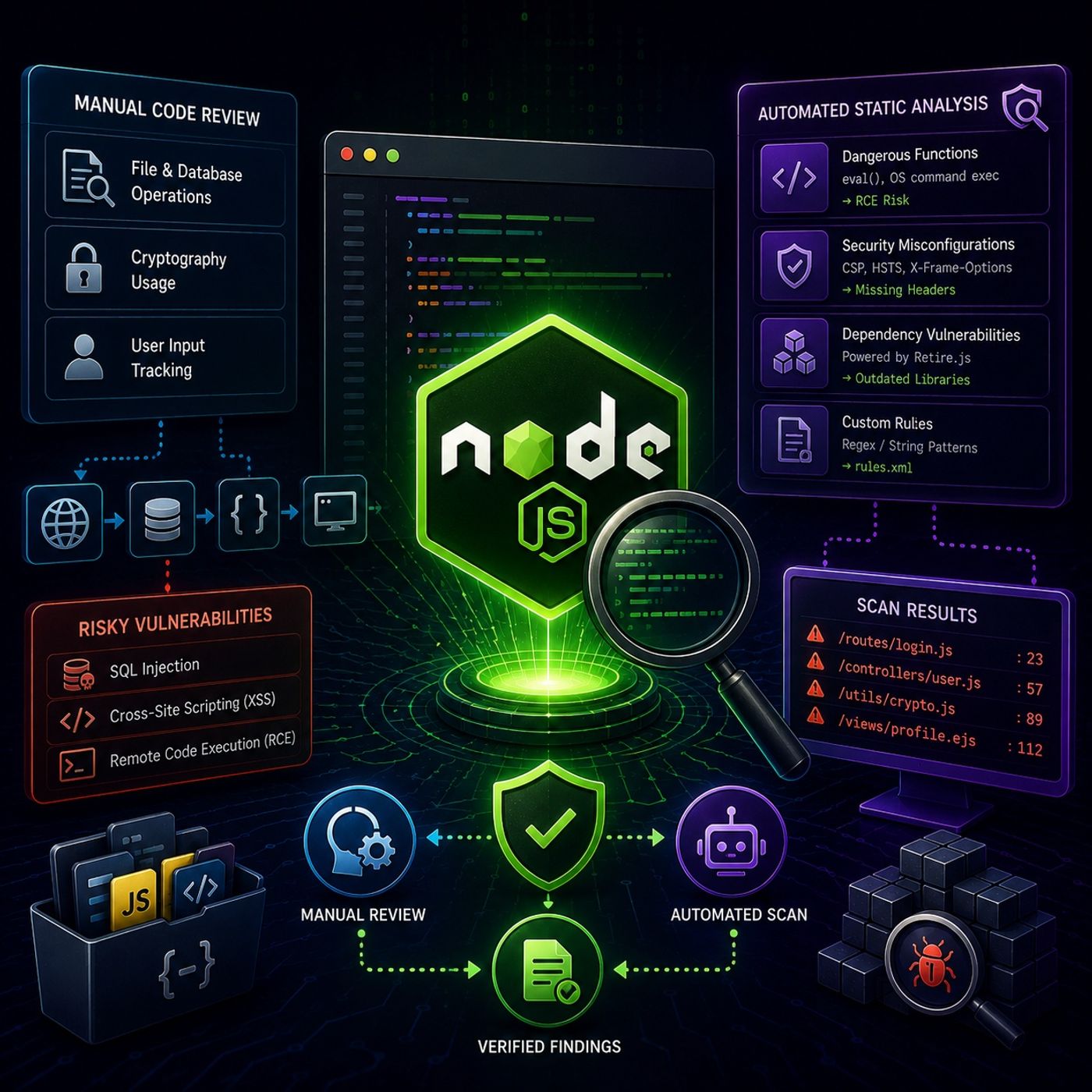
In this lesson, you’ll learn about: auditing Node.js applications using manual code review techniques and automated static analysis tools to identify security vulnerabilities1. What is Node.js Application Auditing?🔹 Purpose:
Systematically review a Node.js codebase to find security weaknesses before attackers do🔹 Two main approaches:
Real security comes from combining both approaches2. Manual Code Review Strategy🔹 Focus areas during review:🔹 File and database operations
request → processing → database → response👉 Key Insight
Most vulnerabilities appear where input is not properly encoded or escaped🔹 Common resulting vulnerabilities:
NodeJsScan🔹 What it does:Scans code without running it to detect security issues🔹 Key detection capabilities:1. Dangerous functions
Static analysis → fast detection at scale👉 Best practice:
Use both together for complete coverageMental ModelCode → input flow tracking → unsafe sinks → automated scanning → verified findings
You can listen and download our episodes for free on more than 10 different platforms:
https://linktr.ee/cybercode_academy
Systematically review a Node.js codebase to find security weaknesses before attackers do🔹 Two main approaches:
- Manual code review
- Automated static analysis
Real security comes from combining both approaches2. Manual Code Review Strategy🔹 Focus areas during review:🔹 File and database operations
- Look for unsafe reads/writes
- Check uncontrolled file paths
- Weak hashing (e.g., MD5)
- Disabled SSL verification
- Improper encryption handling
request → processing → database → response👉 Key Insight
Most vulnerabilities appear where input is not properly encoded or escaped🔹 Common resulting vulnerabilities:
- SQL Injection
- Cross-Site Scripting (XSS)
- Remote Code Execution (RCE)
- OWASP Code Review Guide
NodeJsScan🔹 What it does:Scans code without running it to detect security issues🔹 Key detection capabilities:1. Dangerous functions
- eval()
- OS command execution functions
- Missing CSP headers
- Missing HSTS
- Missing X-Frame-Options
- Uses Retire.js
- Detects outdated or vulnerable libraries
- Add regex/string patterns
- Configure rules in rules.xml
- Tool scans entire codebase
- Flags vulnerable lines
- Shows file + exact line number
- Speeds up remediation process
Static analysis → fast detection at scale👉 Best practice:
Use both together for complete coverageMental ModelCode → input flow tracking → unsafe sinks → automated scanning → verified findings
You can listen and download our episodes for free on more than 10 different platforms:
https://linktr.ee/cybercode_academy
Hosts & guests
No transcript yet
This episode has not been transcribed. Request it and it moves to the front of the queue.
More episodes


