scienceJan 8, 202620:48pending
Cosmic Clues: Unlocking Dark Matter Secrets from a Distant Supernova
About this episode
SpaceTime with Stuart Gary Gary - Series 29 Episode 3
In this episode of SpaceTime, we delve into the latest discoveries in astrophysics and the challenges faced by space agencies worldwide.
Ancient Supernova Offers Clues to Dark Energy
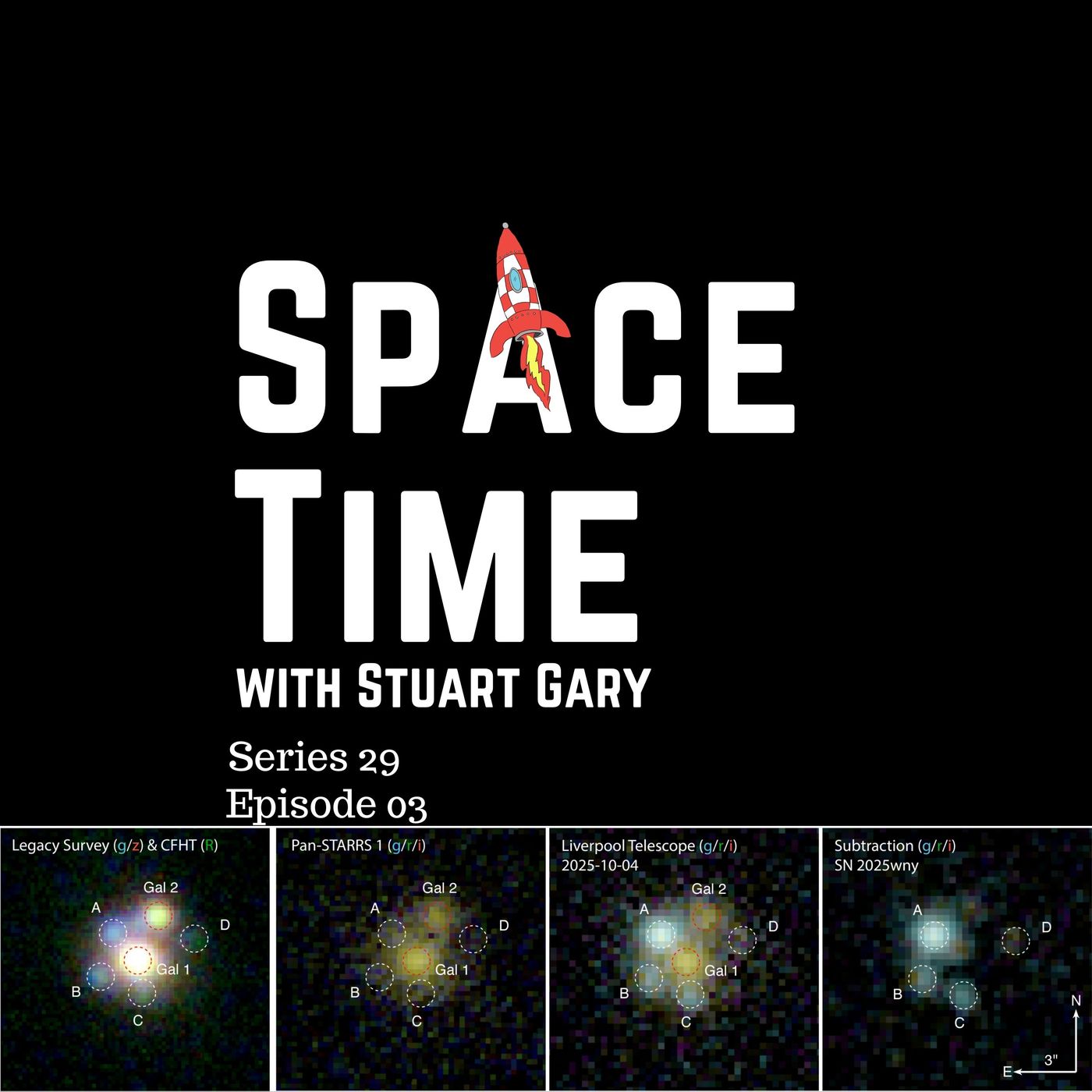
Astronomers have made significant strides in understanding dark energy, the enigmatic force driving the universe's accelerated expansion. A newly observed supernova, located 10 billion light years away, has been gravitationally lensed by a foreground galaxy, allowing scientists to analyze multiple images of the same explosion. This phenomenon could help determine the Hubble constant, shedding light on the universe's expansion rate and its ultimate fate, which ranges from a Big Crunch to a Big Rip.
Sterile Neutrino Hypothesis Nearly Ruled Out
After over a decade of research, scientists have come close to ruling out the existence of the sterile neutrino, a proposed particle that could explain anomalous neutrino behavior. Data from the Micro BooNE experiment at Fermilab has shown no signs of sterile neutrinos, providing a pivotal moment in particle physics that narrows the search for new theories beyond the standard model.
China's Reusable Rocket Setback
China's efforts to develop a reusable rocket faced a significant blow as its Long March 12A failed on its maiden flight. Although the rocket's first and second stages performed as expected, the first stage failed to return successfully, highlighting the challenges in achieving reusability akin to SpaceX's Falcon 9. This setback underscores the competitive nature of the global space industry as China strives to enhance its capabilities.
www.spacetimewithstuartgary.com
✍️ Episode References
Astrophysical Letters
Nature
Fermilab Reports
Become a supporter of this podcast: https://www.spreaker.com/podcast/spacetime-your-guide-to-space-astronomy--2458531/support.
(00:00:00) This is Space Time Series 29, Episode 3 for broadcast on 7 January 2026
(00:00:47) Discovering dark energy through a unique supernova
(00:12:30) Ruling out the sterile neutrino hypothesis
(00:20:10) China's reusable rocket faces a major setback
(00:25:00) Science report: Climate change impacts, endangered species, and digital privacy concerns
In this episode of SpaceTime, we delve into the latest discoveries in astrophysics and the challenges faced by space agencies worldwide.
Ancient Supernova Offers Clues to Dark Energy
Astronomers have made significant strides in understanding dark energy, the enigmatic force driving the universe's accelerated expansion. A newly observed supernova, located 10 billion light years away, has been gravitationally lensed by a foreground galaxy, allowing scientists to analyze multiple images of the same explosion. This phenomenon could help determine the Hubble constant, shedding light on the universe's expansion rate and its ultimate fate, which ranges from a Big Crunch to a Big Rip.
Sterile Neutrino Hypothesis Nearly Ruled Out
After over a decade of research, scientists have come close to ruling out the existence of the sterile neutrino, a proposed particle that could explain anomalous neutrino behavior. Data from the Micro BooNE experiment at Fermilab has shown no signs of sterile neutrinos, providing a pivotal moment in particle physics that narrows the search for new theories beyond the standard model.
China's Reusable Rocket Setback
China's efforts to develop a reusable rocket faced a significant blow as its Long March 12A failed on its maiden flight. Although the rocket's first and second stages performed as expected, the first stage failed to return successfully, highlighting the challenges in achieving reusability akin to SpaceX's Falcon 9. This setback underscores the competitive nature of the global space industry as China strives to enhance its capabilities.
www.spacetimewithstuartgary.com
✍️ Episode References
Astrophysical Letters
Nature
Fermilab Reports
Become a supporter of this podcast: https://www.spreaker.com/podcast/spacetime-your-guide-to-space-astronomy--2458531/support.
(00:00:00) This is Space Time Series 29, Episode 3 for broadcast on 7 January 2026
(00:00:47) Discovering dark energy through a unique supernova
(00:12:30) Ruling out the sterile neutrino hypothesis
(00:20:10) China's reusable rocket faces a major setback
(00:25:00) Science report: Climate change impacts, endangered species, and digital privacy concerns
Get every episode summarized
Each time SpaceTime with Stuart Gary publishes, we email you a written briefing from the transcript — the topics, who appeared, and any specific claims, with the ad reads skipped.
Email me new episodesFree for 3 shows. No card needed.
Hosts & guests
No transcript yet
This episode has not been transcribed. Request it and it moves to the front of the queue.
More episodes
More from SpaceTime with Stuart Gary

Tatooine's New Neighbours, Mars Rover's Drilling Quest, and Soyuz 5's Maiden Voy...
SpaceTime with Stuart Gary
May 11, 202627:18pending

Venus's Hazy Secrets, Planetary Collision Insights, and Lunar Gateway Corrosion...
SpaceTime with Stuart Gary
May 8, 202636:49pending

Uranus' Ring Revelations, Africa's Rapid Rift, and Eris Rocket Mishap
SpaceTime with Stuart Gary
May 6, 202621:45pending

Milky Way's Black Hole Secrets, Solar Flare Spectacles, and Mars Rover Discoveri...
SpaceTime with Stuart Gary
May 4, 202627:19pending