About this episode
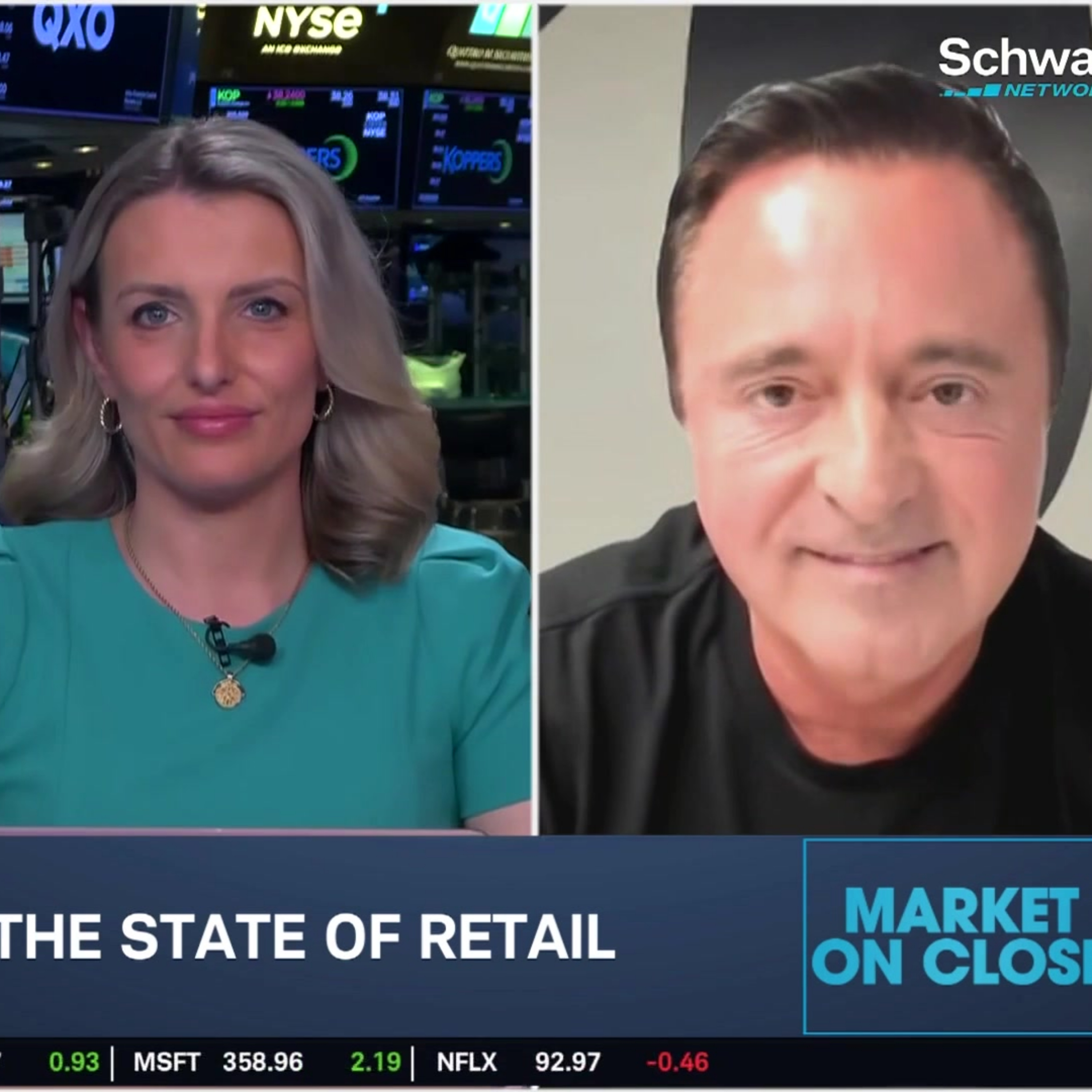
True Religion CEO Michael Buckley joins Sam Vadas and Marley Kayden to discuss the brand’s shift toward value‑driven growth, navigating inflation, supply‑chain costs, and the power of partnerships like Megan Thee Stallion to keep the iconic label relevant.
======== Schwab Network ========
Empowering every investor and trader, every market day.
Options involve risks and are not suitable for all investors. Before trading, read the Options Disclosure Document. http://bit.ly/2v9tH6D
Subscribe to the Market Minute newsletter - https://schwabnetwork.com/subscribe
Download the iOS app - https://apps.apple.com/us/app/schwab-network/id1460719185
Download the Amazon Fire Tv App - https://www.amazon.com/TD-Ameritrade-Network/dp/B07KRD76C7
Watch on Sling - https://watch.sling.com/1/asset/191928615bd8d47686f94682aefaa007/watch
Watch on Vizio - https://www.vizio.com/en/watchfreeplus-explore
Watch on DistroTV - https://www.distro.tv/live/schwab-network/
Follow us on X – https://twitter.com/schwabnetwork
Follow us on Facebook – https://www.facebook.com/schwabnetwork
Follow us on LinkedIn - https://www.linkedin.com/company/schwab-network/
About Schwab Network - https://schwabnetwork.com/about
Get every episode summarized
Each time Schwab Network publishes, we email you a written briefing from the transcript — the topics, who appeared, and any specific claims, with the ad reads skipped.
Email me new episodesFree for 3 shows. No card needed.
Hosts & guests

Transcript ready
148 searchable segments. Every word is indexed and playable.
Full transcript
Schwab Network — CEO Michael Buckley: True Religion’s Value Pivot. Machine-transcribed; use the interactive transcript above to jump the player to any line.
Welcome back to Mark Longclose, I'm Sam Vardas in New York alongside Marley Caden over in Chicago. Let's talk about retail and the state of the consumer through the lens of true religion with the CEO and Michael Buckley. Michael, thanks so much for joining us. Wow, true religion. I mean, it was such a flashback when I was thinking about this company because you were so iconic in the early 2000s and obviously you've changed your strategy to adapt, but I'm sure to the surprise of you and many other retailers I've even spoken to. What was at the CFO of Levi's when Denim really made a comeback in the last couple of years, which has enabled you guys to really capitalize on that, but just talk us through how you are adapting to this current environment right now with the state of the consumer and how they're spending. Well, I'm looking we've done here, you know, we transformed this business from selling 300-dollar jeans, you know, quality of those are only 2000s to now. To today, we sell, you know, our jeans are, which by the way are only about 40 percent of our business are, you know, $52, $80 out the door.
We sell all the parallel classifications. So we're in the t-shirt business or in the hoodies, joggers, you name it every parallel classification as well as maybe a dozen accessory classifications we sell. So we're giving the consumer what they want at the price they want and just making sure that we're giving them, you know, in today's environment where I think there's less money in a pocket, certainly for for our consumer, you know, our consumer is, you know, 65,000 household income. So with higher gas prices, you know, could they be pinched? Yes, but I think we make sure that we're giving them a lot of value for the price that they're paying for our product. So we haven't seen anything yet. I mean, our business will be up double digits this year, but we, you know, I think given the product they want at the price they want, they'll keep coming back. And Michael, what is it that your consumer or the consumer wants right now? What are the big ticket items? Where are you still seeing the spending? Are you seeing pullbacks in any areas? I mean, where is demand and is it holding up?
And with our business, and we have a diversified business. I mean, I'm at 6,000 wholesale doors. I have my own true legend.com. I have 56 of my own retail stores. And in all those channels, we continue to composite. I mean, our business will be up double digits this year. So we're not seeing it yet. I mean, we count traffic in our stores. I mean, our traffic is when from being up, you know, high single digits to being up low single digits, but our sales comp is up, you know, mid single digits. So I think if you're giving them the product they want, if you're giving them the marketing that they want, they will keep coming back. So we haven't seen it pullback ourselves, but we're, you know, watching it with cautious, you know, we're making sure that when the customer comes in through any of our channels, we convert it. But I guess Michael Piggybacking on what Marley asked you. I mean, what is it exactly what consumers want right now? I mean, is it a more of a tailored experience? I mean, are they looking to purchase easier, quicker, faster? I mean, is social media is artificial intelligence part of your strategy?
Yeah, I mean, I think it's all part of our strategy. I mean, I think the consumer today, you know, I think they want to buy it. I think for us, it's really about the consumer, the true religion logo. Obviously, the horseshoe, as you can see behind us here, you know, that iconic branding on all the product that we do is what the customer wants. So as long as we're giving it, giving it to them at the price that they want, they'll keep coming back. And obviously, we need to be on trend if the market goes to baggy jeans or skinny jeans or oversized t-shirts, we need to make sure we're giving them on trend product for what's happening today at the right price. Michael, how important in terms of is marketing to the overall success right now in the retail space? I know you have a partnership with Megan, the stallion, we've seen other denim companies have partnerships retail broadly is bringing in influencers and celebrities. How much is that driving traffic to brands right now? I think it's very important and I think you have to have the, if you're going to use influence of celebrities, people like that, you have to make sure that they're relevant
at this time. So we spend a lot of money on marketing and a lot, you know, we spend 10% of our turnover on marketing, which I think for a better brand is what you need to spend. But you need to give them people like Megan, the stallion and some of the other people we've used over the years that are relevant to this consumer today. So it's very important for us. We came into 2026 with a couple of more sort of conservative outlooks from some of the companies we track through obviously their stocks as well. I'm just wondering if that is the sense that you're getting right now, that, you know, while the consumer does look resilient, there are a lot of uncertainties on the horizon. I mean, how much visibility have you and your peers got right now? So this is really a lot of visibility, where visibility, through the fourth quarter in terms of those forward purchases from the consumer perspective. I mean, we're watching it every day. We're just, you know, again, keep your nose to this, to the stone, give them good product, give them on trend product, give them the right marketing, and obviously we're watching
all that channels, we're watching traffic, committed stores, we're watching traffic come into our website, and we're doing everything we can to convert them as much as possible. And Michael, you've mentioned your stores and the foot traffic, obviously an important metric there for the success of a company. We've seen some retailers pulling back on the physical storefront and moving very heavily into e-commerce, you know, others expanding their physical footprint. What do you think is the right strategy right now in today's environment? I mean, potential you sell, I mean, I think the younger generation, yeah, today seems to want to go into stores more. I mean, once upon a time, we had 140 stores here and we sold a higher income consumer. Today, all the channels are important. So the most important we believe is trivelision.com, but being in 6,000 wholesale doors, I mean, that's important as well. And then obviously the retail store footprint, you know, our stores are very profitable. 45% full. We'll leave it one of the best in the industry. We will keep opening more stores. I mean, based on the size of our audience, based on the amount of product we do, the price
points, we believe we could have somewhere between 150 and 250 stores, even though we're only opening 7 to 10 stores a year, but we believe in retail for sure. I think it's fair to say that you guys in the business of retail have been hit with a sort of two gut punch with obviously tariffs last year and obviously with the previous administration as well. And now with the energy shock, particularly if you're manufacturing in places like Asia where they are particularly exposed, I'm just wondering how you're looking to mitigate a number of those challenges right now and how you're working around some of that. Thank you. We needed the tariffs very well. You know, for a 500 million dollar business, we took about a $2 million tariff hit. We worked closely with our suppliers and we worked closely a year ago when Liberation Day came about and we were able to only take a slight hit on a tariff side and we raised prices slightly as well, which didn't impact our volume.
And then right now, you know, we're, you know, waiting to see what the impact is going to be in terms of really just on transportation costs. The fuel costs stay high, you know, there will be probably an increase in transportation costs. I mean, for us, it's a, you know, we have like a 25 or 50 cent per garment cost of bringing the goods into the country. So we can, we will see that go up, but we don't see where it's going to go up where it's going to impact us negatively, you know, than maybe 5 or 10 cents. And Michael, we spend a lot of time talking about fashion and fashion trends and demand based on the segment of fashion that you're in. You call yours urban casual, the urban casual consumer. And you point out that that consumer is actually growing faster than the broader market. So what does that say about where fashion demand is going and who's driving that move? You know, to me at the end day, it's about being on trend. It's about, and once upon a time, we created the trends. We don't create the trends anymore. We look at what's happening in Rome, ways in Europe, we look at what's happening around
the world. You know, we look at the different services out there available to see where trends are going. And our philosophy is first to be second. So if a market goes in a particular direction, be it jeans or be it silhouettes on tops or other categories, if we go very logo driven or less logo driven, we make sure that we are adapting fast to the trends and marketplace to give the consumer what they want as fast as possible. Well, Michael, we really appreciate you taking the time to join us today on market on clothes. That's Michael Buckley, the CEO of True Religion.
More episodes
More from Schwab Network

JNJ Balances Growth, Patent Transitions, and Legal Overhangs
Schwab Network

nCino (NCNO) CEO on Earnings, AI in Banking & Overcoming "SaaS-pocalypse"
Schwab Network

The Big 3: NET, TWLO, ASTS
Schwab Network

Tie Lasater on Inflation Floors, Energy Risk, and Private Credit Stress
Schwab Network