scienceJul 9, 202523:28pending
Celestial Phenomena: The Largest Oort Cloud Comet and Mars Perseverance's Milestones
About this episode
In this episode of SpaceTime, we explore some of the most exciting recent discoveries in astronomy, including the largest Oort Cloud comet ever observed and remarkable achievements from NASA's Mars Perseverance Rover.
Comet C/2014 UN271 Bernardinelli-Bernstein: A Giant from the Oort Cloud
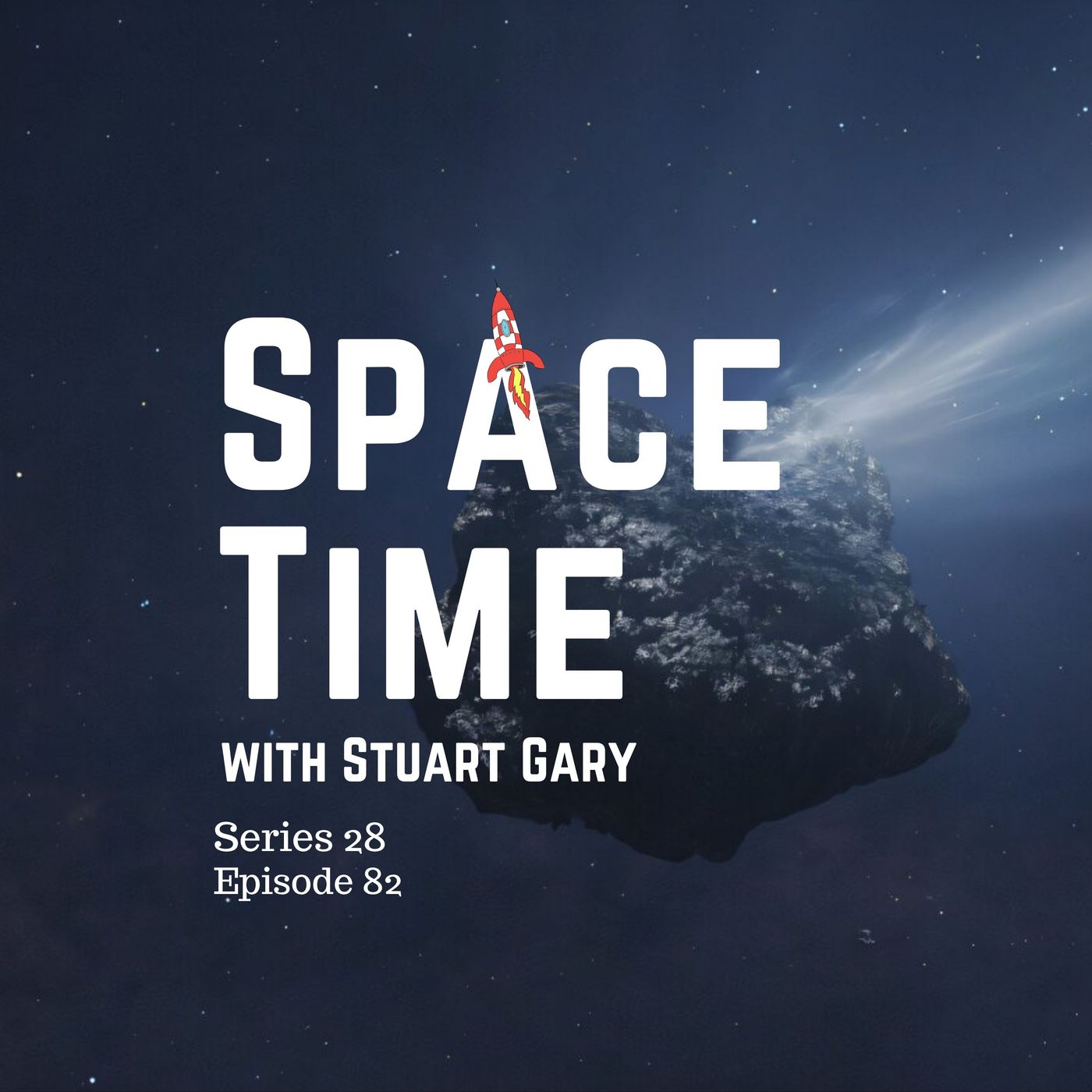
Astronomers have made a groundbreaking discovery by detecting molecular activity in Comet C/2014 UN271 Bernardinelli-Bernstein, the largest and most distant active comet ever observed. Originating from the Oort Cloud, this colossal comet measures nearly 140 km across, revealing complex jets of carbon monoxide gas and providing insight into its behavior far from the Sun. Observations from the Atacama Large Millimeter/Submillimeter Array (ALMA) in Chile have confirmed its status as the largest known Oort Cloud comet, offering a rare glimpse into the chemistry and dynamics of these distant celestial objects.
Nasa's Perseverance Rover Sets New Distance Record
NASA's Mars Perseverance Rover has achieved a new milestone, traveling 411 meters in a single autonomous drive while exploring the Jezero Crater. This episode highlights the rover's innovative AUTONAV self-driving system and its 30th Abrasion Study of a Martian rock named Kenmore. The findings reveal significant mineral compositions, including clay minerals, iron, and magnesium, enhancing our understanding of Mars' geological history and potential past habitability.
Exoplanets Triggering Stellar Flares
Astronomers have discovered that certain exoplanets in close orbits around their host stars can trigger powerful stellar flares, leading to atmospheric erosion over time. This groundbreaking finding, reported in the journal Nature, demonstrates the interaction between planets and their stars in a way never before observed. The study, conducted using the European Space Agency's CHEOPS spacecraft, reveals that these energetic flares can significantly impact the evolution of the orbiting planets, providing new insights into the dynamics of stellar systems.
www.spacetimewithstuartgary.com
✍️ Episode References
Astrophysical Journal Letters
https://iopscience.iop.org/journal/1538-4357
NASA Perseverance Rover
https://mars.nasa.gov/mars2020/
Nature Journal
https://www.nature.com/nature
Become a supporter of this podcast: https://www.spreaker.com/podcast/spacetime-space-astronomy--2458531/support.
Comet C/2014 UN271 Bernardinelli-Bernstein: A Giant from the Oort Cloud
Astronomers have made a groundbreaking discovery by detecting molecular activity in Comet C/2014 UN271 Bernardinelli-Bernstein, the largest and most distant active comet ever observed. Originating from the Oort Cloud, this colossal comet measures nearly 140 km across, revealing complex jets of carbon monoxide gas and providing insight into its behavior far from the Sun. Observations from the Atacama Large Millimeter/Submillimeter Array (ALMA) in Chile have confirmed its status as the largest known Oort Cloud comet, offering a rare glimpse into the chemistry and dynamics of these distant celestial objects.
Nasa's Perseverance Rover Sets New Distance Record
NASA's Mars Perseverance Rover has achieved a new milestone, traveling 411 meters in a single autonomous drive while exploring the Jezero Crater. This episode highlights the rover's innovative AUTONAV self-driving system and its 30th Abrasion Study of a Martian rock named Kenmore. The findings reveal significant mineral compositions, including clay minerals, iron, and magnesium, enhancing our understanding of Mars' geological history and potential past habitability.
Exoplanets Triggering Stellar Flares
Astronomers have discovered that certain exoplanets in close orbits around their host stars can trigger powerful stellar flares, leading to atmospheric erosion over time. This groundbreaking finding, reported in the journal Nature, demonstrates the interaction between planets and their stars in a way never before observed. The study, conducted using the European Space Agency's CHEOPS spacecraft, reveals that these energetic flares can significantly impact the evolution of the orbiting planets, providing new insights into the dynamics of stellar systems.
www.spacetimewithstuartgary.com
✍️ Episode References
Astrophysical Journal Letters
https://iopscience.iop.org/journal/1538-4357
NASA Perseverance Rover
https://mars.nasa.gov/mars2020/
Nature Journal
https://www.nature.com/nature
Become a supporter of this podcast: https://www.spreaker.com/podcast/spacetime-space-astronomy--2458531/support.
Get every episode summarized
Each time SpaceTime with Stuart Gary publishes, we email you a written briefing from the transcript — the topics, who appeared, and any specific claims, with the ad reads skipped.
Email me new episodesFree for 3 shows. No card needed.
Hosts & guests
No transcript yet
This episode has not been transcribed. Request it and it moves to the front of the queue.
More episodes
More from SpaceTime with Stuart Gary

Tatooine's New Neighbours, Mars Rover's Drilling Quest, and Soyuz 5's Maiden Voy...
SpaceTime with Stuart Gary
May 11, 202627:18pending

Venus's Hazy Secrets, Planetary Collision Insights, and Lunar Gateway Corrosion...
SpaceTime with Stuart Gary
May 8, 202636:49pending

Uranus' Ring Revelations, Africa's Rapid Rift, and Eris Rocket Mishap
SpaceTime with Stuart Gary
May 6, 202621:45pending

Milky Way's Black Hole Secrets, Solar Flare Spectacles, and Mars Rover Discoveri...
SpaceTime with Stuart Gary
May 4, 202627:19pending