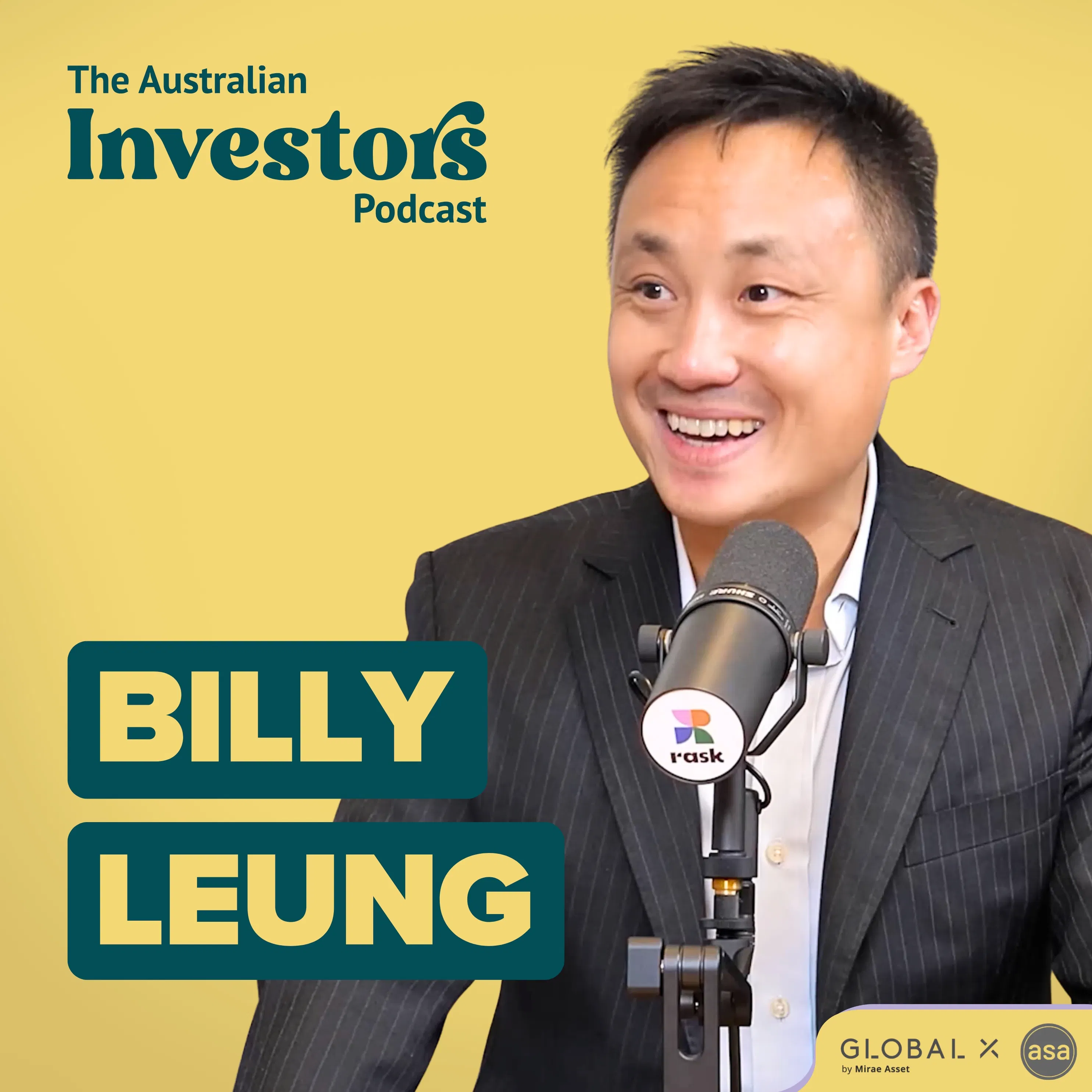
About this episode
Get every episode summarized
Each time Australian Investors Podcast publishes, we email you a written briefing from the transcript — the topics, who appeared, and any specific claims, with the ad reads skipped.
Email me new episodesFree for 3 shows. No card needed.
Hosts & guests
Transcript ready
431 searchable segments. Every word is indexed and playable.
Full transcript
Australian Investors Podcast — Billy Leung's $100,000 ETF portfolio. Machine-transcribed; use the interactive transcript above to jump the player to any line.
We know gold and silver continue to make headlines, but did you know GlobalX ETFs is Australia's largest commodity ETF provider? In fact, their flagship physical gold ETF, that's the ticker symbol G-O-L-D, was the first of its kind in the world. Whether you're looking for physical commodities or commodity miners, GlobalX has 12 options to choose from, including their newest silver miners ETF. Visit GlobalX ETFs.com.au to learn more. AFSL 466-778. Investing involves risk and returns are not guaranteed, refer to the relevant PDS and TMD. As you know, Turn Plus recently came on as a platinum sponsor of Rasp Podcasts, and I invested a small amount myself $2,000 to be exact to get a feel for it. After all, I couldn't tell you to consider it if I hadn't at least considered it myself. And the result is it's a very, very good platform. It's potentially the
simplest technology platform that I've come across in Australian finance. And what makes that extra special is you know behind the scenes something very sophisticated is actually happening. Turn Plus is investing your capital in a globally diversified and professionally constructed portfolio of private credit designed to produce attractive and reliable monthly income. Aside from providing passive income, what really attracted me to partnering with Turn Plus now is potentially falling interest rates. Because Turn Plus starts by targeting 3% returns above the RBA cash rate for a one year fixed term account, there's a buffer in place even as interest rates fall. Monthly income can also be paid directly into your bank account or reinvested for compound returns. I see Turn Plus as a really neatly packaged way for retirees or even accumulators like me to get exposure to professionally constructed global private credit portfolios. You can find out much more information
and grab a hold of the pds and tmd at turnplus.com.au. If you want to just check out the website, you should also know that there's an instant chat function for questions, which is really important. I find really handy before I invest in anything. Don't forget to tell them where I sent you. And as always, consult a licensed and trusted financial planner who can take into account your financial goals, needs and risk appetite before investing. Hey there, here's a quick note. This podcast contains general financial advice only. That means it's not specific to you, you need goals, objectives, so don't act on the information until you've spoken with your financial advisor. You'll find out full disclosure, disclaimer and link to our financial services guide in the show notes. Billy, how you doing, mate? Good, good. Yeah, good to see. Yeah, it's always good to see you. It's bucketing down here in Melbourne. It's raining. Fortunately, we were in this big office, so hopefully no one can hear that, but Melbourne's turned it on for you. And today, we're going to build two portfolios. There's going to be a bit of a twist
on these two portfolios. There's going to be a theme, and I took it in a very different direction. So hopefully it resonates with the community, but if you're watching or listening, you can tell, Billy and I via the comments or anywhere you like to get in contact, what you think of our portfolio. So you can critique us, you can prize us, you can get pick a team and side with one of us, or both of us if you're on the fence. But before we get to those ETFs that we're going to pick, I'll explain the rules in just a minute. I wanted to ask you a question that I hadn't asked you before, which is, what's the one investment that you've held for the longest period of time? And what did you learn? Well, yes. So one investment that I've held for a long time, it's actually a stock that I bought when early on when I started working. It's a company called Tencent. So it's listed in Hong Kong. It's listed in 2004. And I've held it ever since. So interestingly is that it was due to sour thought when I bought it during the IPO.
It's obviously done really well. Everyone can track the performance of it. It's actually one of the best performing listed global equities ever. I think it went to, I think over a thousand percent in 17 years. Only heck, Billy. Honorable global finance says it's up 68,000 percent. It's nice. It's funded a lot of my trips as well. But I think one of the funny things is whenever I look back, when the first bought Tencent, it was actually a PC games company. So they developed PC games. PC games was about 70 to 80 percent of their revenue. And then they moved into mobile games. And everyone was like, oh, no, mobile games aren't going to work. Obviously they did well. They're moving to social networking. It was like, there's some doubts. And then now they're like a multi-conquering internet company with AI. So just looking back, it's as funny for all these years. I bought a PC game company. And now it's like a AI company. Wow. Wow. And you've held on that entire time. It is. Because it's, I mean, it's one of the biggest stocks in Hong Kong. And that's where I grew up. And I was working. But I think one of the key learnings is
that you sometimes have to look at the companies in terms of, are they good innovators? If they are good innovators, if they're well-managed, if their counting is good, it just translates to just long-term innovation and long-term structural growth. Yeah. It doesn't indeed matter. That's fantastic. Like I did not expect you to say that. That's such a long holding story. It's a good story as well. Like a PC gaming company. Yeah. AI company. Yeah. Yeah. And even like people that may not be familiar with the products or use them themselves, we know about 10 cents all across the world. Okay. So on the flip side, then maybe what was one investment mistake that has cost you the most money? Oh, no. Probably another Hong Kong stock. Yeah. I don't think I made the wrong investment per se, but I think the learning was that I sold or I got to shaky in the wrong time. So one of the stocks was actually called metoine. Yeah. So metoine is a food delivery. It's one of the largest food delivery companies in China. And it's actually did quite well after listing. What happened is that it was quite volatile. There was a few periods of time where it went down probably over 30%. I've got a bit weak knees
and I sold it. And that was at a loss. But the funny thing is like right now, it's actually back up to previous levels and even higher than previous levels. And I think obviously again, one of the key learnings is that if you do really see a good company, it's well-positioned, well-managed, there was always a reason to actually sort of, I guess, go through that drawdown and to really, really, I guess hack it out. Yeah. Well, yeah. I think you first introduced me to metoine actually a while ago. It's kind of like the Uber of China as far as I'm aware. Uber Eats. Yeah. Uber Eats. Yeah. That's right. Yeah. It's those businesses, I mean, Uber's in one of the ETFs that I'm going to talk about today. Those businesses have actually been really surprising. I thought that would be also commoditized and, you know, be competed away. But they've actually held ground really, really well. Many of them have innovated. So we're going to get into these different ETFs. I'm going to ask you to explain what they are, like why you went with this particular theme for your overall portfolio because many listeners will know it was a super popular episode. Jess and I did. Jess from the GlobalX team. And you asked me how they're performing
her portfolio versus my portfolio. I don't know exactly. I haven't calculated the numbers as of today, but I'm pretty sure last time I checked she was well ahead. So I'm Kudos to Jess. But hopefully today we can be a bit more specific. Have a bit more fun with it. Sure. And just as a reminder for folks, what we're going to be talking about today, just kind of like a bit of fun from Billi and I, but also there's like a lot of insight in here. But we wanted to have a particular twist on this one and pick a theme that we're passionate about. Talk about that. And then the ETFs that kind of fit inside that theme. So we're going to talk about I think a lot of technology. I'm going to talk about like ETFs in the way they constructed and some of the nuance in the GlobalX range. And the rules of the game were pretty simple. I said to Billi, said you've got $100,000 fake. Rast dollars will call them. And you've got a five year time horizon. And you said, well, let's make it a theme based portfolio as well. So we'll define what that means in a sec. And then ultimately, we'll just track and see who does well and who maybe lags the other. I want to add a little bit extra here just to say that if you are following these portfolios,
please be mindful that we are talking about ETFs, which are considered financial products, head to the GlobalX ETFs.com.au website. I'll put a link in the show notes so you can go find out about all the ETFs that we mentioned today. But please read the PDFs before you consider investing. And in fact, speak to your financial advisor before you act on any information in any podcast. Because we don't know your needs, girls, objectives. So, Billi, with all that disclaimer out of the way, high level, what theme have you chosen for your portfolio? Yeah. So it's probably a subset of the AI theme. I think we've been talking for a long while now. And we all know that I'm as a firm, we're a big proponents of the whole AI development. We are long-term. We believe there's a long-term structural growth. At the same time, we try to look for opportunities within this sort of AI development sub-theme. And one of the sub-things we've been looking at in discussing with both investors and clients as well is the AI infrastructure space. And this is going to be very, very interesting when we talk about it. Because I think this is one sector where it's probably overlooked by a lot of investors. Some of the names we might not
really know. Some of the themes, which might sound surprising. But it's definitely a sector or development that I think is with the AI. And it's probably one that's been surprised. Cool. I like it. So AI infrastructure, which is kind of like a tilt on the high level, just AI as a general theme. Now, I'm going with... I took it in a different direction. I actually took it in a totally different direction, like not thinking about traditional thematics, but more about a theme. And my theme is value investing is back. Because for so many years, growth investing was everywhere. It's all anyone wanted to talk about this idea of value investing, I think, is making a bit of a comeback in 2026. And as I think we're seeing that in some of the stocks on the market at the moment, some of the ETFs, some more technology focus ETFs. There's been a lot of volatility around. So I'm kind of thinking people may retreat to safety a bit in the form of good price companies and good price assets overall. So my theme is value investing is back.
So that's going to frame the ETFs that I pick. I want to know, maybe we'll go, you go, I go. I want to know what's the first ETF on your list. Look, I think before even we've been talking about sub themes, just wanted to take a step back and look again, we are very, very strong believe of AI. We believe the entire value change is not one specific segment. This is going to go on from multi decades. So I'm still very strongly convicted on one of our products, which is called the Global X Artificial Intelligence ETF or GXAI. And we like this because this is a unique product in the market, but more so because it covers the whole much more the value change. So it's an index, it's based on the index, which comprises of 85 names across globally. So it's a global exposure, which again, we like any encompasses any companies that does semiconductor, companies that are using AI, developing AI or even in quantum computing as well. So it has that really nice value chain tilt, you know, it rebalances so that you get that sort of both updates in terms of where I mean, the current market is leaning towards us at the hardwares of software.
So this will always be one of my core thematic parts of my thematic sleeve. Okay, cool. So GXAI, I think we spoke about this maybe back when it first launched this whole idea of quantum computing, like I think myself and most of the people that are listening to this are still wrapping our heads around this idea of AI. And what it's like seemingly limitless possibilities are for our work or personal life and let alone quantum computing, which seems to be like this extra layer on top, which is like, I don't even know what that means, but it sounds kind of cool. So that's a, that's GXAI. I mean, we'll kind of massage around the AI value chain, as you said. If you were building your fictitious thematic focus portfolio, what size position would you put? Yes. So within this sort of fictitious portfolio. And like I said, this is going to be the anchor of our development in terms of structural growth. This would probably be close to about 40% of the portfolio. Wow. Okay. 40%. I like this. You know, I think GS picked this ETF
as well. Nice. It must be something in the water you guys are doing over here because it's very, very popular. So that's great. That's great. Well, GXAI is yours. Now, in the spirit of value investing, I think value investors know the value of everything. And so I would say that if I'm looking at the global X range of ETFs, I'm probably going to go if I'm a value investor to the lowest cost ETF I could find, which for my understanding, really is the A300 ETFs in the global X range. So this is the top 300 companies or 300 largest companies here in Australia. And the key thing is the fee on this is 0.04%, which is in my opinion, basically, you can't even see it is what I mean to say. You just can't even see it. It's that small. So this is like a core building block that I've put into basically any portfolio. I'm going to start at a 20% weighting in my fictitious portfolio because I wanted to make room for another Australian
one, which I'll bring up in just a moment. So A300 is mine. That's my first and biggest position in the portfolio. Nice. Yeah. What's your number two? My number two is probably exactly what I was referring to where the next, I guess, phase of growth in the AI development or one of the core sort of, I guess, underlying growth is going to be AI infrastructure. There is a product that's called global X AI infrastructure ETF or as a name ticker is AI NF. And what's great about this is that this is a very concentrated portfolio or index component where it's only 30 names, 10 names that are doing the data center components, 10 names which are doing the data center, maybe calling equipments and 10 names which are the sort of materials and the energy that goes behind data centers. So uranium, nuclear and also copper as well. So what's interesting or what how we see it is that these are essentially the picks and shovels of data center. And the reason we believe in this is because we think that AI is going through several phases. I think probably six or seven years ago we went through where semiconductors were the sort of
biggest value contributors or, I guess, some market sort of capping proofers in that time. After the semiconductor phase, it went through the hyperscaler phase where we saw the Google's to Amazon's and the meta's really increasing the value and capturing that market game. And we believe that in the future and in the next five years maybe it's AI infrastructure. So these are the companies that are probably taking advantage of all the amount of capex that's being spent by these hyperscalers. So as you know all the major US hyperscalers are spending close to 650 billion annually on this. And we just want to find out who is taking advantage of this, who are so called the second-order beneficiaries. So who's kind of getting paid all that money? Exactly. Exactly. And I think that picks and shovel component and structure really fits in that narrative. And if you look at the components it's generally a lot of companies that are lesser well-known in the whole AI space which means that they could be overlooked and potentially misprice in a way. Yeah, I like that because you want the exposure but you don't want to go into the probably the more well-known and established household names from an AI
perspective. I like the fact that it's actually the it actually is infrastructure in the data centers themselves. I don't know if you know this but my co-host on the show drew, he actually picked an air compressor company and related it to AI infrastructure in some roundabout way. But this actually says to me, this ET because I've seen it before and we've spoken about it, it actually says to me like this is exactly moving down that curve, that value chain, where does that money flow? It hits right on AI and F. If you were building this portfolio from scratch today, what would you allocate to this? This would probably be my 20% sleeve into that. So we've got the whole anchor of GX840% and then the second layup AI and F being at 20%. Cool. Cool. I like it. Now in a similar vein, this is going to be a little bit of a boring one for people. But I do like this ETF and I remember when it launched, it was a I thought it was a really good product and I still do when I say product, I mean fund for people that don't I'm familiar with the the jargon. But U100
is effectively in my opinion in equivalent of a 300 bit in the United States. It's 100 companies and you get all the usual like tech companies, you get that broad exposure, global winners. So that's U100 and it's super cheap at 18 basis points. So as the value investor in me would think, that's pretty convenient, pretty low cost billy. U300 is going to slot in for a 10% position. So not huge. And that's because I want to make wife a couple of these other names a bit more exciting. U100 yet. U100. That's right. So I've got A300 and U100. But great ticker symbol because it's the USA and it's 100. So that's that's there. And there's a bit of overlap. I will say this at the start. There was a bit of overlap between this ETF that I've slotted in the portfolio and a couple of the others. But I'm very comfortable with that because I'll explain why in just a moment. That's my number two. Nice. What's your number three? So if you can sort of see my sort of logic, I'm actually sort of having that sort of high level funneling down. So we've got that all encompassing AI. Now we've funneled down to sort of AI infrastructure. And now we sort of go a
little bit high octane. So what's really driving all that? So one of the things that we think is also driving this is also copper. So copper, we talk about copper a lot because I mean for various reasons being a base metal and obviously there is a debase mid trade in the global right now that's positive for precious metals and base metals. But also from a fundamental sort of view, if you look at copper, it's becoming actually a vital part of data center, which is really interesting because right now, so if you look at the global copper demand, about one percent of the copper demand is actually coming from data center. But 20 years out, the estimate is that about 67% of the global copper demand is going to come from data center. So data center is that incremental demand for copper now, which is really driving that. So we look at that from a sort of AI perspective. And then from a short term perspective, we also see a sudden disruption in supply of copper. So just by chance in the last 12 months, some of the key copper mines in the world has faced some form disruption, whether it be Indonesia, Chile, or Congo, five of these key global
mines have been disrupted, which is going to lead to a copper deficit for the next two to three years. So I think it's like, you know, we're seeing an incremental demand. And we're also seeing a supply disruption, which seems like, wow, this could actually exacerbate this ability for more this, you know, market dynamics. I remember when BHP announced that they were going to push really heavily in the combo. Here's something worth knowing. If you've been meaning to make the switch to a better broker, to celebrate their fifth birthday, Perler offering three free trades a month for five months, if you transfer your portfolio across with a minimum of $1,000 for anyone investing regularly, that's meaningful savings on brokerage that can stay invested instead. Perler is chest sponsored, built specifically for long term investors, and now has over three billion dollars invested on the platform. If you've been with a platform that doesn't quite fit your strategy anymore, it might be time to take a look. You'll find all of the details at Perler.com slash LP slash
rask. That's Perler.com slash LP slash rask. I can't remember the exact thing because I made the acquisition and then minres and all that sort of stuff back in. Yeah, I mean, look, definitely these miners will recover. But again, we have to note that copper mines just aren't like a switch. You can't switch it on. It goes back on. It takes time to actually recover, you know, its previous levels, and then look back at the yield as well. So it takes time. So, you know, even for the next two years, which are the current forecasts by the market, it could extend in terms of deficit. So on that part, you know, we're, for me, I'm positive on this sort of copper, and playing on the copper, we also have our fund, which is the copper, that's global ex copper miners ETF, which is Y-W-I-R-E. Yeah. I remember because we caught up on a video call the other week to plan this. I couldn't believe that that fund itself has already has over $700 million invested in it. This is wild. Yeah. Because I remember when it launched, and I was thinking, oh, yeah, kind of cool. But it's like, wow. And we have to say, past performance is not always a reliable indicator of future performance. But then it was, it's been up 100% or something over
the past year, let the total return here go from the latest numbers is 98.16%. And I was just like, wow, I can't remember the last time, like a general ETF, it's not like hyper leveraged or something, has gone up 100% in a year. Yes. And that's the whole point, right? You know, looking at, you know, believing in that base commodity, base metal, and then looking at sort of a, I guess, a more sexier play, which is the copper miners. Yep. And I think that exactly comes in, and that's exactly what it's supposed to do. I like it. I like it. So if you, if we're moving further down the funnel here, what's the allocation to wire? So we've done 40, 20. Yep. We're probably looking at probably another 20% on wire. Okay. Wow. Yeah. I like it. Cool. Okay. So you've got copper in at 20 or wire in at 20. You've got AINF at 20, GX AI at 40. I started off a bit slower. I've got a 300. I think I broke the rules because I have too many ETFs. But I'll try and bundle them all together. We did mention five, right? Yeah. We did. And I've added too many. So I'm going to
try and, I'm going to try and do two for one in the next bit. And I'm going to add to both my US or my global exposure and my Aussie exposure. Now these ETFs are very similar in what they do. If I was a kind of growth at a reasonable price, a type of investor, a semi-value investor, I'd be looking at GARP, which is GARP. And GARPA. Now, similar ticker symbols. One is Australia. That's GARPA. And GARP is the global one. I remember when we had Mark on the show. And he talked about what is GARP, growth at a reasonable price. It's kind of like Peter Lynch inspired. One up on Wall Street inspired. Where you buy these great companies, but they're also growing. And they're not super expensive. And again, I'm thinking like the value, value play in me is coming back out. And I was looking at the numbers of the portfolio of the latest monthly report. So the GARP Australia ETF is 17 times earnings. And the average market cap is $8 billion.
For the GARP global ETF, GARP is the ticker symbol. P ratio of 21. The biggest positions, however, meta, Google, Berkshire, Ilay Lilly, Microsoft, Nvidia, they're not names that you would think while they're traditionally cheap. But the fact is that they're growing their earnings, which is their profits. That's what makes them look cheap. And so by like for a comparable for people, if you take GARP, 21 times PE ratio, that's the average. You take you 100. That's 42 times. So pound for pound, value investor in me is thinking, this is good value. I'm happy to allocate to this. And I've got 10% in each of those. So that takes me up to 40%, Billy. Nice. Yes. Now you have a lot more conviction in your portfolio than the individual components, which I love, by the way, it's correct. It's going to make tracking even easier. So you've got GX AI, AI and F wire. What's number four? Okay, let's go down. Okay, so now we can
sort of have something even more, I guess I wouldn't call it high octane, but sexier. Is that one thing that's being seen as more long term structural is who are going to be the clearest adopters of AI. And obviously we've seen the US side of things. But even there's a lot of innovation happening outside of US, which goes back to one of the products that we've discussed. It's Dragon. So I'm feeling again, because it fits nicely in the whole AI theme, not definitely the AI infrastructure, but the whole AI theme in that it also has components of AI adopters. It also obviously has semiconductor names, you know, obviously all in pasting China. It also has a little bit of robotics inside, which is seemingly more AI now. So it's sort of the player where we have the picks and shovels, we have the all-incuplicating, we have that sort of wiring as well. And now we have who's going to use it now. So I'm just adding that sort of little element of who's going to be using all this. And I think Dragon fits nicely being a fund of Chinese listed in Hong Kong and China, just 20 names, multi-facted in terms
of size, turnover, sales growth, earnings growth, and also free cash flow. So there's a sort of that Lisa relief in terms of that quality of the names. And generally I think that fits nicely in that portfolio about 10%. I can 10%. I saw an interview from Eric Schmidt, who's the former CEO of Alphabet or Google, and he was talking about how China's, and his words, paraphrasing. So it's my words of his words. But he was saying how he thinks that China's play on AI versus say the comparable being America is actually not to be the, to have the super AI, the AGI that's just everywhere and be the first one to get that. It's actually to enable AI in every kind of piece and component in the ecosystem, manufacturing, like consumer life, defense, like everything. And I think you saw this the other day, but there was like these robotics conventions. And the team and I was talking about him here, these robotics, if you're
watching, we can put it up on the screen. But if you're listening, just imagine these amazing robots dancing and there's like pop stars and stuff on stage and the robots are dancing with them. It was incredible. And it was just such an eye-opener about like where China sits in kind of a enablement of that. Yes, definitely. And I think you've totally got it right and we're in line with that view that, you know, how I see the whole sort of Western and Chinese development AI is that the Western world or supposedly US is more like a close source. They're more like the Apple iOS where everything has been down environment. Whereas the China sort of model is more the Android where we have a very strong base. You guys feel free to use it, you know, use it in your healthcare. And then exactly what you mentioned, different industries can adopt to it. I don't know which model is better, but this is the way they're heading. And I think it's great. And just as an additional plug is that, you know, just on looking at on the internet, there's actually a really interesting development in China recently in AI, but AI video generation. So again, if I can, if I'm for you or for your viewers is that you can search for what they call seed dance, S-E-E-D
dance. So seed dance is developed by bite dance and it's very similar to JetGBT, but it prompts video generation. So you can actually type, can you create a scene of xxxx? And it's been breaking the internet right now. So people have been creating scenes from Marvel, which has actually caused a stir because supposing I don't know if this is a myth, but apparently Disney has sent a cease and disease of like stop using this because it's so realistic and so good. So this is something maybe to share with someone. Yeah, yeah, I'll dig that up. So AI seed dance. Yeah, we'll dig that up and put it in the show notes. And this is like the, it's seeing it play out in real time, like as these kind of like China, the USA, in particular, leaders in these fields, going about it so differently, every day you kind of open your feeds or if you're interested in this stuff. And there's just something new to be like marbled at. Now this is dragon, really popular episode that one that we did, Billy. Thanks. What allocation have you got for it? So we've got 20 left.
So this is going to be 10% leaving one more to next five. Okay, I like it. I like it. I like it. So in the spirit of bundling things together and breaking the rules as a value investor, what was it? Benjamin Graham, who's the mentor of Warren Buffett, fantastic value investor, taught all of his life and educated people and value investing and then basically made all of his money in an investment, which was Geico, which had nothing to do with value investing principles, so maybe that's the spirit. Maybe that's how I can get through this next section. But I'm going to chuck three ETFs into this one. I'm going to be quick because I'm breaking the rules. I mentioned that I had an extra US one, which is FHNG. Okay. Fang, but hedged. So currency hedge, I thought I wanted the currency hedging because I'm a bit worried about the US versus Australian dollar in 2026, to be honest with you. Australia is raising interest rates. US does not look like doing that. So there we have the Australian dollar being currency hedged out. I actually had in my notes here that this ETF will break the rules for my value investing theme.
However, however, Billy, if we take a two year view, value investing is also the art of like identifying companies that can grow in value. And this has the 10 big technology names in the United States. Some of the names we just mentioned. And the earnings per share or the profits per share are growing really fast with these companies. So I think they're going to keep gobbling up and vacuuming up more of the value that's created around the AI system. And so I'm happy to have that as a 10% allocation. Nice. I'm going to throw two more in here, completely left to field, which are the two gold ETFs from global X and I'll be quick, evenly split 5% in each. Why? Because again, interest rates and I like defensive portfolios as much as I like growth portfolios. But GHLD is like I think it's the lowest cost looking at you. But I'm pretty sure off the top of my head, I'm pretty sure it is the lowest cost currency hedged gold ETF in Australia.
At least at the time recording. So if I'm wrong, please correct me in the comments. But I'm pretty sure that's the case at 35 basis points or 0.35%. Again, you're getting currency hedging but you're getting the gold exposure. Actually, can I do a follow up question here, Billy? Sure. Back to you. You mentioned before about precious metals and debatement with copper. Sure. I wanted to follow up. What does that mean for people that don't understand? Well, generally, we've seen a resurfacing theme, which is the debatement theme that in the whole global scheme of things that we are going to see a less significant US assets or US dollar. So this range is from US dollar, US equity assets and US even treasuries. And we've seen that in the past 10 years. So we've seen global central banks reducing their holdings in US dollars and US treasuries. And the whole indication there is that with that less reliance on US dollar, does that mean that hard assets such as precious metals and base metals is going to increase in the value? And I think that's sort of what we were driving at before in terms of the debatement theme. Yeah. And it's kind of been playing out. That's what it is. Yeah. Yeah. Yeah. Which is
fascinating. And there was a bit of a topical thing last year. I think it was 2025 when BHP started settling some of its commodity trading in one, I think it was. I've got the top my head Chinese one. So it was really interesting. I think it was like 20% of the iron ore portfolio or something. So big deal, like not having the US dollar is kind of the backbone of that global trade. Okay. So I've got two final positions, which I'm going to bundle together because they're kind of similar. But you have one final position for us. And I'm going to guess this is a 10% allocation. What have you got for us? So again, founding down worries, the sort of beneficiaries, second order beneficiaries, and third order beneficiaries. And this is going to be one of our classic funds, which is the global ex lithium and battery ETF or other CDC. I love it. So this is one of the oldest ETF products. I think one of the first thematics in Australia. And why we like it is again, very similar to I guess the copper miners and also drag into an AANF, it is part of the
infrastructure. How is it part of the infrastructure? Because as the name suggests, it is batteries. So a lot of people associate batteries simply with EVs, which is correct about 60 to 70% of the current battery, I guess demand comes from EVs, which is I guess obvious. But actually there's a growing demand of batteries, whether or not it's the storage batteries, or I'm going to talk about what energy storage batteries are. They're coming from data centers. So not just data centers, but also what we call renewable energy build out. So even solar plants, nuclear plants, or you know wind power, all of these are requiring more and more of these energy storage systems or batteries. And that's where I see again this whole I guess AI driving into a structure, driving more sustainable energy and what are the beneficiaries batteries is one of them. And ACDC in terms of our fund captures a large part of the global battery manufacturers. And also the element of what's inside of battery lithium. There's also lithium miners that come in. And lithium is also seen as similar, well not
as extreme supply and demand structure as copper. But in terms of it surplus, lithium surplus in the next few is going to come down again because of this supply and demand in terms of production. But yeah, this will probably make up my final sort of portfolio in my sort of so-called AI with an AI infrastructure link. And just to sort of give everyone a sort of a wrap is that obviously we have the anchor of JX AI, funneling down to infrastructure, finding the sort of the parts where it benefits such as China adoption, copper wire, and also batteries. And I think that's how I see this sort of combination. I really like that. I really like that. I was actually speaking of being low on energy. My little fella, he got me up last night and the night before. And I was thinking as I was trying to put him to sleep, thinking about the conversation we're going to have. And I was thinking the ACDC ETF is actually one of the ETFs that over the course of its life, like last five years at least, has almost always been very, very consistent. Whereas normally you'd see in a thematic ETF, you'd see one year great next year. Oh, no, it's great. One
year great next year. Not so good. But this has been very, very consistent. I put it down to like the internal diversification. You've got some Aussie global, but you've got different kind of parts of the value chain, which kind of insulate a different market style cycles, pardon me. And I think that generally a really cool ETF. You know what I was thinking you want to go with though? I thought you're going to go with Robo. Oh, interesting. Yeah. Yeah. No, that was probably that's probably an interesting addition as well. We'll probably keep it on the sidelines. But I think with the top five, I'll probably pick those ones. Yeah, cool. I like it. So my final two, I said they're kind of similar. They're both on defensive sites and they're not as fun. But I've got USDB, which is defensive, fixed income, really good yield, 3.8% high duration. So US treasuries for people that don't know the currency hedged as well. So that's kind of like the if I was anti debatement theory, like if I was rallying against that and say no, debatement's not real, I'd probably look in some like this, but it's actually really popular. It's you have office
good income. And when interest rates are a bit unknown, you want to be positioning yourself in these types of funds where it's currency hedge, the duration, meaning the sensitivity to interest rates isn't that significant. And the other one that I've got is bank B8 and K. So these are both 15% positions, which gives me an overall kind of 60, 40 portfolio bank here in Australia, as you would know, Billy is 5.5% running yield or yield to maturity of 5.4%. So in other words, for simple numbers and ideas, it is really good for income, it's really good for income. And it's Australian, it's got basically no duration, meaning it's not really sensitive to interest rates nearly as much as many other funds. And with those two, I can create a 60, 40 portfolio, which a few years ago, if I was just picking from global ETFs, I probably couldn't do that. At least not as easily. But now I can, because there's so many good ETFs in the list, I wanted to ask you probably one final question, and we'll put links in the show notes, and
you can go and explore the PDFs and the fact sheets and all the information, there's a right up on every single ETF on the Glovelex website with research underpinning each of the ETFs. So you'll be able to see that and go and digest it. And I'd highly encourage you to do that if you're interested in these themes. My question to you was going to be, you've got GX AI, AINF, wire, dragon, acdc, which is probably some of the coolest ethical symbols on the stock exchange, but you've got these five ETFs. If you were to say to someone watching or listening, I know you're interested in AI, but check out one of these ETFs in particular, go and find out what's inside and see the holdings read the documentation. Which one would you pick? I think it would definitely be AINF, the AI Infrastructure Fund, it's unique, it's very concentrated, it has encompasses different kinds of sectors and I guess themes, where people would not have imagined in terms of AI, and just looking at these names, you'll find out how interesting and how
unique it is. Cool, I like that. So AINF is the ticker symbol, all about data centers just kind of mixing it all together. The picks and shovels is interesting. Yeah, yeah, so it's a really, really interesting ETF, indeed. From my list, I mean, I like more, but I think GARP would be the one, I'd say go and check out GARP, grow through the reasonable prices, what the acronym is, and it's the ticker symbol. It's globally diversified. It's got great companies inside it, but had a reasonable valuation, which is probably what we all want. So if you're a value investor at heart, I would put GARP at the top. Billy, this has been fun. I'm going to track these portfolios. So the next time you're on the show, we can refer back to them, and I'm sure the community will do a really good job. They're always in the YouTube comments being like, this is what they picked, and I think this could be better, or this good, this is how it's been since then. Yeah, so please let us know. We'd love to hear from you, but Billy, all the links and the show notes to more of the research that you and the team have done on those ETFs in particular. I hope that when we do this in another 20 years, that you're still holding 10 cents, because that is monumentous, my friend, to hold that
long through the volatility over all those years. Huge multi-bagger for you, mate. I might have passed it to my kids, that's it. Hopefully you do, because that would be like a generational company that you pass on to the next generation, which is really cool. Well, Billy, heaps of fun, mate. Thanks for having me. Yeah, thanks for having me. Always enjoy it.
More episodes
More from Australian Investors Podcast

Advanced ETF portfolio construction - Ep 4: Portfolio Construction Series
Australian Investors Podcast

Why the best companies are scaling faster than ever - Ep 1: The Business Stack o...
Australian Investors Podcast

17 retirement mistakes Australians still make
Australian Investors Podcast

Property without the mortgage? Andrew Parsons on REITs and real assets
Australian Investors Podcast