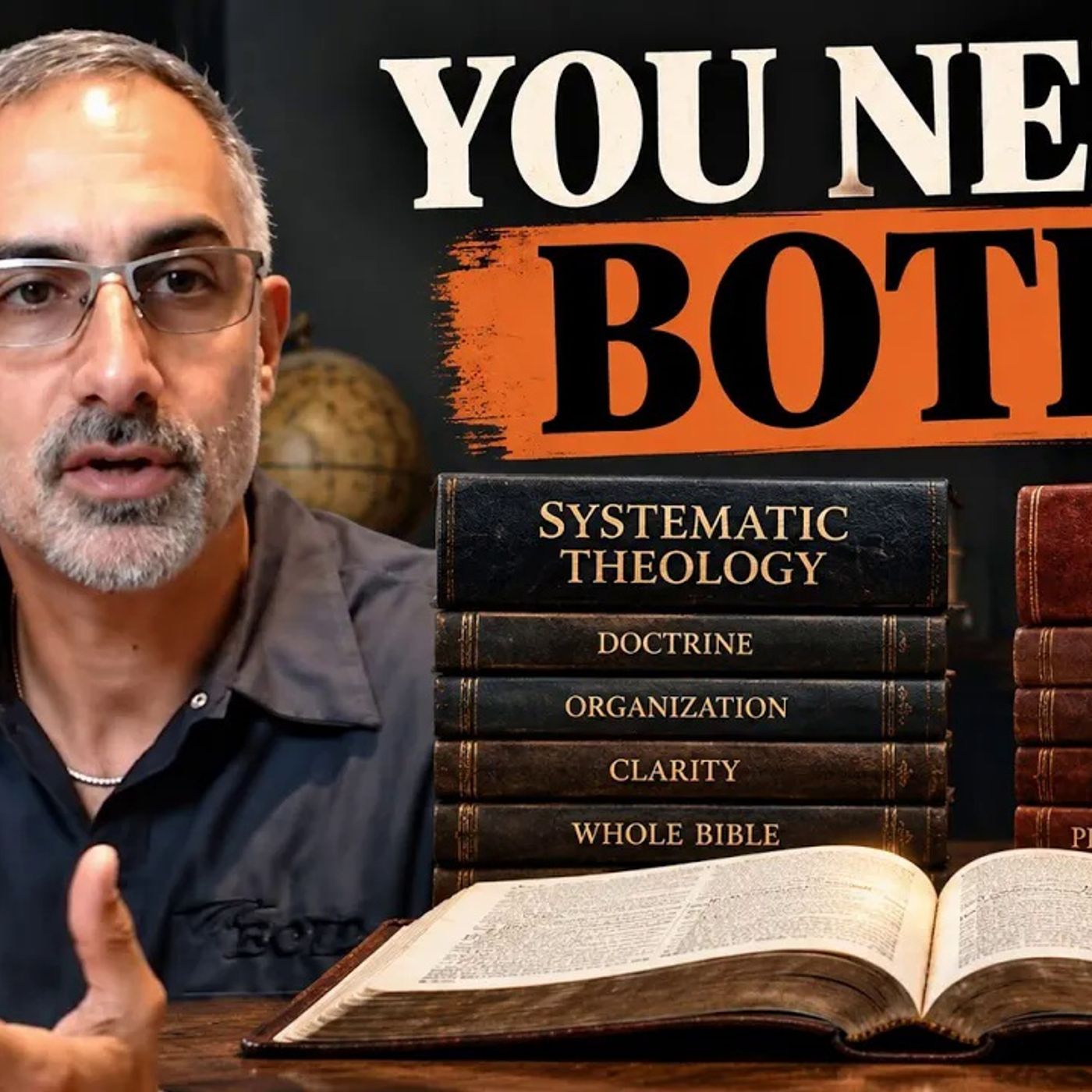
Biblical Theology vs. Systematic Theology: Why You Need Both
About this episode
In this episode of Shadows to Substance, George Sayour explains why the church needs both. Systematic theology gathers everything Scripture teaches on a doctrine and organizes it clearly, while biblical theology traces how God unfolds those doctrines through redemptive history.
Using examples from covenant theology, Christology, David, Adam, Goliath, and the greater Son of David, George shows how biblical theology helps us see the shadows that point forward to Christ without abandoning the doctrinal clarity of systematic theology.
This episode calls Christians to recover the beautiful tapestry of Scripture by learning to read both the whole and the parts together.
Watch all of our videos and subscribe to our channel for the latest content >Here<
For blog entries, articles, and much more, visit our website >Here<
Get every episode summarized
Each time Eschatology Matters publishes, we email you a written briefing from the transcript — the topics, who appeared, and any specific claims, with the ad reads skipped.
Email me new episodesFree for 3 shows. No card needed.
Hosts & guests
Transcript ready
268 searchable segments. Every word is indexed and playable.
Full transcript
Eschatology Matters — Biblical Theology vs. Systematic Theology: Why You Need Both. Machine-transcribed; use the interactive transcript above to jump the player to any line.
systematic theology or biblical theology. Which do you prefer? Which is right. I mean, you want to be biblical, right? But you also want to be systematic. How do you choose? Take heart with Corey Wing, the world view with Alex Cochman, the magistrate with James Baird and Josh Howard, the based Boomer podcast with Mike D. Virgilio, the millennial medic with Jacob Glass, down to earth theology with Matt Plett, shadows to substance with George Seor, five new episodes every week. We are the E-M Network. Shall I pray I'm working round? Glory, hallelujah, the debts of love and the lost it's found. Glory, hallelujah.
That's what we're going to discuss. I'm George Seor on shadows to substance here on the E-M Network. This episode I'm not going to specifically highlight a shadows to substance occurrence in the scriptures that I generally do. I'm going to take a step back and talk about biblical theology as it relates to systematic theology. And how that relates to this show is because this show primarily highlights observations, teachings from a biblical theology standpoint. And so that's what we're going to do. We're going to see that. So as something goes from shadows to substance, you're actually using biblical theology to see that, to situate that in redemptive history. Now, it doesn't mean we don't use systematic theology and that's going to be a point of this is I heard actually John MacArthur say this. And now John MacArthur was not known for using a biblical theology, which I'll explain in a minute.
He was very systematic in his hermeneutics and in his expositional expository preaching. But he acknowledged you can't do systematic theology without having a biblical theology and you can't do a biblical theology without understanding systematic theology. And I thought, well, that's a great observation by him. And it's true. In a sense, systematic theology is biblical theology because it's from the Bible and biblical theology is actually very systematic. So when we use these titles, we are not referring to one being biblical and one being systematic, but instead, we're using them to refer to the system and the way of thinking through theology. And so I'll just explain. Systemat theology is very simple to grasp. It summarizes and combines all the teachings on a topic into defining that doctrine. So it takes all the teachings of the Bible.
Everything the Bible says on a topic to formulate that doctrine, that's systematic theology. And there's major categories for this. So theology proper is the doctrine of God. It's the study of who God is like the Westminster shorter Catechism says, God is spirit, infinite, eternal, unchangeable and is being wisdom, power, holiness, justice, goodness, and truth. That is a part of the theology proper or the doctrine of God. All the omnis, he's omnipotent, omnipresent, omniscient. God is holy. This divine simplicity is part of the doctrine of God. And so on. And so it takes everything's scriptures say about God and it categorizes that and it systematizes it, understands it. We have this for a lot of things. So that was theology proper. There's anthropology, which is the doctrine of man. There's homardiology, which is the doctrine of sin.
There's Christology, which is clearly the doctrine of Christ. There's new mythology, which is the study of the doctrine of the Holy Spirit. There's a ecclesiology, which is the doctrine and the category of the church. And then there's eschatology, which is the study and the doctrines of end things. And then there's others. Those are the major categories. I don't think I missed one, but I may have. And so it takes everything the scripture says about those and it looks at it like that. That's pretty understandable. We get that. That's probably how most of you have learned quote unquote theology. Okay. But then biblical theology is a little different in that it views God's unfolding of a doctrine. So not the whole summary of the doctrine. Now it's not ignorant of the summary of the doctrine, but it's primarily viewed with God's unfolding of that doctrine along the contours of redemptive history
along the creation of redemption and consummation, contours of what the Bible is telling and showing. And in that involves covenant theology quite a bit because we know the covenant of grace has different. Yes, this is going to be surprising. You're different dispensations of the one covenant of grace. So you know, we covenant theologians understand there are dispensations. That doesn't make us dispensationalists. The same way dispensationalists understand their covenants and they're not covenant theologians. So this is just a title for the thing. But the covenant of grace is given or promised into Adam and the garden Genesis three and then in Noah's covenant there's that reaffirmation of some of the creation mandate, but also that God will preserve the earth actually for the covenant community. We have the Abrahamic covenant, God's promised Abraham, we have the Mosaic covenant, the Davidic covenant, the new covenant. That's all part of the covenant of grace.
And we can see the themes of scripture, the individual things that are happening in scripture in light of those dispensations of the covenant of grace. Okay, that plays into biblical theology. And so clear as mud, right? Well, systematic you still get, but biblical you're still maybe wondering about. And again, what I do on this channel is primarily biblical theology. But like I said, you can't be ignorant of systematic theology because when you're doing biblical theology, looking at the parts, you have to understand the whole to look at the parts and when you're doing systematic theology to look at the whole, you have to understand the parts to look at the whole. So you got to understand the whole, look at the parts and the parts to look at the whole. That's basically the two ways. System Aタ ballot's at the whole. Biblical theology looks primarily at the parts. And so how does this play out? Well, we can take the example, perhaps of Jesus Christ.
So clearly, Christology talks about the second person of the Trinity, Jesus Christ, fully God, one of three persons of the one Trinity and yet Christ has two natures when he becomes man in the incarnation in the one person of Jesus. So this is building a Christology. It also understands that Jesus is the new Adam that he will come from the line of David, that he will be the Messiah, the sacrificial lamb. He will pay the price for his people sins or he has, but it sees that on the cross and he grants salvation to all who believe in him and he sits at the right hand of the Father and there's so much in obviously Christology. That's systematic theology. It understands all those things and it says, Jesus is all of this. Biblical theology will see all the parts that went into the systematic theology of understanding Christology,
but it'll see them in the individual stories of scripture. So for instance, David, right? So it can, biblical theology will look at the story of David and say, hmm, this echoes back actually to Adam. David is portrayed as relatively innocent. It's post-fall, so he was, he had sin. But God looks at me. So this is a man after my own heart. God then promises to him to be king, his vice-region over his people and the kings in Israel were viewed as the sons of God just like they were in other religions. And so you haven't David, a sort of a new Adam and yet David has a fall. Now, they've had a lot of sins and a lot of falls, but the Bathsheba incident is, it's interesting. It uses the very same verbs that we're using in the Garden of Adam and Eve. And so David, so they saw that the fruit was good to the eyes and they took the fruit and then they partook of the fruit.
That's what is said of David in about Bathsheba. He saw that she looked good and he took her and then he obviously partook of, of, illicit acts with her. And so what you have there is like a fall. And so there's this and that will begin the foreshadowing of Israel's ultimate fall. The kingdom will split with his next son, who's the fruit of that marriage. So the kingdom doesn't last past that sun, Solomon. And you have, again, you have like a new fall. So you have the best of Israel, man after God's own heart, a new Adam as it were. And he can't, he can't be the deliverer of the people clearly. And it's downhill from there. But even in David's slaying of Goliath, I mean, this story's used over and over and over. And I've probably referenced it a number of times on this channel.
David, even there, he's the representative head as Adam was over the people. And everything that happens in David happens to everybody represented by him. That's the story. Goliath says, you fight me. Why should our nations fight? You fight me and everything. You know, if you win, we'll serve you. And if I win, you're, all your people will serve me. And David obviously conquers the giant. Now, and all of Israel is saved in David. So we echoed back to Adam. Now we're foreshadowing forward to Christ as David is foreshadowing Christ in that. And that's what biblical theology does. Is it takes the idea of a deliverer, sees its fulfillment, it sees its need from Adam. And what Adam was supposed to be and then Adam's failure in that. And so there's promise of one. And is this the next one? And then no, it's foreshadowing the true greater,
the new Adam and the greater son of David and the true deliverer Jesus Christ. And so that's how biblical theology plays out. Both are needed. You can't do system act theology. If you don't understand the flow and beginning to end, you can't do biblical theology. If you don't know the whole, you got to do both. But I think what has been more neglected in the church over the last 50 years is a biblical theology. Everything has become so literal and so systematic that we lose some of the beautiful contours of the scriptures that we see in biblical theology. Now, biblical theology that unhitches from a systematic theology also goes awry because then what happens is everything in the Bible becomes spiritualized and loses all natural significance, all impertival force. And that's when you get these preachers, say things, well, you're not David, that only points to Christ and other stuff like that.
And so you need both to root us and ground us. And then you get the beautiful tapestry that is the Bible. So hopefully that's helpful. Hopefully it gives you a greater appreciation of what we do here. I'm George Seor. This is Shadows to Substance on the EM Network. And you might be listening on the FLF Network. And if you are, thanks for listening. Thanks to Steadfast cigars and Rockwall Bibles for being continuous sponsors of this show and this network.
More episodes
More from Eschatology Matters

The Key to Understanding Revelation
Eschatology Matters

Is Christian Nationalism Really a Dangerous Error? | Responding to Phil Johnson
Eschatology Matters

How Nero Died—and Why It Matters for Revelation
Eschatology Matters

What Christians Should Learn From the G3 Scandal
Eschatology Matters