About this episode
App Marketing by App Masters is made possible by:
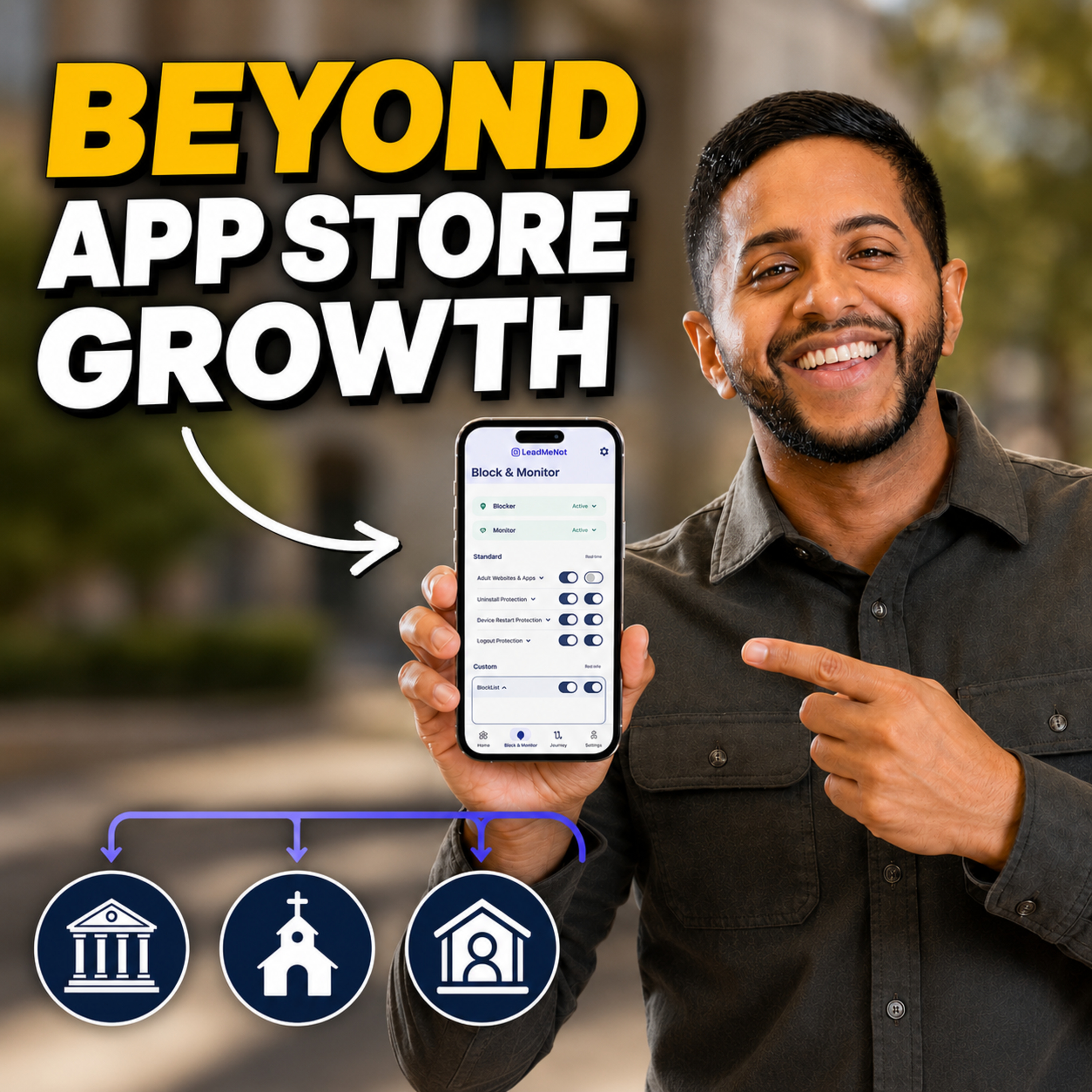
What if your biggest growth opportunity isn’t another ad campaign, but an entirely different distribution channel?
In this live session, we’re joined by Jason Mathew, Founder & CEO of LeadMeNot, a digital wellness platform helping people build healthier relationships with technology.
Jason will share how LeadMeNot is expanding beyond traditional B2C app growth by selling licenses to universities, colleges, churches, therapists, and other organizations, turning institutional partnerships into a powerful acquisition and distribution channel.
We’ll discuss the journey of building LeadMeNot, the challenges of B2C growth, and how B2B sales and institutional purchases can help apps reach hundreds or even thousands of users through a single partnership.
You will discover:
✅ How to build a unique distribution channel for app growth
✅ How institutional purchases can drive app adoption
✅ How to approach B2B sales as a consumer app founder
✅ Strategies for expanding an app beyond traditional paid acquisition
Learn More:
Check out: https://www.leadmenot.org/
Follow on IG: https://www.instagram.com/leadmenotapp/
🚀 Need help growing your app?
App Masters:
You can also watch this video here:
https://youtube.com/live/AKWkaV88B38
*********************************************
SPONSORS
The app growth playbook is changing fast.
AppsFlyer’s State of eCommerce App Marketing Report 2026 breaks down the latest trends, benchmarks, fraud insights, and market-by-market data every app marketer should know before planning Q4.
Download it free from the link below:
*********************************************
Tired of handing 30% of every in-game sale to iOS and Android billing systems? Appcharge is the DTC monetization platform trusted by King, Huuuge, Tripledot, and SciPlay – giving studios a direct line to their players, and up to 95% of every transaction.
Web stores, payment links, and a full Merchant of Record service covering taxes, compliance, and global payments – all in one platform.
Learn more:
*********************************************
Follow us:
YouTube: AppMasters.com/YouTube
Instagram: @App Masters
Twitter: @App Masters
TikTok: @stevepyoung
Facebook: App Masters
*********************************************
Interactive timestamps
Jump to segmentGet every episode summarized
Each time App Marketing by App Masters publishes, we email you a written briefing from the transcript — the topics, who appeared, and any specific claims, with the ad reads skipped.
Email me new episodesFree for 3 shows. No card needed.
Hosts & guests

Transcript ready
723 searchable segments. Every word is indexed and playable.
Full transcript
App Marketing by App Masters — B2B Strategies for a B2C App. Machine-transcribed; use the interactive transcript above to jump the player to any line.
0:00This episode is sponsored by App Charge. The DTC platform trusted by the world's leading mobile game publishers like triple.and sigh play. For a long time, game studios selling in-game items had only one option, iOS or Android building systems at a 30% fee. DTC is the alternative and today, its table stakes across the industry. App Charge makes it simple, a branded web store, payment links, and a full merchant of record service that handles taxes, compliance, and global payments end to end. The result? Studios keep up to 95% of every sale. Learn more at appcharge.com. That once again is appcharge.com. Here's a number that completely stopped me. 92% of all iOS e-commerce ads spend now goes to
1:08remarketing. Yes, remarketing, not acquisition, but re-engagement. The playbook has completely flipped. Apps flyer just released their state of e-commerce app marketing report for 2026 and it's full of data like this. Platform trends, conversion benchmarks, fraud signals, market by market breakdowns. If you're planning your Q4 budgets, this is required reading. It's free. Grab it at the link in the description. What is up, App Nation? It is. steep. Young founder of appmasters.com. And what if I told you, if you sold to one user, you can get thousands of downloads? Well, I brought an amazing guess for you to break down his
2:11B2B strategies. When is the right time to potentially go B2B if you started out B2C? And what's been the best approach to landing those businesses as a B2B strategy? So without for the do, let's get going. I got my man, Jason Matthew. He is the founder and CEO of Lead Me Not. He's going to tell you a little bit more about it, but it is a digital wellness platform helping people live healthier relationships with technology. Jason, welcome to the show. Thank you, Steve. It's an honor to be here, man. I'm super excited. You know, we got to work together. I'm super excited to have you on and showcase some of your success. I would do want to say hi to a few people. Kevin, good to see you. Kevin, first one here. We got Luis. We got BS. I don't know. All right. We got H and H. Come on.
3:13Leo is here. And then we got A.E.T. apps. Cool new intro. Thank you. H helped me with that as well. But Jason, take it away. I'm going to, is there anything else you want to add on with Lead Me Not? I can show off the website as well. Yeah, no, I think you're hidden well, man. Digital wellness. How do we help form healthier relationships with technology? Something I'm really passionate about, which I'll get in a little bit into. Maybe not super novel when you think about, hey, there's screen time apps that are out there, etc. But I think our power is being able to help men and women really dig deeper into the why behind their digital lives. And just looking beyond screen time and really understanding the depth of, let's say, digital wholeness. So, yeah. But yeah, man, you got it. Thank you for this. Yeah, of course. You guys can check it out. Lead Me Not in your favorite app stores or leadmenot.org as well. And then Jason has prepared a cool presentation to walk us through his B2B strategies.
4:18So go ahead, Jason. Take it away. Yeah, sure. Sure. Yeah, man. So again, thank you for the opportunity. You know, I think when we, honestly, like a year ago today, what we're talking about or what I'm sharing was, it was a hypothesis, right? And even now, I'll argue or people could argue it still is. But we have actual data, whereas last year, it was just a thought of like, hey, what could this look like to actually bring leadmenot into what a call institution? So it's really only been over the last, let's say five or six months where we started to actually take steps towards what we call building a district, additional distribution channels for leadmenot. So like we said, hey, leadmenot is here to help people reclaim their digital lives. Something I like to say is digital brokenness looks different for everyone. When you hear brokenness, that could be, it's a spectrum, right? It could be, man, I'm really addicted to digital gambling sports betting, pornography.
5:24And the other side of this is, man, I'm just not taking like, I'm on YouTube for two minutes, too long each day. Right? So we've created a platform across iOS, Android, MacOS, Windows, Chromebooks that say, okay, how do you string all this together to help tell a better story? And today, you had over 100,000 installs. We just hit 100,000 AR a couple of weeks ago. Steve, you and I, masters have been part of our journey and story. So thank you, man. And I don't know the exact number. I'm sure it's over five million distractions that have been blocked over time. That's easy, man. So before leadmenot, it's funny because I actually have come from the beat to be space, right? So I spent years working with B2B technology. Started my career at the company called CEB. They were then acquired by Gartner. So Gartner's magic quadrant, really big IT research firm. And I was working in our HR technologies that
6:30CEB acquired. So I worked in customer success, I did tech sales, count management, product management. And then I was at IBM for five and a half years in a data AI and automation businesses as a product manager. And then I turned into a founder for a D2C app, which I had no business doing just considering my background, but I was something I was super, super passionate about. So how we got here, right? In 2021, lead me not started really just based off from an idea that was from my own story, my own test, I graduated college, moved out to the Bay Area in 2013. Steve, you're home. I was in East Bay working for CEB and Tinder had just come out. So someone who never dated, never had any real experiences with healthy experience or any experiences dating, Tinder was just a black box, Pandora's box for me, where it really led to some unhealthy
7:35behaviors, right? Like sexualized experiences with women, lustful experiences, and you know, that spoke to me as with my faith background of a Christian saying, hey, this is a life that I don't want to live and apps that I was trying, work feeding my use case. So I'm going to go try this myself. So in 2021, we launched an Android just as a free app. I started on Android because I'm an Android guy and as you could, I think anyone listening to this and you're complete idiot for starting on Android, but it's part of our story and journey and we have a reason for it. But 2023, I got to go full-time with lead, me and I after getting laid off from IBM and got a group of investors to come on, impact investors and say, okay, we got to start making money from this. So that's where we started our D to C subscription growth, right? I didn't think we'd even get a dollar and then we got our first five, we got our first 50 plus 100, what have you. And then from there, it felt like a little bit of a slower journey, right? At like Steve, when we started working together,
8:40you know, and the team that we have, anyone I've worked with from App Masters, like Jason, you're the only one here that has an Android-only app that you try to sell. And I'm like, oh my god, but we got to do it. And it's been fun, but yeah, a lot of the first, really the first two years, right? Probably first three years, 2023, like half of 2023, four and five, was me trying to scale an Android-only app. And then we started last year taking steps towards building on iOS. We finally launched for the end of the year, but even then I wasn't super proud of it. But then this year, we got iOS to a parity and really proud of what we've built and knowing there's so much more. We got at the end of last year multi-device, which is a core part of this value proposition, right? It's not just tracking your phone activity. It's a cross-device. But then this year is also as when we started saying, hey, what does it look like to bring lead me not into an institution?
9:45And again, that was, I think, built off of some lived experience, but also just like anecdotally, like, hey, headspaces, you know, selling into insurance plans now, right? And like, I think just hearing like bits and pieces of that over the years, I think is what planted the seed inception. Maybe we could have that too, but also believing strongly in this idea of like, hey, there's a strong faith angle to this. That's not just a marketing gimmick, but beyond that, there is a message that's resonating even with secure audiences. I wonder what that could look like, right? So, Steve, to your point, right, hey, the model that we grew on was, or started with was we're acquiring customers one at a time, right? Anyone who listens to you, Steve, anyone who follows you, anyone who works, if you, anyone with a direct-to-consumer app, we're following this formula, right? We're running paid media, we're getting an individual user trial or purchase subscription, we need to
10:46retain this person, right? And the channels that have been effective, that we're still very much figuring out to continue to optimize, is given our numbers are still very early, whether it's Apple Search ads, Google ads, meta, Steve, we need to talk, because I need to do much more with meta, and we're clearly not doing it well. But what I'm excited about is like, we've come this far even on sub-optimized channels, which, you know, tell me if I'm wrong, Steve, but I think that to me is still, it's still important to signalling, we're solving a real problem, and we've built up a real customer base. Yeah, absolutely. I think you, you know, it was crazy, because when we first started working together, the fact that we were able to generate, and you can tell exactly how much, but we were able to generate money just through Google, I was like, yeah, like a holy crap, and I was super proud of the team for making it work, and to reach certain revenue milestones with just an Android-only app, and so it did set that foundation. But what made you kind of consider
11:48like, when do you think is the right time to implement a B2B strategy? Yeah, I think, I think for me, it was more of like, I was looking at it more from a product perspective, because I felt like we couldn't have a seat at the table with an institution, unless we had a value proposition that actually felt more bulletproof. Like, at a minimum, you couldn't, I couldn't go to a church, for example, and say, hey, we want to talk, I want to talk to you about this app for your congregation. I slowly tested that, I quietly tested in like 2021 and 2, the church I was going to in Austin, and the first question was, dude, we have two people in our church on Android. So I was like, okay, not now. But then later, it's like, well, such a core part of accountability software or blocking software and digital wellness is you need to have, again, multi-device. So for me, I looked at it more from a product standpoint of like, at a minimum, I need to be proud of that and feel like that itself is relevant. And then this, all of this,
12:55on this slide, with the product stuff is what got us to ask that question around like, hey, what if we didn't have to acquire every user one at a time, right? Around like, and this may not be true for everybody, but I think everyone needs to be asking this question, right? If the director consumer side is lead me not to one individual, then what does it mean? Lead me not to one or to 10 or 100 or thousands of potentials. Yeah, we've had clients, we've worked with the clients where B2B model was just as much, if not more than the B2C model as well. And I think it's the general, like not general, but like, if it makes sense for your app, it is maybe the right transition because of growing costs with B2C campaigns on meta, on Google, on Apple ads, like, hey, what if I could just talk to a university, a church, and then being able to license out my software?
13:56So I do like the strategy here. Yeah, exactly, exactly. And you know, even, again, Steve, like, I didn't know by any means, in case this is actually going to work, and it's the message you're going to resonate, because I'm curious, like, even the clients you're talking about, are they doing like a million AR, or then 10 million, or they're actually like smaller, like us are even smaller than us, because that was something I was maybe insecure of, is like, well, we're not, we don't have this huge brand to walk into the room, but we have something, and I wonder how it would go, right? Yeah. No, they're, they're usually around a million plus, and then they start going into B2B. Gotcha. Yeah. So, you know, Jury's out as to how this will continue to sustain us, but again, what is exciting is that something's working, right? And I think you're going to look at this, is it where do we start looking? Is, okay, we ask the question, who already cares about this problem, right? So, one is these universities and colleges,
14:58student wellness, right? They're thinking about digital habits, right? If we start with like Christian, and I started with Christian universities, is, hey, they're already investing in things like discipleship and student counseling, and these different ministries are thinking about it, we're forming a student over four years in a very specific way, on a very specific doctrine, in worldview, which, you know, of course is, again, me coming at this as well as a Christian, like that seems like a great place to start. Same eye content with churches, right? You're already investing in your people, digital lives, no one can say is independent of your physical being, right? Of your spiritual life, your relationship with God, etc. Therapist, treatment providers, less faith-based, but there's that angle too, but also like we're working with people who want help, and then also the angle of, you know, employers and other organizations. So, the cool thing is,
15:58like, it's the same product, right? It's a different entry point. Something I got asked early on, I was like, well, man, are you going to go build a new product for church? That doesn't seem sustainable, like, you know, you have to go higher out of different dev and dedicate, like, no, no, no, no, hold on, like, same product, the way we're coming in, this looks different. Like, we've had to make some adjustments for how that's worked out, right? It's like, we have this concept of a promo code, which funny enough doesn't even discount pricing on our paywall, but I built, we built it so that an org can say, we have a code, hey, 200 students go use this, right? Asbury University, it's a huge university, really proud and honored that, honored, not proud that they've decided to partner, as they purchased 200 students or licenses for their student leaders, and I presented to them in Wilmore, Kentucky a couple of weeks ago, and, you know, we got 150 redemptions right now on that, right then on that code, that was already covered, right? And
17:01everything is tying back into revenue cat, which even revenue cat is like, this is such an obscure use case that we need to build for, but we're able to figure it out. And like, this entry point of take the porn use case, like, hey, we help people struggling with porn, but what we're testing is digital wellness and wholeness as the front door, right? Because as we'll get into like, a pastor of a church talking about pornography, it's still so taboo, unfortunately, in the church, talking about that from the pulpit is going to resonate really different than, hey, how are you thinking about your digital life congregation, right? And like, and a lot of that is because, like, the underlying problems themselves aren't niche, but talking about them can be, right? They're talking about, you know, the tabooness, right? And some just high level metrics, like, 54 barn and pure desire, they did a research study, a refresh, like 54% of practicing Christians say they
18:02view pornography, right? 10% of Christian adults say their church offers programming to help, which is very, very low when you think about what the value of a church space, and then 58% actually say they want to address, but their church isn't doing anything, and then digital gambling, Steve, you know, it's exploded, sports betting, call she, all this stuff, right? So, yeah. Again, the problem itself isn't unique, but the environment in which it's being talked about and interacted with is different. And, you know, a lot of the B2B experiences, again, never being a direct seller myself, but being in those environments at a garden or at an IBM, we have to always be thinking about language of the buyer, right? You have to learn the language of the buyer, right? A direct direct consumer is going to say things like, I need to stop looking at porn, right? 2 a.m. I'm scrolling. I need help point of desperation. I need accountability. I need to stop wasting hours
19:03on my phone. Let's say, again, this example of the church, the church says, hey, how do I, if I'm leading a church, how do I help my congregation pursue digital wholeness? How do I quit families? Because I'm talking to all these parents that are really anxious about, hey, my kids about to get their first phone, how do I support them, right? The language is really different, the underlying way in which we're solving for that problem and then the value that the offer itself fundamentally is not different, right? But the language is. How do you know what language to say, Jay? Other than English, you mean, right? No, you know how do you know that talking to a church, you know, how do we help our congregation pursue digital wholeness? How do you know that's what they're looking for? Yeah, I mean, yeah, that's a great question. I mean, I started again with that hypothesis because I personally, right, I have like time-lived experience in a church,
20:05but then maybe just like talking like anyone who's ever built an app, right? If we're not building it from real research and talking to customers, like I naturally as a founder love that, right? And fun, it's crazy when you talk to founders and builders who are like not thinking about it at all or it's like an afterthought of like, I'm just going to turn out this AI app and like people are going to go pay me money because I'm running this playbook, but they're not talking to customers. That hurts me a little a lot actually, but like in a B2B space, you can't get away with that. So, yes, Steve, it starts with a hypothesis, but then it just goes on just talking to people of like, you know, my brother-in-law is a pastor of a church, right? And like when he's been part of my journey before leading me not ever started. So like some of these just like anecdotal qualitative, like, okay, maybe that'll work, maybe not. So like just starting with these conversations and then
21:07adjusting the pitch and the story as you gather more data. That makes sense? Yeah, absolutely. We got a question from Nita. She says, can you use the same approach on C2B as well? So consumer to business? Oh, I don't know. What would that be? What's the thing? I don't know. Yeah, that's it. That's hoping you knew. But Nita, if you can go still around, I was hoping you can elaborate on what you mean by that. And maybe what like a specific example of what you mean. And then have you seen any benefits from Apple if your app is getting a lot more downloads, those institutional purchases as well? Any improvements, Apple features? I mean, not yet. I mean, the reality is like, if you go to leadmeanod.org, you're scrolled on to our logos, like other, there's a lot of active conversations we're having. But like there's five or six universities that have come on. One, we have a first church partner, we're getting our second one that's going to sign here soon. So like, we're not sitting here like, man, I've got 10 or 20, but like we've
22:12amassed these logos in five or six months. And like, Asbury was cold, right? It's like, hey, I'm Jason founder. I didn't know anyone who worked at the institution. And then some of these were warm, but most of them were just cold. So yeah, that's a great question, but I haven't seen any benefit yet. Now, I'll ask you how you, you know, I know you get a slight coming up. I'll ask you how you got into the cold conversations. And now you're able to get in there. Sure. All right. Yeah. Back in. And by the way, like on the, just for anyone asking, like tactically, I mentioned, like, revenue cat doesn't have, if I want to, if I want to send a link to an institution and say, hey, pay me, this is $2,000 for 300 licenses or something. There isn't a clean way to do that, but you can handle it. So like, all of that, all of that revenue is coming as web billing revenue. So it's only a 3% cut. So like, I don't even think Apple actually knows that it is a institutional
23:14purchase. You know what I mean? Because it's all coming through revenue crafts, web billing, which is powered by strife. Nice. All right, Jason, once you take over, I got somebody at my house, and then he needs help. So I'm going to let you. I'll be right back. I'll just. I love it. Thank God you're not asking me to fix that problem in your house. So yeah, you know, how it actually works is, you know, the institution becomes both a customer and a distribution park. Right. So two customers have to win. The institution has to see enough value to buy and renew. Right. Everyone here knows renewal. It's just as important as the purchase and the individual has to get enough value to activate and keep using it. So when when I'm talking to these institutions, which again, we're still very early when, you know, this is not a repeatable process yet. Where it's like, man, every week we're getting a new purchase, right. It's still like it's founder, led sales. I have to be running it.
24:19And there's going to we're going to get a lot of knows before we get more yeses. But, you know, we have to we have to provide a value proposition to the institution as well because they are the customer, right. So that's, hey, we'll help you roll out. Hey, we have a redemption infrastructure in place. Hey, we're building like we have an admin platform where an org can log in as the as very university and see how many students are using this. How many rules have they created? How many of them have an accountability partner? How many students none of them will know who the students are, right. It's all I had in the many privacy that's part of our value problem too is like their self agency here, right. But, hey, you'll be able to look at all of these key metrics like the unit the institution has to understand
25:21this is actually working and the end user has to know that it's working as well for them, right. The organization invest is investing in lead me not on behalf of the people that they serve. Hey, Jason, what came first the dashboard or the sale? Sale. Okay, I love it. Okay, thank you for saying it. Yes, say it till you make it. Yeah, I mean, literally like funny, funny, the I think the first, I think even the first converse, it wasn't even the first sale and it was the first conversation. Someone asked like, well, like, how will we know usage? I was like, yeah, how will you know usage? I was like, well, I'll give you a CSV file out of our DB. And then it turned into like, let me just do a mock AI image of like what an admin platform look like. And then it turned into, dude, I went and hired out a dev team out of Sri Lanka that I was very confident like, okay, we could build something really quick. And then the next meeting I had, I pulled up a demo staging environment
26:26of the admin platform. Oh, by the way, here's what you get as well. So that's awesome. Yeah. You know, it's funny. Like the customer relationship is so different, right? Like anyone, any founder listening, Steve, you know this with your own apps. Like, well, it's funny because you know with your own apps, but you know, you know, you know this lived experience with app masters. Right. When someone discovers an app, they download it, they pay it, they use it, they hate it, they email me. They are a faceless entity. Yeah. But I get on Google meet calls with my customers to diagnose stuff. People will call me like, I'm very relational with my customers on lead me not because like, this is like a, this isn't an app that helps you look like a dog, right? It's like this, this is a deep, deep emotional problem and solution. The institution is, is has a face and it's built on a relationship, right? So they're not just
27:28trusting lead me not in, in many cases, they're trusting me. You can even argue, they're not buying it out of man, we just lovely this app and the app is badass and all that stuff. You could argue just like you're a pre-seed and seen investor, they're investing in the founder rather than the business. Are they actually purchasing because they trust me more than the actual product? Yeah, Steve, how do you experience that? Because you have both sides apps and you sell on app masters. You see your customers. Yeah. I mean, look, the B2B route is the, the human side, you hit it on the head, Jase. Like, the human side is important and I think, obviously for us, when we do YouTube, it's changed the game a bit and that people feel like they know you are ready, they come and it's already a very, very warm lead. And so we have that advantage to it, but I've done a lot of B2B work in the past and it, yeah, like it is you. Like, you're selling you and that's it.
28:32So I think it's a great distinction that you put down here. We got a question from Leo just to back to your screen because I don't want to go over it, but he says, like, you know, what have you realized from a B2B? Obviously dashboards, reports, self-service, like anything surprising that a B2B customer has asked for that you didn't think of like in the very beginning? Well, I mean, in one example, you said Leo, isn't it? Yeah, Leo is his name. Yeah, like, Leo, like, I mean, that admin view is one example, right? Thankfully, it came up once and then it was like, yeah, you're right. Like sending CSV files isn't going to work. I mean, we've gotten some other like, actually, like, there hasn't been anything else that's come up that's been too surprising. And I think part of that is because the like, the instant, like, this is such a,
29:32I think I say this humbly. I think it's such a unique value proposition. When I in the church, there's two resources that I've seen churches invest in for their congregants. Dave Ramsey, financial piece university and right now media. And both of those are very different, right? Dave Ramsey is about, hey, how do I help you be more financially well and steward your finances? Second is like, right now media is like online content, like Christian content. And then lead me not as like, well, I'm going to help my congregations help manage their digital lives and parents with kids. And, you know, we have men's ministry, guys who are struggling with sexual brokenness and men, women's ministry, like, it's such a unique value proposition where I think they themselves don't know yet as to like, what exactly do we need? Because I don't, I don't think others are coming and knocking on their door for say, right? Maybe
30:36covenant eyes. They've been around 25 years. But even like our sale and our pitches is different, right? Then a covenant eyes. So why not lead with just the Christian aspect, the religious aspect of it? Because I've seen a lot of different apps that lean into that and then combine it. Have you, did you think about that in the very beginning or was that just something that you consciously stayed away from? No, no, I mean, going, so I've leaned into it. Like, I want to say lean into it. I've fallen face into it, man. You know, because like the churches are like, I think Christians are very sensitive. I just, as of like, bias, you could say, yeah, like we're very sensitive to like, is this person being disingenuous? I can't go into a church and talk to a pastor and subtly talk about my faith. Like it is a
31:38like front and center. And like Christian universities, you know, for those listening, like, there's very conservative Christian university and that conservatism can, you know, is a spectrum. So like, I don't want to hide that at all. I'm like, hey, I might like, let's go, right? But there, I, Steve, I haven't talked to an institution yet where I've had to be a bit more muted. Oh, I'll give you a good, actually, I'll give you a good example. There is a, I left it out of this deck. There is a beat to G angle to lead me not as well, business to government. Because there was a public solicitation on a state government agency looking for gambling, blocking software, literally is what it was called. And I read the RFP and I was like, dude, we got a, we got a bid for this. So we put in, you know, a bid and we'll know this month of who, who got awarded by October 1st. But like, I'm wondering if the fact that we're lead be not
32:43into temptation, I think the faith angle will end up hurting us because it's a government fund and publicly funded, like agency that is then funneling dollars into a software provider, right? So does that make sense? Like, yeah, yeah, I don't know for sure how that will or won't, but it'll be interesting. And, you know, signing the contract itself isn't the win here, right? The win is, we don't know if institution going to renew. I'm signing and pushing for 12 month, again, from B to B experience, like, you do not get a B to B customer on a one month subscription. You get them on a 12 month subscription. And you, at that, you get them on a, try to push for a three year commitment, right? And like, I will lock in this price of you commit for three years. You can do like a one or two month trial, like I'll give you an example. There's a church that has verbally committed that started with a men's ministry that was specifically
33:46focused on sexual wholeness. And we did like a two month trial. And then that guy who let the group pitched it to the elders of the church. And then the church leadership said, we want to do this for everyone in the church, right? And I sent them the contract at one year to three year commitment, what the pricing clips are. But like, that's a perfect like, yeah, it pushes out your time to close the deal, right? Quote unquote. But you had to win and trust, you had to win trust on that like three three month pilot or so. When you're talking about winning the contract, and I think you're going to talk about a little bit here. We got questions from Leo as well. But how do you should measure the success? So when you sign the contract, are they buying the licenses? So you sell 100 or 1000, you tell me how much you're selling it. And then buying the whole licenses, right? And then probably at a discount. But like, wouldn't that just be the win? Because you got
34:47the money, right? Okay. Yeah. Oh, yeah. I mean, yes, that's true, right? Like from a cash flow perspective, we'd, and maybe I'm being too hard on myself. Maybe it's because I had a two day workshop with our investors last week where they're like, hey, listen, we need renewal data too. But you're right. Like the cash flow itself is huge, right? Because hey, we're still working towards profitability on a bit positive roles on meta. I need to figure out meta and all this stuff. But yeah, you're right, you're right. But to me, 12 months from now, if all of these institutions start coming back and saying, ah, sorry, we don't want to do this again. Yeah. I see. That's more painful than someone who turns after one year, like an annual sub to me, to me. But I mean, you tell me if you disagree with it. No, I think it makes sense. I think it's, you know, like it's
35:51the way I think about things is one at a time. You got to get the first win. So you sign the contract, you get the money into the door. And then second win, let's keep these people happy. Let's get them using it so that the year comes over. That's sort of like the philosophy that I have from a B2B perspective. Like we make it pretty easy for you to sign up. We don't try to lock you in. But I say, like, I want to earn your business. So like, obviously, there's been clients we've been working with for four or five years now. And that's me earning their business. And so, you know, I think of it as like, obviously one is a monetization perspective and clients. So you're signing those contracts. And then two is a retention because if I can keep them happy, my LTV continues to grow. And so it's like two different health problems. Yeah, yeah, exactly. Exactly. And then, you know, Leo, to your question, I mean, it depends on the group, right? Depends on like, hey, in this particular case, I'm talking about this church was like, Hey, look, we have a group of 10 and three, four,
36:52five guys were like, man, lead me not super helpful for me in my marriage. And like, it was like, hey, listen, that's enough where we like, we see the we see the overlap. And then, obviously, like the elders of the church had to be convinced, like, okay, we see the applicability. But yeah, it really depends on like everyone, I go in and like, try to work with them of like, here, let's get really pointed on what success looks like. So that after 30 days or 60 days, we're not looking back and saying, well, you know, only one out of 10 used it. But it's like, well, but hey, you said success was even if one person finds value, that in and of itself can be powerful for everyone else in the church, right? So yeah, it just depends. Yeah, you know, steep to your point, like the math changes on the partnerships, right? Because of the number of users you're getting. But again, a 5,000 person org is not 5,000 users. The organization,
37:58and like we're working, you know, I sent all these universities this week, a bunch of marketing materials that I had of design, you know, put together of like, okay, here's how you communicate this on campus, right? It's like distribution isn't the contract distribution is successful deployment, right? Because again, you could sign something and then it's like six months in. Oh, by the way, we forgot to actually tell people about this thing. So like again, what do we know? What do we not know? Right? We know that orgs are willing to pay. There's a problem as a resonating. One relationship can create access to many, right? And I think the relationship itself is creating a competitive advantage for us, right? If we're going in, not to the next university, the next church and like, hey, and like I hate it, I hate it to be like a marketing gimmick of like, I don't want to just go in and say, hey, by the way, here's everyone using us already.
39:03But like it's true, right? And I don't, I don't, I hate conflating truth over, over conflating truth. But like, yeah, what we don't know yet, like we said, is these long term renewal rates. And is this going to become a major share of revenue? Like, if you look at our ARR now, of that 108K, well, like 5% or something last I look 5 to 7% is from institutions. And that's because of like, I'm not, Steve, I'm not going in trying to maximize revenue on these first deals. Like that's part of it too. Like I have, we have no credibility. We can't go in and say, this is a, you know, pay us 20 grand a year, right? Like maybe one day, like I think we, there's a day where that will come, but I don't know when and I don't know who yet. And we need a lot more data and testimonials. And the story needs to be strong. I think you're there. I think you're in there suddenly now. I think you're there. You think so? Yeah. I mean, you got a lot of,
40:05like, look at these all see, like I'm looking at your website obviously, but look at these great institutions that you have. And one thing I did want to point out, but I was going to late wait, you know, for me, like the go-to-market strategies always, for me in the very beginning, because it's go-to-market is trying to find the easy yes. And because of your Christian background, like, to be honest, I've never heard of these in universities, but like, for our faith base, like, and they are all Christian from what I can tell Christian universities. So that's the easiest yes that you could have gotten, giving your background, giving how you built it, and the the reason for you building it. So I just love that, you know, instead of going to, I don't know, Yale, Duke, whatever, you went to like, which ones are the most relevant? And which ones can I get an easy yes? That is more faith-based versus just going after any university. Yeah, yeah, exactly. I might get laughed out of the room now, Duke, or so maybe more, you know, more on the liberal side, let's say, but maybe not, maybe one day that isn't going to be true.
41:11But anyway, now you're going to get people saying you're your show got politically going perfectly now. Oh, good. Yeah, so just a bunch of lessons right now, like, I'm not going to read through all these, but like, yeah, again, buy and use are different. Positioning changes by audience. Pricing is still an experiment very much so, right? Like Steve, like you're saying, hey, Jason, you're there already. I'm saying like, are we, I don't know, let's see, short version. This is just the beginning of the work. It's not the end. And you know, I personally, it feels like a comfortable circle here, right? Like early career, C.E.B. Gartner, and IBM, the managers that managed me, the leadership I was under, the products I worked on, the customers I worked with, like, those are all super formative for me in my career and life in my 20s. And then,
42:11you know, I'm 35 now started, I started, lead me not in those early years and, you know, we've come a long way. And it feels full circle. We're like, okay, a lot of this B2B stuff matters again. And, you know, the difference though is like, yeah, I, I, my team, we own the outcome, right? It's like, I'd be on a bunch of calls with sellers demoing product. And then I can get up the demo and be like, okay, good luck. And I hope the deal works out. Now it's like, oh, God, I'm praying this deal works. Like, will they say yes to another call? What have you? So it's, it's quite different. Again, say what we're talking about. We're building two growth engines. I'm curious from those listening and who listen later. It's like, one of the things I got, like Steve, I'm curious your perspective, like, hey, we're building two growth engines, right? Direct to consumer and then B2B, B2B to see B2G if that comes to fruition. There could be people, like I had a call with someone
43:15recently, not too, someone recently, it's like, hey man, I think the B2B stuff's a distraction. Like, figure out real scale on D2C, 10 grand a month on Metta's turning into 20 back. Now I'm setting 100,000. Man, just focus on that. Don't waste time on B2B. And I'm like, I mean, what's your take? Like, do you think this is the distraction for me and us where we are and for other founders? Or do you think, no, it's all everyone it's worth trying? I think it's the way I see it. I saw this quote from GaryVee a long time ago. There's every, there's millions of way to do get to a certain point, to a certain goal. You just got to find the right way for you. So if you feel like in your heart of hearts, this is the right way to go. Great. Do it. Right. For me, I started with B2B, well, I started with B2C and then I was like, okay, I got to go B2B because that just became the easiest way to go when I left my corporate job to do outmasters full time. B2C was the easiest
44:15way I could go instead of B2C. And so I think it just honestly, like, there's no right answer to this and you're gonna have to feel it. Like, I do understand. Like, sometimes like most of our clients, just to give you some intel, Jase would be, they've hit a certain point with B2Direct to consumer B2C. And then it's like, okay, let's try the B2B angle now. And just like, okay, we've heard, we've hit all the scale that we can potentially squeeze out of the D2C. So let's go to that. Certain clients, they're gonna go directly to B2C. And given your background, I don't think this is a waste time because you come from the B2B background. Like, if you're somebody like an engineer and I have no sales experience, I'll be like, bro, maybe not figure that out. Don't go to B2C. So right, don't play to your advantages. Sure, sure. Yeah, that's a good point, man. That's a good point. And like, and even my the B2B stuff, it's like, I don't even know if I was good at it, other than just like, I experienced it. And like, I think if there's anything that's, I'm learning about myself is like, again, I don't have the profile of a hardcore, hardcore
45:21cellar. But we're talking about relational based celling when you think about the challenger model of coming in and using data to disrupt someone's thinking and narrative of a situation. Plus like, hey, man, I want this to work. And like, I'm, I genuinely am caring and loving. And this is something out of my own testimony and story. I think all those pieces together at least seems to be working. But then, yeah, and then maybe at some point, it's like, hey, now I need a full time cellar that is the exact opposite of Jason Matthew and just out there pounding the pavement. So yeah, thanks for saying that Steve. Yeah, and then just to close, the next question isn't that I'm asking, can we sell B2B? It's all this others. Can we make it repeatable driving adoption? Will they renew? Can we scale? Will we scale beyond founder web sales?
46:21Still early, we're seeing enough to keep going. I really want a government deal to come in just because it's so unique. And like, yeah, so I just get excited of like, what else is out there that we're not even seeing? Right? Of like, what is this really obscure case that someone comes in and says, like, boom, can we get a hundred thousand dollar deal for lead me not? I don't know. But, yeah, man, it's been cool. Yeah, any other questions, Steve, or the audience, anyone? No, I was hoping you go to the next side and now I'll have questions for you. Oh, okay. Yeah, some of these were more just, you know, the, the anatomy of the deal. Like, I think they can read it, yes, but like, the interest, the prospecting and intro, like, when you are going approaching someone cold, what is, what have you found to be the best way to get your foot in the door? Yeah, I think the getting the foot in the door, whether it's
47:23so when it's cold, right? So cold email is just being, and I'm like, I did not use an AI cold email company. I'm actually on month two with one sales.co shout out, sales.co. And like, I don't know if that's actually going to be as effective after this month than if I'm doing it. But like, just being really genuinely like, hey, Jason Matthew found to lead me not created this because of my own struggles. Can we talk? And then like, I'm very persistent, right? With dating and women and with this, there's some older love here, my hyper fixation, for better or for worse, but like, following up and being like, hey, can we just talk for 15 minutes and getting on a call, getting on a video call, and just having slides ready, and just having a conversation and being really trying to be really just very genuine and like, not every, okay, I think everyone can be genuine, but it can be hard
48:25or other. So that's I think what's been working. And then on the warm side is not being shy to ask your network for help of like, Hey, man, who do you think this could work with? Can you make an intro? Can you make an intro? Can you make an intro? I'll take it over. And people respond differently to that, right? Like, even my own investors have had to be very careful about who they intro with. So, yeah, then the prospecting intro stuff, I think is, okay, if I showed you my hub spot, which I won't do, there's, there's like a 150 plus 200 plus deals. Like, you have to constantly be expanding. I got on a call yesterday with a ministry. He sent an email on that call to three other ministries, intro to Jason, intro to Jason, intro to Jason. I'm like, Hey, man, thanks. Can we talk next week? Talk next week? Talk next week? So you got to like just, yeah, man, it sounds different. It's a different grind, right? Steve, it's a different grind. Yeah. Yeah. So you guys
49:26could read this, right? Of like, the anatomy of these deals just look really different. And it requires a different level of effort. And then again, just, you know, hypothesis being tested. Churches were just, we have one church on that hasn't rolled out yet. They just sign and then two churches that have verbally said yes. One will roll out in January, the other one. I don't know yet. But once their sign invoices paid, logos will go up and then just start working with them on roll out. I mean, those church that verbally said yesterday, like they want me to come down to Dallas and like record some content and like they'll play during church service and stuff like that. These, you know, set 800 person in church, which is big, but also even smaller compared to some church that thousands of members. So yeah, yeah. So that's impressive. Well, A E T apps, get a community name. And let me see if I can remember it. Said, this is one more positive for your
50:28specifically. Individual users can stop using it after you help solve the problem. Whereas institutions are more likely to renew the subscriptions because they're congregation or their users are seeing benefits that are like, Hey, let me just, you know, push this out to more of our organization. That's a good point. Yeah, that's a really good point, right? Like getting getting someone, yeah, getting someone to renew again on like an annual sub. I don't actually don't know. It's easier or harder. Like if a, what do I do next 12 months from now, if one of the institutions like, yeah, like, we want to do this, but you got to, you know, let's we're not going to pay you the same amount. Cut and give us a 50% discount. I don't know. So yeah, but like, I think the upside is there's higher. Love it. All right. Okay. I'm good to see you, bro. And then a, a Lissio, good to see you. I always put his name. That's why I'm not. He said,
51:30I always wondered some apps we featured on phone carriers. These apps that charge a fee inside the mobile plan. This is very common in Brazil. Do you guys know something about it? CTO, like, I think you can work with these. I have work with clients that have done deals. There's certain companies that allow you to pretty much be on a device, right? When somebody buys that device. So it's hit or miss. Like, I think it's really for bigger companies, like a LinkedIn or, you know, like a really big company of that size where you can do that. You might not just, you get the downloads, but you might not get the usage. So, and there, it is a lot cheaper install. But I would say it's really for, in my opinion, the bigger guys in there, be, I don't know. And then you got some love from yeah, okay, good. There you go. He's on LinkedIn. And then Leo says, have you run pilots before selling it? If yes, were they paid or free pilots? No, yeah, yeah. That's what I'm saying. Like that, that one shirt technically did a pilot. Interesting. Let them use lead me not for 30, 60, however many.
52:37Try not to go beyond like I lead with like one to two months. Free, right? But some of the institutions like even say like, hey, we're going to pilot this for a year. I mean, it's semantics like, hey, we're going to, okay, let's take Asbury as an example. Asbury is talking about this as a pilot year with the intent to go to all students next year. So it's, to me, it's not a pilot because they're paying customer, right? And like, we got to make this successful. But if a pilot is like an extended free trial, then yeah, like 30, 60, 90 days, and again, get really tight on success much. I love it. All right. Well, if you got any questions, Jason, to be here and we'll answer any of these questions, but we'll get into the app audit side of the show and you know, what's up?
53:39That beautiful sound is all about dad jokes. All right, Jason, we're going to, you want to go first or you want me to go first? Yeah, yeah. All right, I'll go first. Got that ready to go. Jason, anybody want some dead batteries? They are free of charge. There you go. Okay. Sorry. I don't need to respond to your rhetorical question. Steve, what do you call a cow that just had a baby? What? Decaffeinated. I like it. But Jay, if you thought Jason's joke was better, but as if you thought, my joke was better. And then, hey, I don't even know what we should do. Maybe we pick a winner. Well, I'll get on free call with somebody and help with that. And then, and then, Jay, you and I will play for some drinks or if you don't drink, we'll drink, play for coffee. All right, let's do it. We've got just put a vote in and then I'll jump on a free call with you and we'll pick a winner out of that. The, all right, let's do this. Let's even get some more votes.
54:45We've got this app. We've got this from Paul. Paul wants some help with the onboarding. He's got an ADHD timer collection. I don't know what timer collection means, but okay, stop fighting your brain and start working with it. This collection of ADHD miners is ultimate. Okay, so pretty interesting. Any feedback from the screenshots? Jay's. Yeah, I think like my, before I went to the headers of the screenshots, I went straight to the images and I feel like the color schemes maybe are a little, the contrast is distracting where it's like I looked at these images and I actually don't know what I'm looking at. So part of me is inclined to say make the visualizer day with linear clock larger, more prominent or maybe pick different screens. I don't know. I'm just looking at these first two left to right.
55:48Yeah, I agree with you. I don't know what timer collection means. I like the KADHD poll timer as your like ASO and you're you know, I've seen that that ADHD is an interesting keyword, but I would say show off the timers then like, hey, the timers that are meant to help you with X, Y and Z. This timer helps you with X, Y and Z. So if you know your audience very well, then that's what I would kind of be like highlighting versus anything else. So all right, and then HD HD. There is. Oh wow, congrats, Timo, former podcast guest. That's awesome. The number one for ADHD. That's crazy. All right, let's get into the onboarding because that's what Paul really wanted. So let me pull that up. See. Shoot. All right. Are you on time, Jay? I'm good. Okay. You all right, allergies? Yeah. Allergy is in September,
56:58dude. I'm. California. All right. I'm having trouble. Man, this hard to just showcase your phone these days. I'm going to try to pull up the app right now, but it's taking me a little bit. Let me try another way. It was up and then my phone got locked. Anyways, yeah, don't care. Let me get into some of this stuff. All right. All right. All right. Let's get into the app. This works really well for a podcast. All the silence. Okay. Here we go. ADHD timer. Time challenges losing. Okay. Time challenges. I think the text is kind of small, Paul. Yeah. That was all I meant to say. And then next and skip intro, I would just put skip up here, a top, and then just make next big
58:06and bold right in the center. But all right, let's get into it. Solutions you need. Does that for ADHD minds? Your next time. Cool pilot. Go ahead, Jay. So you if you want to talk, just talk over this. No, I was going to say the text. I couldn't even read the text, to be honest. Yeah. There just doesn't seem to be any. Paul, where's the on like, where's the paywall? Unless you don't want to charge me anything, whatsoever. But maybe that was the pay, maybe that was the onboard those. Okay. Yeah. He's not charging me. Okay. Looks fine to me, then. Otherwise, it looks pretty good. I think the onboarding, what I would just say, yeah, like we kind of talked about, it's hard to start. Steve, do you advise? Is your advice to new founders like go heavy on like everyone, hard paywall, hard paywall?
59:10Or are you still? Well, free of me can still work. Like what's your mantra now? I think free of me could still work. Like my mantra is build an app where I can hard pay wall them. So that's my mantra. Like meaning like there's certain categories of apps where a hard paywall work. It is literally the first thing we do when we have a client that's getting downloads, but the start trial rate is very low. So if it's under 5%, I just hard pay wall them. And it's the easiest way to kind of figure out if there is a true demand for what you're trying to provide. So for me, the way I would say this, Jason's like, there's no better way to figure out if you have product market fit than just hard paywalling them. Then you'll know. Yeah, it's great. Yeah. And that hard paywall can eat like I don't, we do direct subs on monthly and free trial and annual. So like whether it's, hey, I'm starting a trial. I'm just going to give you $5 right now so I can see this thing. Like when we first our first hard paywall in 2023, do people were paying, somebody who paid $100 just to get past the paywall? And I was like, whoa,
1:00:16like so yeah, everyone listening and Paul, like I think yeah. Perfect. All right, Paul. So I think we kind of gave you feedback. If you're trying to make money out of paywall during the onboarding process, if you're trying to be noble and just get people to use this app and try to help out the community, the HD community, then you're on your way for that. But I think it's just a little bit harder to read some of this stuff. And then if your thing is all about timers and the different faces of timers, maybe show that off in the onboarding, looks kind of blank. I think you can use some UI UX help on this. I got a guy. You got a guy. All right. Okay, we got Hakeem says we are planning to pilot and deliver our B2C game and I'll pull that up a game for you with a few schools that are interested in a web version of our app. Any general recommendations we should keep in mind? And now Hakeem is trying to copy my strategy.
1:01:21So yeah, general, so first is, I listen, I'm big on make sure you have like your actual story and clean. I'm big on not death by PowerPoint, but like, hey, make sure your pitch and value proposition is really clean to these schools and then have a recommended path to start. Right. Say, hey, our recommendation is let's do a 60 day pilot. Here's how we see rollout. Here's how we think we want to measure success and then work with them. And again, make sure that you're going into it with a clear plan and recommendation. Don't force them into it, but work with them on, hey, what do you think works best? But don't let Hakeem, don't be so like open-ended, willy-nilly about it. You've got to just get really tight from the jump.
1:02:22And then, Hakeem, like, you know, just like Jason said, you got to sail first and then decided to build out the web version. So it's like, yeah, the web versions and the work, maybe using AI, you can get a pseudo beta version of the web version up ready to go and you can show it off. But, you know, Hakeem is going after the Muslim community and kind of like representing that community. And you can go kind of like what just Jason did with Christianity, you can go after schools that are more Muslim-based. And then that's an easier yes for you versus, you know, going after some Jason's schools. Sure. Yeah. Yeah. That's a good point. Yeah. I see. Come. Okay. We've got another question. Let's take on the B2B and then H, I'll go to you next. I've considered B2B for my hip noses app. I see calm does it from a tech perspective. How do you set up and distribute app access to multiple users under one company purchase? Oh, so that's what I'm saying. And we did for lead
1:03:24me not was we created this concept of a promo code where when the code is redeemed at paywall and then under the paywall, it's like, hey, are you part of an organization? Click here, type in promo code, Steve. And then that promo code sends a signal to, we sent a signal to our backend and says, hey, Jason is redeeming this code. He has full access. And then on swagger, like an admin view that I have, I attached certain, like certain expiration dates. How many times can the code be? Yeah. So you, I had to do some little bit of infrastructure work. My developer had to maybe was, you know, a month's worth of work. So I have over many hours. That was not full time. Which now, now it's like it's such an easy way to roll it out.
1:04:24I like it. If you don't want to spend an hour, a month's worth, just of which you can also do is Apple has a promo code feature. So let's say you sell 500 licenses. They have different 500,000, 2000, I believe. But anyways, you can do a promo code. And then you can just say, a year free, it does not auto-renew and kind of say, all right, if you use this and then you can even set it up as a link. And so you sell it to an organization and say, hey, send this off to your users. They get a free year on us for free. And then if you renew, then we'll have to obviously give you a new link. But I think, you know, for me, it's like one step at a time before you can sell it. There's a way to distribute it. So the more important thing is selling it. So you can hack it if you don't want to build Jason's system yet. Yeah. And we do, I don't even know that Apple did that. That's some bad. But like I did, we built it too because like, what about for the part like, okay, we wanted something for Android. We want someone. It's like, I just want this for my laptop or
1:05:27whatever. Yeah. That makes it very, like, yeah. So it's like download the DMG file from our website, but attach to the code. Yeah. I like it. And then Leo says, he's got some good background schools. Also use one day of clear as a signing mechanism you want to build into that. So Joseph said, thanks Jason. And the community says as well. All right. H, come on in, bro. What first? Who won the dad joke round? Okay. So any guests is Steve. All right. You know what the guests is our age. So the score is six on one. Oh, sorry, Jason. The winner is Steve. Oh, wow. Thank you. Six. What? PJ, you got to thank PJ. That's your one, bro. Thank you, Leo. PJ. Oh, God. Okay. Thanks, PJ. And then let's let's pick a winner. Let's pick a winner. I'll jump on a call with this lucky winner, lucky winner. Maybe or unlucky, depending on your needs. Go ahead.
1:06:33Age spin that wheel, baby. Let's go. Give me something out. It's somebody I haven't talked to. Talk to. I think I've already talked to this. ACO. All right. I'll talk to you. It's you. Hey, reach out to me. I'll schedule a call and anything you need help with. We'll jump on a call with you as well. And then if he want Jason's help, I'm sure he'll, he's willing to help you as well. So I'm offering your services. Since you took the L on that, Jason. I'm going to read him, dude. He gave me that joke. I love it. All right. We got the one final at Abdullah has this at UI UX functionality. So we'll get into that. It is a team and task management. We use base camp personally, but you know, I guess Trello, no, what's the other one? Click up. What's the other one? That's very popular. I forget what the other one is. But Trello, I know. But anyways, this is what this app does. And then just for the sake of time, let's get into the app itself. Hold these down. Hold this back up.
1:07:33My Android. Let's get into the app. Tampa. I don't like the name so much of Dulo, but okay. Very close to something else. Yeah. It was savage. Bro, that's what I searched. I was searching for Tampa. And then it said, Tampa on. I was like, no, it's a little different. Yeah. All right. Logan, I don't have an account. Look, I think creating an account is before you, I would try to win them. I don't like these moving things particularly. If you're going to do something like this, you might do it like a story format on IG or I don't even know if TikTok has it. But you might want to think of that versus this spinning wheel. You're just driving me crazy with this spinning thing personally. But I don't have an account. I will sign up. Gmail. Did I never check? Okay. Monday. Yeah. Monday's a good one. Thanks Adam.
1:08:38Okay. How do you plan to use Tampa on? Okay. Okay. I'm planning to use it for my team. How do you currently? Another task manager? What matter the most to a task? Cool. I like this. I think you I would ask these questions. And this how I feel, Jason, you let you feel free to jump in. If most people drop off. So look at your numbers of do-look. If you're getting most people to sign up, then great. Don't change the thing. If you're not, let's say anything under 80% in my opinion, then I would say, let's ask these questions first so that you understand your users. So you understand like, hey, speed and simplicity. You only have 100 downloads. So if I've only have 100 downloads, I'm looking for data kind of like what you said, Jason, right? Like getting a one-on-one calls. You're looking for that qualitative data like that. What words should I use? What should I say here? Right? Like speed and simplicity. Oh, that's a main thing people want. Let me just put that in my screenshot. So you're looking for that. If you're
1:09:38too early, I'm without efficiency, I want data. Now, I asked these questions before I should make you sign up so that I can get some of that data. Right. What's the difference between startup founder entrepreneur? I guess if you're a startup founder, you're not quite an entrepreneur yet. You're just getting going. And Steve, what's your recommendation on longboard? Right? Like that these D to C play, like that same playbook of just quizzes, but like that's still highly effective, it seems. It depends on the category of apps. Like if you are education and health and fitness, generally have long onboarding. So like fitness apps generally have long onboarding hard paywalls. But for like utility apps, you might just need a few screens. And so really, I think about onboarding as a, I think Nicole said it best in her podcast where she was saying, look, onboarding, you want the users to, for me, I'm going to add on to hers, but you want to ask
1:10:41these questions where they feel like they understand you, they understand you, them, and they have the solution for their problems. And then for me, on top of that, you get that data from the end user as well. And so I think long as you're going to have to play around with it, but definitely in education, health and fitness, the longer the better, because yes, you'll get more drop off, but the people that do make it through end up buying as well. But for utility apps, you're going to have to A, B test that. And the thing shorter might be better. And what do you see before it? No, no, go for it. No, I was going to ask like, I was looking at our install to pay it on iOS and I was like over like six or 78% right now. That's awesome. So I don't know like what is, what is seen is like, that's it. So on average, it's about 2% installed to pay. Right? Obviously, you got start trial and then trial to pay, but we're about six to seven for our other app too. And that like any, in my opinion, like anything above 2%, that's the average is really good. So
1:11:47and I've seen as high as 20% installed to paid. So that's why I'm like the more niche you can go, if you're solving a huge problem, you can hard pay all them. And that's where you'll get the 10 to 20% conversion rates from install to pay from what we see. Okay. And then what I would just kind of like what Jason said, I would remove the free trial from the monthly. The 299 seems pretty cheap in the US when we see cheap, we actually think the product sucks. So you might want to, especially if I'm an entrepreneur and I want to use it with my team, that's where I would price differentiate. So if I'm going to use it with my team, we pay like $1,000 a year plus for base camp. And I would, you know, like $30 is nothing like $30 a month from a B to B perspective is more reasonable to me. But I know you're on Android, so it might be a little bit different updula. But I would say like figure out the pricing because if I said it's unlimited team members and I see $30, it seems too cheap to me. Like this is even worth it. Given that I'm paying like thousands of dollars a year
1:12:53for base camp. So that's it. Anything you want to add on? Jason. No, man. Cool. All right. Let me see what Adam said. For B to B employee management, this is it's always okay. I don't know. I do what you're talking about. All right. That is it. Anything I miss, Jason, you want to make sure we cover? No, man. I just think it's again, it'll be interesting. Anyone out there again, if you're thinking about it, it's like, I think everything's on the table as far as experimentation and testing. And just don't like. So I asked Steve that question of like, man, what if that person said this is a distraction was correct? And it's like, okay, I don't, you know, you're guiding the ship. You're steering the ship and like, I don't want to make the wrong decision, but you got to try and see what sticks. Yeah. I love it, man. And then you're playing to your strengths. And I think
1:13:57that's important. Like if you weren't, then I would be like, yeah, it might be a waste of time. But if you've got experience with it, go on and do it as well. All right. I want to take my sponsors at Flyer. Go check them out. MMP. You should know about them. So if you're building like a multi-channel distribution channel, then go check out apps flyer. They are the number one attribution platform MMP. And then app charge, if you're looking to, you know, hopefully take some sales outside of Apple's 15 20% just like Jason's doing with the B2B play. The checkout app charge are going to help you build a web shop right on your app or your game Leo. Thank you for always being there. My friend. This morning. Next week, we got another indie success story. Chris, I got to meet him. He wasn't the audience. And I got to meet him at MAU. I'm going to let him tell a story. But he's got one simple app that's making close to a million dollars a month. And he's got a portfolio of apps. So it's really interesting. You're going to get some really great insights.
1:14:57And that is it. Yes, Adam, too nerdy for me, bro. Well, cool dude. Okay. It's to earn it. All right. Join us every Friday night and Pacific. Thank you, Jason, for coming on. Check out. Leave me not. It is lead me not.org for all that info. And I will see you guys. Have a great weekend. Thank you guys. Bye.
More episodes
More from App Marketing by App Masters

Best ASO Tools: Which One Has the Most Accurate Data?
App Marketing by App Masters

This Dev Made $5K MRR Look Easy (Copy This ASO-First Strategy)
App Marketing by App Masters

The UGC Marketing Playbook Behind 300M+ Monthly Views
App Marketing by App Masters

The Highest Performing Paywalls for Apps
App Marketing by App Masters