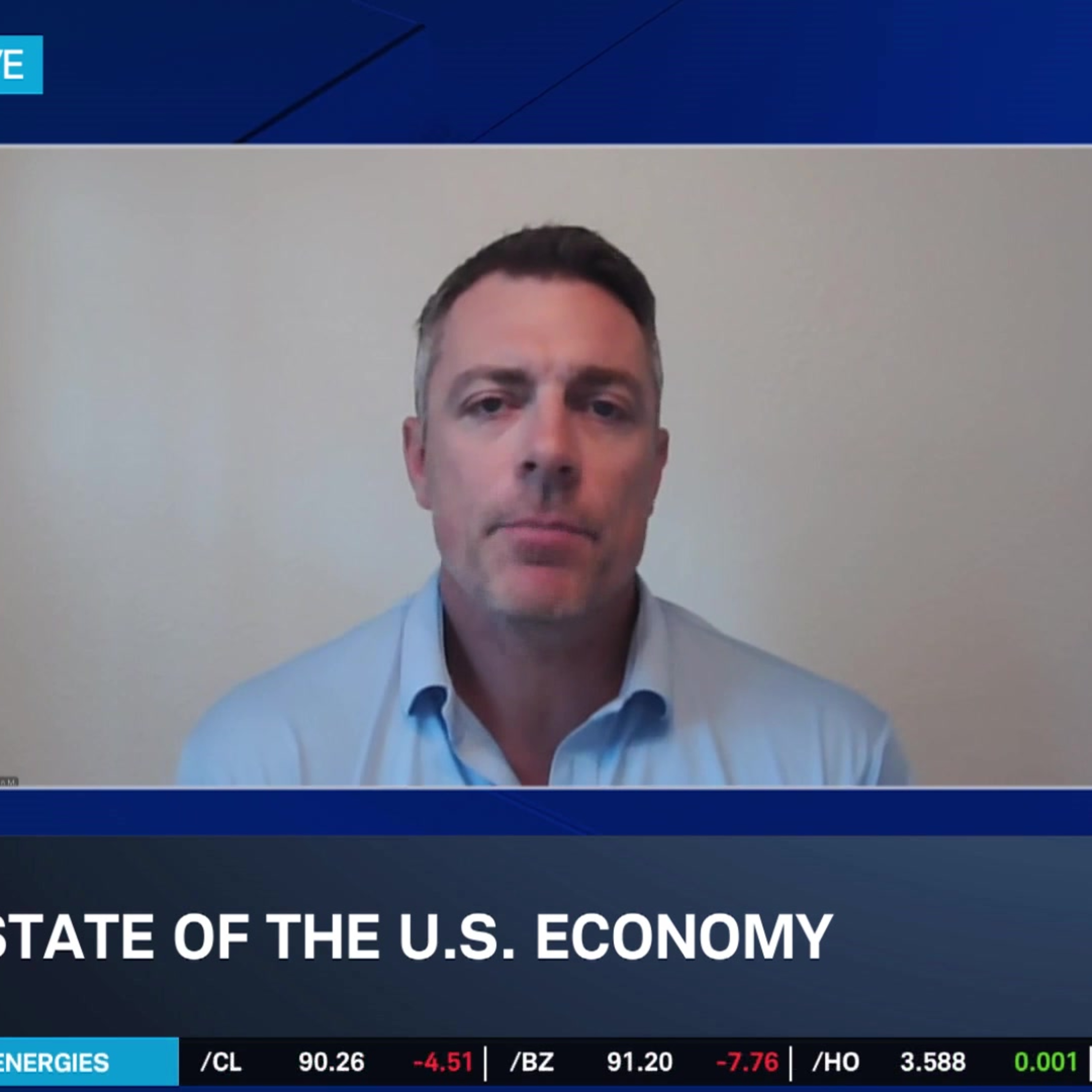
Avoiding Oil Market Disruption & NVDA's "Extremely Strong Outlook"
About this episode
Ben McMillan says there's "two sides of the coin" to crude oil's recent volatility. He underlines the key players in the Iran conflict looking for an offramp within the next few weeks to avoid any supply disruption globally. Ben adds thoughts on the challenges to a declinging country actually blocking the Strait of Hormuz. Domestically, Ben turns his attention to the labor market saying it isn't "flashing red signals just yet" but something that we're keeping an eye on. Later, Ben looks at the tech sector including potential "generational buying opportunities" in beaten-up software names and Nvidia's (NVDA) massive presence in the AI trade. Ben says Nvidia has an "extremely strong outlook" but isn't looking for a "multibagger" return.
======== Schwab Network ========
Empowering every investor and trader, every market day.
Subscribe to the Market Minute newsletter - https://schwabnetwork.com/subscribe
Download the iOS app - https://apps.apple.com/us/app/schwab-network/id1460719185
Download the Amazon Fire Tv App - https://www.amazon.com/TD-Ameritrade-Network/dp/B07KRD76C7
Watch on Sling - https://watch.sling.com/1/asset/191928615bd8d47686f94682aefaa007/watch
Watch on Vizio - https://www.vizio.com/en/watchfreeplus-explore
Watch on DistroTV - https://www.distro.tv/live/schwab-network/
Follow us on X – / schwabnetwork
Follow us on Facebook – / schwabnetwork
Follow us on LinkedIn - / schwab-network
About Schwab Network - https://schwabnetwork.com/about
Get every episode summarized
Each time Schwab Network publishes, we email you a written briefing from the transcript — the topics, who appeared, and any specific claims, with the ad reads skipped.
Email me new episodesFree for 3 shows. No card needed.
Transcript ready
199 searchable segments. Every word is indexed and playable.
Full transcript
Schwab Network — Avoiding Oil Market Disruption & NVDA's "Extremely Strong Outlook". Machine-transcribed; use the interactive transcript above to jump the player to any line.
You want to welcome in our next guest, Ben McMillan Founder and Chief Investment Officer of IDX Advisors. Ben, thank you so much for joining us. I want to start out with a conversation about the volatility in oil markets. I mean, you know, we've been on a wild ride since this weekend where we saw oil heading up towards $120 to Barrow, then it was solidly over 100 for much of yesterday's session. We've seen this pull back now. We're sitting at around $90 to Barrow. If we were talking about this some weeks ago, we would have been shot $90. But now it's like, okay, since we hit $100, $120 is not so bad. Talk to us about how you dissect all the volatility we're seeing in energy markets. Yeah, I think it's kind of two sides of the coin here. The first is, of course, you know, you've got war in the Middle East, you know, spiking oil prices is not near. We saw this in the 70s. I think the big thing here though is to remember, and I had this conversation yesterday with the big investor who was going long oil, and I said, listen, I'd be very wary of trying to buy into this
because coming into 2026 supplies were very robust. The outlook for oil was tepid at best. There was a lot of supply online. We've got, you know, an exogenous war spike here, but also don't forget every single major player in this conflict, you know, including the US and China wants an off ramp here. And I think that's why we saw oil come back a little bit yesterday. It was, you know, Trump starting to signal to the market that they're looking for an off ramp. So I think that'll happen in a matter of weeks, probably instead of months. And not the next things will necessarily go back to normal. There's definitely going to be a kind of embedded geopolitical risk premium here. But a lot of this is just the markets digesting. All right, what does an off ramp look like and how quickly could all parties find it? And to your point, it looks like parties were standing by and ready to deliver a solution to necessary. For instance, the G7 and the potential for tapping the strategic reserves, that seemed like that's an option. That's on the table. It might not be one that has to be exercised.
But to your point about supplies, it doesn't seem like there would be a major issue with supply. What's your thought on that? Yeah, exactly. I mean, like I said, everybody's, you know, kind of looking to solve this quickly. You know, the other thing too, and I was talking to somebody in the military complex a couple of months ago, actually. And they said, you know, Iran's ability to actually, you know, blockade the Australian Hormuz is virtually nil. And you've even heard recently some reports of, you know, ships just kind of turning off their transponders and kind of sneaking across. So, you know, there's also kind of the practical implication here of, you know, if everybody kind of gets behind and says, all right, let's just, you know, figure out a solution here. You know, Iran is clearly in a state where they're, you know, basically just swinging as they go down. You know, there's, you know, nobody in charge or firing missiles that, you know, basically, you know, anybody within, within, you know, your shot. So it's, you know, it's very chaotic for sure, but it is difficult to see how this structurally persists
for, you know, much longer than, you know, several weeks. Okay, it does seem like it's a timing issue because obviously it is a key corridor to where, you know, a good chunk of global oil passes through, maybe this is for all intents and purposes. Now, it's a timing issue. When you think about the broader economic picture here in the US, because obviously now that we have high oil prices, there's a concern about impact to inflation, we recently got that much weaker than expected jobs report, along with some revisions for the prior couple of months. How would you characterize the health of the economy now? Yeah, the jobs report was a big one because a lot of people for several quarters ourselves included have been kind of looking at the jobs market and waiting for potentially cracks to emerge. You know, the US economy has done a fairly good job of kind of navigating the soft landing, which is, I think, what was priced in. And, you know, any upset to that is, you know, it's going to be tough for stocks, especially with frothy valuations, you know,
which we had, you know, coming into this year. So when you look at the stagflation scenario, that's what's really concerning. If we do get oil persisting, you know, at levels where it is right now, and you get, you know, the labor market starting to show some signs of stress, you know, in part because of, you know, AI, the things like AI disruptions, which we've already seen and that looks like it could be picking up. You know, the stagflation scenario, you know, could be tricky. So it's, the jobs market is something where it's not necessarily flashing red signals just yet, but it's something we're keeping an extremely close eye on. So speaking of the tech sector and AI disruption, we've started to see some recovery. And one of the things we've been keeping a close eye on is the IGV, and we've seen a discovery in there, or recovery rather recently in there. Do you think that short lived or just a blip because of all the destruction that we've seen, the SaaS apocalypse, if you will? Yeah, no, that's the next question. I, you know, when the SaaS apocalypse happened,
it was, it was interesting. I, you know, I think it was overblown at the category level, but there are definitely names, including big names that are going to be permanently impacted through AI. And we've seen that. You know, even just anecdotally talking to people, you know, companies like Microsoft, for example, I think are going to benefit from AI. You know, if anything, this, this looks like it probably a generational buying opportunity. But you've got other, you know, companies like Salesforce, you know, expensive legacy CRM software. They don't own the data, you know, it's customers data. And, you know, all of a sudden, cloud code or, you know, AI tools in general can, you know, start to replicate a lot of, you know, features and functionality, you know, it's hard to see how they don't see, you know, margin compression going forward. And so some of these discounts that we've seen for these software companies, I think are deserved, but not these, not the entire sector. So to your point, I think that come back in the software sector is not surprising. I think we'll start to see that take up. But I also think there's going to be some discrimination within that sector among investors in terms of who really benefits from AI
and who potentially is displaced or competing with AI. Okay, so speaking of that, let's talk about the heavyweight there that being in video. Now, is in video still the clearest way or the clearest path you think with regard to the biggest beneficiary of the AI build out of me, what keep in mind is still is a, has a more than $4 trillion market cap. Yeah, I mean, that's, you know, look, Nvidia is the train that keeps on chugging. You know, their, their consensus 12 month price target, I think is roughly 50% higher from here. You know, before, you know, I would be the first one to kind of bulk at that, but then you look at their four and multiple and it's, you know, it's not that crazy. And it's because, you know, this data center revenue just continues to surge at, you know, all these big massive capital expenditures from, you know, all the big players, Amazon, meta, alphabet are, you know, are directly going to benefit in video. And, you know, if we were to have this conversation in last quarter, everybody was, you know, was concerned about the CapEx build out,
what's the ROI going to be. But again, I think in the last couple of weeks, we've started to see exactly how this is getting manifest. And it's, you know, tools not necessarily just cloud, but, you know, they're the first ones out there making headline, but putting tools in the hands of consumers and small businesses that are going to basically move time compute and spend away from some software, not all software as a complex, but some software companies onto, you know, native AI. And so I think that's actually been a boon for not only the AI narrative in general, but Nvidia in particular. So Nvidia, you know, it looks good. Yes, it's got a, you know, huge market cap and I wouldn't be betting on a multi-bagger from here, but, you know, the outlook is extremely strong and I think, as importantly or more importantly, the outlook for AI adoption and the structural use case for chips is very strong. All right, Ben, we'll leave our conversation there for a time, great conversation. That's Ben McMillan, founder and chief investment officer of IDX advisors.
Thank you.
More episodes
More from Schwab Network

JNJ Balances Growth, Patent Transitions, and Legal Overhangs
Schwab Network

nCino (NCNO) CEO on Earnings, AI in Banking & Overcoming "SaaS-pocalypse"
Schwab Network

The Big 3: NET, TWLO, ASTS
Schwab Network

Tie Lasater on Inflation Floors, Energy Risk, and Private Credit Stress
Schwab Network