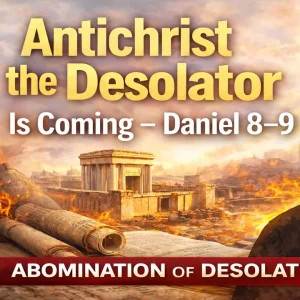
Antichrist the Desolator Is Coming – Daniel 8–9
About this episode
In this in-depth teaching, Alan Kurschner lays a biblical foundation for understanding one of the most critical events in end-times prophecy: the abomination of desolation. Drawing from Daniel 8 and Daniel 9, this session explains why the abomination of desolation is not a side issue in prophecy, but a central event that anchors the timeline of the Antichrist, the Great Tribulation, and Jesus’ teaching in Matthew 24.
The post Antichrist the Desolator Is Coming – Daniel 8–9 appeared first on Bible Prophecy Answers with Alan Kurschner.
Get every episode summarized
Each time Bible Prophecy Answers with Dr. Alan Kurschner publishes, we email you a written briefing from the transcript — the topics, who appeared, and any specific claims, with the ad reads skipped.
Email me new episodesFree for 3 shows. No card needed.
Hosts & guests
Transcript ready
305 searchable segments. Every word is indexed and playable.
Full transcript
Bible Prophecy Answers with Dr. Alan Kurschner — Antichrist the Desolator Is Coming – Daniel 8–9. Machine-transcribed; use the interactive transcript above to jump the player to any line.
Okay, the abomination desolation, the reason why this is so important of a event because it's like an anchor, it just really, it anchors a framework in which when you look at the passages in the Old Testament, the All of Discourse, Thessalonians, Book of Revelation, they're all kind of gravitating or they're linked to this event. That's why we can, we can understand why certain, we can understand a chronology because, again, the abomination desolation is a very definitive event. For example, again, when we, when Jesus says, you know, the, um, in Matthew 24 regarding the abomination desolation, he says, those days, those days of great tribulation. So we know, obviously, we know the great tribulation occurs after the midpoint, not before. And so that's just kind of one example of the importance
of this event of the abomination desolation. We're all here, of course, we're within this, uh, this conference here, and I'd like to call this, these conferences, especially from a pre-rath perspective, these are participation conferences and not spectator conferences. There's a lot of spectator conferences. And what I mean by that is, is, so I, I'm an exponent of the pre-rath view. And that says that, or we affirm that the church, the very last generation of the church is going to encounter the antichrist, great tribulation. We're going to participate in an event that we're actually talking about tonight. This is not a, you can go to Mary, it's a biblical prophecy conferences. And you're talking about events that they think they're going to be raptured out of here before they encounter it. Those are spectator, you know, those are spectator, spectator type of, of conferences. And they may pick the interest of some,
but it really doesn't do much good, I think, for the health of the church, especially the last generation of the church. So we're, we're all participants in this because we're learning about a very important event that our Lord Himself commanded us to understand. And if we don't, we're in disobedience to our Lord. I think about that for a moment. Jesus is commanding us to understand this event. He's not saying, well, have the attitude of, there's so many views out there, or, you know, we just can't know or just be ready for Jesus as return. Jesus not teach that. Well, he taught, we need to be ready for his return, but a main way we, we become ready for his return is that we understand how we're going to encounter these events and how we're going to respond to them. All right. So this, in this hour, I'm going to cover Daniel chapter eight and
nine, which is, which is a good chunk of important prophetic, biblical prophetic text. I mean, we could spend a few sessions just on Daniel eight or, or Daniel nine, but I'm going to, I'm going to draw from Daniel chapter eight and nine, what I think are the most important aspects of of this text, at least as it's relevant to the abomination of, so, in fact, if I could generalize, maybe we could begin with a generalization with chapter eight and nine, chapter eight, Daniel chapter eight, the ram goat and, and, and tie a kiss. I, so chapter eight, I would say it establishes a type of the antichrist. This is the type of the antichrist. Antichrist will prefigure, shadow of, basically, we're going to learn what the antichrist is also going to do
through the actions of, of antichests. And again, I'll explain a little bit more of who this person is. So chapter eight will establish a type of the antichrist, while Daniel chapter nine establishes the time frame of the antichrist. So fulfillment in, in, in antichests and antichests for, we'll, or shadow the antichrist. And so these two important facets of biblical prophecy, I would say, again, they, the type characterizes the action of antichrist. And then the time frame situates those actions in a chronological order. All right, I'm going to read chapter eight. Daniel chapter eight here. So I'm going to, again, tomorrow's questions look different. I'm going to be honing in on some key verses or passages. Tonight, I'm going to kind of, I'm just
going to read through the chapters and actually stop and comment on them. And then of course, I'll draw out some implications on that. So chapter eight verse one. In the third year of King Belchazer, Belchazer's reign, a vision appeared to me, Daniel, after the one that had appeared to me previously. In this vision, by the way, I'm reading from the New English translation, in this vision, I saw myself in Susa, the citadel, which is located in the province of Ilan. In the vision, I saw myself at the Ulai Canal. And this is just a note here. So this vision, it's during, we're told during our Belchazer's reign. So this would be about 550 BC. Verse three, I looked up and I saw a ram with two horns standing at the canal. It's two horns
were both long, but one was longer than the other than the other. In the first section, first half of chapter eight, Daniel receives this vision. And we'll see in the second half of the chapter, he interprets, he receives an interpretation of this vision. So that's how we know who, you know, some of the reference or the identities of some of these reference. So for example, the here, the ram, okay? So you have two horns, one is longer, it's referring to meadow Persia empire. And why one is longer than the other is most likely because Persia, the area Persia or that aspect of the empire lasted longer than the meads. So that's most likely why it's referring to the has two horns and one was longer. Verse four, I saw that the ram was budding westward, northward, northward, and southward. Again, that demonstrates a meadow Persian
empire here. No animal was able, or the conquering of the Persians, no animal was able to stand before it. And there was none who could deliver from its power because it was pretty brutal. The Persian empire, if you read on it, it was a very brutal, powerful empire. And it was very well known for in history. And it did, it did as it pleased and acted arrogantly. While I was contemplating all this, a male goat was coming from the west, Greece, over the surface of all the land without touching the ground. That's clearly referring to, again, I know, later on, it identifies as Greece, but we know that Alexander, the great conquered this whole territory within three years. Quickly, the Persians, it took decades for them to conquer their region. Here, the Greeks,
it took three years with Alexander the Great. So this reference without touching the ground. This goat had a conspicuous horn between its eyes. It came to the two horned ram, which conspicuous horn would refer to Alexander the Great. It came to the two horned ram that I had seen standing beside the canal and rushed against it with raging strength. I saw it approaching the ram. It went into a fit of rage against the ram and struck it. By the way, a fit of rage against the ram. So Greece is going to have an a fit of rage against the ram. I think that would refer to the Greece they had, the Greeks they had just a deep seeded hatred toward the Persians because of their humiliating defeat of previous battles between the Persians and the Greeks and the Greeks held this grudge against the Persians. So I think that's what it's referring to here as far as a fit of rage. And struck it and broke off its two horns. The ram had no ability to resist it.
The goat hurled the ram to the ground and trampled it. And no one could deliver the ram from its power. In fact, the last, if I'm not mistaken, the last battle between the Greeks and the Persians with Alexander the Great was a battle near the ancient city of Nineveh. Verse 8, the male goat acted even more arrogantly, but no sooner had the large horn. Of course, Alexander the Great became strong. Then it was broken. That has to refer to the short lived span of Alexander the Great. He died young. So he conquered within a few years and then he died at a young age after that. And so again, I think that's what it's referring to when it says that this is here, but no sooner had the large horn became strong. So he in his prime,
in his prime, that's when he died. And there are rows four conspicuous horns in its place, extending toward the four winds of the sky. Clearly, this is referring to the four generals that emerged out of Alexander the Great. And two of them for our purposes was Ptolemy and Solusus. So Solusus would be had the region of Syria, Babylonia, up in that northern area. And then Ptolemy, of course, Egypt, Arabia, and Israel, the beautiful land. And so these, the Solusus dynasty and the Ptolemaic dynasty, kings, they're always fighting it out for, and of course, the Israel was in the middle of that constant battle between their territorial pursuits. Verse nine, from one of them came a small horn.
Well, Antichrist IV, the Piphanes, eventually came out of the Solusa. He was a Solusus king. He became the fourth, became out of the Solusa empire in the north. And so that's, I believe that this, that's this, this one horn. I'm going to learn about this little horn. By this little horn, it grew and it became very great toward the south. And because he was always, he was always going down to Egypt and fighting the Egyptians. And the east, that would be Israel. It grew so great, it reached the army of heaven. Now this is where there's a lot of kings who would fight against Israel. But Antichrist, again, if you read the history on it, you'll see this, but it actually indicates that here in this text that we're going to
read, had he just a hatred toward Yahweh. Again, the Persians, the Babylonians, you know, even the Romans, but the Antichrist had just a deep hatred. I believe that Antichrist was, if not, you know, satanically possessed by, well, Satan himself, as the text hints at in a bit here. But it says here in verse, this year, verse 10, it grew so great heaven and it brought about the fall of some of the army and of the stars to the ground where it trampled them. It also acted arrogantly against the prince of the army from whom the daily sacrifice was removed. He hated Yahweh, he hated the sacrifice, he hated what the Jews were doing. They hated their religion. So he stopped this daily sacrifice, removed them, the sanctuary he defiled it, desecrated it. This is beginning this pattern, this type of the abomination of desolation.
Let's see here. Verse 12, the army was given over, along with the sacrifice in the course of his sinful rebellion, it hurled truth to the ground in enjoyed success. Then I heard a holy one speaking, another holy one said to the one who was speaking, to what period of time does this vision pertain? This vision concerning the daily sacrifice and the destructive act of rebellion and the giving over both the sanctuary and the army to be trampled. There's a lot of history behind here, but trying to outline it here, said to me to 2,300 evenings and mornings, then the sanctuary will be put right again. Most likely this is referring to 1,150 days that some would indicate that it's between the Antiochuses' desecration of the Jewish temple and its restoration. I've
looked at some of the numbers and the calculations. It seems pretty much on that this three, four-year period was this time in which it took time to precipitate the Maccabeean revolt. It took some time for it to secure the precinct to cleanse it and to rededicate it, which of course we know it as Hanukkah, the celebration of Hanukkah, but it was during those few years in which it took time to restore the sanctuary, or as it says here, the sanctuary will be put right again. I'm going through this relatively with rapidity here, but I'm trying to draw out some of the significant issues here because once we get into the next session and tomorrow, I'm going to be
honing in on some of these key texts in Thessalonians and the Book of Revelation, but here for our purposes there, we have to go through this swath of two chapters to, again, to develop this pattern in this chronology for the Abomination desolation. Okay, verse 15. Okay, this is where it gets kind of interesting. And in to get a little bit more disagreements on interpretations, and I'm going to bring those out and explain what those interpretations are, but I'm going to give you my interpretation of this as well. In verse 15, now we begin where an angel actually interprets, so Daniel received this vision, an angel comes to interpret, this is what it means. Verse 18, as he spoke with me, I fell into a trance with my face to the grave, but he touched me and stood me upright. Okay, this is the verse. This next
verse is probably the most debated in chapter 8, and and probably for good reason, and again, I'm going to note why that is. Then he said, I am going to inform you about what will happen in the latter time of wrath, for the vision pertains to the appointed time of the end, the horn that was broken and in whose place there are four others stands for the key, for the four kingdoms that were raised from this nation, though they will have hit, and in verse 23, this is where a lot of interpreters believe that now we're making a shift from Antiochus to the Antichrist. And I'm from the persuasion that that's not what's going on here. I actually think that the text here continues to describe the Antiochus, but there's indications here that it's God's
intention that we're looking, the significance of this is we look at Antiochus, he's establishing a pattern by which the Antichrist will also act in the same way. So this is not mere historical novelty, because we can gather from this pattern, and we're going to see, by the way, this is confirmed in chapter 11, and in Matthew 24, in 2nd Thessalonians, and the book for Revelation. In 23, it says, toward the end of their rule, when rebellious acts are complete, a rash and deceitful king will arise, which I take it as Antiochus foreshadowing the Antichrist figure. Verse 24, his power will be great, but it will not be by his strength alone, and this is where 2nd Thessalonians chapter 2, by the way, says that the Antichrist is going to be
possessed by Satan himself. The Greek indicates that. And so I think that, I think that that Satan actually possessed certain leaders throughout history, including Hitler, but I think he's also, he also possessed Antiochus, and I think it was maybe Satan's goal to have Antiochus as the Antichrist figure himself, but God thwarted that plan. At any rate, the Antiochus is functioning as a pre-figure. Verse 24, again, his power will be great, but it will not be by his strength alone. He will cause terrible destruction. He will be successful in what he undertakes. He will destroy powerful people and the people of the holy ones, Israel. By his treachery, he will succeed through deceit. He will have an arrogant attitude. This is everywhere in scripture. You have it in
chapter 7, this arrogant attitude, the Antichrist, arrogant attitude in Daniel chapter 11. You have this in Matthew 24, 2nd Thessalonians 2, especially in the book of Revelation 13. This is one of the main characteristics of the Antichrist is arrogance and arrogance attitude, and he will destroy many who are unaware of his schemes. He will rise up against the Prince of Princesses yet he will be broken apart, but not by human agency. The vision of the evenings and the mornings that you were told is correct, but you should seal up the vision for it refers to a time many days from now. I, Daniel, was exhausted and sick for days, then I got up and again carried out the King's business, but I was astonished at the vision and there was no one to explain it. Okay, let me, I want to summarize something here or just note something about Antichrist. And this is,
so he ceased, he stopped this daily sacrifice, he abolished it, and you can read this in first Maccabees, by the way, about his actions. That's where we are main source for Antichrist. And let me just note some of this. He says while returning from his conquest of Egypt in the year 143, Antichrist marched against Israel and Jerusalem with a strong army, arrogantly entering the temple, he took the golden altar and the candlelar, candlelar broom with all his furnishings and the table for the show bread, the libation jars, the bowls, the golden ladles and the curtain, he stripped off all the furnaces and the ornamentation of gold from the temple and he took the silver, the gold and he deposited in his own treasury. With all this loot, he returned to his own country having polluted himself with massacres and and uttered words of great arrogance. And he did this again
on the 15th day of Kislev, he says, the king Maccabees, the king had an abomination of desolation built upon the altar and he took whatever scrolls of the Torah they found they tore up and burned and whoever was found with the scroll of the covenant in his possession or showed his love for the Torah, the kings decree put him to death and I think that's going to happen in America soon. I really do believe it and you know I think in a matter of years you won't be able to find a Bible online, Amazon or you're not going to be able to find this. In fact, you're going to take another stuff further if you even own a Bible. I think there's going to be penalties for that. So again, these are these are prefigurements of what we're going to be seen in the future. Though their strength, they acted arrogant, acted against the Israelites, let's see sure, okay, I'll just finish with this, the woman or the women who had their sons circumcised,
they put to death according to the decree. So let's contextualize that, you know, you perform baptism in the church, that's going to be illegal and there's going to be penalties for that. The Lord's Supper, penalties for that. What did they do or would it antihicus? I mean, he was one of the most wicked, next to Nira, one of the most wicked leaders. He was hanging the babies from the mother's necks and executing also their husbands and the men who had performed their circumcisions. All right, I could read a lot more on you. It's online if you don't have first Maccabees, but it gives you a little flavor of who this person is. And so now I want to shift to chapter 9. And chapter 9 is interesting because now we have a very one of the most salient
prayers in the Bible. Daniel, Daniel is in Babylonian exile and he recognizes, he recognizes, he's reading Jeremiah and he recognizes that the Babylonian exile, Jeremiah says there's a prophecies going to be for 70 years of desolation of Jerusalem. You can read that in Jeremiah 25 and 29. And at the end of this exile, and so Daniel knows the exile is almost finished. They're going to be going back to Israel. By the way, the 70 years there would be from 609 BC when Judah loses the independence and to 539 with the Kino Babylon being punished. That was just so many year exile. But Daniel is, he's not satisfied because he understands, okay, the exile is going to be finished, right? But he recognizes that Israel is not in repentance and that's a problem. They're not going
back in repentance. And let me just note here one other thing about the why there was a 70 year exile. It was a punishment because the land, they didn't give the land the rest, right? The Sabbath years. They didn't give the land the rest. You can read that in 2 Chronicles and Leviticus. There's some other related passages here in Exodus 23 and Jeremiah and Deuteronomy. But 2 Chronicles 36 says it right there. This took place to fulfill the Lord's message spoken through Jeremiah and lasted until the land experiences sabbatical years. So 70 times this happened. And so they're being punished for the 70 times that they did not fulfill the Sabbath, the land Sabbath laws. So Daniel cries out to God and he says, he says, God, when is Israel? Not? When are they going to come
back from the Babylonian exile? But he's concerned more about their repentance, their salvation. And so he prays to God, God, when is God? When is Israel going to be saved? When are they going to repent? And when is your name? Your name going to be vindicated and upheld and your righteousness upheld and within this prayer. God sends the angel Gabriel to answer this prayer. And this answer is, and we're because of time, I'm not going to read the whole prayer, but I really want you to, you know, maybe in the next day or two, read this prayer in Daniel chapter 9, chapters, verses 3 to 23. So verses 3 to 23. And Gabriel answers the question. And by the way, in Daniel's prayer, Daniel recognizes he acknowledges God, God,
we don't deserve salvation. We don't deserve your mercy, but he's pleading on behalf of Israel. And God is a merciful God. And he comes through Gabriel, or he sends the angel Gabriel, and he answers the question. And he says, to answer your question, basically in so many words, Gabriel says, look, when is Israel going to be saved again? God is taking a 490 year chunk out of history. And at the end of that 490 year chunk of history, that is when Israel will be saved, the nation of Israel. They will no longer have this rebellion. In fact, if you go look at verse 24, so it's called the 70 weeks prophecy and practically all scholars, liberal scholars, conservative
scholars would understand that the week here represents seven years, so unit of seven years. And so you have the 70 weeks, 70 times seven, 490 years. And in verse 20, this is what he says, he says, this is the answer that Daniel receives. 70 weeks, that is 490 years, have been determined concerning your people and your holy city, but by the way, he was also concerned about the city and the sanctuary in his prayer, if you read that. So, concerning your people and your holy city to put an end to rebellion, okay, to bring to sin completion to a tone for iniquity, by the way, finished transgression or rebelling means, it's basically rebelling, bringing about an end to sin, this is a cleansing from their sin, and to a tone for iniquity, this is a purging for or through forgiveness,
and then bringing an everlasting righteousness or perpetual righteousness, this means justice and peace, and to seal up vision and prophecy that is to secure or preserve that which points to fulfillment, and then the final aspect is to anoint the most holy or the most holy place, actually. And I believe that refers to the millennial temple, it's interesting that Daniel, practically all of these elements are linked to his prayer. So the angel Gabriel is answering, it's multifaceted, right? It's not one thing, so all of these cluster of self-servific aspects to that Daniel is concerned about and cries on before God on when this is and so verse 25A, verse 25A says, the first part, he says, so no and understand from the the
issuing of the command to restore and rebuild Jerusalem, this is in 444 BC by the decree of Ardazurkese, you can read this in Niyah 2.5, by the way, Niyah 2.5, so this decree to, it was a decree in issuing, right, to restore and rebuild Jerusalem, 444 BC. Until an anointed one, a prince arrives, this happened in 833 about the time of Christ crucifixion. And this is, obviously I'm not getting into all the calculations here and whatnot, especially using more based on what's called a 360 day prophetic year or 30 day month, but I've analyzed this and it's quite amazing, it actually comes down to the exact month. Some scholars will try to get this exact same day, I don't know if we can, but come down to exact same month in which for the time of Christ
crucifixion, they're in 833. And then Daniel 25A says, there will be a period of seven weeks and 62 weeks, so this, you have these two, there's three time periods, these are the first two time periods that make up the 490 year period, it will be built again with the plaza and moat, but in distressful times. So again, these 70 and 62 weeks, that's 483 years, that leaves seven more years to make up 490 years. Daniel chapter 9 verse 26, now after the 62 weeks, an anointed one will be cut off and have nothing. So after the 62 weeks, that is after the second period of 434 years, the Messiah will be crucified, as mentioned earlier. And then it says, as for the city, now this, this is the verse that's the big, but I'm going to give
you my interpretation of what I, I believe what it's the, the identifications of the reference and the, you know, pronouns and all that, but it says, as for the city in the sanctuary, obviously Jerusalem, right, in the sanctuary, the people of the prince, we know this to be the role is Titus destroyed it in 80s, 70, the people, that's the Romans, the coming, the people of the coming prince, Titus, but the people, the focus here is on the people, it's the Romans, they will destroy them. I'm sorry, let me just correct one thing, the ruler, Titus destroyed, Titus is part, he was a, he was a Roman general, he destroyed Jerusalem 80s, 70, but the reference here, the coming prince, I believe is referring to the antichrist figure, why? Because of what it says here in a moment, but his end will come speedily like a flood, until the end of the war that has been decreed, there will be destruction.
So again, Roman soldiers destroyed Jerusalem and the 70s, and then this language here, regarding the, his end will be decreed, there will be destruction, this, this links back to Daniel chapter 7, but it's, it's Daniel chapter 727, that's interesting, he will confirm a covenant. I can only take this as the closest antecedent, he will confirm the covenant, that is the, the antichrist, again, of the people of the prince, the Romans, so it's pointing to a future person here, because he's going to make, he's going to be the one making this covenant. So in other words, antichrist can confirm a covenant with many for one week, for seven years, and in the middle of that week, so three half years later, in the middle of that week, he's going to bring sacrifices and offerings to a halt, he's going to stop these sacrifices
at the midpoint. On the wing of abominations will come one who destroys, again, I believe it's antichrist figure, until the decree and it's poured out on the one who destroys. So in other words, I understand this as antichrist is going to establish a seven-year covenant with Israel, in the middle of that seven-year period, antichrist stops these sacrifices, and he's going to commit this abomination of desolation. And this was prefigured with antichrist in Daniel, in the previous chapter, chapter, Daniel chapter 8. Now, again, this is, we've gone through a lot of material here, two chapters, only to kind of establish a foundation for our topic of the abomination desolation. We've established a pattern. We look at antichrist, his activities, and I believe God intends us to look at that and go, look, this is, he was an evil man, but he's
prefiguring an eschatological figure, the antichrist figure. And then in chapter 9, it shifts to Daniel's prayer. And the answer to Daniel's prayer is going to be the chronology given to us quite precisely, in which we know that the abomination desolation is not going to happen at the beginning or the end of the seven-year period. It's going to happen in the middle of the seven-year period. And this context, the pattern context in chapter 8, the chronology context in chapter 9, is establishing for us now a context in which we can move forward with the book revelation or with the book of Daniel. And then move forward to what Paul has to say about the abomination of desolation and this antichrist figure in desolonians. And of course, Jesus is teaching of the abomination desolation in Matthew 24, Luke 21, and Mark 13. And then of course, at the end, I will
be tomorrow or my last session. I'll be discussing what is this abomination desolation? What does it tell us? What's this message in the book of Revelation? And how do we understand this second half of the seventy-th week of Daniel that's going to be very important with biblical prophetic events? So thank you for bearing with me in this in these in chapter 8 and 9. But I think I think just reading through some of this text, in fact, I intended to read Daniel chapter, the beginning of Daniel chapter 9. But I really encourage you to read his prayer in light of what I discussed tonight. So I'm not going to take any questions because we're going to be pressed for time. However, I'm going to be up here and during a break or during the, you know, tomorrow and anytime I'm happy to answer any questions that you have. Thank you.
More episodes
More from Bible Prophecy Answers with Dr. Alan Kurschner

The Battle of Armageddon: The When and the Who
Bible Prophecy Answers with Dr. Alan Kurschner
What Is the Meaning and Location of the Battle of Armageddon?
Bible Prophecy Answers with Dr. Alan Kurschner

The History of the Battles of Armageddon
Bible Prophecy Answers with Dr. Alan Kurschner
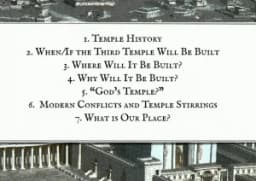
The Third Temple
Bible Prophecy Answers with Dr. Alan Kurschner