Loading...
About this Episode
Did you know that it’s almost guaranteed that every single species will eventually die out? In fact, scientists believe that 99% of all animals that have ever lived are now extinct. Sad, I know, but maybe extinction isn’t as permanent as we thought. Through advances in biotechnology there are some animals that are on the cusp of resurrection. It's time to learn about some unbelievable species that just might make a comeback.
Our Sponsors:
* Check out BetterHelp: https://www.betterhelp.com
Advertising Inquiries: https://redcircle.com/brands
Privacy & Opt-Out: https://redcircle.com/privacy
Hosts & Guests
Transcript
Welcome to your Peloton Pilates era.
Built on precision, backed by results, and trusted by over two million members.
Experience instructors with true Pilates expertise,
offering classes for every level, from foundational to powerfully challenging.
Choose from 10 to 45-minute sessions with little to no equipment anytime, anywhere.
And with the cross-training swivel screen, you can move seamlessly from cardio to mat.
Press Pilates, small moves, big impact.
Find out more at onepeloton.com slash Pilates.
Did you know that it's almost guaranteed that every single species will eventually die out?
In fact, scientists believe that 99% of all animals that have ever lived are now extinct.
Sad, I know, but maybe extinction isn't as permanent as we thought.
Through advances in biotechnology, there are some animals that are on the cusp of resurrection.
It's time to learn about some unbelievable species that just might make a comeback.
You know how the ice caps are melting and we're all totally doomed?
Well, there might be an interesting solution to that.
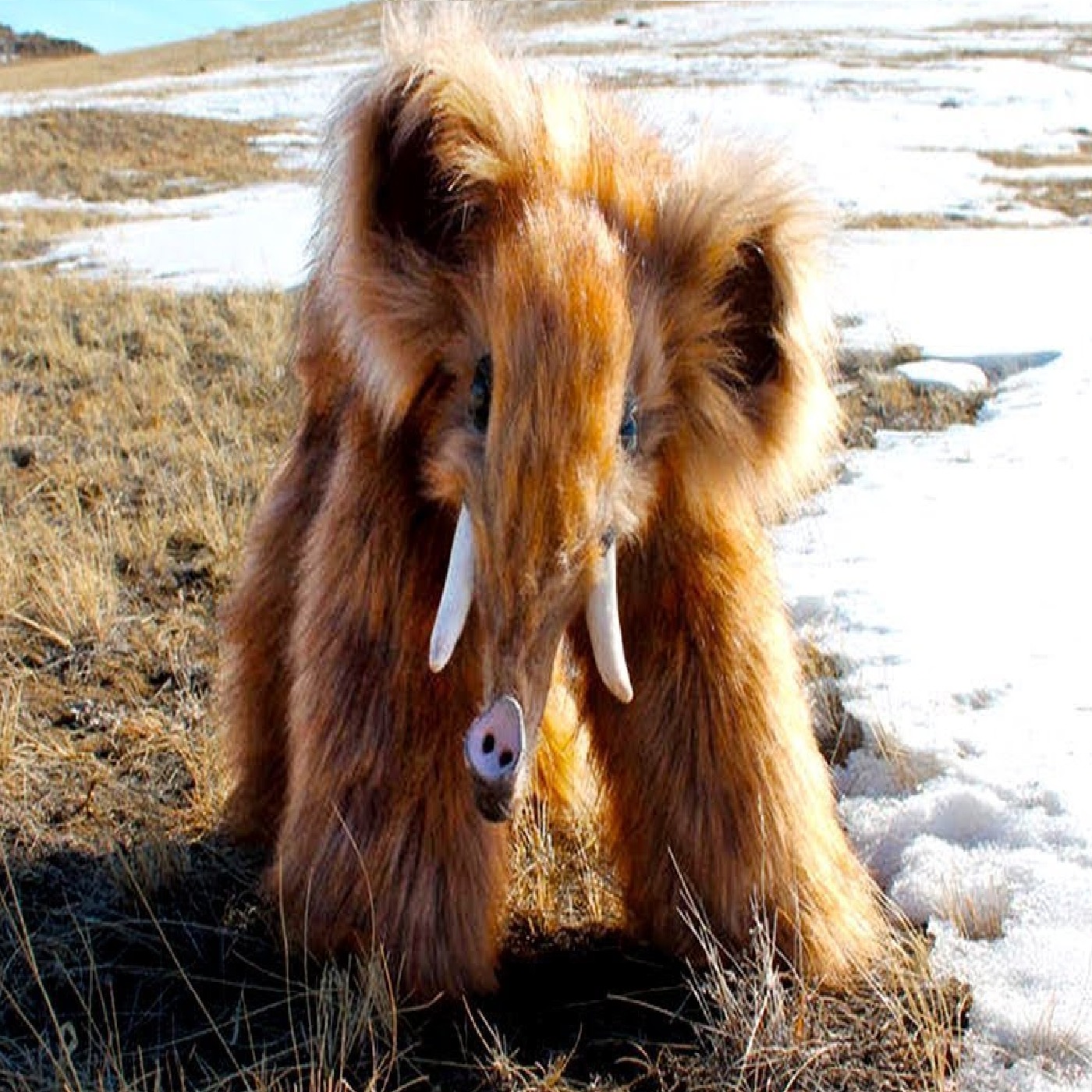
Bring back the woolly mammoth.
These gigantic creatures could grow up to 12 feet tall and weigh eight tons.
That's the weight of four and a half cars.
Herds of mammoth were once widespread across the mammoth step,
grasslands that covered Europe, Asia, and North America.
Okay, we all know their need.
But how will these wombo woolly's fight climate change?
Well, across the Arctic tundra, there's permafrost,
ground that remains completely frozen for at least two years.
But thanks to good old global warming,
permafrost has begun to thaw.
When permafrost melts, it releases carbon into the atmosphere,
further accelerating the effects of climate change,
that will lead to mass extinction.
Geophysicist Dr. Sergei Zimoff theorizes that if the tundra can be turned back to grassland,
like it would have been in the mammoth's time,
it could stop the permafrost from melting.
Introducing big grazing herbivores disturbs the ground
and allows for deeper freezing of permafrost during the winter.
When summer rolls around, the layer of grass insulates the permafrost,
keeping it from melting.
I guess we just need to find some mammoths.
It can't be that hard.
Bringing these beast back is one mean feat,
but Dr. George Church feels up to the task.
Church is a founder of multi-million dollar
Texas-based company Colossal Biosciences,
who plan to bring back all sorts of extinct creatures.
Let's hope they do better than Jurassic Park.
Church plans to create an elephant mammoth hybrid that will live in the Arctic tundra.
The animal wouldn't exactly be a mammoth,
it would only contain 1% mammoth DNA.
For this, they need mammoth DNA,
which isn't too tricky to get,
considering the species vanished later than you probably think.
The last herd only disappeared in 1650 BCE.
That's over a thousand years after the pyramids of Giza were built.
Now, the closest relative of the mammoth is the Asian elephant.
Church will remove DNA from a female Asian elephants ovum and replace it with mammoth-like DNA.
The elephant mammoth embryo will then be placed into an African elephant surrogate.
Despite the difficulties of cloning and the moral objections some might have,
Colossal claim, they will have an elephant mammoth calf by 2027.
I know I can barely take care of a plant, but come on, who wouldn't want a pet mammoth?
Next up, let's travel to Australia, home to some of the most wonderful fauna on the planet.
Or rather, it was until the arrival of Europeans.
Colonizers weren't too kind to the region's wildlife, and one of the species they ended up wiping out
was the thylacene. Also known as the Tasmanian Tiger, and being a totally different species from
the Tasmanian Devil, this carnivorous marsupial was once found across New Guinea,
Australia, and South Tasmania. It was nocturnal,
praying on kangaroos and other marsupials.
Persecution of the thylacene started when farmers claimed that the animal killed their livestock,
though the extent of this is likely exaggerated.
In 1936, the last thylacene died due to neglect in Hobart Zoo,
and the species finally sputtered into a sad extinction.
Then things got worse, removing an apex predator from an ecosystem has devastating effects on
the environment, and a process called trophic downgrading.
One thing thylacenes did was keep illnesses under control by praying on sick and dying animals.
After their extinction, diseases in the region became widespread,
such as the horrible devil-faced tumor, which quickly spread through the Tasmanian Devil.
Without predators, rodents and birds overgraze on vegetation,
leading to premature tree deaths and wildfires.
And to top it all off, invasive species brought over by Europeans have grown out of control due to
the lack of predators and prey on native species. As a result, more mammals have become extinct
in Australia than any other country with 35% of all mammal extinctions being Australian.
However, some believe that this problem can be averted.
Colossal have teamed up with the University of Melbourne and Research Center TIGRO
to de-extinctify the Tasmanian tiger using preserved specimens.
Before the species went extinct, many thylacene embryos and young were preserved in alcohol,
like a horrific pickle. In 2018, Dr. Andrew Pask, the leader of the thylacene de-extinction program,
sequenced the thylacene genome from a 108-year-old specimen preserved at the Victoria Museum in Australia.
Colossal plan to use gene editing to take the stem cells of a dasherid,
a family closely related to the Tasmanian tiger, and transform them into thylacene cells.
The cells would create an embryo hybrid, which would then gestate in an artificial womb,
or a dasherid surrogate. The animals will then be reintroduced to Tasmania
in order to help rebalance the ecosystem.
Here's hoping that thylacene gets a second chance.
Do you know what else is good for the ecosystem?
Clicking the follow button so you can keep up to date with amazing animal facts all year round.
Now let's move on to even more Colossal ambitions.
Take a trip to Mount Hatham ski resort in Victoria, Australia,
and there's a slim chance that you might come across the mountain pygmy possum.
This thumb-sized crumb of cuteness is so rare that for a long time,
it was only known by its fossils and categorized as extinct,
until it was spotted in a log pile at the ski lodge in 1966.
It spends seven months of the year hibernating in burrows under snow,
occasionally waking to snack on its winter stores.
They only fully emerge in the spring to stuff themselves with food and find a mate.
Sounds like me. If I ever made it, that is…
Anyway, their diet consists of invertebrates, particularly the tasty bogong moth,
seeds, and berries.
Since they made it into this episode, you can probably guess that there aren't many of them left.
There's estimated to be fewer than 2,000 left in the wild in fact.
The growth of ski resorts in Australia has destroyed a lot of their environment,
disrupting mating practices.
Males in particular have been prevented from migrating up the mountain to get the posse.
The poor possum has also proved to be a nice meal for invasive species like
feral cats and foxes. Due to droughts, there aren't many dog on bogong moths around anymore,
either. If this weren't enough, climate change means less snow for the possums to burrow in.
Without this snowy blanket, their burrow drops down from 96 degrees to 35 degrees Fahrenheit,
freezing them as they hibernate. The wane in possum numbers is so drastic that Dr. Michael
Archer of the University of New South Wales decided to step in. Archer didn't want to risk releasing
them back into the mountains, considering said mountains are still being messed up by climate change.
But he had a solution. He found that the direct ancestors of the possum lived in Lowland Forest
15 to 25 million years ago. So why not try moving some mountain possums there?
Archer says they won't be releasing any possums straight into force without preparation,
otherwise you'd have a very confused possum. The paleontologist says that possums at the
breeding center are adaptable, eating unusual foods, mating, and some have foregone hibernation
altogether. Archer and his team will trial slowly releasing animals to force and monitoring
the experiment. We'll have to wait to see if the possums adapt to woodland living.
Giving birth is such a bore. Ladies, do you ever wish that you could eat your eggs,
grow your baby and your stomach, and then give birth through your mouth?
No, man, I really don't understand women. The southern gastric brooding frog was discovered
in 1972 in Queensland, Australia, and its birthing practices are indeed that bizarre.
In 1974, her patologist Mike Tyler discovered how it reproduced.
A mother frog begins by swallowing her eggs. To stop those eggs from getting scrambled,
her stomach turns into a womb and stops producing hydrochloric acid.
For six weeks after, she would be unable to eat. Jeez, I get hungry if I skip breakfast.
Meanwhile, 20-25 tadpoles hatch inside her. As they grow, her stomach becomes so bloated that
there's no longer room for her lungs, so she begins breathing through her skin. Finally,
she vomits out her brood as fully formed froglets. Alas, these awesome amphibians went extinct in
1983 when the last frog in captivity died. This was shortly followed by the extinction of the
northern gastric brooding frog in 1985. The frogs may have been driven to extinction by deforestation,
invasive species such as weeds and feral pigs, and the lethal kichrid fungus,
an awful disease that has wiped out more than 90 amphibian species worldwide.
Feeling that these animals were too cool to be consigned to the history books Dr. Michael Archer,
yes, him again, decided to clone them back to life. He contacted Tyler who provided the frogs'
old tissue samples, the team then put the DNA of the gastric frog into the egg of a bard frog.
It's closest relative. The problem is, bard frogs only lay eggs once a year. Archer frustratedly
admitted, we had a few times when we went in and the frogs weren't laying, and that was that for
the year. Unlike other animals up for deextinction like the mammoth, the frog was not a social animal
and wouldn't need a complicated surrogate parent. And at one to two inches in length, the frog was
also pretty pint-sized and could easily be raised in a laboratory. In 2011, Archer successfully
produced a frog embryo. With any luck, there will be mother frogs puking up babies in no time.
Did you know that the closest living relative of the terrifying monstrous carnivorous
tyrannosaurus rex is the humble chicken? What's more, it might even help us bring the terrible
lizard back from extinction. Sort of
In 2015, scientist Dr. Bart and John Boulor and Dr. Arhat Abzonov reported that they found a
way to reverse engineer the beaks of chicken embryos back into dinosaur-like snouts. A bird's
beak is formed from pre-maxilla. These are two tiny distinct bone plates at the front of the jaw.
In other animals like ourselves, pre-maxilla hold our front teeth in place. As birds evolved,
their pre-maxilla extended and fused together to form a beak. When the bird is an embryo and has
yet to grow a recognizable face, a large patch of cells in the middle of what will become its face
develops proteins, and it is these proteins that form the beak. Boulor and Abzonov hypothesize
that if they caused a chicken embryo to develop the proteins the way other animals do,
the embryo would become a bird without a beak. Instead, they would have skulls like their dinosaur
ancestors. The scientist added microscopic beads into the middle of what would become the chicken
embryo's faces. The beads released chemicals into the tissue that hindered the proteins.
Just as predicted, instead of growing beaks, the embryos developed rounded,
unfused pre-maxilla like a dinosaur's snout. Note that these embryos weren't hatched,
sadly. Boulor says, we were interested in the evolution of the beak and not in hatching a
dino chicken just for the sake of it. Someone who is interested in dino chickens for the sake of it
is Dr. Jack Horner, a professor of paleontology at Montana State University. Unlike the nursery rhyme,
this Jack Horner is less interested in Christmas pies and more about playing with genetics to create
a chickenosaurus. For Horner, four major modifications are needed to make such a creature,
the animal would need to have teeth, the long tail, and its wings would be reverted back into
arms and hands. So what motivates Horner to create a dino chicken abomination?
With verbals last minute deals, you can save over $50 on your spring getaway,
so whether it's a mountain escape, city break, or a week at the beach,
there's still time to get great discounts. Look your next day now.
Average savings $72, select homes only.
The most important thing is that you cannot activate an ancestral characteristic
unless the animal has ancestors. So if we can do this, it definitely shows that evolution works.
Now imagine walking down the street, minding your own business when suddenly a large cat with
teeth the length of daggers lunges out of nowhere. A noid you then found it made kitty litter in
your lawn and didn't even bury it. Well, this nightmare might be closer than you think.
In 2020, the University of Copenhagen successfully sequenced the genome of homotherium latidins
or the Cimitar tooth cat, a relative of the saber tooth cat. The DNA was extracted from a cat
that was discovered in the melting permafrost of Canada's Yukon territory.
The specimen lived at least 47,500 years ago. That's one old pus.
Sequencing the cat's genome allowed scientists to discover more about this apex predator.
These felines were certainly a force to be reckoned with. An adult could weigh up to a
ton and measure over 10 feet long. That's as big as a polar bear.
They would have snacked on bison deer, horse, antelope, camel, and even bruises like the woolly
mammoth and mastodon, another distant relation of the elephant. Fossils of the saber family have
been found on five continents, a testament to the success of these deadly creatures. According to
paleontologist Dr. Ross Barnett, the current geological period is the first time in 40 million
years that Earth has lacked saber tooth predators. We just missed them.
Oh no, what a shame. If these creatures were so formidable, what drove them to extinction?
Change in climate led to a decline of large mammals, which may have caused more direct
competition with other cat species that were better suited to catching smaller prey.
When it comes to de-extincting these fearsome fuzzies, there are hurdles to overcome.
For example, a cemetery toothed cat has no close modern relatives.
They are very distantly related to modern cats diverging around 22.5 million years ago.
In comparison, humans and Gibbons only split between 15 and 20 million years ago.
In other words, you'd have more luck making some unholy Gibbon human hybrid than getting
these two together. The lack of modern relations means that it's unlikely that these animals will
be brought back in the near future. Thankfully, think we're safe from cemetery toothed cats prowling
the streets. Dogs and cats are alright pets, but there are lots of things they can't do.
For example, you can't ride them to work or use them to smash up cars in your way.
I'd much prefer a prehistoric pet, and lucky for me, this dream may one day become a reality.
Let's talk about the woolly rhinoceros. These hairy hoax could reach six and a half feet in
height and weighed 3.5 tons. That's about one and a half times as heavy as modern rhinos,
which weigh in around 2.3 tons. These shaggy goliaths would, while their days away,
munching on grassland throughout Europe, North Asia, and Asia between 5.3 million and 11,700
years ago. That was, of course, until climate change, not man-made climate change, obviously,
just the natural warming of the globe that occurred towards the end of the ice age.
It could be that their thick fur couldn't adapt to warming temperatures, or that there was a
shortage of their favorite food. There's also a good chance our ancestors had an appetite for
rhino meat, though I bet they'd be pretty gaming. In the end, all we know is they died out.
In 2020, a specimen with its organ still intact was found in the melting permafrost of Yakuucha
and northeastern Russia. Valeri Plotnikov, a researcher who examined the remains,
told Russian media that the rhino was between three and four years old when it died, most likely
by drowning. As you might have guessed, discoveries of specimens in melting permafrost are becoming
more common due to climate change. The remains of extinct animals, such as mammoths,
foals, puppies, cave lion cubs, and a bear, have all been discovered in Siberia.
Using an 18,500-year-old specimen, the woolly rhino's genome was sequenced in 2020.
Gene sequencing makes it more likely for the woolly rhino to be cloned by taking their DNA
and breeding them with a related living animal. Will this mean we'll be able to have woolly rhino
safaris? No! Here to burst our bubble is Dr. Albert Proto-Popov from the Yakuudian Academy of
Sciences in Russia, who thinks that woolly rhino revival is unlikely. Conventional cloning
techniques won't work since there is no modern relative close enough for the rhino to crossbreed with.
There go my dreams of having cemetery tooth cats and woolly rhino's duke it out.
Maybe it's a good thing I'm not in charge of this. You may have heard something described as dead
as a dodo before. Well, put that saying in your back pocket because it might not be true much
longer. The dodo was a flightless bird native to Mauritius, an African island in the Indian Ocean.
Scientists believe that Mauritius was formed around 8 million years ago and that dodo's ancestors
arrived on the island not long after. The species began to decline when Dutch sailors colonized
the island in the 16th century, leading to their extinction 100 years later.
Europeans destroyed their habitat and released invasive species such as cats, dogs, and pigs,
which preyed on the bird and their eggs. The bird's image has been constructed by incorrect accounts
and fanciful illustrations that paint the bird as slow, fat, and unintelligent, which seems
a bit like victim blaming to me. In reality, the dodo was quick and agile with at least one
sailor describing them as hard to catch. If they were alive today, maybe we'd be training
dodo's for whatever the bird equivalent of crufts is, and that day might come.
The bird may have died out in the 17th century, but that won't stop scientists from trying to
bring them back. In 2022, Dr. Beth Shapiro, professor of ecology and evolutionary biology at the
University of California, revealed that a complete dodo genome had been sequenced from a specimen
in Copenhagen. Sequencing has revealed that the dodo's closest relative is the Nicobar pigeon.
If scientists were to bring the dodo back, they would edit the pigeon's DNA to include dodo
DNA. However, we mustn't get ahead of ourselves. As Dr. Mike Benton, paleontologist at the University
of Bristol, says even if we could do this, the animal would probably not look anything quite like
what we would expect a dodo to look like. Another problem is that even if scientists were able to
create a pigeon dodo embryo, they wouldn't have anywhere to keep it. When cloning a mammal,
the embryo can be stuck in a surrogate mother's uterus and left to grow. Birds have no uterus,
so scientists currently have no place to gestate the embryo. Currently, researchers are working on
solutions to this problem, but no dodo chicks have hatched yet. Let's hope they haven't put all
their eggs in one basket. In 2003, something amazing happened and hasn't been replicated since.
No, I don't mean audio-slave having a hit. For a few minutes, an extinct species was brought
back to life. The animal was a bicardo, also known as a perinean eyebex. This was a species of
wild goat typically found in the Pyrenees Mountains. 220 years ago, the eyebex began to die out.
Although no one is exactly sure why it was likely due to overhunting and their habitat being
taken over for farmland, just once I wish we'd find a cool and original way to eradicate a species.
In 1999, there was only one bicardo left, a female called Celia. She was captured by researchers who
took a cell and froze it in liquid nitrogen before releasing her back into the wild.
Curtains closed on the bicardo species in 2000 when Celia was hit by a falling tree.
What a tragic end for an entire species. However, Celia's story was not over yet.
Scientists led by Jose Foltz from the Center for Agro Nutrition Research and Technology in
Eragon, Spain had the means to clone embryos from her tissue sample. Scientists emptied the
original genetic material of domestic goat ovum and inserted bicardo DNA in its place.
These were implanted into other subspecies of Spanish eyebexor, goat eyebex hybrid.
A goat became pregnant and the experiment worked. Sadly, when the calf was born, it had
lung abnormalities and died shortly after. Moving DNA from one cell to another can lead to problems
during fetus growth and is unfortunately common during cloning. Despite this story's unhappy ending,
this was no doubt a massive achievement and is the only example of an extinct animal being brought
back to life, albeit briefly. Some argue such as reproductive biologist Bill Holtz from the
Zoological Society of London that cloning is an unsustainable method of conservation.
Even if scientists were successful in de-extincting creatures, the cloned animals gene pool
would be so small that they'd be prone to ill health and disease. Additionally, with the natural
world shrinking, there's a good chance that a revived species would become extinct all over again.
Should scientists spend more time conserving endangered species rather than bring back
extinct ones? Now, lastly, remember singing pop? Goes the weasel as a kid? Well, do you still
think it's an innocent song knowing actual mustelids are going extinct? You monster!
The black-footed ferret once scurried through burrows underneath the American planes and is the
only ferret species native to the USA. These days, however, their numbers are restricted to the
mountain states. These guys are nocturnal, only waking to hunt prairie dogs, or they usually do.
Regrettably, these animals habitat is being destroyed to make way for farmland,
tick your bingo card. If that weren't enough, their numbers are dwindling from the rise of the
silvatic plague. This plague is the same bacterium as the Black Death, which wiped out an estimated
25 million people during the Middle Ages. The plague is incredibly deadly and 100% lethal to the
animals when unvaccinated. Of course, fewer tasty prairie dogs means more hungry ferrets.
The black-footed ferret population deteriorated to the point where it was officially declared extinct
in the wild in 1979. To save the species from total extinction, 18 animals were captured by
conservationists for breeding, including one special female called Willa. But we'll get back to her.
From these 18 only seven gave birth to kids. These seven were released into the wild and eventually
grew to over 300. As a result, the ferrets gene pool is more of a puddle with the animals being
victims of genetic drift. This is when animals are too closely related to produce healthy offspring.
To solve this issue, scientists turned to cloning. Willa was a girl from Métitza, Wyoming.
She never bred in captivity and died in 1999. Knowing that her genetics were unique,
clever scientists took her tissue samples to be cryopreserved at the frozen zoo.
No, that's not somewhere Batman once fought Mr. Freeze. It's a storage facility in San Diego
containing over 10,000 living cell cultures, o-sites, sperm and embryos for organisms under threat.
In December 2020, biotech company Revive and Restore successfully created Elizabeth Anne,
a clone made from Willa's cells, just like her mama. The company expected Elizabeth Anne to
reinvigorate those ferret genes, but LEA needed a ovario hysterectomy, a surgical removal of the
uterus and ovaries, and so won't be breeding. On the plus side, however, Revive and Restore
aim to breed more ferrets from Willa's cells, looks like they might weasel their way out of
extinction after all. So, there you go. If you could choose one of these animals to bring back,
which one would it be? Thanks for listening, see you next time.


