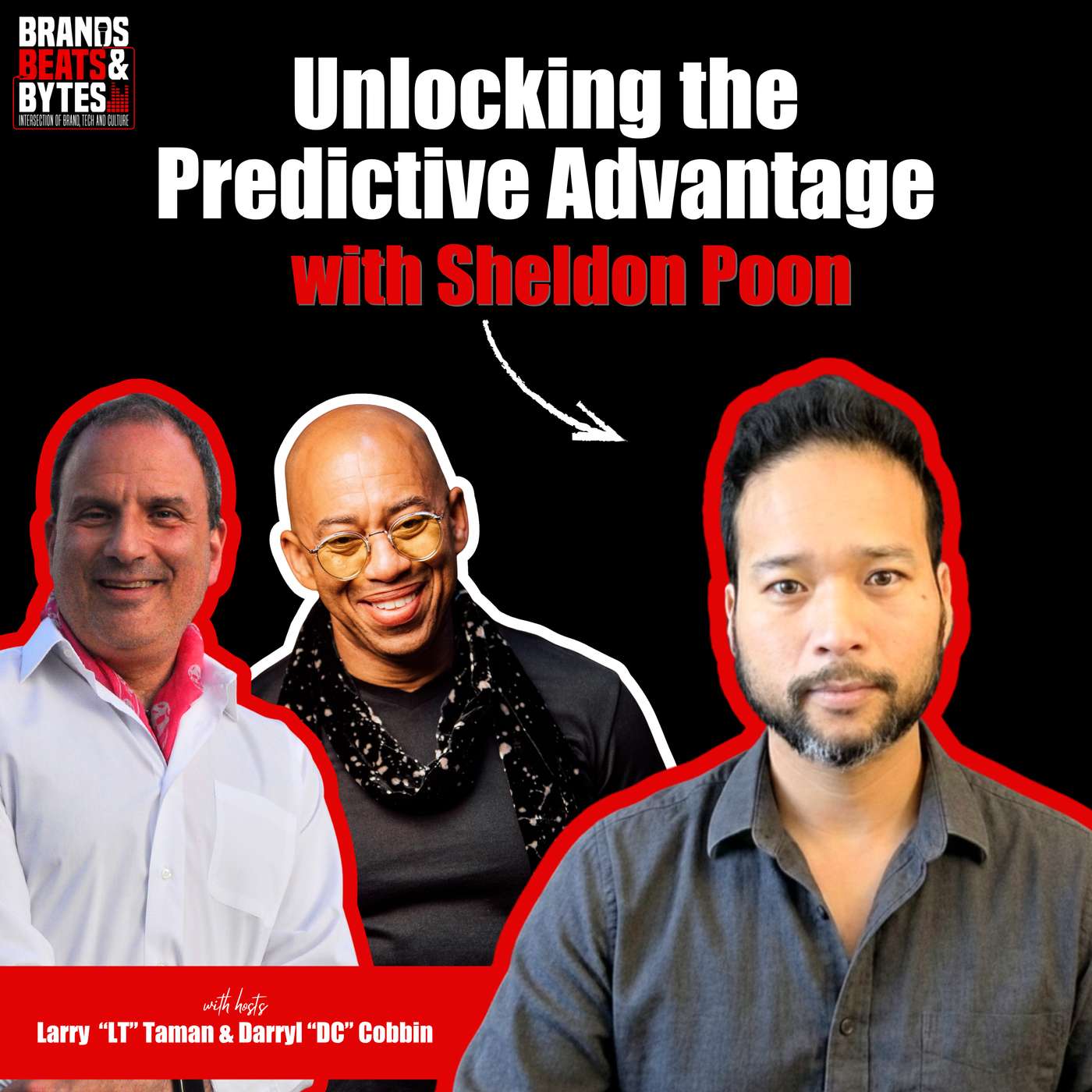
Album 8 Track 20: Unlocking the Predictive Advantage w/Sheldon Poon
About this episode
Album 8 Track 20: Unlocking the Predictive Advantage w/Sheldon Poon
What happens when you mix a computer science background, a decade teaching high schoolers, and a philosophy degree?
You get today's guest, Sheldon Poon, Founder and CEO of Drive Marketing, a leader driving $10 back for every $1 spent on Meta and Google ad campaigns.
In this episode of Brands, Beats & Bytes, Darryl "DC" Cobbin, Larry Taman, and Sheldon Poon examine why the digital marketing playbook shifted 180 degrees. Sheldon explains how modern ad algorithms use 50,000+ data points to identify deep psychographic patterns and why forcing tight demographic boundaries actually destroys your return on ad spend. Plus, Sheldon shares a candid, real-time look at a major business misstep that reshaped how he approaches pipeline growth, agency scaling, and company culture.
In today's AI infused world, we know this is an episode you'll enjoy (and learn a lot from)
Don't forget to subscribe, rate, and share with a fellow Brand Nerd!
Get every episode summarized
Each time Brands, Beats & Bytes publishes, we email you a written briefing from the transcript — the topics, who appeared, and any specific claims, with the ad reads skipped.
Email me new episodesFree for 3 shows. No card needed.
Transcript ready
1,111 searchable segments. Every word is indexed and playable.
Full transcript
Brands, Beats & Bytes — Album 8 Track 20: Unlocking the Predictive Advantage w/Sheldon Poon. Machine-transcribed; use the interactive transcript above to jump the player to any line.
Brand nerds, brand nerds. It's the next episode of Brands Beats and Bites. And Larry, I gotta go a little philosophical here. I gotta go philosophical. I love when you do that. All right. So we thank you, Larry. We know that we hold a belief that if there's a problem with a brand and business, it can typically be mapped back to brand positioning. The great brands all have something in common and it's called a sharply defined well-position brands. The ones that are not so good, 99% of the time, their problem is that they got a murky positioning. People don't really understand what it is. Merky at best. Yeah.
So that's our philosophy on branding. But our next guest has some other philosophies in addition to that. The first one is, I'm gonna give a quote here, is Buddhist. It's a Buddhist quote now. When the student is ready, the teacher will appear. Brand nerds, when you have the ability to be in front of a great teacher, take a beaten listen. Listen to what this teacher has to say. And we have not only a branding and marketing expert, but a teacher. Number two, I got a story to tell. Way back in the day, we used to have these folks who were partners of the Coca-Cola companies, celebrity partnerships, athletes, or as Charles Barkley says, Larry, athletes.
One of them was a NASCAR driver. His name was Tony Stewart. So he was in our meeting. We were having this executive leadership meeting. He visited the meeting and said a couple words and asked him, I said, excuse me, Tony, when you're racing around the track, it upwards of 160, 70, 80, and you're coming towards the end of the race and you're leading, and there's someone that's in second place barreling down on your behind. What do you do? This brother Tony Stewart said, the first thing I do is slow down. Not the, wow, slow down. Not what I thought I was going to hear from him. Our next guest understands the value of taking a moment to slow down. I want you to listen to that, brand nerds, because some of us are scared to take a moment to slow down. And thirdly, I'll say this, brand nerds, you all know I'm from Detroit, the motor city,
Detroit, Detroit. We're in a moment now where, as I used to look across the Detroit River, my brethren, over in Ontario, Canada. And I do think of them as my brethren and sister. Right now we are in the middle of some ridiculousness, okay? And I just have to acknowledge it. I'm sorry to make this political. I'm not trying to make it political. But I've always thought of my brethren and sister, and I used to go over what was then the Ambassador Bridge to go visit. And I would see my brethren and sister in Ontario and Canada, they would come over and by the way, if you all have never been, if you have never been to Toronto, it's not Toronto, it's Toronto. And they have a festival, this called the Caribbean Festival. It is one of the best you can ever go to. So I just want to say, brand nerds, we have a Canadian in the building, okay? And I'm just so happy that we have a Canadian in the building because as a relates to all
this stuff that's going on right now between our two countries, I'm going to say this in the nomenclature that my Canadian brethren will certainly understand, we should be using a different process to eliminate the drama, okay? With that, Larry, can you tell the people we have in the building today? That's crazy. With you, we have Sheldon Poon in the house. Welcome, Sheldon. Thank you so much. That's a great intro. And I just want to say, the last time I went to Detroit was literally coming from Ontario, so there's a small town on the other side of the bridge. And there's one bus line that goes between the two countries and you just take it like a regular city bus. Oh, wow, I did not know that. Yeah, it was the weirdest experience because you hopped on a regular city bus, you went under the tunnel and in the tunnel, there's a customs guy and then he just takes your basic information, checks your passport, you hopped back on the bus and you continued,
but now you're in the US and you're in Detroit. And it was just one city line. That's how close the country is in my mind. That's how it should be. Oh, yeah. And once this old ridiculousness is over, I think the actual people from both countries can go back to normal because I haven't heard of a single person, actually actual real person on the ground who sees any of this as anything other than ridiculous. So I'll be here. I, I, I, I resemble that comment. I agree. I agree. I agree. Oh, hardly. Okay. So Sheldon, it's time for us to give the brandards your full background here. So brandards, we are coming you today to you today with someone who is founder and CEO of Montreal based digital marketing agency drive marketing and for those, see, those on YouTube, you can see the drive logo behind Sheldon, where their clients get $10 back for every dollar spent on, on meta and Google.
Do you heard me $10 back for every dollar spent? Mm hmm. That is performance marketing. But let's walk you through Sheldon's very unique and super cool and non-linear career path leading to drive marketing and DC was giving you some Easter eggs in his context. So Sheldon first attends Dawson College and he perfectly fits the stereotype as he would say for his computer science major, technical, introverted and much more comfortable behind a computer. Unexpectedly, while in school, he takes a job in telemarketing and to his surprise, he becomes one of the strongest salespeople on his team and eventually trains new hires. He learns an early lesson unknowingly, directly shaping his future career. And it's this understanding systems is important, but understanding people matters just as much or more. After graduation, Sheldon expects the land of corporate tech job. And nerds as we have said so often, timing is really key to everything.
Sheldon graduates right when the dot com bubble is bursting and he is competing for entry level roles against people with years of experience. Given the situation, he takes a job in construction and a year later, you say that this brilliant mind, in digital and performance marketing, with a degree, took a job in what industry construction. Construction. I see the parallel, please continue. Gotta pay the bills, right? Yeah, gotta pay the bills. And a year later, he lands what he thinks is a temp job teaching computer skills to high school students. He falls in love with the classroom and stays for nearly a decade. That's what DC was alluding to as the teacher. When budget cuts move him to the school boards at office, Sheldon becomes one of four tech staff responsible for a multi million dollar technology network. At this time, he begins to conceive drive marketing on the side, wanting to give the company a real shot. Sheldon finds an unconventional way out of his day job.
His union agreement allows full time students to take a sabbatical. So he applies to university. His view is first computer science rejects him, then business rejects him. Philosophy lets him in. Sheldon takes his sabbatical and becomes a philosophy student that can cordial university and simultaneously starts running drive marketing full time. When his sabbatical ends, he chooses the agency. The unusual path still shapes how he approaches marketing today. Sheldon's background spans technology, sales, teaching, philosophy and entrepreneurship. Rather than treating Google and meta as collections of tactics and best practices, Sheldon and his team focuses on the systems underneath them. How the algorithm's learn. What incentive drive the platforms and how data and campaigns can be structured to work with those systems. This thinking is foundational to drive marketing's approach. It helps clients achieve return on ad spend and the acronym is R O A S.
Results of at least three X industry averages across multiple industries. Here's what drive marketing says on their website on why they are different than other agencies. Quote, every marketing agency says the same thing. Makes the same promises and claims to be different. Here at Drive we don't focus on anything other than results for our clients. That means R O A Y. Every one of our clients makes measurable revenue on the work we do, which is why our clients continue working with us after years. Outside of work, Sheldon lives with his partner and young son, splitting time between Montreal and summers and New Brunswick. He enjoys climbing, motorcycle, snowboarding and tinkering with code and technology. Really looking forward to this one brand nerds. Welcome to Brands Beats and Bites. Sheldon Poo. Such an intense intro. I think that's the same feedback you guys got with all your other guests. Everybody's just like, oh my God, that sounds so much more impressive than I feel. Are you, man?
Are you? Are you? All right, Sheldon, we're going to get comfy. The word's back. Words of that. Right. Your sabbatical was a little different than what people typically think of as a sabbatical. Yeah. That said, it was a sabbatical. And so can you walk, walk the, the brand nerds through your thinking at three different stages of the sabbatical? We know what happened at the end. You chose the agency. We kind of know what was going on at the beginning. But we, but not entirely sure what you were thinking at the beginning of that sabbatical, but maybe even more juicy is in the middle, in the middle of this sabbatical. What was going on with you? So, um, I think so I don't have a very typical entrepreneurship story.
I think a lot of people start their businesses nowadays because some other chapter in their life came to a close and they were kind of forced into it. They looked around different options and said, you know what? Now is the time there's some like, there's some moment, right? Yeah. For me, it didn't really work like that. I think today, and I talked to, I still tried a lecture to high school students because that's kind of where my heart is at. And I tell these kids a lot of the times that today you take it for granted that people just want to be an entrepreneur. That's like the, the height of what they want to achieve. But that's not what it was like back in like the 90s, back in the early 2000s. It didn't make sense to be an entrepreneur. Why would you take that risk? Right. It made sense, especially I was studying computer science. Computer science at the time too was not a sexy industry. It was just like a whatever job. And for Tran. Yeah, that's it. Like, yeah, I was doing cobalt actually. Cobalt. Okay. Okay. I mean, friends. Yeah. But, but also, Sheldon, what I think you're also saying is there's a very distinct career path
at that time, you have your science major, you get a tech job and you're good. Yeah, this is you work at you work at a bank, you work at insurance, you work at like some whatever like a established big industry on a team. And I don't, I wasn't surrounded by entrepreneurs. I was surrounded by engineers. I myself was an engineer. Yeah. But when I was a kid, when I was a young, young, in elementary school, my buddy and I just came across like this random spool of like old wire that constructions that I left behind. And we started making these little bracelets and selling them on the playground. And we started an entire elementary school to the point where teachers for whatever reason called wind of it and shut us down as it was some sort of threat that these like, you know, that these tenures are going around selling these bracelets to each other. But that was my first kind of foray into like entrepreneurship. And I enjoyed it. I liked it. I liked it so much. I also always growing up looked around and said, I did not want that typical typical career path.
It was just something I got pushed into. I was told by my parents, you know, being, being from an immigrant family, you know, they sacrifice so much to be here. We got to work hard to make sure that we don't have to go through that same level of struggle and sacrifice. So we set you up so you can have that career, get that job, raise that family. But that never sat well with me. I always wanted to do my own thing. So in the back of my mind, I always had this question, could I really make a go at it? Could I really build my own thing the way that I want and escape that kind of typical corporate path? So that was a question that went on answered as I was teaching as I was working at the school board. So the opportunity didn't come up. What happened was I was I was on a very understaffed tech team at the school board. We were responsible for I forget how many at least three dozen buildings. So we're the biggest English school board in Montreal.
And we had tens of thousands of users that we had to support. This was at a time when the government was giving us tons of money to buy more equipment. There's metrics and it so every IT person on the ground should be supporting no more than I think like 20 20 pieces of tech. I think our guys were supporting 60 or 70 pieces of tech. You were way understaffed. And because I was one of four guys who was kind of like I was just under management. A lot of the calls flowed to me. All of the hard problems came to me and one of my buddies. My buddy was about to take a sabbatical to go travel Europe. And I sat down with him one day and over lunch, I was just realizing that, oh my God. Once you leave, all of your work is coming to me. Wow. I need to get the hell out of here. Okay. Okay. I didn't plan ahead. So I after that lunch, I literally ran upstairs the HR and I had a friend there. And I said to her like, okay, this is the situation.
I need to leave in the next few months for sabbatical. I was like, what are my options? Because I haven't planned for this at all. And she looks up the union rules and she's like, well, it says you're that technically, I guess if you're going back to school, you're entitled to take sabbatical. And we can't, she put it, we can't stop you. Union rules. Union rules. Exactly. So immediately I started looking around like, okay, well, I have a background computer science. Let me apply to computer science. They took my college grades and said no right off the bat. Because at that point, computer science was no longer just a whatever program. It was very sought after. And they were the best of the best. And my grades did not reflect that at all. So computer science rejected me. I had already started a version of drive when this happened. So I already had a bit of business experience. So I said, okay, I can go into business school. Business school said no. So again, business school was looking for the best of the best. And their websites and their program and everything.
All the talking points kind of said, like, you know, you have to be like cream of the crop, like absolute best marks, best grade, passionate, driven, all that stuff. And they were both at Concordia, the computer science and the business programs are very highly regarded. I argue absolutely world class and they do accept the best of the best. Very well funded. So then I got desperate. And I was like, well, I always like philosophy. Let me see what's going on there. And the website is the complete opposite. And they're desperate for funding. And they said, please, please sign up for philosophy. You can do something after this is your door. This is your way in. You can just like join us and just make our program relevant so that, you know, the school doesn't shut us down. So they accepted me right off the bat. So once I got accepted into full time school, I was like, okay, perfect. I went back to the union. I'm taking some time off. So not the most passionate driven story. And it's definitely a weird way to get into entrepreneurship.
Larry. Not your please Larry. Please. So she'll then what I'm struck with is that, you know, you're obviously starting from the very left brain place, computer science is yourself describing, you know, all your attributes that fit computer science. But philosophy is the antithesis of that. Yeah. And what that sort of that, that I don't want to put words in your mouth. But I guess the question goes, did that provide a whole new viewpoint and outlook for you that you wouldn't have had if you didn't study philosophy? Yeah, absolutely. I, I was going into the philosophy program out of convenience because it was the one program that was accepting me. I came to absolutely love that program. My, my original thinking and they, they even said this because I'm not kidding. The philosophy program is at any moment being ready to be dismantied. But they even said like, listen, we'll accept anybody.
You can join us and then what you can do is get your other prerequisites, get your marks up and then switch into the program that you want. So that was my original plan. Wow. But I just like teaching, I just fell in love with the philosophy program. I really, really enjoyed what I was reading. It gave me a different lens, a different perspective on things. And I kind of just stuck it out. Unfortunately, with the timing and everything, with the agency and with COVID, I never finished my degree, but that's something that I definitely want to, want to do at one point. But yeah, it definitely shaped my thinking. The most interesting thing was at the, at the time when I was in the philosophy department, you know, there's all the typical like ethics and all that stuff that you study. But the up and coming, not up and coming, but the branch of philosophy that was doing the most interesting work was philosophy of mind, particularly because this was the beginning, beginning, beginning of machine learning of AI.
So there started becoming these questions of what can these things do? And what I found interesting was because because I was in tech and I was working with some of these algorithms that they were talking about, I was able to dispel a lot of the things, a lot of the rumors that they were working off of. So because they were philosophers, they did not have an understanding of the tech side. So the things that they thought that the technology couldn't, couldn't do was based on sci-fi. It was based on not realistic like interpretations of what it was. And this is going back before LLM was taken seriously. So we're really talking about like TensorFlow machine learning, more like the beginnings of what we can serve AI today. So I found myself a lot of the times being in those classrooms, bringing a professional technical lens, even though this was an undergrad, and I was, I just ended up having one on one conversations with the professors, with the rest of the class just kind of listening in because I would tell them like, you think AI can do this, but it can't.
It actually works like this under the hood. This is what it does. This is how it does it. Like your thing that you're coming up with, that's not realistic in terms of what the threats are. Like it's actually more closer to this. So I ended up really enjoying it. And today, now that we're getting into LLM's and we're seeing it do things that we wouldn't have thought possible like 10 years ago, it, I draw a lot on what I learned in those philosophy classes because it brings in some interesting ideas. Why is something like a large language model, which is a statistical predictive algorithm, seemingly having some sort of thoughts that go beyond what it should be able to do. It's almost like there's a human consciousness that's been built into our spoken language that these machines are reflecting back to us. So it's interesting what you think of as a mind. And that's one of the ideas that's explored heavily when you're doing philosophy of mind. And that's if in another life, once I finish my 100 grad,
if I continue going to philosophy, I'd probably look at what other aspects of philosophy of mind are there given what we now know that's happening on the ground with these AI technologies. That's deep D and I love how what seems to be serendipitous, but we believe in something larger than that, Sheldon, has really helped inform what you've done with Draft. Right? It has. I think so I think one of the big advantages that we have is that because of my background in computer science, I personally tend to be very early when it comes to tech just because I'm always tinkering with things. Right. And with the reason even though we call ourselves a marketing agency, I always tell people who get to know us. I'm like, we're really a tech agency that is wearing a jacket that says marketing on it.
We our philosophy is really that there is a pivot that's happening in the industry. And where before I would even say 18 months before, marketing, winning at marketing was probably like, call it like 70% content and 70% creative work and like 3% technical. I think that balance has now shifted where it's probably like 60% technical if you really want to win. And I think the reason we're able to get the return on ad spend and the return on investment that we do for our clients is because even though we're not great on the creative side, we lean very heavy on the tech side. And when you fall in the tech side and you fall the engineering standards and you start understanding the way in which these algorithms are making decisions, you can play with that. And just having that technical advantage is enough to get you those business wins. Very interesting. Extremely. Thanks for that, Sheldon. We're going to get into five questions now.
Larry and I go back and forth until we arrive at five, I begin. Take yourself back. I like the story of front of you going back to getting on the bus in this small city in Ontario on the Ontario side and riding it through the tunnel to the US. But this is about branding experience. Take yourself back to the first branding experience or brand that you can recall where you were just really into it, Sheldon. You just couldn't spend enough time thinking about it, talking about it, interacting with it, whatever the case may be, a bit like a first love. What was the, what was this branding experience for you? So I have two answers for that and for very different parts of my life. That's okay. So we have a, we had a brand in Canada called Eton's. And it was a department store. And how do you spell it?
E-A-T-O-N. Okay. So the Eton's department store is used to take up like a fair chunk of the downtown core. Like there was a big, a big department store that was right downtown. And Eton's and the Bay were the two like big department stores that we had in Canada. At this point, they're both pretty much gone. We still have the Eton Center in Toronto. So the Eton's at its height created the Eton Center in Montreal and Toronto. And that's where we get that name from. But the reason that always, that was a brand that I connected to very strongly was because growing up, my father worked at the Montreal Head Office. And he was the one responsible for creating the ads that would go around. I knew that they were all over the city, but I think it went province-wide if not like national. And back then, this was like the 80s, he would literally hand draw the ads that would then get printed and blown up.
So I, as a kid, I remember like walking through our metro system. And my dad's work representing the Eton's company would be plastered on the Metro walls as these giant billboard things. And my dad always had added a little, he always hid his signature somewhere on the drawing. Oh, that's cool. Yeah, so he would point it out to me on these giant blown up pieces of art that you saw everywhere around the city. And this is back in the 80s when at the height of that company, you know, it was like if you were part of the company, you were family. So they had like, I remember as a kid going to these elaborate Christmas parties where they would gather like hundreds of staff members from all across the company. In at the top floor of what used to be the department store, there is this beautiful space to host events that is a historic like antique space that the city is actually now in the process of renovating and saving. And that's where they would have these Christmas parties.
So all of the because it was department store, all the stuff in our house was from the Eton's. I have like a little stuffed bear that I've passed down my son that's from the Eton's. So it's a brand that obviously because my father was so involved with it, it's a brand that always like has a very special place in my heart. And when in the 90s when they when bankrupt, it was just devastating. It was devastating obviously for like my family's finances. But on a personal level, it's like we lost something that was just taken for granted. That was just in the background that was always there. That was a part of my life growing up that all of a sudden one day, it's like, what do you mean? This brand is just gone. Right. So that's the that's the brand that I that I remember from my childhood. And then the brand that I connect to as I was growing up is Google because just because I was in computer I was studying computer science. I always part of that era of watching from a distance when you know the corporate mindset was this.
And then all of a sudden you had this scrappy little company doing web stuff and it was disrupting everything and everyone was was pissed off at them. And back in the back in the early 2000s, I graduated in 2002. Computer science culture was hacker culture, right? Yeah. You didn't have like you couldn't go into the store and pick something off of a shelf. You had to like go and assemble stuff yourself. You had to find random parts and look up schematics and buy a book or go to a library and figure out how these things worked. And really like mess with it and piece it together. So Google when it was coming around was kind of like, oh man, this is this was the beginning of this is our time now. Like us nerds us. You know, the guys they got like kind of picked last on the on the soccer team in school. Like this is our chance now. This is our this is now something that's coming up that's going to be our home. And it was fun to watch that as I progressed in my career. Obviously today Google is something completely different, but those early days.
Of those tech companies before Silicon Valley became Silicon Valley of what it is today. It was something very different. We were all watching from the sidelines and looking at this thing as like a utopia. And I remember like as time continued, right? Google had a very specific philosophy. It wanted to be like I have friends that work at Google and I've had friends that work at Facebook and I've had friends who work at Amazon. Each one of these brands has carved out a very specific philosophy has carved out a very specific way of doing business as it were. Google. So one of my one of my one of my buddies was working there as an engineer and any minor little project that he did. He was always told like, okay, no matter how much you've engineered it, you have to make sure that whatever number of users you expect, it has to be able to handle at least. 10X, 20X, 50X, that number of users. The four will sign off and let you do anything in any kind of open beta.
Whereas I have friends that work at Facebook and they're like, yeah, anything. Like just go for it. Just try it and if it breaks whatever, we just shut it down and do it again. And then there was Amazon and I won't get into the specifics, but I've heard a forest where is that Amazon. But each one has a very specific engineering standard and it comes out in the way that they present themselves to the public as well. So the brand that I always followed was Google because I think that was the kind of like the unicorn story that a lot of us kind of aspired to be. And then there was other people that like the Facebook story and kind of the counterculture and the difference between the two I think was that. Google was trying to build almost like a utopia where Facebook seemed angry at the world and wanted to take some sort of vengeance for us nerds. And that's why I always kind of lean towards more of the Google side. So that's my that's my whole spiel about like what I saw in terms of branding there.
Interesting economy and the two. Harry, anything you like to add before we go to the next question? I just have one quick thing and then we'll before we go to the next question. Brand nerds what the new ones is that Sheldon picks out are actually embedded in each of those brands brands positioning. And that is something that we take. We had brand positioning doctors and here at Brands Beats and Bites pay very close attention to. So we're calling it out for you to do the same. All right, next question. So Sheldon, who is had or is having the most influence on your career? So I went back and forth on this one a lot and I think like it's cheesy, but I have a two year old now. And I think he's made the biggest impact in terms of my thinking in terms of just my career path in terms of like how do it forced me to reflect on my life and my decision and my time more than anyone.
Has has ever made me reflect before because obviously now everything that I'm doing I'm always it my son's always in the back my mind. I'm like how is this going to affect his life right? It's no longer just my life. It's not cheesy by the way because DC and I are parents and it. The biggest change in one's life you can get married. The biggest change in one life is being from the time you were not a parent to a parent. Yeah, you see that I've talked about this a lot. So it and by the way other folks have said it. So please. Oh, are they okay? Oh, yeah. Yes. Yes. Well, that's good to know. I'm sure I'm in good company then. You are. You are. But yeah, no, definitely like I you know, you can even tell the way that I started the company was almost like a point of convenience. I was just I was sick and working at the school board. Right. I wanted to change. I want to see if I can do something. And then I just kind of went for it. It didn't matter if it failed or whatever. Now it's like every.
My wrist tolerance is a little bit different, right? I'm trying to think ahead. I'm trying to think plan for the future. I'm trying to make the decisions that are not going to keep me stuck at the office till midnight. Because I have to be home. So these are the things that are kind of starting to affect my decisions and my career. It's definitely had like the biggest impact. And then at the end of the day, right? It's also from an ethical standpoint. I want to be able to make the decisions that I can stand behind and be proud of and tell him like, Hey, like this is what I did and not have to be embarrassed or shy away from it or hide it from him because it was something that was and scrupulous. Love it. I. I. I've got three words that sum up. Being a parent that I did not get until I crossed the threshold of becoming a parent.
Now these three words are true just in life, but I didn't recognize that they were true in life until after having my first daughter. Her name is Haley. And those three words is actually four words. It's not about you. Yep. Yeah. Yeah. It's not about you. And you now know that. Now the reality is, even before we had Haley, it wasn't about me then either. I just thought it was about me. Exactly. I just thought it was about me. That's a beautiful answer. Beautiful answer. Yeah. Love that. And it does your whole view of the world changes. It just does. And for you to notice it and it's going to shape your company too. I think in the best way. Sheldon, which is really cool. Do you want to go to the next question? I do.
Sheldon, you've been running your own shop for a while. You've had a meandering matriculation through your career. As you look back, what's the biggest effort that you've encountered that was on you? You're thinking, not your business partners, not your partner in life, not some colleague, not some above you manager or executive or C-suite person. But you made a decision or a call. It was an F up. And most importantly, what did you learn from it, Sheldon? So I think the biggest F up. We're still in the middle of to be honest. Like not in the middle of it. I'm maybe not the middle. We're seeing a lady in the tunnel. I think I'm almost out of this point. But I went against one of the rules that I put for myself when I founded the company.
And low and behold, it came back to bite me in the ass. When I was, before I started my company, I had friends who were in various industries, a couple of them were working with marketing agencies. And I had seen firsthand a couple of agencies that had not set themselves up properly, where they were beholden to like three big clients. And when one of them left, they would have to do like around a way off. Right? Oh, yeah. Yeah. So you see where I'm going with this. So when I started driving, I was like, okay, this is not something. I want to make sure I don't put myself in that situation. But low and behold, like what ended up happening was one of my very close friends. He works in the finance space. And he came across this deal. He was working with a group. They had just got their funding and they were in the process of buying a whole bunch of companies. And we started consulting with them. And we came up with this plan where one of the things that they will look for in terms
of what companies the buy was companies that had solid foundations, but were weak in terms of marketing. So there was potential there to kind of grow the revenue. Right? Very, very basic play, very standard thing. Yeah. Yeah. Everything was good. They went around. They started buying up these companies. They started handing out these contracts. And they were too good to pass up. Even though I recognized at the time that we were getting in bed with like a single kind of source, like a single point of failure, the monthly retainers that were coming in from these new projects were going to double our revenue just overnight. So I was like, how do you say no to that? How do you say no to that? Right? So I was like, okay, I'm going to go into this. Why like eyes open, I'm going into one of the rules, but I'm going to plan ahead for it. So financially what I did was I didn't change anything in terms of my, in terms of our operating expenses or as much as much as like we could avoid as possible.
Any profits that we had, we put it back in the company and just kind of held it because I was like, this is for sure going to blow up in our face. So let's let's hang on to this money just when the rainy day comes. The problem was that we had to grow our team. So during that time, we actually grew our team to not nothing crazy, but we were at 15 people at that point. Somebody's got to do the work. So it's going to do the work, right? So we grew our team to go at 15 people. And because of that, our payroll went up obviously. And we were just kind of, we were doing quite well actually with these contracts until they had a principal funder, they decided to pull out. There was some sort of problem between the group and the funder. And then because of that, they could no longer hit their milestones with these companies. The companies, their funding up, their revenue, another revenue, but the funding that the funds that they had and the plans that had been placed to continue growing got messed up. So they started cutting our contracts.
And then we found ourselves in exactly the situation. I didn't want to find myself, which is, you know, we've now increased our headcount. We've increased our expenses. But now we've lost this source of revenue. And what do we do about that? So fortunately, we had that, that the extra funds were sitting around. But what it turns out is that when I look back on it, the real screw up was not taking the contracts. That was not the problem. The problem was when I took the contracts, I was too personally invested in making sure that I would work out. Because I think I got nervous knowing that there was going to be an end date. I didn't do a proper job of onboarding the clients. I didn't do a proper job of just handing off the work and letting the team do it. It took up too much of my time to manage those relationships, to try to keep these going as long as possible. And because it shifted me from working on the company to working in the company,
without me realizing it, all of a sudden we lost our front of house. And there wasn't anyone doing that networking to continue bringing in the fresh work and the new clients. And I didn't realize that after the bottom fell out and I was like, oh my god, our pipeline is gone. Right. That was the mistake. Yeah. So we're still dealing with that now. And not to say that I didn't try during that time, I kind of knew what was going on. So I had tried to hire a guy to do sales, but our foundation wasn't there. That's the same. It's not the same. So when our pipeline disappeared and our funding and our lucrative contracts were gone, that's when I started having to make some different decisions and start cutting back. We had a few folks that they had come on short-term contract because I knew this was going to happen. So they finished their contracts. They left. We brought our head count back down a little bit. But we were in a bad spot. We're still not in a great spot now. We're still kind of getting out of it. But that was a huge, huge kind of kick in the teeth.
And one of the things I came up with that too was that during that time, it was a domino effect. So the initial F up was looking at this and going like, I got to take this. I can't not take a contract that's going to double the revenue of the company. So that was the big hit. That was the first mistake. The revealing mistake was the fact that I ended up working in the projects when I should have just been handing them off. But the final thing was the reason the sales guy that we had hired during that time because we had a bit of money, the reason he failed was because we set him up for failure. And I think that's the thing that we're still trying to recover from. Our own marketing efforts, our own branding efforts, had fallen by the wayside because we were focused on the client we had. My networking had fallen off a cliff. We weren't doing the same things in the past that had been bringing in attention and revenue. And those cracks are still there and we're still trying to patch that up to get us kind of back on track. So yeah, it's been, that's probably been the biggest FF so far.
And when I say so far, it's because I noticed that the bigger the company gets, the bigger these FFs are. So until the next one. Yeah. De thoughts? What a story. Sheldon, if you were going to put a percentage on someone who's leading a company or team leading the company, what percentage of their day-to-day time should be placed on working on the business versus working in the business? What percentage would you give to on versus in? I, that's a question, but I don't know that it works out that cleanly. I've seen, and it depends on philosophy, right? I think I've seen a lot of, by many metrics, very successful companies,
where the owner was a hundred percent focused just on getting new business, getting new contracts, figuring out the next, like, whatever move. Actually, one of my, one of my best friends did this and he admits that this was a huge mistake. He was a hundred percent investment invested in getting new contracts and making sure that he was handling that side of things. He left a hundred percent to his operating team. What his operator did was he created this toxic culture where everybody was infighting many, many cliques. Everybody was backstabbing each other. All sorts of weird politics. Like, we talked about it now and I'm like, dude, how did you not get sued? He's like, I have no idea. Like, there was so many people. You were zero percent involved. There's what you're saying, too. Yeah, he was zero percent involved. Yeah. But he was making a ton of money at the time and everything was running great. But ultimately, the company just fell apart because the operations like killed it. I've also seen other guys that they're just so a hundred percent like deep in the operations. They have everything running like clockwork and they have business just flowing to them
because they just set that up where they can just be there on the ground, smoothing with their existing clients, making sure that everything's going well, keeping the culture up and everything's fine. So I don't know that there's like a magic number. For me personally, yeah, for me personally, I'm very lucky that I had a very particular mindset of how to build the team and how to build the culture and drive. Everybody gets along, I think, pretty well in our team. And our philosophy is that everybody learns, everybody teaches. So everybody teaches the new stuff that they've learned. And I always, I asked the interns, like, what's going on with you guys? Like, show me something new because you guys have a different perspective. Yeah. So out of that, our operations are pretty clean. Brent, our head of operations does a phenomenal job of making sure the shop is taken care of. So I personally should be spending 80% of my time just working on the company and only 20% checking in to make sure things are going well.
And I know more or less what we're doing so I can represent it properly. But that's a personal split, I think. That would be my ideal. I don't think I'm quite there yet. I'm still a little bit too in the weeds for some of the things just because I like, I have an engineering mindset. I like play with code, but yeah, I shouldn't be spending 80% of my time. Probably just working on the front of house as it were. Thank you. Thank you very much. Larry, any more from you before we go to the next question? I just have a quick comment. That's a great story. Thanks for sharing it, Sheldon. And I just, I do have one quick question before we get to the next question. So Sheldon, it sounds like you've done a lot of thinking about this. It's like, you know, to diagnose it, right? So what, when did this all occur to you? Like, was it, well, you say you're still in it, but you're obviously towards the,
you're still dealing with the repercussions, it sounds like. But when was, did you have, did the aham, was there an aham moment, or did it come to you over time? Like, man, I, I, the pipeline dried up because I was too immersed in the business and, and was it well past that point where you could really shift to do anything about it? There was definitely a moment of panic when we, we found out that the contracts were coming to an end. Fortunately, we had, you know, I was looking at a bank account that was very healthy, cash flow wise. So I was like, okay, we have a little bit of time to figure it out. But then when I sat down, I did the math. I'm like, I know more or less how long it takes to close a project. I know like, what are pipelines look like? I know what's coming over the horizon. I think it was a particularly bad time too, because it's right around the holidays where everybody's like, you know, effod. So I think it was that moment that I was like, oh no, this is bad. Like they were in bad shapes here. We don't have anything coming in.
We have to kind of, it's a flywheel, right? So like market is a flywheel. It's a running train. So to get that flywheel going, to get that train going and from scratch is, it's not an easy thing. And like I said, when we had our sales guy as well, he exposed a lot of these cracks that I, and again, this is part of it where instead of saying like, okay, I see these cracks, we got to deal with this right now. We were in a comfortable position. So it was like, okay, I see these cracks. Let's make a note of it. Let's come back later. And that's when it was like, okay, now this is a real problem. Gotcha. A good thing you planned for the rainy day, though. Again, I think what you, what I'm gleaning, though, is you would still take the contract, but you would have done a number of things differently after you did that. Yeah, exactly. I think I don't know that even though I went against one of my rules, I don't know that it was the wrong call to take it. It wasn't. Yeah, yeah, yeah. It also gave us a huge boost in terms of the way the company operates in terms of the size of the
company. Like sure. I can track a very clear, like before and after those contracts for better. There you go. No, yeah. All right, let's get to the next question, question four. And I love this for you, given your, your, really unique and interesting background, especially your tech background. So regarding technology and marketing and the confluence of those, I think you can really help enlighten the brand nerds in us here. Can you tell us where you think marketers should lean in or best leverage tech or you can take us to an area or areas they should be linear simply avoiding? So, um, yeah, tech obviously has shaped the my career, my company since the beginning, right? So this is a very, I could do an entire series just on this separately. I'm sure you could. Yeah. The obvious thing that people are talking about is AI, right? Yep.
There's a lot of myth around AI and I think, yeah, and when I talk to a lot of non-technical people about AI, their understanding of it is, oh yeah, chat GPT, I log into chat GPT, I'm using AI, right? But that's not it. AI has been serving ads, for example, I'll, I'll try to stick to my lane and talk about mostly the ads and algorithms because that's the one that we definitely know the best. So when people are using a system like chat GPT, they're using a large language model and LLM and large language models are statistical machines that are basically trying to guess at what the right answer or the most statistically likely answer is going to be. But that's only one type of AI. There's also predictive algorithms. So whereas the LLMs are considered what's called a generative algorithm or it's generating content,
a predictive algorithm is taking a very, very large data set and then trying to glean patterns that a normal person using normal math would not be able to do, right? So think of like things that predict weather, the algorithms that predict the stock market. In our case, algorithms that predict who's going to buy an ad, who's going to click on an ad. So these predictive algorithms have been embedded into Google and Meta for at least the last like last decade or so. Right. In some form or another, they've been used way before people started realizing that AI is everywhere, AI has actually been everywhere. And I think the thing that's happening right now is that people don't have enough technical expertise to take full advantage of these algorithms. So what they're doing is they're defaulting to an older way of using these ads platforms and they're actually budding heads with the way that the AI is meant to work and then they're getting
poor results and not realizing what they're doing. So I would say to anyone who's in marketing today, understand that marketing, like even though yes, like the foundations have stayed the same, like even us, we still use Ida, we still use attention, interest, desire, action as our fundamental framework, the tools have changed. And I think what's happening is a lot of people have not caught on to the fact that the shift in winning at digital marketing has shifted towards the tech side towards the data side. So while it's important to have the branding and all that stuff, the quality of your data, the completeness of your data, the way you're feeding the data into your algorithm, the way you're sending up your campaigns makes such a big difference in today's in this day and and if you just read up and follow best practices and take some time to understand what these algorithms are doing, how they like to work, you can get the results that we see because they're meant to get those results. Our theory is that the average return on ad spend that's out there in
the marketplace is actually so low because most people don't know how to use them properly. Most people don't use the tools properly. We do think that if everybody was using the tools the same way we are, they would see a similar return on investment. It just takes a lot of work. So more concretely, right? The meta, so meta ads is a very good example of how people are going against the algorithm right now. Traditionally, the way you set up a Facebook or an Instagram ad, you would kind of go back to basics and go like, well, my brand is this. So I think it's going to appeal to women who live in suburban areas between this age and this age making this income and you put in all the demographics. And then you start serving up the ad, you start making the creatives and you just start seeing like, okay, I'm trying to, I made the ad for this person, for this persona, I want to serve only this persona, right? And the meta algorithm, the meta platform would let you
do that previously. It doesn't work like that anymore at all. What you have to do now instead is you have to flip it on its head. What you do is you say, I think that this ad, this creative represents my brand well. And this is where the branding is really important, the positioning is really important. Your positioning should be clear enough that when you look at the ad, it instantly tells you who this brand is for without doing anything else. Right? If you look at a McDonald's ad, you know, you're not targeting corporate America. You're not targeting like the high end lawyer who is driving around in an expensive Mercedes. He's not necessarily stopping at McDonald's, at least they're not targeting, they're targeting families, they're targeting like a certain demographic. If you, if you see like an ad for a particular product or a brand, it should immediately speak to your
target audience regardless of demographic. And it's the regardless of demographic piece that's important. And I think you guys must see this all the time with branding that people fail to connect to their to their audience because they're going to broad, right? Yep. So fundamentals are absolutely important. You have to make sure that your assets properly represent the fundamental of who this is for, but more importantly, who it's not. And that should be immediately obvious. Once you have that, this is where it gets interesting. You don't target people specifically. What you do instead is you, you, you let the algorithm go broad. So you want it to hit as many people as possible. And you want to go as wide as, democratically as possible and not bias the model. When you bias the model in computer science or an AI, it's called overfitting. When you overfit, what happens is you're losing out on the actual, on the actual data. When you do instead in terms of
meta, as you go for a very, very broad audience and you go for reach. And if you've set up your ads properly, what's going to happen is the people will self filter. Yes. So got it. So what happens is they start self filtering. And then as they're interacting with your ads, your events are firing in such a way that you're going to target those people again and you're going to target more of those people. And the events will signal back to meta. These are the types of people I want. Now, the types of people that you that you want to target are going to be self selecting based on your ad. The way that they're, based on your ad creative, just being clear, add creative, a basic brand positioning more. Yeah. The algorithm is going to be using the, I think it's 52 or 54 that was in data points that has on each of us to find a pattern. So it's going to say when we look at all of the users that you guys are identifying for us, we see this pattern emerge. So we don't know
what this pattern is. We just know that when a user shows this pattern in their data profile, we should target them. And then that's what they'll start doing. They'll go through their database and go like, Hey, we just found another 10,000 people that match the pattern of user that is, is reacting well to your ad. You want to target more of those people. This is how much it costs. And by letting the algorithm do the work, you're getting right to the people, the way the algorithm is intended to do it. And the pattern matching that I'm that I'm talking about is that predictive algorithm that you can't do by hand. So when you're trying to do it by hand by trying to force the algorithm, you're working against it. Now, the interesting part is if you were to take your client list from those ads and you line those like 10 people up in front of you, you would go, I don't understand why you guys have anything to do with each other. You have by the by by my. Because it's psychographic, not demographic is where you go exactly. It's psychographic. It's much, much deeper. And it's not something that's immediately obvious. So when people are still
focused on demographic targeting is traditionally that's what we did. Yeah. They completely missed the point. They completely work against the algorithm and they fail. So this is just a small example, but this is an example of how by reading the white papers, by understanding how these algorithms work, by understanding the underlying technology, by being able to understand it to a point where I can tell you a story, that's our advantage. That's our strategy. That's how we have like you, you can start kind of reverse engineer that and go like all set up events here. I got to make sure my conversions are track properly. I got to make sure I'm signaling this to the algorithm. I need to set up one ad asset that's telling this story for this group, this group, this group, and see which group wins out. Your creative start coming together. Everything starts sharpening its focus just by understanding how the platform wants to serve your ads. Well, D, this is amazing. Sheldon, you did an incredible job of explaining that. But I want to ask you a pointed question. So what I'm, what I'm gleaning is, again, brand nerds, we can't
emphasize this enough. You best know, you know, really a sharp brand positioning and that needs to show up in every piece of creative you do. So let's say you're, you're doing that. And then what you're saying is, but to serve the algorithm, you don't want to take a tight brand position because the opportunity causes you may miss folks who you who don't fit what you perceive as who your brand, who your target audience is different. We talk about this a lot. Brand positioning is much different than the target audience target audience. Why brand positioning narrow, right? So what, but what you're suggesting though, Sheldon is that you need to make it wide for the target audience. But what's, so would you be best set? And I know you're not saying this, but I'm asking this question to just really get the best answer from you. Wouldn't you just say, well, let's put it out to anyone because then the, the, the creative of the type brand positioning is going to self-select.
So what's, what's the right narrowness of the target audience that's not too narrow to your point is wide enough to, to get the opportunity caused but isn't for everybody. So there's a time dimension to this. So one of the things that people kind of know about AI is that it learns, right? So you want to learn. So part, an important part of the strategy is you need to give the algorithm enough time and budget to learn. Once it's done learning, then you can scale. Those are two separate phases. So what you do is when we're testing new creatives, first of all, human eye, you look at it, is this for everybody or is this actually saying something that someone's going to go like, oh, this is for me, right? That's really important because if it says nothing, it says, hey, I'm for everybody, it's for nobody. We know that. Yep. So that's the first sniff test to make sure that it gets past our human eyes to make sure that, okay, we see what it's saying, we see that there's a message here. For the first two weeks, two weeks to, to a month,
depending on the budget and depending on the audience side, we just, we go for reach as the main objective rather than conversions. So we build the top of funnel where we're just trying to go as wide as possible. Got it. And then based on that, once the algorithm has done its first like call it two or three weeks of learning, it will be able to let you create an audience out of that learning. And then that audience has that user pattern that we want to target. Then we can rerun, but at that point, we can scale and we can change the goal from reach to something lower down in the funnel like conversion. And that's how you save on budget. Oh, this is good, Sheldon. Thanks. Yeah, this is good. Do anything else you want to go to the next question? This is awesome. Next question. What are your most proud of, Sheldon? I'm almost proud of, I'm proud of having built
the company that I would have always wanted to work at. That was one of my goals at the offset. And I was very open about that with my with my staff. It's like anyone that's new to the company, I always tell them that my goal, my mission is to build a company I would want to work at. So what does that mean? It means that like I said, everybody learns, everybody teaches. I love just jumping into any random meeting that my team is having. And we will have the deepest, most interesting conversations about tech, business, world politics. Just all of these really, just things that peak my curiosity. And then as part of building the company I would want to work at, I think we built a very ethical company as much as you can in marketing agency, I guess. Where we try to treat people as people, not just as an end to a means, a means to an end.
We are currently being challenged by that as automation technology becomes more and more kind of important in our day to day and asking ourselves, you know, like what value do each team members bring and making sure that we treat each team member as a person, not just as a colleague in the machine. And it's funny, but like when it's silly, but like when I remember when we signed up for insurance for our employees, like that was a really proud moment, the fact that we had gone to a point where we were structured enough, we were mature enough as an organization. We've taken care of all these other things that we're now making sure that, you know, our employees have dental coverage. And I know it's different in the US, but in Canada, big milestone. And in Canada as a business owner, I don't need to get insurance for my team because, you know, we have our government insurance, this is just extra. Right. That's great. You should be proud of that. That's awesome.
Thank you. It's awesome. It really is. All right, D we get, we ready to go to, uh, to what's popping? Let's do it. All right. So, Sheldon, what's popping? D what's popping? What's popping? So, Sheldon, uh, this is our chance to shout out, shout down, or simply air something in and around marketing today. We think it's good fodder for discussion. And, and we, we discussed this a little bit with you in the prep session. So I'm going to read the brand nerds a little bit, uh, from an article that will, will be the foundation for the conversation we're going to have. So, brand nerds, uh, this article was written by a, uh, person named Mack Hagle on mediapost.com. The headline reads, brands needs to be, brands needs to become findable, chooseable, viable in the AI search era. Okay. And I'm going to read the, the beginning of this article and then they're very in. So, for over two decades, organizations have been built around channels, SEO, improved rankings, paid search, captured demand, social expanded reach,
and commerce, uh, commerce optimized conversion. The model worked because consumers connected the dots themselves. They searched, compared and decided which brands to trust. Now they asked AI to recommend products, compare alternatives and simplify purchasing. AI is becoming the decision layer between brands and consumers. Marketers spend years optimizing channels independently, but AI doesn't care about channels. It evaluates brands. That's why many marketing conversations begin with the same questions. Are we showing up in an AI search? This is understandable, but it's the wrong question. Large language models synthesize hundreds of trusted signals to determine which brands deserve recommendations. Showing up within AI searches the floor, the challenge is becoming the brand AI chooses. This requires a fundamentally different operating model that we call connected search. Connected search recognizes that AI evaluates the complete information ecosystem surrounding a brand not SEO, PR, social commerce, or paid media separately.
Success is the cumulative outcome of every signal working together to build confidence. In the AI era brands must achieve three things being findable, chooseable, and viable. So, the end to this, which will be the platform for our conversation is brands hoping to lead must build connected marketing systems where media, content, PR, commerce, CRM, customer experience, and everything else reinforce one another, making their brands truly findable, chooseable, and viable. After Sheldon just gave us that wonderful lesson, D, I would say, on what's happening in that biosphere for meta and whatnot. Sheldon thoughts on this. So, as much as I'm a tech guy, right, like I'm the first to say we're not a branding agency, we're not a content agency. Fundamentally, the brand has always been at, even for us,
the center of what is going to make or break a campaign. Because it doesn't matter if you get all the tech side right. If you're getting bad reviews, your product doesn't solve a problem, your brand is not geared properly, it's not going to work anyways. The fundamental still has always been, right, like how are you positioning yourself, how are you standing out, how are you being different, how do you speak to an engaged audience and carving out a niche that says we are for this, but more importantly, we are against this or not for this. I think that's still always been fundamental. The difference with the AI stuff is that the AI, there's been a bunch of studies on this in terms of how it evaluates brands and how it decides what to recommend. Time and time again, social media and reviews are top of the list. That's what we found too. Yeah, the stuff that you cannot fake. And I think it's called, I think it's the brand gap,
the book that talks about how a brand, it's not what you think it is, it's what your audience thinks it is. Every single person has an idea of what you brand is. So the AI has been trying to figure that piece out. And how it's doing that, it's going to the reviews and getting it right from the horses mouth. What do people think about these brands, right? And that's how they're basing the recommendations on. So yeah, no, absolutely. I think it's always been that way. And I think like everybody has in their life, you know, that one person who every single product they buy, they will spend three weeks researching everything about it. And all the alternatives and know all the stats and all that, all of that work, right? Most of us would not do because it's a crazy amount of work. Right. AI has just made it so that now you can just ask it and it does the work for you. Yeah. So people have always cared about those things. And it's like the type of thing where like my uncle and my dad will nerd about, nerd out about cameras all day long. And I will zone out
until, hey, I need to buy a really professional. Right. Now I'm going to ask you like, okay, give me all your rights. So that, that, that, that information has always been valuable to people. I think it's just been a lot more work in the past to go and source yourself. The difference that AI has made is that AI is now doing that legwork for us. And that's why people are turning to it because they just, they just need a summary. They need to consolidate a consolidated report of this thing that they want to buy. So yeah, your reviews are doing a lot of heavy lifting. How you position yourself absolutely is important. And like people are, are wise to the fact that if you're, if you're too broad at your two general, you're not going to stand out. Because when you're going to chat GPT or you're in a Gemini, you're going to say, I need a camera for this specific purpose, for this specific event that means the specific criteria, you are being specific to your situation. The system is going to find the product or the brand that is specific to that situation.
When you're positioning yourself in a way that you're not specific to anything, well, guess what, you're never going to make that list. Right. De thoughts. I completely concur with, Sheldon. I want to quickly say this. You mentioned the word persona in the domain of performance and digital marketing. Personas have seduced many of companies. And I believe personas have, have an outside now influence. They have become in many marketing instances, the center. And I think they should be pushed out of the center. This is personas. And brand positioning should be firmly ensconced in the center. And the reason why is simple. You've already stated it. Most organization build their brand positioning statements from the inside looking out at the consumer. That's not how this is done. What they should be doing is building what we call brand brand creation statements about the consumer outside and how they are
looking in at the brand. I think, I think we got it in reverse. Larry. I'm going to state the just add to what DC just said. And you were you alluded to the Sheldon. The consumer in the B2C case in the B2B case customer, they will position your brand. They do it all the time. We can influence it, but they ultimately do it. And they have more of the tools than they've ever had before. And the old and even 10, 15 years ago, if you were a brand with a big budget, you can outspend. You might have muddled brand positioning, but you can sort of outspend your way to still doing well. You can't do that anymore. It doesn't matter how much money you spend because people are going to go to this. And so your brand positioning to what DC said better be dead ass right and on point. That's really what really needs to happen. All right. Sheldon, that was awesome. We're going to segue the show clothes now. This has been an incredible conversation,
Sheldon. We love it. Love it. Love it. Love it. I'm going to share some, I had a bunch of learning, but I'm going to share seven quick ones. Sheldon's story at the beginning, brand nerds. The number one, my first learning is go with the flow. Sheldon learned this through his teaching out of college after a year of construction and his sabbatical slash philosophy study later. He had, he sort of had no choice with the sabbatical, like he had a no shit moment, but he went with the flow and looked what's happened. So go with the flow. Number two, can you imbue brand nerds in your organization, a culture where a Sheldon does it drive that quote, everybody learns and everybody teaches. That's beautiful. That's wonderful. Also Sheldon, you know, his biggest F up, but what what he was saying, eyes wide open and taking in that great new client, but he planned for the rainy day. You got a plan for that rainy day. So he was able to at least adjust in a way that he couldn't have done if
they didn't plan for rainy day. Number four, people fail to connect with an audience because they go too broad. We see that time and time again, you cannot be too broad. You have to sacrifice. Number five, a brand's position should always be clear enough for people to know who the ad is for. If it's muddled, problemo is DC would say number six, you should immediately know who a brand is not for and that from their communication. And number seven, this was what incredible stuff that Sheldon taught us for digital marketing, creative needs to be tight. Target audience needs to be wide when you put it out there and the algorithm will then do the work for you. Those are my excellent Larry. Sheldon, you said you listen to some of our podcasts so you know what happens at this part of the program. I do my attempt of explaining in my view what it is that our guests have that the planet of 8.34 billion people is getting in a way that they can only get from this guest
in the way they would get it from this guest. So I'm going to attempt to do that with you now, Sheldon, I'm going to go to the question during our five questions thing. Larry asked you a question about technology and so your thoughts about what marketers should be thinking and you talked about, yeah, there's a lot of people that focus on the obvious thing in AI. And you said, but that's not it. So folks used to be very focused on generative algorithms and you talked about predictive algorithms. And you said, this is where AI gets to the point to where normal person would not be able to do what a predictive algorithm would do. And then you revisit at this thought of there's a shift into tech now. And the reason why folks are not getting getting their Roas where they need it to be Roas. Why it's so low is because they don't see the shift. They don't see the shift that has happened.
You see it. Also in the same section of five questions on your biggest effort, you talked about how the sales person that you hired has exposed the cracks, exposed the cracks, this notion of working on the business versus in the business. And you were a little bit too far in the business, but now you see, hey, need to kind of say the mistake was not taking on this business because that was some fresh meat laying out there on the prairie. Okay, you had to eat that you kill what you eat in this business. And you killed it and you ate it. But as you were eating it, your head was down. So you you were not thinking ahead to the next hunt, which is why the pipeline dried up on you. But then you saw it. In the get comfy section, when we ask you about your sabbatical, you said you you were brought you, according to your university, this is a great school. I want to
get into computer science. I'm a tech guy. Sorry, no. Okay, well, I want to go to the business school. Can I go to the business school? Sorry, no, Sheldon. We're not we're not accepting you. Philosophy. Hey, oh, come on in, Sheldon. Please come on in right away. Philosophy as a department was always there at Concordia. They were always there. It just took you a moment to see it after you were told no twice. But the thing that really got me, Sheldon, was the answer to the question of your favorite branding experience. And you talked about your father and how he would do these ads for Eaton's. And he told you as you're going as you're going down the track here, the Metro walls and you're you're seeing on the on the walls, these ads that your father created. And you knew within each of them was a hidden signature that he would point
out to you. That's so cool, by the way. Yeah, that is cool. And I'm thinking, okay, not obvious in tech, predictive algorithm shift the tech hidden, but not to Sheldon. Biggest F up working on the business versus in the business, you had a rule about it. It messed up many a company, but has not messed up drive marketing. Not in computer science, not in business. You could have just said, well, I'm going to go back and get my ass kicked here at the in my tech job and get deluge, but you kept your head up and saw philosophy. So that was not hidden to you. And then your father taught you, just pay close attention, son. And you can see what is hidden to most, which has me think of you as you're a teacher who illuminates the patterns hidden in plain sight, aka the neo matrix of marketing.
That's what I got for you, brother. That's awesome. I like that. Thank you. That is awesome, D. That was incredible. That was really cool. So, Sheldon, we're at the show close. Any any quick thoughts for us for what you've learned from this wonderful conversation we've had. And it's been a great conversation. Oh, thanks. I appreciate that. I was like I said, I was intimidated based on the conversations you had with some of your previous guests. I'm like, I am not a brand guy. And I hope that like I have interesting stories and not just boring you guys with like tech stuff. You're not. Stuff's been amazing, actually. We have a wide array on purpose. This is why we loved we said that to you, Jaden, I straight up when we met you at the beginning of our prep meeting. Oh, yeah. You guys have been amazing at just making me feel comfortable. I really appreciate it. The experience. Well, this has been wonderful. We thank you so much for joining us and brand nerds. We thank you so much for listening. This is the executive producers of Brand Speed. Some parts are Jeff Shirley, Darrell, Casey Cobb and Larry, Taman, Jay Tate and Tom
DeHorough. The part for that is he and if you do like this podcast, please subscribe and share for those on Apple podcasts. If you are so inclined, we love those excellent reviews. We hope you enjoyed this podcast and we look forward to next time where we will have more insightful and enlightening talk about marketing.
More episodes
More from Brands, Beats & Bytes

Album 8 Track 19: How Authentic Positioning Drives Success w/Krista Patterson
Brands, Beats & Bytes

Summer Remix: Album 8 Track 12: Win the Room - Accelerate Your Career w/Bernard...
Brands, Beats & Bytes

Summer Remix: Album 8 Track 15: The Currency of Purpose w/Stephen Greene
Brands, Beats & Bytes

Summer Remix: Album 8 Track 9: Accelerating Your Career: Think Two. Act One. w/K...
Brands, Beats & Bytes