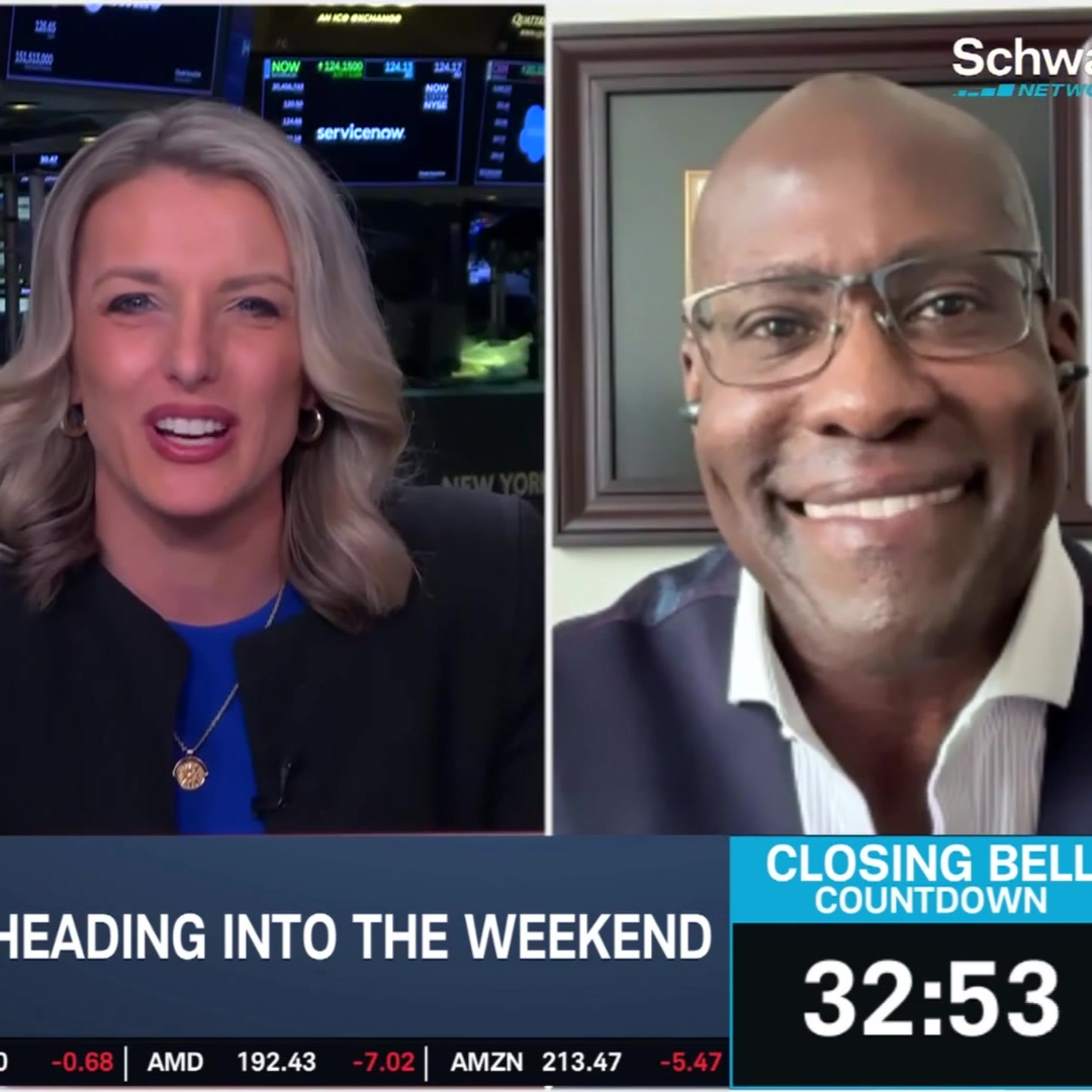
About this episode
Jason Greer argues that the labor market isn’t collapsing despite the shock of losing 92K jobs in February, but it is definitely slowing down. He attributes a part of the issue to the Kaiser Permanente strikes, which he says just happens every few years because of contract negotiations. He thinks workers are anxious for a ton of reasons, including politics, cash, global conflict, inflation, and more. Jason argues AI is pushing down wages as workers scramble for jobs, although he notes that businesses are still struggling to figure out how to use it.
======== Schwab Network ========
Empowering every investor and trader, every market day.
Options involve risks and are not suitable for all investors. Before trading, read the Options Disclosure Document. http://bit.ly/2v9tH6D
Subscribe to the Market Minute newsletter - https://schwabnetwork.com/subscribe
Download the iOS app - https://apps.apple.com/us/app/schwab-network/id1460719185
Download the Amazon Fire Tv App - https://www.amazon.com/TD-Ameritrade-Network/dp/B07KRD76C7
Watch on Sling - https://watch.sling.com/1/asset/191928615bd8d47686f94682aefaa007/watch
Watch on Vizio - https://www.vizio.com/en/watchfreeplus-explore
Watch on DistroTV - https://www.distro.tv/live/schwab-network/
Follow us on X – https://twitter.com/schwabnetwork
Follow us on Facebook – https://www.facebook.com/schwabnetwork
Follow us on LinkedIn - https://www.linkedin.com/company/schwab-network/
About Schwab Network - https://schwabnetwork.com/about
Get every episode summarized
Each time Schwab Network publishes, we email you a written briefing from the transcript — the topics, who appeared, and any specific claims, with the ad reads skipped.
Email me new episodesFree for 3 shows. No card needed.
Transcript ready
134 searchable segments. Every word is indexed and playable.
Full transcript
Schwab Network — AI Pushing Wages Down & Potential for Labor Market Collapse. Machine-transcribed; use the interactive transcript above to jump the player to any line.
conversation and bringing our next guest, Jason Greer, founder, president Greer consulting. Jason, very nice to have you on the show. Look, I'm wondering if you could help me. Look, a surprising downside number that we got over in the 90,000 range. But I'm just wondering if the markets were pricing in the fact that January and February is seasonally a bit volatile when it comes to jobs numbers. Then of course, we had the storm and mother nature unleashing its fury. And then of course, we did have some of the job strikes, particularly with what we saw in health care. Does this jobs data tell us more about the labor market and the weakness or where the market's at with its estimates? I think it's a mixture of both, but I really, you know, let's really focus on the fact that I came into this job report thinking that we're going to see a gain of at least 50,000 of not better, especially considering that, you know, the January and February, or the January post job report was relatively robust. I'm shocked by the fact that we himmaged over 92,000 jobs, but I think this is more
of a matter of the fact that when you really look at the numbers that are toned at bigger tail, you look at the fact that health care, which has been a bedrock of the economy for a number of years. Yeah, health care, which is imaging jobs, but you can also say that's as a result of the kinds of fermented strikes. So immensely, those striking nurses are going to come back to work, but you're also looking at the fact that construction, we have people who are leaving jobs. And that's what started to trouble me a bit, especially the fact that you're in the, you know, we have a war going on. And the impact that that's going to have on gas prices, as well as food prices. So it's one of those things that, for as much as I want to say that it's a seasonal issue, I think it tells the tale of something a little bit a little bit bigger, a little bit darker. And Jason, I want to talk about the strike and some of the noise in this report, because we talked to Kevin Green throughout the day about the numbers, and he pointed out January, typical, typically a volatile report because of some of the holiday season turnover. February can sometimes also have some issues, but we did have that big KP strike affecting the numbers.
We also had a lot of weather related potential noise in this report. You obviously the KP strike a one off here, but what are some of the metrics you're keeping a close eye on here? You said under the surface that could be signaling some problems here that aren't tied to some of the noise. I'm so glad you asked that question because I deal with companies like Kaiser Permanente all the time because I'm a labor relations consultant. So I'm in the field talking to employees, talking to managers. And I said this before and I said this on your network a month ago that the economy needs a better PR job because in terms of people's daily lives, they don't really think that the economy is doing as well as the number suggested it is. When we look at the Kaiser Permanente strike, it's sort of the microcosm of what's going on in other companies where you have employees who are saying we're tired of the fact that we're not making more money, but we're scared of the fact that we can't go into the economy to get a new job because the job's just unavailable. So Kaiser Permanente, you can pretty much guarantee that they're going to go on a strike every three to four years because that's the nature of that contract negotiations.
But away from non-Unionized facilities, non-Unionized jobs, employees are saying we're sick and tired of paying more for gas, we're sick and tired of paying more for eggs and we just don't feel comfortable in today's the economic society. And what is the function of, I mean, what is the biggest challenge right now holding back hiring, Jason, from what you're hearing from some of your clients and the businesses you speak to and the companies? Is it AI or is it geopolitics? It's AI, it's your politics, it's cash, it's inflation, it's also a matter of and I'm not a political analyst by any stretch of the imagination, but you ask the question I can only get at the answer. My clients are legitimately saying and other companies that I talked to, we are scared about what this looks like from a political standpoint, especially what we have going on in our area. We don't know if that's going to negatively impact our business and it doesn't matter what business they're in. I'm hearing this from TechSek, I'm hearing this in manufacturing, I'm hearing this in healthcare. There's so much uncertainty that's going on in today's economy, but in today's society as a whole
that employers are saying I don't want to go out there and hire 40,000 new people, even though we need them. Unfortunately, they end up putting all that work on those employees who are still there and those employees decide they can't go anywhere because they know their neighbor down the street has been on the job market for the better part of eight months and is about to sell their home because they can't afford to stay there. And Jason, I'd love to know in your conversation with clients or your observation of some of their hiring trends. When it comes to AI, are you seeing them using it to replace roles? Are you seeing it as more of a supplemental function in the workplace here? And how is it affecting overall hiring decisions? I'm seeing people utilize the AI in ways that they have absolutely no idea how to utilize it because it's sort of the bright Chinese toy that everybody wants to take in. So I'll give an example, I know of an employer who they reduce their employee roster by about 30% because they brought in a bunch of automation and a bunch of AI. So they had all these shiny tools and their shareholders loved it, stakeholders loved it because that up their price dramatically,
they're making more money than they ever thought they'd ever see. The problem was the company had no overall strategy on how to utilize this beyond one year. So what they ended up doing is they ended up requiring those employees and here's the interesting thing. When they retired those employees to do the job that they thought AI was going to do, they didn't have to retire those employees at 30 or 40 thousand dollars more. They retired those employees actually less money than they were making before because the economy was so bad for those employees and they had been on an employment line for six, seven months, eight months. So what I'm generally seeing in terms of AI, I think that it's such a buzzword in companies feel like they are scared of getting left behind so they're incorporating it, but they don't always know what its real function is. They don't know how to really utilize it for their business. You know, it's interesting. The head of macro research over to Charles Schwab that is Kevin Gordon pointed out today that perhaps some of the data we've been getting really reinforces that we are in some form still of a jobless expansion because in fact Jason,
some of the data we've got out earlier this, we didn't look too bad. I mean, the retail sales gave a case in bad weather and maybe some seasonal factors there. I mean, it's holding up okay. Particularly when you look at the services PMI as well, we got from ISM. At what point do you think it becomes a problem? Or do you think we still keep chugging along with this jobless expansion and recession in some parts of the labor market? Yeah, I actually think we have a problem right now because we're not creating new jobs. What I'd like to see is the fact that, and I'll go back to healthcare because healthcare has been the bedrock of our economy in many ways because it's the one industry that has continued to grow. But when you have, you know, excluding what's going on because of permanency, if you spend time in the healthcare arena, which I do, you will hear nurses, you will hear medical assistance, you will hear physicians, you will hear going down the line all the way to the janitor. And they're saying, I don't know how much more I can actually stay in this because these companies are prioritizing metrics as opposed to direct care experience. And so you're starting to see more and more people that are leaving that
industry. And I look at healthcare and when I start seeing people leaving in healthcare, that's when I start to think maybe we do have a bigger problem here. So Jason, if we have a bigger problem here, are we looking at from your perspective, we're seeing a shift in momentum and perhaps healthcare isn't going to be our bolster here anymore? Or are we looking at a potential collapse brewing under the surface? I'm always the eternal optimist, but I'm looking at the numbers and I'm going based on what I'm hearing the field and we're looking at a potential collapse. Now, I understand when I say a collapse, I'm not talking about a 2008 collapse, but I am saying that our economy has been incredibly robust and incredibly strong. We're starting to see a cooling on that economy and we're also seeing and not enough attentions being applied to this because we spent so much time talking about the numbers, but we don't really go out there and hear the voices of the people. And what the people are saying is, I need more because inflation is going up, my mortgage is going up, the price of A's is going up, my kids, healthcare is going up, and I don't know how much longer I continue to survive when I'm working two jobs just to make
ends meet. You're not talking about people making $15 an hour and you're talking about people who are six figure earners who are still struggling. You know, and Jason, I'm just wondering, you know, as we follow the stock market here, I mean, you know, things have been holding up because corporate earnings have been doing pretty well. I mean, even a company like Block in recent weeks, which, you know, let go almost half its workforce was then rewarded the following day and saw a double digit prop and it's stock. I mean, this is the reaction that we're seeing from traders and investors right now. I'm just wondering exactly what indicators you're looking at and pressure points we should be watching out for to get a sense of, you know, when it's going to become a real problem here, when we should be sounding the alarm bells on the economy. I think any time that layoffs for use as a business decision from a plan in terms of making our finances better in terms of the perception, I think that's an indicator that maybe we have
something wrong because look, we can talk all day long again about numbers, but we're also talking about public trust. We're talking about corporate trust and when you have employees who are saying, I'm doing my job. My numbers look great. I'm hitting all these markers, but I'm still on a chopping block because our company wants to go public next week or our company is public and their stocks are stumbling. Therefore, they say, let's go ahead and do a layoff and I get the axe and close on us to those stocks, you know, 15%. That's when I start to say that how we're looking at this is backward. That we need to start incentivizing companies to do the right thing by employees, but at the same time, go out there and do your job. Be effective, put out products, put out supplies, put out goods that people like, that people trust, and let that fuel your economic engine. Don't go through the layoff process. If you can help. Jason sobering chat to in the week on, but I hope you have a good weekend there. We'll catch you next time. Thanks so much for joining us
today. Really appreciate the insights. Jason Greer there, Greer Consulting, come
More episodes
More from Schwab Network

JNJ Balances Growth, Patent Transitions, and Legal Overhangs
Schwab Network

nCino (NCNO) CEO on Earnings, AI in Banking & Overcoming "SaaS-pocalypse"
Schwab Network

The Big 3: NET, TWLO, ASTS
Schwab Network

Tie Lasater on Inflation Floors, Energy Risk, and Private Credit Stress
Schwab Network