About this episode
Interactive timestamps
Jump to segmentGet every episode summarized
Each time Travelers In The Night publishes, we email you a written briefing from the transcript — the topics, who appeared, and any specific claims, with the ad reads skipped.
Email me new episodesFree for 3 shows. No card needed.
Hosts & guests
Transcript ready
20 searchable segments. Every word is indexed and playable.
Full transcript
Travelers In The Night — 889-Lick Observatory. Machine-transcribed; use the interactive transcript above to jump the player to any line.
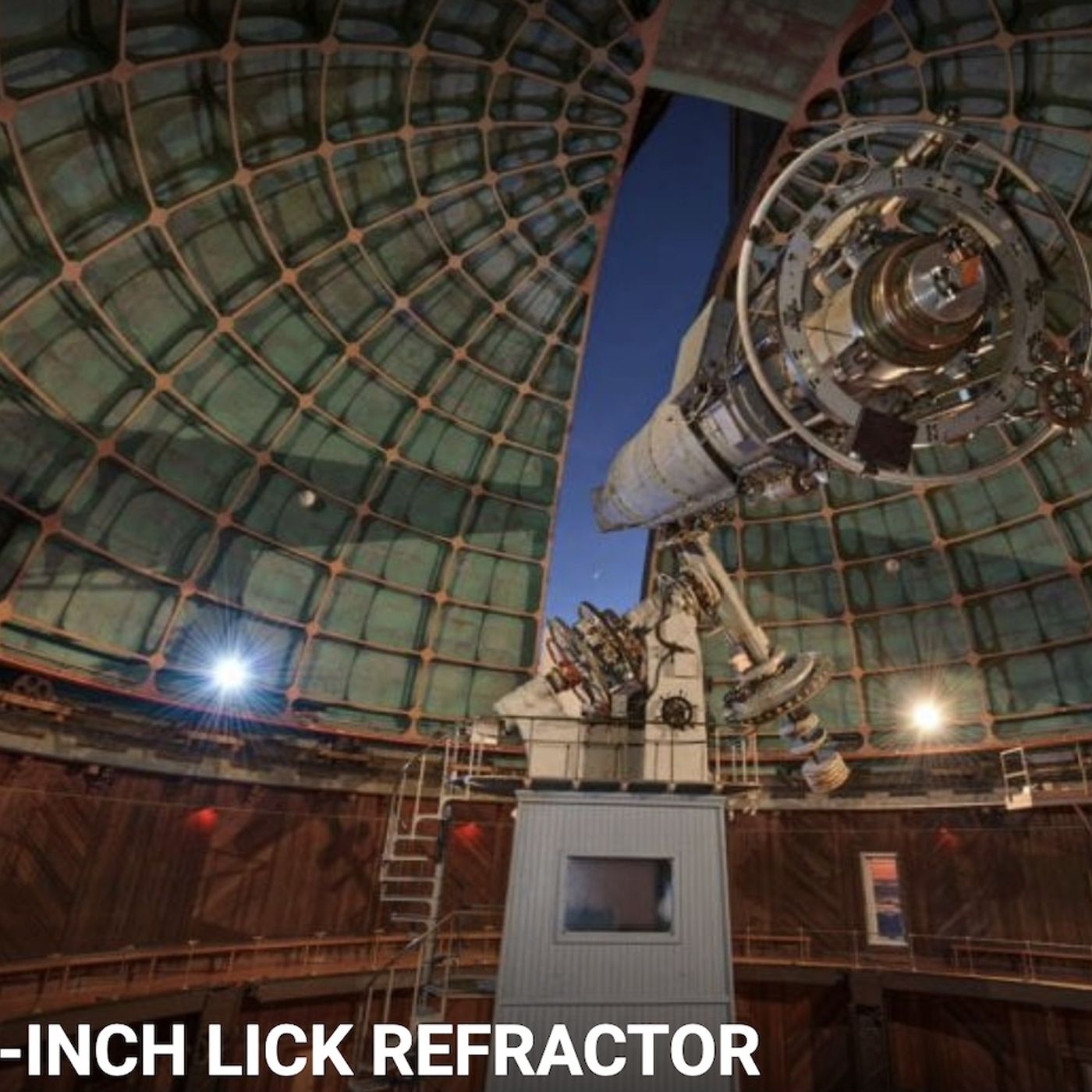
0:00In 1892, the world's largest telescope, the Lick Observatory's 36-inch refracting telescope, made the news when E.E. Barnard discovered Amalthea, the fifth moon of Jupiter. In 2025, this historic telescope made the news again, when on Christmas morning, winds of 114 miles an hour blew off a three-ton piece of the shutter on its dome. After considering building statues of himself and his parents on the coast of California, large enough to be seen by ships at sea, James Lick instead decided to build the world's largest telescope. The result was a 25,000-pound 36-inch refracting telescope, four-feet-in-diameter and 57-feet long. It took many years and 18 attempts to transport the glass lenses from where they were cast in Paris, France, to Boston, Massachusetts, where they were polished and finally to the top of 4,200-foot high Mount Hamilton, where they arrived by horse and carriage. At the time, the world's observatories were located in cities. An important part of its legacy
1:04is that the Lick Observatory was the world's first mountaintop facility where astronomers could live and work under conditions where their telescopes were away from lights and smog. When commissioned in 1959, the 120-inch Shane Reflecting Telescope at Lick Observatory was the second largest reflecting telescope in the world. Lick Observatory is owned and operated by the University of California and is still used by students and professors to do astronomical research nearly every night. Astronomers at Lick Observatory have discovered planets outside our solar system, supernova, active galactic nuclei and more. The Adaptive Optics Research pioneered at Lick Observatory, helped in the creation of the twin giant 10-meter telescopes that sit atop monochia in Hawaii. For travelers in the night, this is Dr. Al Grower. Stay tuned.
More episodes


