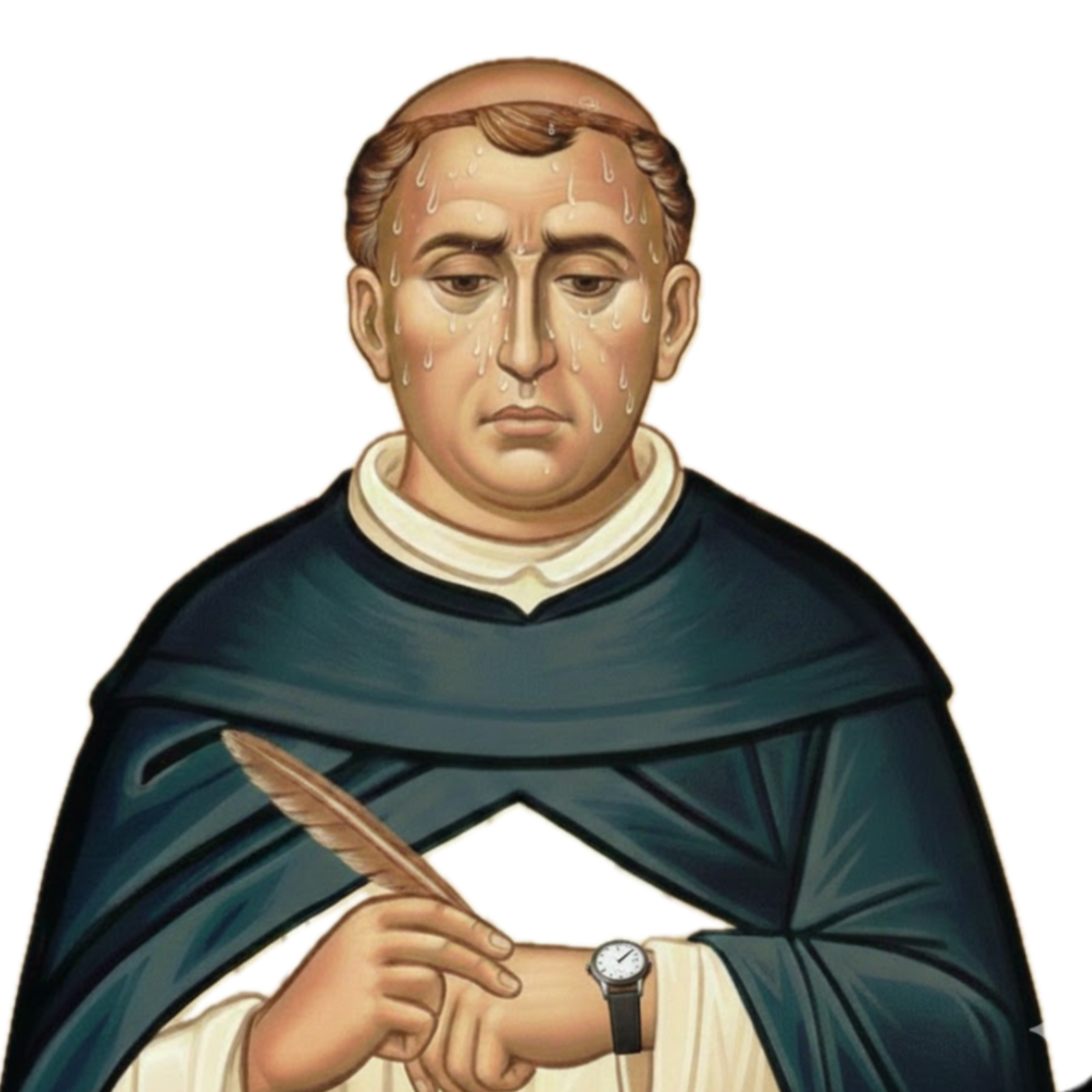
About this episode
Trying to cram some theology into 5 minutes or so. These brief treatments are intended only as a spur to further study on the part of the listener.
Please consider donating to help keep this podcast going by going to buymeacoffee.com/catholicdailybrief Also, if you enjoy these episodes, please give a five star rating and share the podcast with your friends and family
Interactive timestamps
Jump to segmentGet every episode summarized
Each time Catholic Daily Brief publishes, we email you a written briefing from the transcript — the topics, who appeared, and any specific claims, with the ad reads skipped.
Email me new episodesFree for 3 shows. No card needed.
Hosts & guests

Transcript ready
76 searchable segments. Every word is indexed and playable.
Full transcript
Catholic Daily Brief — 5 Minute Theology: Redemptive Suffering. Machine-transcribed; use the interactive transcript above to jump the player to any line.
0:00Many people who grew up Catholic can recall hearing after making some complaint, the retort, offer it up. Even though this remark is often both given and received with an eye role, it is actually a very profound scriptural command. As we said in the episode on our redemption, Christ alone was able to make the infinite offering necessary for our sins. The least action of his was infinitely valuable in the eyes of the Father, since it was all done by the God-man with infinite love. So the grace and salvation one for us by Christ is super abundant, more than enough to redeem all of mankind a trillion times over. This is not in doubt. And yet Christ couldn't be more clear about his expectations for us. We are to imitate him and suffer as he did. If the Master suffered, the servants will certainly suffer. We are to take up our cross and follow him, or we can't be his disciples. And St. Paul along these same lines makes this startling claim in his letter to the Colossians.
1:05Now I rejoice in my sufferings for your sake, and in my flesh I am filling up what is lacking in the afflictions of Christ on behalf of his body which is the church. Lacking in the afflictions of Christ, what could be lacking in Christ's afflictions if, as we said, they are infinitely super abundant. The key to the answer is given in that same verse, on behalf of his body, the church. The church is the body of Christ. He is our head, and we are his members. Together we form the One Christ. Christ will never be separated from his church. So the church and her members will manifest in themselves the sufferings which Christ the head of the church endured. If this seems strange, consider that Christ's redemptive act is outside of time. It is not as if because it happened in a particular historical time and place, it is limited to that time and place. Because it was the action of God, it transcends time, and as we become united to Christ by being in his church, we suffer with him and with and for each other.
2:06Consider these words of St. Paul in the second letter to the Corinthians. We are afflicted in every way but not crushed, perplexed but not driven to despair, persecuted but not forsaken, struck down but not destroyed, always carrying in our body the death of Jesus so that the life of Jesus may also be manifested in our bodies. Christ redeemed us by his suffering, not just by doing so on the cross 2,000 years ago, but by uniting us to himself so that we can also suffer with and in him. It is by this means that our own suffering can become redemptive for ourselves and others. Not on account of our own power, but because of the power of Christ within us in our suffering. For Christ words to St. Paul, my power is made perfect in weakness. St. John Paul II in his apostolic letter on the Christian meaning of human suffering, Salvifici de lotis, explains, the very participation in Christ's suffering finds in these apostolic expressions as it were a twofold dimension. If one becomes a sharer in the sufferings of Christ, this happens because Christ has opened
3:10his suffering to man, because he himself in his redemptive suffering has become in a certain sense a sharer in all human sufferings. Man discovering through faith the redemptive suffering of Christ also discovers in it his own sufferings. He rediscoveres them through faith, enriched with a new content and new meaning. Unquote. In other words, not only do we share in Christ redemptive suffering for all of humanity, but in doing so we learn the meaning of suffering. It is no longer senseless and brutal and tragic if viewed in the light of faith. It is the very means by which we attain life beyond this fallen world. St. John of Avala says quote, I pray God may open your eyes and let you see what hidden treasures he bestows on us in the trials from which the world thinks only to flee. Shame turns into honor when we seek God's glory. Present affliction becomes the source of heavenly glory. To those who suffer wounds in fighting his battles, God opens his arms in loving tender friendship. That is why Jesus tells us that if we want to join him, we shall travel the way he took.
4:14Unquote. St. Padre Pio says quote, Suffering born in a Christian way is the condition that God, the author of all grace and of all the gifts that lead to salvation, has established for granting us glory. Unquote. And again, St. John Paul II says quote, each one is also called to share in that suffering through which the redemption was accomplished. He is called to share in that suffering through which all human suffering has also been redeemed. When bringing about the redemption through suffering, Christ has also raised human suffering to the level of the redemption. Thus each man in his suffering can also become a shareer in the redemptive suffering of Christ. Unquote.
More episodes
More from Catholic Daily Brief

1962 Missal - Commentary on the Mass Readings: Sat, Aug 22 (Immaculate Heart of...
Catholic Daily Brief

Commentary on the Mass Readings: Sat, Aug 22 (Queenship of the Blessed Virgin Ma...
Catholic Daily Brief

1962 Missal - Commentary on the Mass Readings: Fri, Aug 21 (St. Jane Frances de...
Catholic Daily Brief

Commentary on the Mass Readings: Fri, Aug 21 (Pope St. Pius X)
Catholic Daily Brief