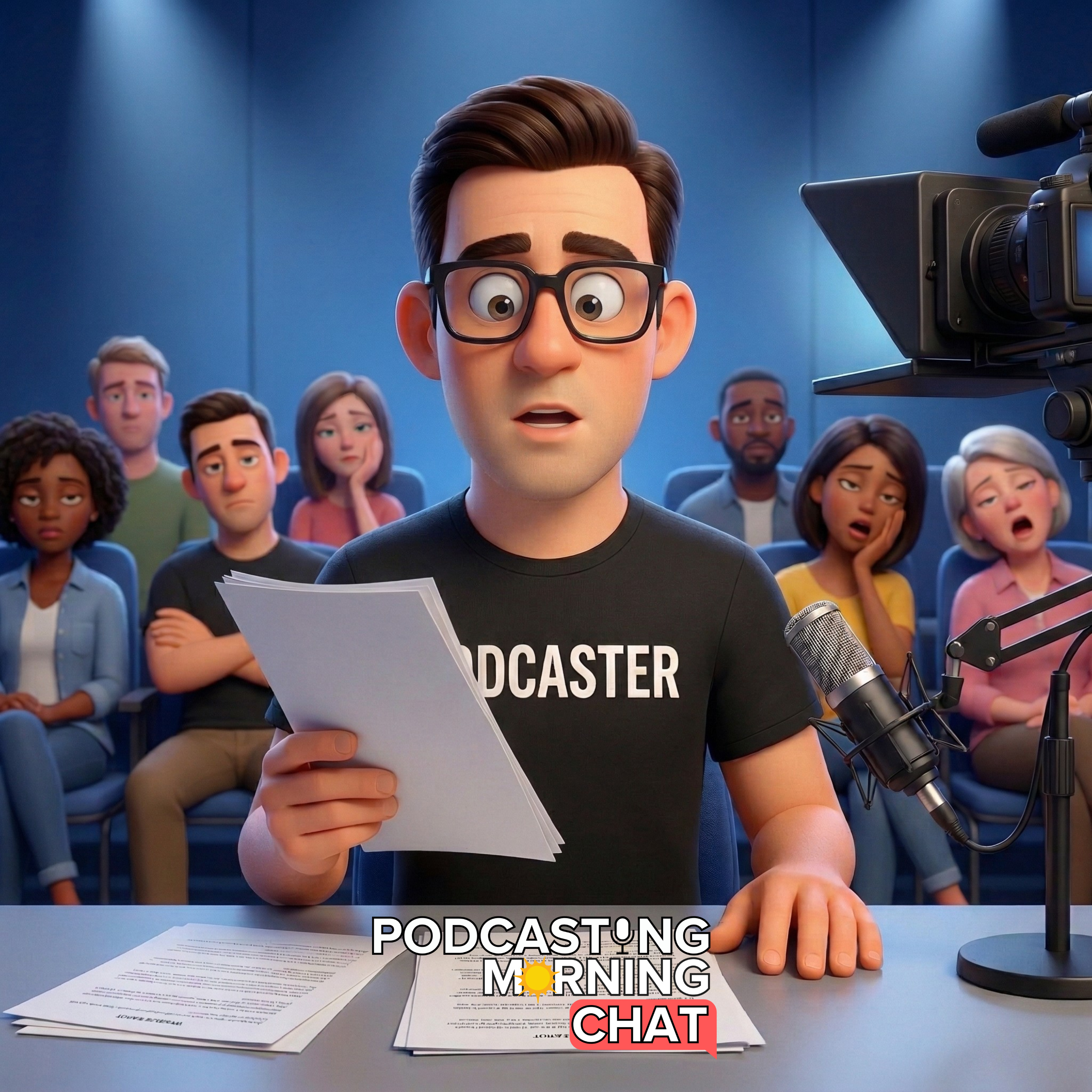
478. Why Your Podcast Script Sounds Stiff (and How to Fix It)
About this episode
Why do podcast scripts feel stiff, even when you know exactly what you want to say? In this episode, we talk about the difference between writing for the page and speaking for the ear, and why that matters for how you sound. I share simple tips with the PMC cast and crew to help you loosen up, like reading your script out loud, adding pauses and inflection, keeping your wording simple, and using outlines instead of sticking to a word-for-word script. We also get into tools like teleprompters and AI, plus a few easy ways to practice so you can feel more confident and connect better with your audience, and we wrap things up with community wins, celebrating progress, personal milestones, and the reminder to keep showing up and give yourself grace as you grow.
Episode Highlights:
[00:04] Why podcast scripts sound stiff and what we’ll cover
[06:11] Writing for the page vs writing for the ear
[08:13] Knowing your message instead of just reading words
[11:51] Reading scripts out loud to improve delivery
[13:33] Rewriting scripts to match how you actually speak
[16:49] Using pauses, pacing, and inflection to sound human
[19:11] Marking up scripts for emphasis and natural flow
[24:00] Using outlines instead of full scripts for flexibility
[32:42] Using AI to turn scripts into conversational delivery
[39:30] Weekly wins: celebrating progress, growth, and community
[42:18] Giving yourself grace and learning through mistakes
[50:42] Personal wins and meaningful moments to close the week
Links & Resources:
The Podcasting Morning Chat:
www.podcastingmorningchat.com
Meet the PMC Cast and Crew:
https://podcastingmorningchat.com/people
Join The Empowered Podcasting Facebook Group:
www.facebook.com/groups/empoweredpodcasting
Book A Free Call With Me:
https://calendly.com/ironickmedia/freestrategycall
Application To Submit Your Show For Evaluation:
https://podcastingmorningchat.com/eval
Remember to rate, follow, share, and review our podcast. Your support helps us grow and bring valuable content to the podcasting community.
Join us LIVE every weekday morning at 7 am ET (US) on Clubhouse: https://podcastingmorningchat.com/clubhouse
EPC3 Speaker Application: https://empoweredpodcasting.com/speakers
Podcasters Happy Hour (March 26, 5:30pm EDT, North Bethesda Maryland):
https://podnews.net/event/podcaster-visibility-meetup-in-the-dmv
Marc's Stepson Matthew (Instagram):
https://www.instagram.com/matthewbcooks/
Marc's Stepson Matthew (TikTok):
https://www.tiktok.com/@matthewbcooks
Live on YouTube: http://podcastingmorningchat.com/joinus
Powered by iRonickMedia.com and ContentCreatorsAccountant.com
Please note that some links may be affiliate links, which support the hosts of the PMC. Thank you!
--- Send in your mailbag question at: https://www.podcastingmorningchat.contact/ or [email protected]
Want to be a guest on The Podcasting Morning Chat? Send me a message on PodMatch, here:
https://www.podmatch.com/hostdetailpreview/1729879899384520035bad21b
Get every episode summarized
Each time Podcasting Morning Chat publishes, we email you a written briefing from the transcript — the topics, who appeared, and any specific claims, with the ad reads skipped.
Email me new episodesFree for 3 shows. No card needed.
Hosts & guests
Transcript ready
533 searchable segments. Every word is indexed and playable.
Full transcript
Podcasting Morning Chat — 478. Why Your Podcast Script Sounds Stiff (and How to Fix It). Machine-transcribed; use the interactive transcript above to jump the player to any line.
Good morning, podcasting morning chat. Today is Friday, March 20th, 2026, and today why your podcast script sounds stiff, and it's not you, how to write for real conversation and loosen up your delivery, plus we'll celebrate this week's community wins. So if you're listening live on Clubhouse at the Share button, bottom left hand side of the screen and share it, however Clubhouse lets you, and if you're catching us via podcast, YouTube, LinkedIn, etc., please share this with a fellow podcaster. And now give us about 30 seconds and we'll get things rolling. Thanks for being here. The podcasting morning chat is powered by ironic media, helping podcasters launch, polish and grow great shows, and by Content Creators Accountant, helping creators build real business
behind their content. Good morning again, podcasting morning chat. Thanks so much for being here. I am your host Mark Ronik, and currently on stage with me, we have my co-hosts, D.R. Faye, Ralphie Step, B.C. Babbles, Sid Meadows, Alex Balish, and also tied a K.A. Nikki from the audience has joined us again on stage. Today is a Friday. So yes, we will get into our wins from this past week. We like to celebrate each other's wins and it's important to me to recognize those wins. So we will do that in a moment before we do. I have a couple of things of interest I believe of interest to you. So first, wanted to let you know our evaluation series is
returning. We took a little bit of a hiatus. I think I needed the break, but just because it's a heavy lift to put those shows together for me. And I'm ready to rock and roll with those again. I want to get back to it. So you can apply one of your episodes to be evaluated by this fine team by going to podcastingmourningchat.com slash eval eval. And you that'll take you to a Google form. You fill that out and we will receive that and we'll let you know if and when we're going to break that down. I know we have a couple that are pending that have already applied, but we need more. So please submit yours and you never know. Don't worry. I don't necessarily go in chronological order. So you could be the very next one. So go ahead and apply today. I think that these have been really valuable for the podcasters who have submitted at least that's the feedback that we've received. Also another reminder that empowered podcasting three speaker applications are now open. And if you have experience
insights expertise around the world of podcasting and content creation, this is definitely something that I encourage you to apply for. So go to empoweredpodcasting.com slash speakers and you can apply there today. Now also the last thing I want to share with you before we dive in to script reading discussions. I wanted to preview Monday because Monday we are taking the week off of our obsession worthy podcast series. We'll be doing that again March 30th. It will return. But next week we're going to bring in a new semi recurring series that will probably alternate on Mondays money Mondays and Ralph is going to help us with money Mondays. Ralph, you want to tell us a little bit about what we're going to do this Monday. Yeah. Monday we're going to talk about the one money mistake that I've found working with creators that will absolutely destroy your business. So don't forget the tune in on Monday.
Awesome. We will do that. I'm sure we'll end up sharing other things. Other reasons why you can have that struggle there. If not just this one, I'm sure we have many more we could probably list. But looking forward to hearing what your number one money mistake is, Ralph. Yeah. And listen, if you are a new podcaster or new to content creation or just haven't dabbled in actually making it a legitimate business, I think that this will be really valuable to you. And of course, if you are already monetizing your content, I think that this will also be important to you too, because you may not know what these mistakes are. So come join us this Monday 7 a.m. Eastern. I'll be there as well. Of course, and Ralph will help lead the charge because he is our money guy. Okay, let's get into the mail bag, technically. This I found actually from the Riverside Facebook group coming from Shane W. He said, let's talk teleprompter
tips. I have only ever produced interviews on my podcast. And now I need to start mixing things up with 10 minutes solo episodes. What advice do you have for a podcaster who would like to go scripted solo and use the teleprompter function? We can get into some of the teleprompter stuff, but I think where I really would like to go with this is really talking about if you're going to work from a script, whether it's a teleprompter or something else, I think that there are proper techniques to doing that. And we happened to have had a story for the news on Wednesday that we didn't get to and we were going to have Ralph share that story on Wednesday. So I think Ralph, the best bet would be let's let's go to you and get into that story and then we'll get into the discussion. Go ahead. Yeah, very good. I want to bring this quick story. I think it's going to hit a nerve for a lot of us. I know when I read this, it really hit a nerve for me. If you've ever listened back to your own podcast and thought, why do I sound like I'm reading? This is for you.
Now, this was a piece published by DW academic and the core idea this was simple. Most podcast scripts sound stiff because they're written for the page, not for the ear. I want to say that again, because it's really important that we all understand that you're not struggling because you're a bad speaker. You're struggling because you're writing like a writer, not a speaker. And those two are very different skills. Here's what they pointed out in the article and I see this all the time and I'm pointing this at me because I've dealt with this very situation myself. When we write for the page, we have longer sentences. Our language is usually more formal and the structure is more rigid. But all of us will relate to the fact that when we speak naturally, we use shorter thoughts. We repeat ourselves. We pause and we emphasize. But more importantly than any of those things, we sound human. So many of us think that when we start to monetize and we start to get more
interested in this, we think, well, I need to sound more professional. I found myself in this very situation. So what do we do? We tighten up. We script even harder. We polished the life out of it is what the article said and I thought that was great. And that's the moment that we become less engaging. So Mark, we can open it up to questions, but I have some ideas, some practical fixes, but has anyone else felt the same tension? Speaking for myself, this has been a struggle for me because I really, I use a prompt or like Mark talked about and I really wanted to script everything out. And what I found is when I stopped doing that, I connected more with my audience. Now, I've hired a speaking coach like I've shared on the show and that's really helped a lot. But just the idea of the pauses. But anyway, I want to open it up the floor to other people who had comments and I come back with some ideas that I came up with or how to overcome this. Awesome. Yeah, I want to, I have several ideas here and I see several people want to chime in as well. So I will bite my tongue for the moment. Actually, you know what? Let me share one and then I'm going to go to Alex,
BC and DR in that order. One thing that I have taught myself is this idea of knowing what I mean, not just what's on the page, right? So if I know the point I'm trying to make, I'm much less likely to sound like I'm just reading words, right? So yeah, I'll stop there for now, but I think it's really important to remember that you really have to understand what it is you're trying to communicate and not just regurgitate what you're reading on the screen or on a piece of paper. All right, Alex, I'm coming to you. Good morning. Hey, how you doing? That was kind of what I was going to say, but at the end of the day, read what you've written over and over again. I think a lot of times people and especially we've gotten very lazy with chat GPT, I'm just going to put it in there and then I'm just going to read what it says. Well, good speakers know how to pivot
and good speakers know like I love the outline or just bullet points and what I've done, I've done this for years and sales. I might have a script. I'm going to read it, read it, read it until it I've exhausted it, but then that's first reading of what I'm doing and what I'm actually saying are probably two totally different things because I've added like Ralph said, you know, you add those pregnant pauses, you add the different words, you put your personality into it and that's where it really gets fun and I really do believe that works and there is a lot to be said when you do stumble, take that pause. Yeah, remember and I say this with the instructors that they teach for my business. They don't know what you're going to say. They don't know what you're going to say. If you miss something, it's not a big miss. So I mean, those are a couple of things. I know other people have other things. So I'll let them down. No, thank you. I appreciate those
points. Alex, yeah, I think the key for me is reading out loud before I record. Now, I think most of you know, for the most part, I don't script a lot on this show and where I always script is that intro in the beginning with the music right now. Most of that I know by heart because I say most of it all the time every day, five days a week, right? But the the meat of it, the what's to come on this episode that I always have scripted because I'm working on the timing and the delivery of what I'm saying with I'm doing it with the music. Okay. And I've talked about this before. I like to time it so that I what it's called in the industry hit the posts, right? That's where in the song, you might hear a little extra drum beat, right? I'm sorry. I'm not a musician. So I don't know like the terminology of that. But you know, you'll hear a little drum beat or you'll hear those vocals early on in the intro where it's where they go. Oh, oh, oh, yeah, right. I pause at that point.
And so I really work on the timing all this to stay. I read my scripts out loud before I hit record. So if I'm stumbling over a sentence while I'm reading it, that usually is a sign that it needs to be rewritten or that I haven't practiced yet. Hey, Mark. Yeah. I do want to say one thing about this. And then I know you guys are different people scripting does not need to be stiff. And that you just made a great point there. As a podcaster, you want to create the right moment and you want to set it up the right way. So one, you have the best clips as well as you get the best answers. And that all comes back to scripting and timing. And I think that that is something that people just underrate a lot. Because the I'll figure it out method to what Ralph said in the beginning, a lot of times just doesn't work well if you're not scripted. And we could go on about what
scripting means. But I'm not saying works for work because I've been on podcasts where it's word for word. You have to say what you wrote down. Right. And that's a pain in the butt too. I agree. There's a lot between New York and California. There's a lot in between. Yeah. And you know, for me, reading it out loud a few times before I actually pressed record also builds that muscle memory, which helps prevent those stumbles and mistakes, right? Because if I'm just saying here, chat GPT, here's what my show is about. Now write me a script. And then I don't even really read it. And again, reading it out loud. I really want to emphasize that point because reading it in your own head isn't really creating those neuro pathways. It's not building that muscle memory, though the same way, right? Because ultimately the delivery is going to be out loud. So I'm encouraging you to practice it out loud. It makes a huge difference. Okay. BC, you're next. Good morning. What's up? Good morning. I agree with everyone so far with Alex and Ralph talking
about how familiarity with what you're talking about can definitely cause an issue if you don't have that. And especially who it's written for will affect it. For me, this goes back to my days in broadcast radio for those who are not from the industry. You know, if you're doing a spot on here, a commercial spot, you're probably getting be given a script written by somebody who sold the package to a brand, but they don't write for you. So a lot of times what you get to do as the on-air talent is you get to rewrite the script you're provided to fit your stylistic means of speaking so that when you do deliver that spot on air, it sounds natural to who you are and you deliver it. You hit the main points and it's a good selling point. I'd also like to add to I think would we script things out and if in an instance where we don't take the chance to rewrite it for us and if we're given longer run-on sentences, I think what sometimes happens is that when we try to approach those more
formal stylistic sentences, we sometimes forget that a single sentence does not have to be done in a single breath. So we kind of trick ourselves into thinking, oh, I've got to try to take one breath, deliver this whole bit here and what that does is it kind of tricks us into this lackluster performative attempt at speaking which causes this kind of monotone or robotic sound. We have to remind ourselves that just because something's written a certain way, we still get to apply our own pacing to it, our own breathing technique because every bit of a sentence deserves its own inflection, its own swell, its own cadence so that it allows our personality to come through. And again, I also want to delve down again on familiarity with script. If you don't read it beforehand, yeah, you're going to sound very monotone because you got no idea what you're talking about, even if you gave Chan-Chi-Bti a prompt and technically it gave you what you were asking for, but you still have to make sure you understand how that story is going to come across with that flow.
If you don't, you're asking yourself to kind of sound not great in the final product. Also, reminder for podcasters, unless you're doing a live broadcast like this, you can pause in the middle of your recording, read section by section, practice each section, and then deliver it to the microphone. You don't have to run all the way through in a recording session. You've got the beauty of post-production where either you or a team will take care of all those weird pauses and practice moments. Also, I'll add for myself personally, I also deal with, I'm not sure I've mentioned this on the show before, I deal with a speech issue called cluttering, which is related to stuttering. The difference is that instead of getting caught on the beginning of a word, my mouth will leave out or replace sounds and letters where they don't belong. So for me, even simplistic English phrases can be difficult even after a lot of practice because I will just confuse or try to run through what I'm trying to say and my
annunciation and articulation just fly out the window. So, love the topic though so far. That's my title. Oh, B.C. Thank you. Yeah, I can tell you love the topic. Yeah, thank you for all of those insights. I was taking notes as quickly as I could because there were things you said that I wanted to point out the thing about inflections. I think that is so key, especially when we're talking about practicing because again, if you're reading it just in your head for practice, you may not be thinking about the way that it's actually coming out of your mouth. And I know that when I don't practice and then I do read from a script, I can tell I'm reading from the script, right? Like, there is an obvious difference because where I would normally put the inflections on certain words, I forget to do that because I'm just reading word for word for word, right? So, I appreciate you sharing that. And then I also appreciate you sharing the idea of recording while you're practicing. And even if it's not an intentional practice, but you let's say you're reading from your script,
you stumble, you fall a couple of times and you're and then you say, oh, forget it, you hit stop, start over, hit record again. I know that this might seem obvious that you can just keep recording all the way through, but the reality is it's not obvious to a lot of people. I had a call with a client that's launching a podcast earlier this week. It's actually two people. And that was one of the things that I reminded them. I said to them, you know, listen, don't worry because we did a practice run together. And I said, don't worry, if you mess up, just stop for a second. You could maybe acknowledge, oh, let's edit that out, right? Because I'm doing my company's doing the editing for them. So it could be a queue for them to tell the editor. But then I just say, go back a couple of sentences and then just go from there. And I could see the light bulbs and they explain the light bulbs are going off for them. Like, oh, yeah, I can do that. Oh, that's right. Okay, cool. So it's important to call out some of these things because what we might
think is obvious isn't so obvious. All right. I know we still have DR and BC wants to chime back in. Ralph wants to chime in, but I saw and tied wants to chime in as well. I'm going to go to, yeah, and said that's exactly who I was going to next. I'm coming to you, Sid. And then I will figure out the rest of the order. Go ahead. Good morning. Thanks, Mark. Good morning, everybody. The only thing that I'll add to this that I do in my solo episodes where I do use the script is, I print it and I read it from the printed paper. I have a red pin and I am circling and underlining things of how I want to like change things or I want to make a space and I'll put a note like space. And then I go into my computer and I don't rewrite it, but I reorganize it. So to the point earlier about long run on sentences, the way that we write structured sentences, the way that we write, I might break it up and put it on three or four different lines. And that's telling me as I am having the script in front of me that I'm pausing, I'm emphasizing,
I might put something in parentheses that I want to add lib to there and not script to put the topic that I'm really comfortable with. So I go and take the script and edit the script so it still doesn't look like an article or a blog. And that's my cue when I am recording to make those intentional pauses to change it up and to add lib when I need it. So that helps me a lot to mark it up and then to change it. Yeah, I think, thank you, Sid. I think that goes back again to creating that muscle memory that I was talking about earlier when you're engaging with your script. And I love what you're saying, you know, creating that physical form and then going in and writing notes and crossing things out and circling things, it's helping your brain get to know the script. So that it does sound more natural when it's coming out of your mouth. And one of the things that'll help you sound more natural is taking out the words that you don't normally say, but you would write. Oh, yeah. Because there, there are words you will write that you won't necessarily say. So be sure you take those out and change it into a word that you would say.
Oh, yeah, I'm with you there. All right, DR, I know you've been waiting so patiently. Go for it. So this is one of those skills that podcasters really need to add to their list. And I encourage everyone, if you do not have the ability to read off of a page and sound as though it's not on the page that it's coming from your heart, that it's coming from your head, that it's in prompt to, if you do not have that ability, then please seek out a coach or seek out some local acting lessons. Number one, you're going to have a blast when you go to acting lessons. And number two, it will bring out in you some stuff that you never thought you had. So that's my number one tip. I mean, I went through when I was a kid, I did a ton of musical theater, I was involved in an acting conservatory when I was a kid that's very prominent in the San Francisco
Bay Area ACT. So yeah, if you don't have that ability, then get a coach or better yet go to acting classes. Yeah, I'm with you there. And look, I am not technically by trade a speech coach, but I do this all the time with podcasters. And I hope you can hear my passion about this and my knowledge about this stuff. I am happy to work with anybody if that is something of interest to them. And there are some people that have it in them already without the coaching, without acting classes. There are those people who have that ability. But you just have to be honest with yourself. And if you don't have that ability, then please seek out some help. And it's one that anyone can learn. I agree with you that it's more natural for some people. I feel like for me, it was just a more natural thing. And I've been doing this for 20 years, right? So like I've gotten comfortable doing this. But yeah, I great points, DR, I appreciate you chiming in there. By the way,
I just want to say hello to our live audience on Clubhouse. We've high Greg Dave Austin Tim Chris, Mike John, Christina Jen Royfield. And and thank you all for being here this morning. Great to have you in the room on a Friday. And remember, this is just a reminder later in the show. We are sharing our wins from this past week. So if you have some wins, which I think everybody must have at least one come bring it later in the show. So and if you don't start thinking about it. All right, Alex, do you have something real quick? Because then I want to go to Nicky. Yeah, I do. I think one of the other things you might want to to dovetail off of what DR said. Think about like organizations like toast masters. You can do online versus in person. And you might get more listeners. Yeah, I'm with you there. And actually, thank you for bringing that up because I was really challenged. You know, when we talk about toast masters, right? Toastmasters is helping you with your public speaking abilities and skills. And I was really
challenged. If you don't remember to figure out how I was going to prepare without a script for my first solo presentation at podfest earlier this year. And I found this is what and I, yes, I had somebody who I could talk to. I had a coach, Sean, who is Simone is better half or a significant other is probably better. She, I think she's probably the better half. Anyway, Sean, he gave me overall guidance. But as far as like the nitty gritty, that was all on me. And what I found worked best was that I dumped out all of my ideas to chat GPT, all of my intentions, all of my goals. And then I had it actually write a script for me, even though I knew I was not going to use that script. But it was something that I could first dig my teeth into, right? I could, I've read it a bunch of times. I read it out loud several times. I was, again, creating that muscle memory. And by the way, this all applies to a way you could prepare for your podcast.
And then what I did was I hand wrote an outline and really the outline was more of like a mind map. I'm not going to sit and explain the mind map right now. Go ahead and Google it or ask your favorite AI to tell you more about it. But what I did was I did it in sections. I wrote an act one all on one page with my mind map. And then I practiced it a lot. I put the paper on like my kitchen counter and walked around my kitchen as if it were a stage. And every once in a while, I would just go back and peek at my mind map to help me remember. But I did that several times. And then once I felt like I knew it fairly well, I didn't perfect it. But once I just felt like, yeah, those neuropath ways were being formed, then I went and went back and wrote act two. And then I practiced act two. And then again, once I got comfortable with it, then I started practicing both acts together. And then I do the same for act three and so on. That helps a lot. And yes, it's it takes some time and it takes some work. But it sounds in my opinion so much better
than just sitting there and reading a script. These days, people are recognizing it. They are noticing it more than ever, especially because I think we're so sensitive to AI that we're really listening to hear that human element. Chris, welcome to the stage. What did you want to add? Hey, Mark. Thanks. I've got to say toast masters is a good organization. You've got to find a good club though. A club that meets every week. And I definitely am person. Also, while they're not as easy to find, and this is kind of emotional for me because I started taking acting classes back in 2005. And the guy was taken from us in hospice right now. But I never found a group of people in my life who treated me better than the people in the Austin acting community. I mean, I walked into that studio and I really felt like that was a place where everybody was my friend. I find acting classes just an amazing therapy cheaper than therapy. You know, just there's a lot. And don't you
become a family like almost instantly. It is built in family. I think it's because you're always applauding each other and it does depend on the coach. The other thing too, as I've noticed is, well, you have to let people, you know, be flexible and try different things and take risks. But one thing is another thing about a good acting coach, a good acting coach will read you the right act if you're late. But you'll meet a lot. You'll find a lot of interesting people and just you'll learn a lot. I definitely can say acting classes are great. Toastmasters is good too. Yeah, you know, if you find a really good club work, they really do try to help people along and yeah. Yeah, thank you. Appreciate that. And I agree with you. You know, look, that's all about sense of community. Those Toastmasters and acting classes and I can speak from the improv experience. It really is a community. Like you said, you got to find the right group and the right leaders, of course, think that applies to any community that we're joining. But yeah, I'm with you there.
And thank you for sharing your experience. My experience with improv was not the same at all. I don't know what it is, but I always just say the number of times I've said acting is not improv. It's not. No, it's not. They are two different things. I mean, there's some similarities, but yes, they are definitely two different things. And the community, the acting community will absolutely agree with you there. I know that they feel very strongly about that difference. Look, it's not for everyone just like there. I'm probably there are probably people listening right now that say the same about acting classes, right? It's just that there's whatever your preference is. But yeah, I encourage anybody who wants to improve their speaking skills to consider some of these things. For sure. Okay. Thank you, Chris. Appreciate you. And glad you came up on stage and shared your experience with us. Okay, tied. Thank you for being so patient. What did you want to add to this? Thank you. These are really, really great tips. And I was just going to say that for me, I have to know that it's okay to slow my brain down. So in the way that I'm talking now, there will be some
moments where I'm speaking a lot faster. And then there will be moments where I slow it down like this so that I can purposely choose each word. And that really helps me to process what I am saying and to hear what I'm saying. Because the last thing that I want to do is listen, and it happens all the time, but the last thing I want to do is relist into my podcast and say to myself, wow, what were you saying? Like, I don't even know what you were saying when you were talking. And if I don't even know what I'm saying, when I'm relistening to the recording, that probably indicates that I'm babbling and that I need to slow down. And then as Ralph said, I need to take a pause. And it's okay to have a pause because when I think I don't, I think it was said maybe who had said, you know, not every sentence has to be said in the same breath. And I think that's so true. And when you listen to talk radio, the people who do the best in their shows oftentimes take
what I've heard called a radio pause. And a lot of radio producers didn't like the radio pause because there was a lingering silence for an uncomfortable period of time. Now it wasn't super long like 10 seconds, but it was enough where you're like, oh my god, fill the airspace now, fill the airspace now. Oh yeah. And I think that a lot of times I know for me personally, I feel like, oh shoot, I got to fill the airspace with something. And then that's when I start to word vomit and not say the things that I actually mean and want to say. The other piece that I was just going to add is I really do work very hard on improving my vocabulary. So I'm a very, very, very big reader. I love to read. And I do like to read some books that are very challenging in terms of lexio levels. And I like to keep a personal dictionary. I really do take the time that to look up a word, sometimes it's a word that I know. And I will look up the etymology of
that word because I'm an academic and hard. I'm a teacher. So that's just kind of part of my personality. And what I'll do is I'll look up the etymology of that word. And then I will look up the definitions of that word. So I do take a lot of time to go over words since the dividends and the benefits of that have really been fruitful for me personally. And I say that more so coming from a teacher's perspective, less from the podcasting perspective. Uh-huh. Thank you, aka Nikki. I appreciate that. Yeah, I think when it comes to reading and all of the different suggestions you shared around reading, that's like seed planting for me, right? It's prepping you. It's kind of like exercising. You know, if you want to get in better shape, it's the same idea. It's like reading will help you get in better script reading shape. So yeah, thank you for that point. I appreciate it. Ralph, how about you, sir? I wanted to go to something that I learned
it's really practical. And I'm a big user of AI. And what I do is when I've written my script, I tell AI to put this in teleprompter form and give me speaking cues, short sentences, and put it in a way that I would speak to another human being. And mark that's actually what I use for my practice. And I have found that to be hugely impactful because it'll say pause. It'll say raise your voice. It'll say lower your voice. It'll say lean in. It'll say lean back. And working with my speaking coach, that's the thing that we've, that's sort of become my superpower. In that, like Nikki said, I always felt like I had to fill the air. And I go back and listen to stuff I've recorded before. I started like, I sort of sounded like a, uh, air traffic controller or water cronkite. I'm not sure which. But now that I'm speaking, and what's funny about this mark is it's the way I speak to people now. I used to be a real fast talker and somebody did. And finally, it's funny. One of my clients said the other day, she goes, Ralph, she says, I see a major change in
you. She says, you let things land now. She said before, like, you would put so much stuff because you're a really smart guy. You know a lot of stuff. She said, you put it out there so quick that I didn't have a chance to grab it and understand what you were saying. So I just did it right then. So what I'm finding now is that, you know, you can, you can do this. Listen, I'm an accountant. I went to school to be, I've been doing accounting for 30 years. I'm the definition of, yes, you can do this. Even if you don't have that natural core strength set, investing yourself, practice, you know, one of the things my speaking coach has me do, she has me reading children's books. And because it puts you in a tone of voice, like once upon a time. So if you are a big UAI user, you can have AI give you the speaking cues. And Mark, I've found that to be really, really helpful. Yeah. Thank you, Ralph. I appreciate that. It's nice to hear your experience as you put it. You know, somebody who is not an experienced content creator, at least you weren't coming into it anyway. And yeah, I think that that's a really
important point. Thank you for sharing some of those tips. You know, for me, I also think when it comes to reading from a script, energy matters. Because people can hear when you're tight or you're flat or you're overthinking it, right? They can also hear when you're relaxed and connected to what you're saying. Again, I'm going to go back to the client that I was mentioning earlier when I was giving her feedback after we went through a dry run, if you will. One of the most positive things I shared with her was that when she was reading from her script, she was smiling the whole time. She wasn't doing it intentionally. She wasn't realizing that she was doing it. But what I told her is I can really hear your smile. And that stopped her and her co-host for a second because they were like, oh, that was again, another light bulb moment. Yeah, that's true, actually. Now that you say that, you can hear a smile. So I encourage you to
practice that a little bit, right? Maybe there are times in your script where smiling isn't appropriate. You don't want to sound super excited if you're talking about something say sad or serious, but it does convey something. People can pick up on the vibe. So I encourage that as well. And one other thing I'll say is that if you're going to use a script, use it as a guide, but don't use it where you're feeling caged in, right? There is something to that. Sometimes the best delivery happens when I just glance at the script, because then I can just grab the idea and say it a little more naturally in the moment. So outlines serve me really well in that kind of scenario because I do struggle. If I have a full script in front of me, I struggle with veering off script because then I'm afraid I'm going to lose my place and start to stumble. And to the points we've made earlier, not as big of a deal if you're recording because you can
go back and fix that. But for show like hours that we record live as they used to say live to tape. I think it's, it's something that I have to practice. Yes, Ralph, go ahead and then we got to get into wins from the week. Yeah, and I just sort of trump it what you just said because one of the things that's really helped me is being on this show because this is not scripted. And when you work in a live environment, you will learn skills that you don't realize you have and they are super useful to you, Mark. So that's, I just want to trumpet that because that is a very brilliant point that you just brought out there. That has been what has made me grow more than anything else. So I want to thank the community for that because it's, it's challenging. I mean, I don't have a script in front of me right now while I'm talking. And to be honest, if you want to first start on the show, it may be very nervous because I had gotten to this point where everything I did was scripted. So Mark, I just want to say that's a very good point. So even if you just go into and, and put the recorder down and just give yourself a question and just start talking. That's one of the
exercises that I was doing every day for a while. I would just go in and record 10 minutes of me just talking about a particular topic. No script. It really refined your skill set. I love that. Thank you. And I'm just going to wrap it up with this. If there's nothing else you walk away with from this part of the conversation, at least walk away with the idea of practicing out loud. Because you'll hear it. You'll start to hear it. If you do this for every podcast, if you go through your script a few times out loud, you'll start to notice the improvements. You'll start to notice the changes, the evolution in how you deliver your script. So I encourage you and if you can tolerate it because I know a lot of podcasters, even though we record all the time, we can't always tolerate our own voice. But what I would say is do your best and go back and listen, record those practice runs and then go back and listen and ask yourself, did this sound like I was reading? And look, you're not going to be perfect at it right out of the gate. But if you can hear
those improvements as you practice, I think you're going to get more excited about the idea of practicing. It's time for wins from the week. So let's dive into that. It's Friday. And that's what we do to wrap up our Fridays. We wrap up Friday and the week with sharing community wins. So I will set the bar here. I will set the pace is the better way to put it and share just a couple of mine. And then we will go down the line. But listen, we've got a nice full house here in the audience. Come up if you want to share any of your wins from this week. It doesn't all have to be podcast related. I'll give you bonus points if it is. But it does not have to be podcast related. For me, here are my wins. One is I made it through a full week of shows after missing the past two Mondays, not this one, but the one two prior in a row. So and again, thanks to the team for
always holding down the fort for me when I need it. Another win, I would say, is podcast yesterday's episode really touched me. It was also for me, as your host, it was a nice change of pace. It was a way that we could really not only support these important organizations that we like to support, but it was also a wonderful way to get to know each other even more on a deeper level. So thank you to all of you who participated. And by the way, if you missed it or you want to go back and support one of the organizations that we shared yesterday, go to podcastingmorningchat.com slash charity. And you can see all the ones listed that were shared, including people from our audience that came up and shared as well. Ralph took care of that yesterday and added those there. So for example, Tim, we added a link to support multiple sclerosis. So we tried to hit everybody.
I think Janade also had one to support Islam, right? So we put that in there. So yeah, go support these different organizations. And by the way, Ralph, I'm just thinking out loud here, we should probably put a link to that show on that page to the show that we did. I think that's a great idea. Yeah. So we will do that as well so people can easily find that show. Last win is Ralph joining the team as officially as co executive producer. That is a huge win for me. It is a load off my shoulders because Ralph is really going to help me a lot with the behind the scenes. And let's be real, already has. So a huge win for me. And I believe for the community as well. Okay, who would like to share a win or two with the group? And if you don't, I'm just going to go down down the line. Actually, here's what I'm going to do. John from the audience has joined us on stage.
Let's go to John first. Good morning, John. Welcome to the stage. Please share a win with us. Hello, everyone. Well, the first win is finding this show in the community. I want to thank Ralph for that. The second win is knowing when to walk away. I had some technical issues with my roadcaster pro and I have a roadcaster duo. I have a couple of them. And at one point, I had none of them working. And I was on the call with tech support. And I finally just had to walk away because I've tried so many things. Your head spinning. Just walk away. Take a break from it. Come back with fresh attitude and within five minutes, I had everything fixed. And then the third one is to give yourself grace. Every show I do is live. It's not really scripted. It's bullet points. And you're going to mess up and you know what? Everybody messes up. So give yourself grace. Make a joke out of it. Don't freak out. So they're my wins. Oh, also, you know, the community here, you guys tell
me things. I'm like, Oh, why didn't I think of that? That's a great idea. So being able to do that incorporate that is they're my wins. Thank you, John. I will also add a win. And it's that you've joined our community. So thank you for sharing that. I am so glad that you're already finding it really valuable. And please keep coming back. You're welcome to join the stage at any time. If you want to add, and I really appreciate your wins, you definitely earned the bonus points because you really went all in on the podcasting wins. So I appreciate that. And you knowing when to walk away, I think is such an important point for all of us to take away today. Because yeah, I think one of the best parts of walking away is it allows your head to just kind of reset and reorganize and then you have a new fresh perspective going back to it. And I'm glad that that worked so well for you. And yeah, giving yourself grace. Yeah, we all mess up. And I think it's more appreciated now than ever before those mess ups. Thanks, John. What is the name of your podcast?
I actually have two. One is called the Boomer Bunker. And the other one is called Brandex. Brandex, we do once a month, three friends from college, we get together, we day drink, we eat lunch. So that's just a pleasure project. I love it. Okay. And it really should be a phone call. But, you know what, we record it. And we've been doing Brandex since 2016. We took a four-year break. We came back to it. And then the other one is the Boomer Bunker. I'm going to warn everybody. It's a very not politically non-correct show. And it's definitely not for children. So, if you have, if your sensibilities get insulted, it's not the show for you. But we have a lot of fun with it. We do it twice a week. We live stream at 6.30 p.m. Eastern time. We live stream it on Mondays and Thursdays. And I've listened. I'm retired. I podcast for fun. I've been doing this since 2012. I was more of a podcast editor for a long time. And I just really enjoy it. But I wanted to sound like a broadcast show. And that's my main consideration when I do this.
Love it. Great question. Thank you for asking that DR. And yeah, John, thank you for sharing. Thank you for diving into this community and coming every morning. It's good to have you here. And again, you're welcome on stage anytime as any of you are here live on Clubhouse. And by the way, again, if you want to learn how to be a part of the Clubhouse community, find the right links and where to go, just go to podcastingmorningchat.com slash join us. Yes, that's the one. And there was one other thing I wanted to say about the whole giving yourself grace. Oh, when I was saying everyone messes up and it's needed now more than ever, I'm referring to the fact that AI has been so overwhelming that I think now people are looking for the mess up and breathing that sigh of relief when they hear it because they're saying, okay, that is a human. It goes a long way. Thank you, John. Appreciate you. Anyone else want to share wins? Ralph, I'll come to you. But I want to hear from DR, Sid, BC, etc. So I'll first go to you. Ralph, go ahead. Yeah. So my win is definitely being
a more active party here on the community chat here. So thank you for that. Second big win is John joining us. That was great that John reached out and said, Hey, how do I get on the Clubhouse? That was fantastic. My third win is actually kind of cool this week. I got featured on pod news twice. And that was really cool. I wrote an article. And if you're a content creator about tips. So go check that out on pod news. But that was really cool that the James Kiddlin featured me twice on pod news. So that's my wins of the week. I got one more. I'm sorry. It's not podcast related. During the show two weeks ago, my office receptionist texted me that she was quitting by text, which was not a great time in the middle of the tax season. But yesterday afternoon, I hired somebody new. So relief is on the way. So thank you for letting me share those wins today. Ralph, remind me, what was the third win you shared that I just had hired a new person because I had somebody quit in the middle of the right before that. Sorry. Oh, being on pod news featured twice. Oh, yeah. And actually featured three times in two weeks on pod news. Very true. Actually, I actually got to the point where James
says, and here's Ralph East up again. And it's funny because yesterday, I'm a member of the podcast professionals association. When I joined the call, somebody says, Ralph, you're everywhere. Are you cloning yourself now? I said, yeah, I got to get some sleep. You and Jim Kerry. Okay. Thank you. Ralph, appreciate that. All right. DR, I'm coming to you. Share a win. I have one. I have one. Everyone does. I'm glad you found yours. Go ahead. Yeah. I don't get the extra points for a podcast related, but okay. So in Nashville about, I guess, six weeks ago, we had a huge ice storm. And up until yesterday, everyone's lawn was full of trees and limbs and debris and that they had just shoved to the edge of their lawn. It was finally picked up yesterday. And it just feels so when I open the door now, it's like I can see the person across the street
piles were so high and so intrusive. And so it prevented us from moving forward. And so now it's paved to the way for spring. It's paid. Yes. Yes. I know that feeling. It's like, it's the same idea as, you know, when your house has been messy and you've cleaned up everything, it's that you get breathed that sigh of relief. Yeah. And it feels so good. Yeah. I get it. I get it. Thank you, DR. Thanks for sharing a win with us. B.C. I'm coming to you and then Sid, you're on deck. Go ahead, B.C. Okay. So wins for the week. I wanted to say nothing monumental has occurred. So I will just say that I am continuing to truck along and try really hard to build a career for myself. I am as you in Ralph's saw yesterday. Looking for full-time work. He was some consistency. So I'm open to new ventures. But other than that, I'm still working with several avenues to build something a bit more unique. So I guess my
win for the week is just not giving up yet. And congratulations for putting yourself out there, putting the word out that you are available for hire. And yeah, B.C., you want to just share quickly what kind of work you're looking for. Man, I've got such a pretty broad background when it comes to non-profit and for-profit communications marketing work. So anything that involves overseeing the team, we're helping to coordinate good, large-scale products for non-profit or for-profit would be ideal for me. I've just been all over the place. So I bring a pretty varied background to whatever team I get to be on. Awesome. Congratulations, B.C., I know that yeah, you have a lot going on and it's good to see that you're exploring the different avenues to make it happen. So kudos to you. And Sid, my friend, you are, unless someone comes up on stage, you are our final win-sharer of the week. So go for it, my friend.
Yeah, so my win for the week is a personal one. My son Jackson is home for a few days for some. He's been home since he went back to school in January. So it's nice to have him here. Nice. To catch up on all things going on with him. So that is my win for the week. Love it. And enjoy your time with him. Yeah, I'm going to be visiting my family next week and get to see one of our kids next week as well. So yeah, I feel and share the excitement with you. Also Tim, yeah, I'm sorry. Um, your stepson Matthew. Yes. His content is really good. You should tell him now, like his content is really good. I enjoy watching him cook for his roommates. So I love it. Thank you for sharing. You reshare those. That's how it shows up on my TikTok. Yes. Yes. Well, give him a follow. I think I started. I think I did actually. I think I started following, but I really enjoy his cooking content. So telling me, he's doing a good job and keep it up. I love it. I love it. I will tell him that said that's awesome. And yes,
if you want to follow my stepson, he does all sorts of cooking videos. And yeah, like Sid said, one of the big angles with his content is that he cooks for his roommates every Sunday. And then he records the whole prep and everything. And he's doing quite well at it. And you can follow him on Instagram at Matthew B cooks. I don't have his TikTok up in front of me. But I think his Instagram is actually doing even better than the TikTok. And all I'll say is this said he's doing really well at it. And he's been I have to be really careful. He's been noticed by an extremely large content creator, meaning popularly large. That's all I can say. There's a lot more behind that. And fingers crossed more to come on that. And it's been in place right now. What's going on? What's that? It's about an NDA or something in place right now. There is an NDA
in place right now. Wow. So I you can only imagine as a content creator of 20 years how proud and excited I am and how frustrating it's been not to tell you all about this. I've been chomping at the bit to share. And I still can't. But I have a feeling over the next well more is supposed to develop over the next week or two. And hopefully I will have more to share follow my steps on Matthew B the letter B cooks. All right gang. We are back Monday 7 a.m. Eastern talking all things podcasting with our new series coming up money Monday by Ralph E step. And again, I will be there as well. But Ralph as our money guy will help lead the charge. Ralph, did you want to add something before we wrap? I just want to add one thing. If you are getting value from the show, one of the ways you can give back value is to go to support the show. We actually added by me a coffee. Now this
is in a physical coffee. But it's a way for everybody to support the show. You can go to podcasting morningchat.com slash support. You'll see the little icon there on all the website. So that's a great way to help support the cost of the show. Again, that's podcasting morningchat.com slash support. So thank you for let me throw that in their mark. Thank you for throwing it in. I appreciate it. So remember, we're back every day Monday through Friday. So please come join us podcasting morningchat.com slash join us. And until Monday, make it a great day everybody. Take care.
More episodes
More from Podcasting Morning Chat

513. Why Independent Podcasters Are Losing Control
Podcasting Morning Chat

512. The One Question That Keeps Listeners Hooked
Podcasting Morning Chat

511. The Video Race Reshaping Podcast Hosting | Podcast News
Podcasting Morning Chat

510. Stop Telling People to Check Out Your Podcast
Podcasting Morning Chat