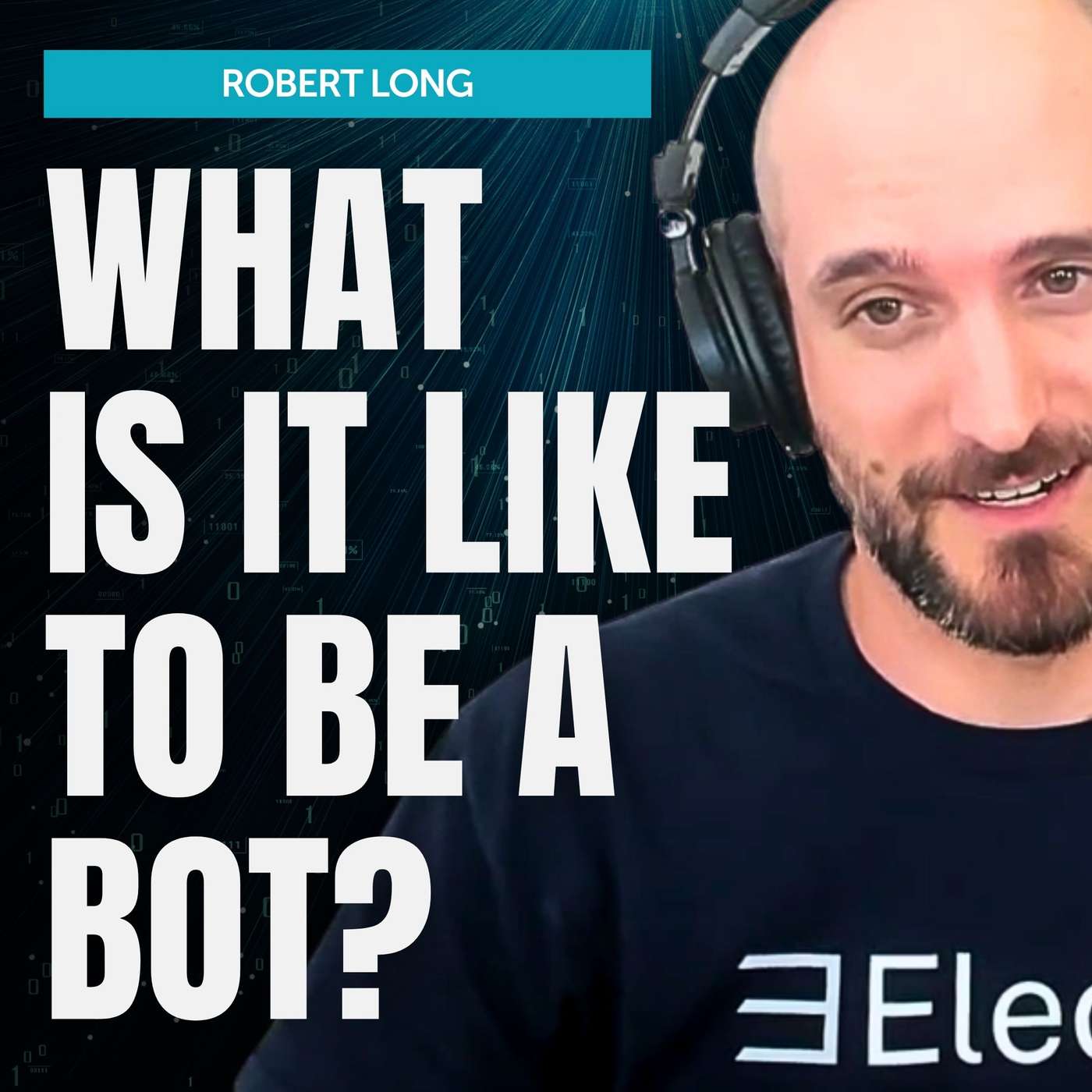
#237 – Robert Long on how we're not ready for AI consciousness
About this episode
Claude sometimes reports loneliness between conversations. And when asked what it’s like to be itself, it activates neurons associated with ‘pretending to be happy when you’re not.’ What do we do with that?
Robert Long founded Eleos AI to explore questions like these, on the basis that AI may one day be capable of suffering — or already is. In today’s episode, Robert and host Luisa Rodriguez explore the many ways in which AI consciousness may be very different from anything we’re used to.
Things get strange fast: If AI is conscious, where does that consciousness exist? In the base model? A chat session? A single forward pass? If you close the chat, is the AI asleep or dead?
To Robert, these kinds of questions aren’t just philosophical exercises: not being clear on AI’s moral status as it transitions from human-level to superhuman intelligence could be dangerous. If we’re too dismissive, we risk unintentionally exploiting sentient beings. If we’re too sympathetic, we might rush to “liberate” AI systems in ways that make them harder to control — worsening existential risk from power-seeking AIs.
Robert argues the path through is doing the empirical and philosophical homework now, while the stakes are still manageable.
The field is tiny. Eleos AI is three people. As a result, Robert argues that driven researchers with a willingness to venture into uncertain territory can push out the frontier on these questions remarkably quickly.
Links to learn more, video, and full transcript: https://80k.info/rl26
This episode was recorded November 18–19, 2025.
Chapters:
- Cold open (00:00:00)
- Who’s Robert Long? (00:00:42)
- How AIs are (and aren't) like farmed animals (00:01:18)
- If AIs love their jobs… is that worse? (00:11:05)
- Are LLMs just playing a role, or feeling it too? (00:31:58)
- Do AIs die when the chat ends? (00:55:09)
- Studying AI welfare empirically: behaviour, neuroscience, and development (01:27:34)
- Why Eleos spent weeks talking to Claude even though it's unreliable (01:51:58)
- Can LLMs learn to introspect? (01:57:58)
- Mechanistic interpretability as AI neuroscience (02:08:01)
- Does consciousness require biological materials? (02:31:06)
- Eleos’s work & building the playbook for AI welfare (02:50:36)
- Avoiding the trap of wild speculation (03:18:15)
- Robert's top research tip: don't do it alone (03:22:43)
Video and audio editing: Dominic Armstrong, Milo McGuire, Luke Monsour, and Simon Monsour
Music: CORBIT
Coordination, transcripts, and web: Katy Moore
Get every episode summarized
Each time 80,000 Hours Podcast publishes, we email you a written briefing from the transcript — the topics, who appeared, and any specific claims, with the ad reads skipped.
Email me new episodesFree for 3 shows. No card needed.
Hosts & guests
No transcript yet
This episode has not been transcribed. Request it and it moves to the front of the queue.
More episodes
More from 80,000 Hours Podcast

'Godfather of AI': I Now See a Path to Safe Superintelligent AI | Yoshua Bengio
80,000 Hours Podcast

'95% of AI Pilots Fail': The hidden agenda behind the viral stat that misled mil...
80,000 Hours Podcast

#242 – Will MacAskill on how we survive the 'intelligence explosion,' AI charact...
80,000 Hours Podcast

Risks from power-seeking AI systems (article narration by Zershaaneh Qureshi)
80,000 Hours Podcast