About this episode
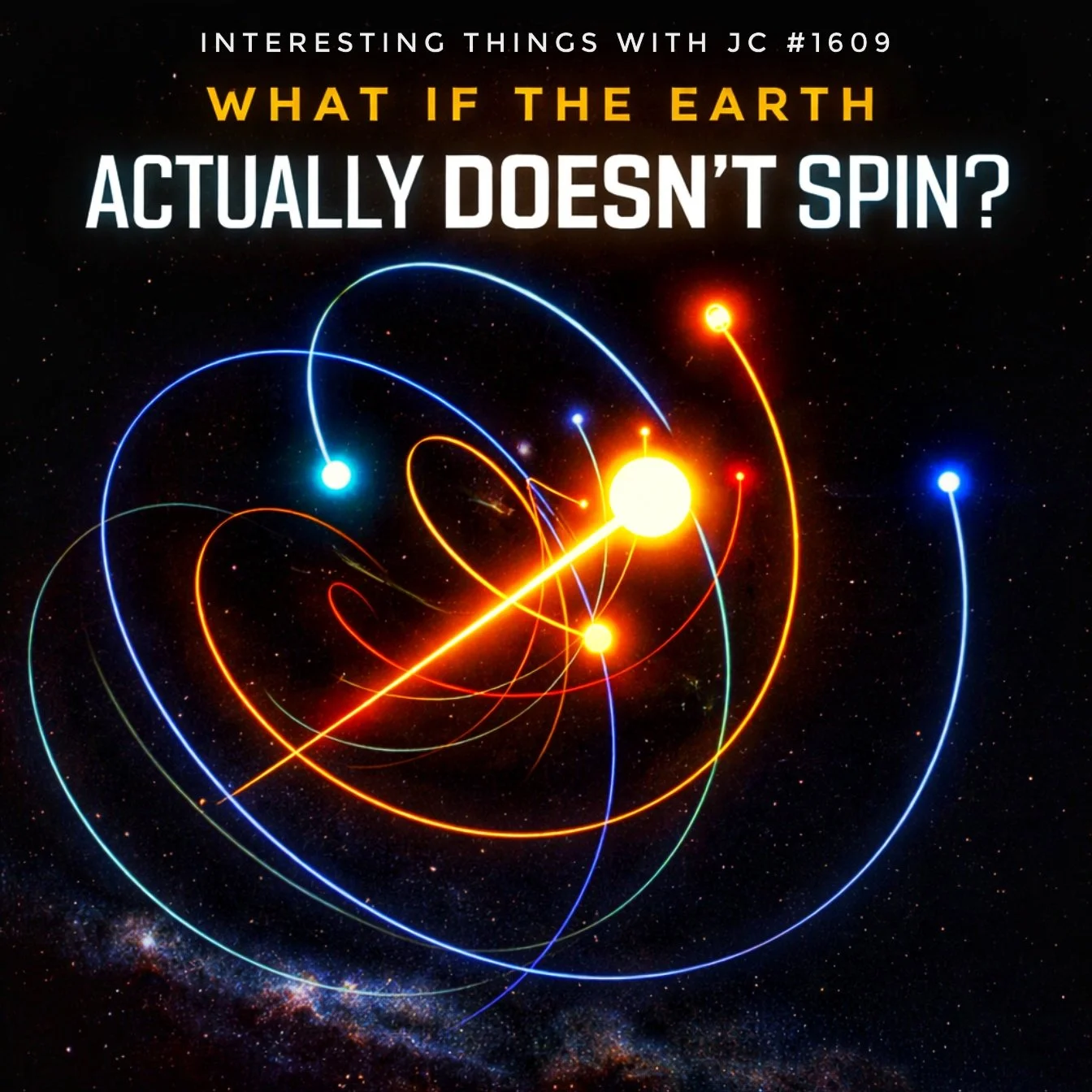
Interesting Things with JC #1609: "What If the Earth Actually Doesn’t Spin?" – It looks like everything moves around you. For centuries, that was enough. But when perspective shifts, the universe changes with it, and the cost of standing still becomes impossible to ignore.
Get every episode summarized
Each time Interesting Things with JC publishes, we email you a written briefing from the transcript — the topics, who appeared, and any specific claims, with the ad reads skipped.
Email me new episodesFree for 3 shows. No card needed.
Hosts & guests
Transcript ready
92 searchable segments. Every word is indexed and playable.
Full transcript
Interesting Things with JC — 1609: "What If the Earth Actually Doesn’t Spin?". Machine-transcribed; use the interactive transcript above to jump the player to any line.
If you stand outside long enough, you'll see it. The sky moves. The sun crosses from one horizon to the other. At night, the stars follow the same path. They're very steady, predictable. But the ground beneath your feet it never gives you any sign that it's moving. If you trust what you see, it feels like everything is moving around you. For most of humanity, that wasn't just a feeling. It was reality. In the second century AD, Claudius Tulummi built the system from exactly what you would see standing there. Earth is fixed. Everything else moves. To explain why planets sometimes reverse direction, retrograde motion, his model added layered circular paths called epicycles. It was very complicated, but it matched the sky. Then in 1543, Nicholas Copernicus,
he asked you to shift your perspective. What if the ground on your feet is what's actually moving? In that model, Earth rotates once every 24 hours. About 1,040 miles per hour or 1,600 kilometers an hour at the equator. And at the same time, it orbits the Sun at roughly 66,000 to 67,000 miles per hour, roughly 107,000 kilometers per hour. So what you see in the sky, it doesn't change, but the explanation does. Over time, that explanation had held true. Johannes Kepler, he showed that those paths are elliptical. Galileo Galilei, he saw moons orbiting Jupiter. And Isaac Newton, he explained the force behind it. So you're spinning and you're orbiting. That part's established. But here's what you don't see.
The Sun itself is moving. It's traveling around the center of the Milky Way at about 514,000 miles per hour, 828,000 kilometers an hour. And if you're not being dragged behind it, you're already moving with it. It's held in place by gravity while continuously falling around the Sun. That means you never return to the same place in space. Each year, as you complete an orbit of about 584,000,000 miles, 940,000,000 kilometers, the entire solar system has moved forward. Your path, it's not a circle. It's a continuous path through space, layered motion, not a loop. And the stretched corkscrew often shown in simplified diagrams like the cover art today. Now go ahead and take that one step further. What if the Earth actually doesn't spin? Modern physics allows you to say it. In 1905, Albert Einstein showed that motion
depends on your frame of reference. You can describe everything as moving around you while you remain still. But if you do that, everything has to follow that choice. Not just what you see in the sky, but the motion you don't see. The orbit of planets, the forward motion of the solar system through the galaxy, all of it has to be folded into a single rotation around you every 24 hours. So that means distance drives speed. For Proxima Centaurium, about 4.25 light years away, roughly 25 trillion miles or 40 trillion kilometers, completing that motion in one day would require speeds at or beyond the speed of light. It would also require constant acceleration, non-inertial effects. Introducing forces that you do not observe. So instead of simplifying the system, it makes it more complex at every single scale.
So you can describe the universe that way, but it doesn't behave that way. What it remains is this. You are not standing still. You're part of the system moving in layers. Rotation, orbit, shared motion through the galaxy. It's all happening at once, all consistent under the same physical laws. And you don't feel it because everything around you shares that motion. Without an outside reference, it all disappears. That original belief came from exactly what you can see and feel. But you're inside the system, and from the inside stillness, is exactly what motion feels like. These are interesting things with J.C.
More episodes
More from Interesting Things with JC

1769: "Football Brain Injury Cover Up"
Interesting Things with JC

1768: "The Science of Jealousy"
Interesting Things with JC

1767: "The Spider-Man of Paris"
Interesting Things with JC

1766: "Autistici/Inventati - The Network Behind the Network"
Interesting Things with JC