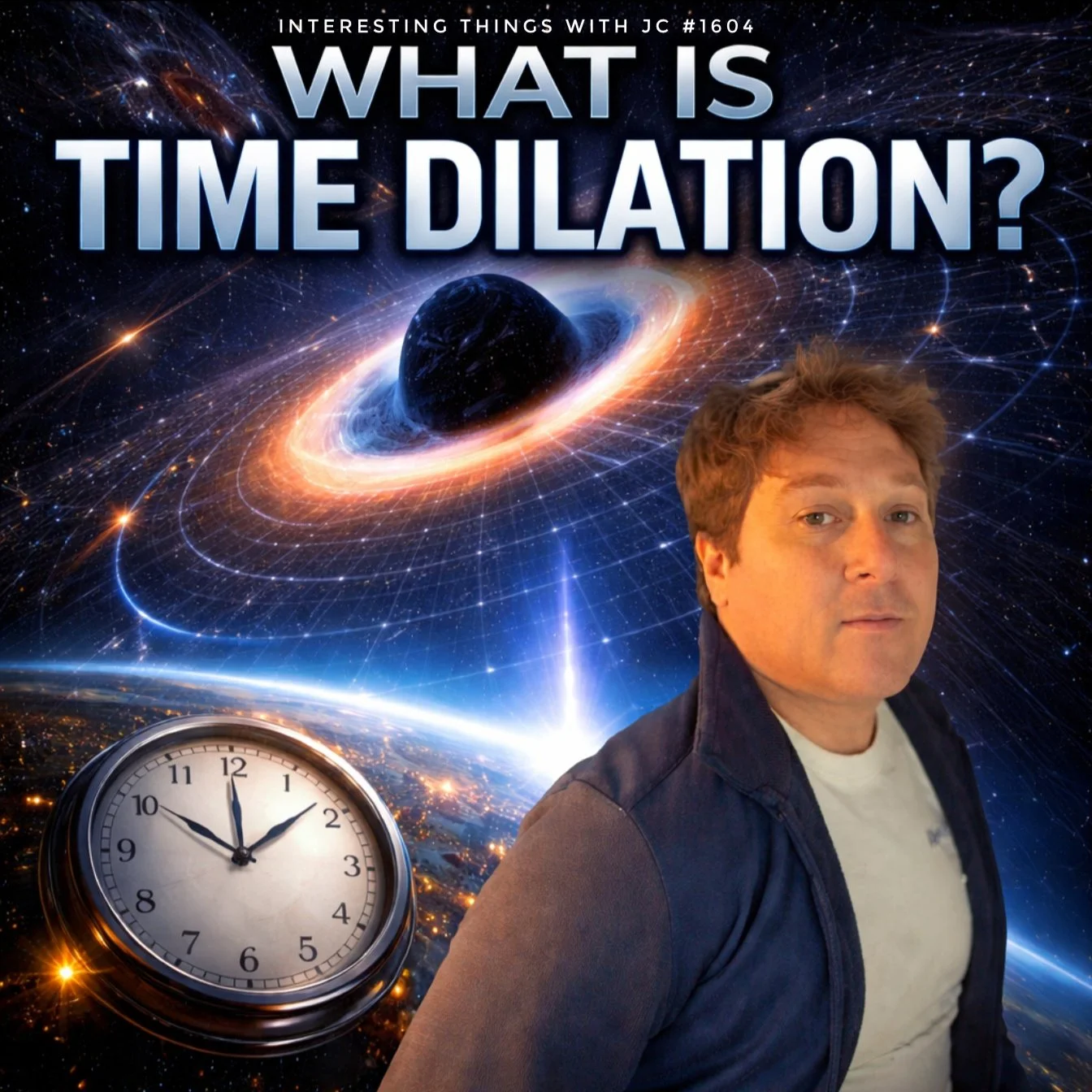
About this episode
Interesting Things with JC #1604: "What Is Time Dilation?" – Two perfect clocks start together, then reality pulls them apart. Motion changes time. Gravity changes time. And once you see how, the universe feels far less stable than it did a moment ago.
Interactive timestamps
Jump to segmentGet every episode summarized
Each time Interesting Things with JC publishes, we email you a written briefing from the transcript — the topics, who appeared, and any specific claims, with the ad reads skipped.
Email me new episodesFree for 3 shows. No card needed.
Hosts & guests
Transcript ready
51 searchable segments. Every word is indexed and playable.
Full transcript
Interesting Things with JC — 1604: "What Is Time Dilation?". Machine-transcribed; use the interactive transcript above to jump the player to any line.
0:00two atomic clocks, they could be synchronized within less than one second over 100 million years. Place one on Earth, another in orbit, and they're no longer going to agree. In 1905, Albert Einstein defined special relativity. It established the time depends on relative velocity. In 1915, general relativity extended this framework by showing the gravitational fields alter the rate at which time passes. These effects are not theoretical approximations, they're quantified, measured, and applied. Time dilation describes the difference in elapsed time between two observers due to velocity or gravity. At low speeds, the effect is negligible. A vehicle traveling 60 miles an hour, 97 kilometers an hour, it produces a time difference on the order of nanoseconds over extended periods. As velocity approaches the speed of light, 186 282 miles per second,
1:00or 299,792 kilometers per second, the rate of time slows measure believe for the moving system relative to a stationary observer. This relationship is expressed in the Lorentz factor, derived in 1904 by Hendrick Lorentz. It defines how time scales with velocity. At 99 percent of light speed, time for the traveler passes at roughly one-seventh the rate of a stationary observer. Experimental confirmation followed. In October 1971, physicist Joseph Heifel and Richard Keating plays cesium beam atomic clocks aboard commercial aircraft. The flight circled the Earth covering approximately 25,000 miles or 40,233 kilometers. Upon return, the airborne clocks differed from reference clocks at the United States Naval Observatory. Eastward flights lost 59 nanoseconds, westward flights gained about 273 nanoseconds, and these results matched relativistic
2:03predictions within experimental error. Now gravity produces a separate measurable effect, you see, according to general relativity, time passes more slowly in stronger gravitational fields. So at Earth's surface, gravitational acceleration is 32.2 feet per second squared, or 9.81 meters per second squared. At the altitude of global positioning system satellites, approximately 12,550 miles above Earth, or 20,200 kilometers, Earth's gravitational influence, it's a lot weaker. So satellite clocks gain approximately 45 microseconds per day due to reduced gravity while losing about seven microseconds per day due to orbital velocity. The net gain is 38 microseconds per day, and without correction, positional errors, they accumulate at roughly six miles or 10 kilometers per day. Stronger gravitational fields, they produce larger effects, and near a non-rotating black hole.
3:10Described by the Schwarzschild solution in 1916, Karl Schwarzschild's time dilation increases rapidly as distance approaches the event horizon. At that boundary, the escape velocity equals the speed of light. From the perspective of a distant observer, processes near the horizon appear to slow towards zero. Now modern theoretical physics extends these principles even further, while remaining anchored to the same equations, okay? In standard quantum field theory, time is typically treated as continuous, but some candidate theories of quantum gravity suggest that space time may not remain smooth or classical at extremely small scales. The plank time, approximately 5.39 x 10 to the negative 44 seconds, is a natural timescale derived from fundamental constants, and it's often taken as the scale where current theories are expected to break down
4:15without a theory of quantum gravity. Below about this scale, physicists expect that classical descriptions of space time may no longer be adequate. Additional speculative frameworks attempt to reinterpret cosmic structure itself. One such proposal, sometimes described as inverted stellar cosmology, it applies relativistic equations under alternative boundary conditions, and in these models, large-scale regions of space time are treated as interior gravitational systems, which can alter how time and distance are then interpreted across cosmic scales. These ideas are not experimentally confirmed, but they rely on the same relativistic principles the govern time dilation. If such configurations exist, the governing rule does not change. The rate at which time passes would still depend on the velocity and gravitational potential, and what would change is the frame of reference used to measure it. Time dilation is therefore
5:17a measured property of space time, is confirmed by atomic clock experiments required for satellite navigation and consistent with astronomical observation. It defines how time behaves under motion and gravity, and it remains one of the most precise predictions in modern physics. These are interesting things with J.C.
More episodes
More from Interesting Things with JC

1769: "Football Brain Injury Cover Up"
Interesting Things with JC

1768: "The Science of Jealousy"
Interesting Things with JC

1767: "The Spider-Man of Paris"
Interesting Things with JC

1766: "Autistici/Inventati - The Network Behind the Network"
Interesting Things with JC