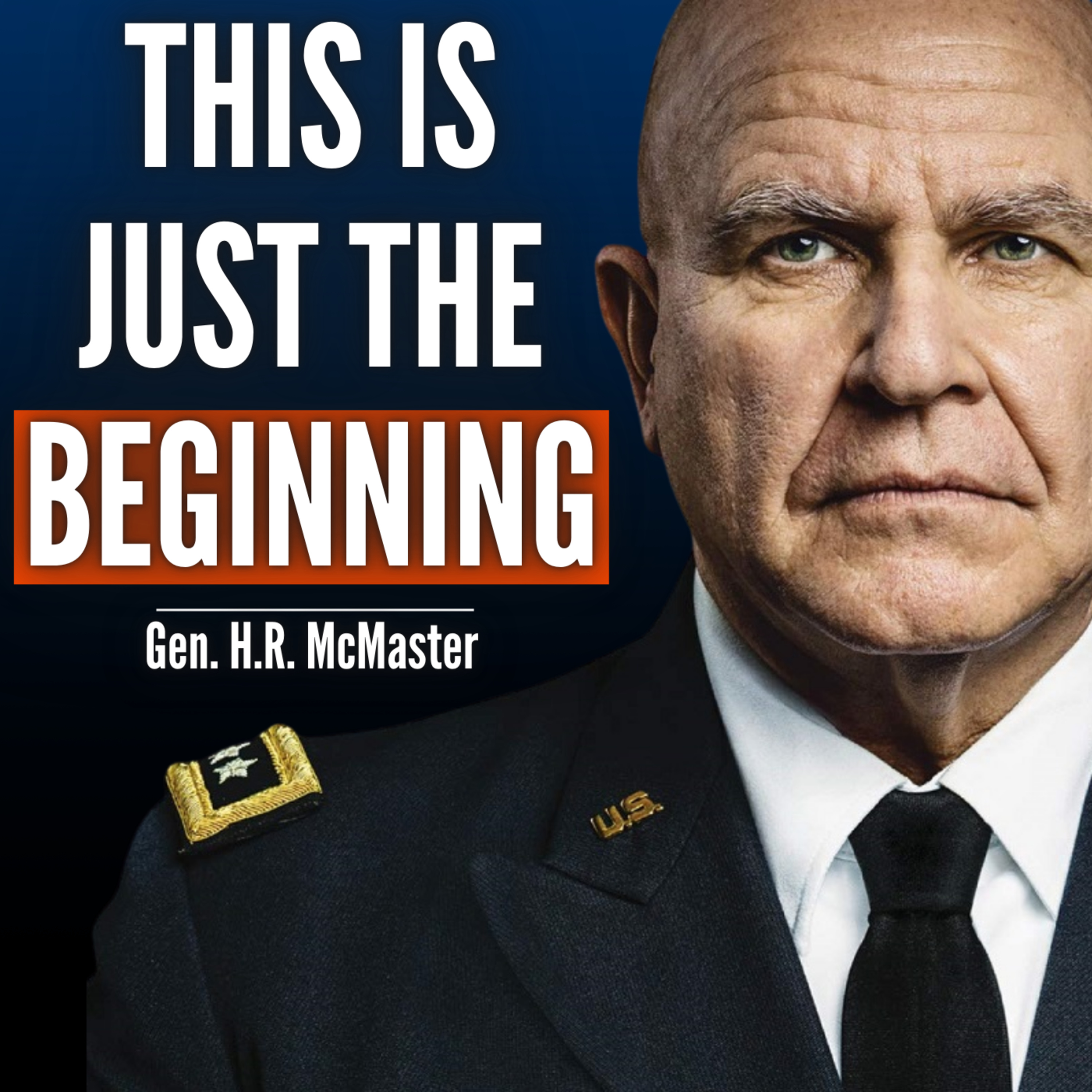
#113 General H.R. McMaster Warns: The Wars Are Just Getting Started. And Time Is Running Out
About this episode
➡️ Buy your own Geopolitics of the Western Pacific Map Print: https://decoding-geopolitics-shop.fourthwall.com/
➡️ Watch the full interview ad-free, join a community of geopolitics enthusiasts and gain access to exclusive content on PATREON: https://www.patreon.com/DecodingGeopolitics
➡️ Sign up to my free geopolitics newsletter: https://stationzero.substack.com/
This is a conversation with General HR McMaster - one of the most experienced, respected and impressive military and national security thinkers and practitioners of our time. He is a military historian, Senior Fellow at Stanford University’s Hoover Institution, former National Security Advisor to Donald Trump in his first term and a former three star general in the U.S. Army - who among other things commanded US troops during the Gulf War in the biggest tank battle since the 2nd world war and who has been called the “best brigadier general of our time” and “the pre-eminent warrior-thinker of the 21st century”.
As we're recording this, the United States and Israel are two weeks into a war with Iran, and the war in Ukraine is still grinding on. And General McMaster has been warning for years that these - and other conflicts - aren't separate crises - but that they're part of one connected, escalating struggle between the West and an axis of authoritarian aggressors. In this conversation, we get into why he thinks the West is dangerously underestimating this threat, what's really driving Putin's strategy and why does Trump keep refusing to increase pressure on him, whether starting a war with Iran war was a good decision and how will it end, whether the West still even exists if U.S. president threatens to take Greenland or why is the momentum of escalating and cascading events only picking up steam - and what comes next.
Get every episode summarized
Each time Decoding Geopolitics Podcast with Dominik Presl publishes, we email you a written briefing from the transcript — the topics, who appeared, and any specific claims, with the ad reads skipped.
Email me new episodesFree for 3 shows. No card needed.
Hosts & guests
Transcript ready
330 searchable segments. Every word is indexed and playable.
Full transcript
Decoding Geopolitics Podcast with Dominik Presl — #113 General H.R. McMaster Warns: The Wars Are Just Getting Started. And Time Is Running Out. Machine-transcribed; use the interactive transcript above to jump the player to any line.
This is a conversation with General HR McMaster, one of the most experienced, respected, and impressive military and national security thinkers and practitioners of our time. He is a military historian, senior fellow at Stanford University's Hoover Institution, former national security advisor to Donald Trump in his first term, and a former three-star general in the U.S. Army, who among other things commanded U.S. troops during the Gulf War in the biggest tank battles as the Second World War, and who has been called the best brigadier general of our time and the pre-eminent warrior thinker of the 21st century. As we're recording this, the United States and Israel are two weeks into a war with Iran, and the war in Ukraine is still grinding on. And General McMaster has been warning for years that these and other conflicts aren't separate crises, but that they're part of one connected escalating struggle between the
West and an axis of authoritarian aggressors. In this conversation, we get into why he thinks the West is dangerously underestimating this threat, what's really driving Putin's strategy, and why does Trump keep refusing to increase pressure on him, whether starting a war with Iran was a good decision and how will it end, whether the West still even exists if the U.S. President threatens to take Greenland or why is the momentum of escalating and cascading events only picking up steam and what comes next. This podcast and interviews like this can exist only thanks to its supporters on Patreon to whom I am deeply grateful and who get a bunch of perks in return for their support, including the full ad-free version of this and other episodes and additional bonus content. And if you want to get even more geopolitical analysis, I also write a newsletter. You can
find the link in the description. And now enjoy the conversation. So welcome to the podcast. As I said, it's an honor to be with you, Dominic. Thanks for having me. So there's obviously so much going on in the world, so much that I would like to talk with you about. And we're going to talk about a lot of that. We now have a war with Iran. We still have a war in Ukraine going on. But I think I'd like to start with a bigger picture view because you have been arguing for years by now sooner than I think maybe anyone else for that big picture view on these threats. And you've been arguing that it would be a mistake for the West to view what's going on these different theaters as isolated crises. And that would make them particularly dangerous is that they're deeply interconnected. And so I have maybe two questions on that to start.
First, if you could actually make the case for why you think it would be a mistake for us to view them and treat them in isolation. And second, if you don't think that we're actually going more in that direction in the opposite to what you argue for because it does seem that now the US at least is treating these different conflicts less as something that's interconnected and part of one bigger axis of threat and more as separate with having completely different policies towards these different actors in what you call the the axis of aggressors. So what's your view on that? So Dominica, I think just the evidence is really demonstrates dramatically that these actors are working together. So the axis of aggressors, what I'm talking about is obviously Russia and China to revanche this or revisionist powers on the Eurasian landmass who have pulled into the
fold other allies like the North Koreans, like the Iranians, like Venezuela and under Maduro and others, like the Cuban Army, regime of Cuba and Nicaragua and so forth. So what they are endeavoring to do and what they've been quite clear about is to rewrite the rules of international discourse in their favor. I think you could go back to maybe the joint statement issued by Putin, as Xi Jinping prior to the Beijing Olympics in 2022, which occurred just a week prior to the massive re-invasion of Ukraine in February of 2022. And they said, hey, this is a new era of international relations. What they meant is, hey, you're finished in the West. You're finished United States and Europe were in charge now get used to it. They echoed that same sentiment in April of 2023 when they got together and Xi Jinping turned to Vladimir Putin said, Vladimir, you were seeing changes like we haven't seen in a hundred years and you and I are driving those changes. They felt like
they were in the driver's seat. They had the initiative not only with the massive re-invasion of Ukraine, but also what followed that October, which was when the Islamic Republic of Iran lit the ring of fire around Israel after building up the capabilities of its proxy forces and terrorist organizations around Israel's borders. And what happened the next day? Is Vladimir Putin hosted Hamas leadership in Moscow? China covered for Iran in its manipulation of its algorithms on TikTok and with its wolf warrior diplomats to obscure the heinous crime committed in October 7th and to portray Israel as the aggressors. So there's so much evidence, right? I mean, there are North Korean troops fighting along Russians on European soil. There is an Iranian drone factory in Russia producing shahead drones for the onslaught against Ukraine and the workers are North Korean
slave laborers, right? I mean, these connections are they're intertwined. Russia is providing shahead drones back to Iran and providing intelligence to target critical capabilities in the Gulf and to target the 14 countries that Iran has attacked and attacked in the region. So it's really clear they're eating it and betting each other. China is financing is foundational to the entire effort. The economy is based in large measure on buying oil at a discount from its clients, the Venezuelans, the Iranians. Okay, so, okay, so now what about the response? How's the Trump administration doing? Hey, I think they're doing pretty well. The reason is at least they're acting. I mean, the Biden administration, I think in its its its passivity, right? In this mantra of always trying to deescalate portrayed weakness to the axis of aggressors and it's the weakness that is provocative. So I think Trump acting in Venezuela, acting against Iran with this window of opportunity as they
were trying to build up even more capacity to do even more arm in the region and around the world. I think what he has now is regain the initiative. Now, would I like him to place more pressure on Russia and to double down on support for Ukraine and to take a more competitive approach to China, then then pursuing kind of this big trade deal that you like to get and we'll see if the summit happens at the end of March for him going to Beijing in an effort to get that. Yes, I would. But hey, at this stage, I'll take what we're getting right now, which is if you look at this, the world's situation, the global situation from the perspective of Moscow and Beijing, what happened first, Syria regime collapse, Iran loses the leverage to the Mediterranean. Russia loses its bases in Syria. Their main platform for influence in the Western Hemisphere. And I really, the influence with far left anti-American parties, dude, not just these dictatorships,
but the Merino Party in Mexico, Petro in Colombia, the pink wave that washed across the Western Hemisphere, that's all correcting now. And so I think they're the losers. If the Iranian regime collapses, which I think we should all hope it does, and remember that they just murdered 30 to 40 million or 40 thousand, excuse me, of their own people in January, 18th and 19th and a 48 hour period, if that regime collapses, if there is a new government in place that reflects the will of the Iranian people, they can integrate back into the global and the regional economy in an effective way and represents and protects their own people. I think then China loses its influence in the Middle East, which was mainly using Iran as a hedge, you know, as a way to portray themselves as a hedge against Iranian aggression. Well, to follow up, because I want to talk about Iran in more detail a bit later on,
but maybe to follow up on what you were saying. And maybe to dig in a little deeper into the argument about the access being interconnected, because I'm sure there are some people who would argue that the connection is maybe overstated, including people in the current US administration, and that you have these different actors who have some overlapping interests, but also have a lot of contradicting interests. And as we see, they're not going to fight for each other, they're not really allies in the traditional sense. And maybe the access is because of those things is not really a thing. What's your view on that? I think that's a delusion, because what people are trying to do is recreate kind of the policies of the 1970s, and during which we tried to separate China and Russia, when you try to separate them, what that allows Putin to do is to hold out the prospect of that, you know, all of
actually could separate maybe from China's, if you give me a pass on my aggression in Ukraine, for example, and then it actually allows China to escape responsibility for underwriting all these wars and underwriting all these efforts to undercut US interests, as well as turn a blind eye to various forms of Chinese economic aggression and coercion. So, yeah, I think instead of trying to separate them, we should glue them together, not only because they deserve each other, but when we act like they're separate from one another, we allow them to cover for one another. I want to take a quick break here to make a little announcement. I love maps, historical maps, geographic maps, all kinds of maps. I've got a bunch of them on my walls, and there's just something about looking at a beautiful map that I find for some reason really satisfied. And because I also love geopolitics, I always wanted a map that would both look beautiful and actually have geopolitics as its focus to capture and visualize balance of power.
And since that didn't really exist, I decided to make one. It's called geopolitics of the Western Pacific, and it's a physical map print that I created together with a professional designer. It shows the strategic flashpoints of the region from Taiwan to North Korea and the South China Sea, and all the key basis invasion routes, missile ranges, and everything else. And it's presented in a way that's actually beautiful enough to hang on your wall. I basically made it for myself, but if you're also a geopolitics and a map nerd, you might like it as much as I do. So if you'd like one for yourself, you can get it now using the link in the description. And now back to the video. Yeah, yeah. Well, I guess what do you think is maybe the biggest mistake that the West is making? Is it this that we're not actually seeing them as one as one big actor or one group of actors acting in unison? Or is it as you were saying in your critique of Biden's administration,
that they have been recognizing them in that way, but they weren't doing anything about it. So is it maybe the the passivity of that approach? And Trump, despite the criticism, maybe as you said, is at least doing something? Yeah, I think the biggest, the biggest criticism of our approach in the West at this moment, I think, is that we are portraying a lack of unity to the axis of regressors. What emboles the axis of aggressors is the belief that the US, Europe, the West is weak, divided, and decadent. And so we should try to disabuse them of that notion, but through greater cooperation. So, I mean, I wish, for example, President Trump would stop insulting allies, you know, or suggesting, and I don't think he was ever serious about this, but it did a lot of damage that he would invade Greenland. For example, I wish that he would stop these so insulting to the Canadians or to Europe generally. But of course, also, I think Europe needs to step up,
and it's time for us to work together to counter various forms of Russian, you know, to have Chinese, Iranian aggression, you know, I think that we have tremendous opportunity at this moment, because this axis of aggressors, you know, they, they try to portray themselves as strong. Look how Iran for so long, try to portray itself as strong. The reason they looked strong is because they were using proxies, they were willing to act to sacrifice every Arab life, if necessary, to accomplish their objectives as of kicking the United States out of the region, encircling Israel and killing all the Jews, right? And to establish his hegemonic influence across the region. Our mantra was, was escalation management, which gave Iran really the ability to escalate on its own terms with impunity. And so, I think this, you know, this idea that, you know, these aggressors are strong really is inaccurate, you know, I mean, China has huge economic problems, really based on its race to surpass Europe and the United
States and the, and the, and the Western world. Russia, Russia's economy is in his shambles, you know, and they've taken a million casualties, dead and severely wounded in the war that was supposed to take one week, you know, and they're supposed to be on parade in Kiev at the end of that week. So I think we see the frailty of, you know, of the Maduro or Chavista regime in Venezuela. So again, another regime to try to appear, appear strong. So I think we should be more confident. And that was the time for us to kind of re-emphasize our common interests in the free world and to come back together and to get over, you know, kind of the Trump insults, you know, and recognize that hey, we have a lot of work to do to make our economies more resilient, to strengthen critical supply chains, to expand industrial production, to counter various forms of Chinese economic aggression, to restore deterrence, you know, by strengthening our militaries, to have energy security. What President Trump calls energy dominance, you know, to deregulate,
to get all of this done, you know what? I mean, so it's as a common agenda, you know, the Draghi report in many ways is really Trump's economic agenda. Let's work on it together. Yeah, well, I think I couldn't agree more with what you're saying. But then sitting in Europe, if you look at the reality of how the Trump administration is acting towards Europe, it kind of seems like they don't really share your view that it seems that they don't really see the need to have allies in general, and that they kind of, it seems from my point of view, that their view is that they think that America is just good on its own, and that it doesn't really need all these alliances that have been building up over the decades, and that they're more of a burden rather something that is benefiting the US as well. And that this, if you're European, it's quite hard to, you know, deal with that and convince someone to be an ally if they don't want to.
Well, Dominic Pearson, here's the perspective of a lot of Americans, right? And a lot of Trump's biggest supporters, and this is what European should recognize. Europe was free writing on the backs of American taxpayers in the area of defense for decades, right? And so from the perspective of Americans, you know, who have been buffeted across those decades by, you know, by the tax of 9-11, September 11, 2001, and maybe the length, you know, and difficulty and cost of the wars in Afghanistan and Iraq, remember financial crisis 2008, 2009, the opioid epidemic in the United States, the effects of social media, you know, so Americans, you know, were disenchanted many of them, and they looked at Europe as, you know, as the European economy that produces about 19% of the world's GDP and countries that account for 50% of the world's social spending. So America is really, hey, why are we covering their defense bills and underwriting their social
programs? And so that's a valid point. But I think what we, the point to make now is that Europe has woken up to shoulder more and more of the defense burden or responsibility. If Europe does, you know, in fact spend 3.5% on hard defense capabilities and another 1.5% of GDP equivalent on critical defense and resilience-related infrastructure, hey, you know, so Donald Trump won, right? He was right, you know, Americans grievances there are being addressed. And I think then the next point to emphasize is really that our common principles and our common values, you know, and how those are under duress by authoritarian regimes. And in China's case, it's status-market supposed economic model. There's trying to rewrite the rules in favor of their authoritarian regimes and in favor of that status economy. I mean, Europe is bearing the brunt of that. I mean, look at how Germany's economic model has failed, you know, based on over-reliance on Russian
energy and over-reliance on exports, especially to China. And what is China done? Well, hey, they do what they always did. They stole your intellectual property. They stole your know-how. They picked Chinese winners like BYD. They manufactured products, you know, at an artificially low cost and dumped them into your market and drive you out of business. That's what they always do. So, hey, do we want to work together across our free market economies, you know, with the US and Canada, North America, working with Europe and working with Japan, you know, and Australia, other against the economic regression? Hell, yes, we. Because, you know, as we said in our revolution, 250 years ago, in America, Benjamin Franklin, when he in 1776 after the Declaration of Independence, he said, you know, he said, we must hang together, or most assuredly, we will hang separately, you know, and so I think we should recognize it's time for us to hang together.
Yeah, yeah. Well, I definitely agree that Europe has been a free writer, and I think we should still do far more than we're doing now. And as you said, I think the recognition of that has happened in Europe. I think we have woken up to this reality mostly. But I do think that the discussion in Europe now is actually to what extent long term we can really rely on the US. And whether if their, for example, is a conflict with Russia, let's hope there isn't, but if there potentially is, to what extent can we actually rely that the US will come to help and want, for example, demand, you know, Greenland and Iceland in return for that help, which probably wouldn't make my sense. So I understand if you would, for example, if you would try to put yourselves into shoes of European leaders with what do you know, and the the background and the perspective you have, what do you think you would do? Because in either case you're making a bit of an uncertain
fact. Well, you know, hey, I just don't think there's an alternative, you know, I mean, who's going to lead in NATO without the US? I mean, is it going to be France? You know, is it coming, is it going to be Poland, Germany? I mean, like, you know, I think the US is indispensable in that connection, and fostering kind of, you know, the, you know, the, the continental commitment that, that the, the UK didn't make prior World War One to the continent and allowed kind of the devolution into into the, the first of two incredibly destructive world wars of the, of the 20th century. So, so that US commitment to the European continent, I think, is essential to preserving peace. It's actually succeeded across over 80 years in doing so. And, and I would just say, hey, look at the historical record, you know, since the United States kind of came into its own in the late 19th century, think about the world the United States played in 1917 to 1918. Think about the
world the United States played in 1941 to 1945, and then beyond in the Cold War, preserving peace, competing, and winning the Cold War against the Soviet Union. If you're, if you're a Korean, you know, and you doubt the US, you know, think about what would have happened if the US hadn't intervened after the June 1950 attack on the Korean Peninsula. Would you rather live North, you know, or South as a 30th parallel? You know, if you're, if you're a Bosnian Muslim, where would you be today without the United States? You'd probably be dead unless the United States had intervened in the Balkans. If you're a Kosovar, where would you be today? You know, you know, so I, I mean, the list, the list goes on. And, and, and, and, and frankly, if you were a Ukrainian, where would you be today? You know, if there was, had been the support, I mean, the halting support, not enough support in my view for Ukraine. So I would just say, hey, I mean, without the US, the prospects for improved
security, really the restoration of peace in Europe, is pretty grim, you know, and, and, and I think, again, what we need is strengthening of the alliance, physically as we've been talking about, you know, with greater investments in defense. But as we're also talking about, we need a psychological and emotional, you know, strengthening of the alliance at this moment. Yeah, yeah. Well, I'm, I'm a from a country that has a lot to be grateful to the US. So I would be, uh, nothing would make me happier than to have a US firmly, uh, by our side in Europe as a, as an ally without a doubt. Going back to the axis of aggressors, from what we were talking about, looking at the chain of events that has happened, Venezuela, Syria, uh, perhaps Iran now. We'll see how that ends up. Does that mean that when you look at it, are you an optimist looking into the future that you think that the momentum is going against the axis of aggressors? Or if you look at, you know, where
will be five years, 10 years from now? Are you concerned about what the balance of power or where are we going and where is the momentum shifting to? Yeah, Dominic, I think we have a, we have a tremendous opportunity at this moment. If we can come back together, cooperate with one another, counter Chinese economic aggression, strengthen our defense, restore deterrence with Russia and exacerbate the weaknesses in the Chinese and the Russian economies, uh, as we, I hope, let's hope, let's all this hope, uh, witness and help foster maybe, um, you know, a transition in the nature of the Iranian government such that it ceases its permanent hostility, you know, to the great Satan, you know, the US, the, uh, the cancerous boil, as well as referred to as, as Israel, uh, and it's Arab neighbors who it's, who it's kept, you know, kind of enmeshed in, in conflict in the sectarian civil wars to keep the Arab world perpetually weak so it can extend its hegemonic influence. If that's rolled back, you know, uh, I, I think the world is in a much
better place, you know, than, than it has been. I mean, it's a part of remember Iran has been the greatest sponsor of terrorism in the world, right? So not only if there's a shift in the nature of that regime, that, that only reduced to the benefit of the Iranian people certainly, but hey, how about all the people in the region from the Lebanese, you know, to the Syrians, to the Iraqis, to the Yemenis who have suffered because of their support for proxies and their fostering of these fitness or, or sectarian civil wars, uh, across the region. So hey, I, I think there's a huge opportunity, but let's not get in our own way. I mean, I hope, I will present a President Trump when I get in his own way in this area and, and then also for the Europeans as well, you know, and, and of course, you know, you have, you have President Macron who loves to declare strategic autonomy, you know, and, and say, okay, you know, we can do this on our own. It's actually a pretty bleak picture, you know, I mean, so I think let's keep the family together at this moment, take advantage of these opportunities, take advantage of the weakness of this axis of aggressors, and build a future,
you know, where, uh, where we, we build and regain confidence, confidence in our democratic principles, institutions, and processes. It's really important to remember, Dominic, that we are under assault, uh, with a form of cognitive warfare and political subversion run mainly by the Russians, who are very good at this, in an effort to pull us apart from one each other, a form one another, to pit us against each other, to create centripetal forces that spin us apart from, from, from one another, and again, diminish our, our, you know, our confidence in, in who we are, in terms of our, you know, European identity, the transatlantic relationship, but even within European countries, you know, to support far left and far right parties, uh, and, and to feed into, into people who are buying into it, these conspiracy theories and, and false narratives, you know, and, and, and to create even further division. I do have to make a little jab and maybe point out
that the support for some of the far right parties is also now included in the new US national security strategy. You're all, hey, I mean, I think that's a mistake. It's a mistake, you know, and, and again, this is part of Russia's campaign of political subversion. Okay, now this is ridiculous, but Putin is portraying himself as kind of like the shirtless, you know, anti-woke warrior on horseback, you know, and, and so he appeals to elements of the US population, like he does the elements of, of the German population, especially in the eastern part of the country, like he does the elements of the French population, you know, like he does to, you know, in, in, in, in the UK, and, and, and so what he, what he, what he's portraying himself is as a cultural warrior, right, who's going to, going to save Europe from, from wokeism or the unwashed masses of brown people from the South. I mean, this is a, this narrative, right, that he's spinning out. And then there are useful idiots in the United States and Europe who buy into this, you know, this is the
Tucker Carlson, you useful idiot and others. And, you know, so I, I think that, you know, we have to call this out for what it is, you know, and, and, and this goes back to the, you know, what, with the Soviets were all about. And back in the 1920s, they were very active in the United States, cultivated useful idiots on the far left and on the far right. Are you concerned that now we have one theater in Ukraine that's not going anywhere most likely? Now we have another in the war with Iran. And then you have China that could possibly at any point try and launch an invasion to take over Taiwan. Are you concerned that at some point in the near to midterm future, as you have all these conflicts in which you have these actors who, as you say, are working together, that all these theaters that are still sort of separate could start overlapping more and more into one bigger
conflict, because looking at history, the biggest conflict often started that way by having a few smaller ones that then interconnect into something much bigger. I am concerned. I mean, I think what we have seen are cascading conflicts. I think we saw the, the humiliating what I would describe as a self-defeat and disastrous and deadly, which are all from Afghanistan as precipitating the massive re-invasion of Ukraine. So remember, you know, the fall of Kabul is August of 21, a massive re-invasion of Ukraine, February of 2022. I would draw a line between that and our inability to sustain the weapons and ammunition support for Ukraine in early 2023. And, and also other, you know, other elements of perceived weakness like the judicial reform efforts in Israel and the backlash. I think that's what led Ayatollahamanate to conclude, hey, I'm going to cross this off my list, this being the destruction of Israel and the killing of all the Jews. So you get October 7th of 2023.
I think then, you know, you see at the perception of weakness carryover to Maduro's behavior. When President Trump tries to make a deal with them and he says, no, you know, I've got my sponsors of China and Russia. This carries over to the Iranian behavior when President Trump gave him 60 days and they thought, he's not going to do anything. This is, this is last year's strikes against the nuclear facilities. And then negotiations, again, when they thought he could string him along. So what's important about this, I think, is that now we are acting in a way that could restore deterrence. That's positive. But I think what we have to do is continue to portray strength because it's strength that prevents conflict. I think if the Chinese were to perceive weakness, weakness in our resolve, for example, to challenge their claims of ownership of the ocean in the South China Sea or their claims over Taiwan, that would embolden them. But I got to say, you know, China's got some problems right now economically and apparently within their military.
I mean, Xi Jinping just fired all these generals again, including one he went to kindergarten with. You know, so, so that doesn't really communicate great confidence in the PLA. Now, not that we would want to be complacent. I think what we really need to do is reduce China's course of power over our economies by making our supply chains more resilient, reducing our reliance on manufacturing in the southeastern coast of China, so much of being concentrated there. And we have to build up our militaries to convince China that it could not accomplish its objectives through the use of force and an objective associated with maybe they're they're they're desiring an exclusionary area of primacy across the Indo-Pacific region. Yeah, yeah. Well, I want to use the time we have and talk more about Iran and in a bit more detail because it's not every day that I get to talk to someone who was both a high ranking general but also former national security advisor. And I wonder if first, whether you think that it was a good idea to launch this war and in the way
that it was done because probably you could have went about it a few different ways. But if you were still the national security advisor to the president and he would come to you and ask you, this is what we want to do, this is how we want to do it. Would you tell him, yes, this is a good idea, let's go for it. And is there anything that you would advise that should have been done differently or that you would personally do differently? Thank you for listening to the free part of this interview. The conversation is not over yet, but the next part is only for the paid members on my Patreon or sub-stack. I try to make the best possible geopolitics content and I put a lot of effort and time into this podcast. And there's quite a lot of costs that I have to pay that are associated with it. It's the supporters on Patreon that allow me to do all that and making part of every single interview exclusively available only for them is my way of saying thank you.
Since without them, it just wouldn't exist. So if you want to listen to the rest of the interview, ask questions to guests who appear on the show or myself, get bonus content and my own takes on geopolitics, become part of an active community of geopolitics enthusiasts, and most importantly, make the continued existence of this podcast possible. Do consider becoming a supporter. It really helps. To join, you can find the link in the description or go to patreon.com slash decoding geopolitics.
More episodes
More from Decoding Geopolitics Podcast with Dominik Presl

#114 Janis Kluge: The Biggest Threat to Russian Economy Is Not What You Think
Decoding Geopolitics Podcast with Dominik Presl

#112 Nigel Gould-Davies: Something Is Breaking Inside Russia's War Machine - And...
Decoding Geopolitics Podcast with Dominik Presl

#111 Mujtaba Rahman: Why Iran War Exposed Europe’s Biggest Weakness
Decoding Geopolitics Podcast with Dominik Presl

#110 Jeremy Schapiro: The Real Reason Why Trump Attacked Iran - And Why It Won’t...
Decoding Geopolitics Podcast with Dominik Presl