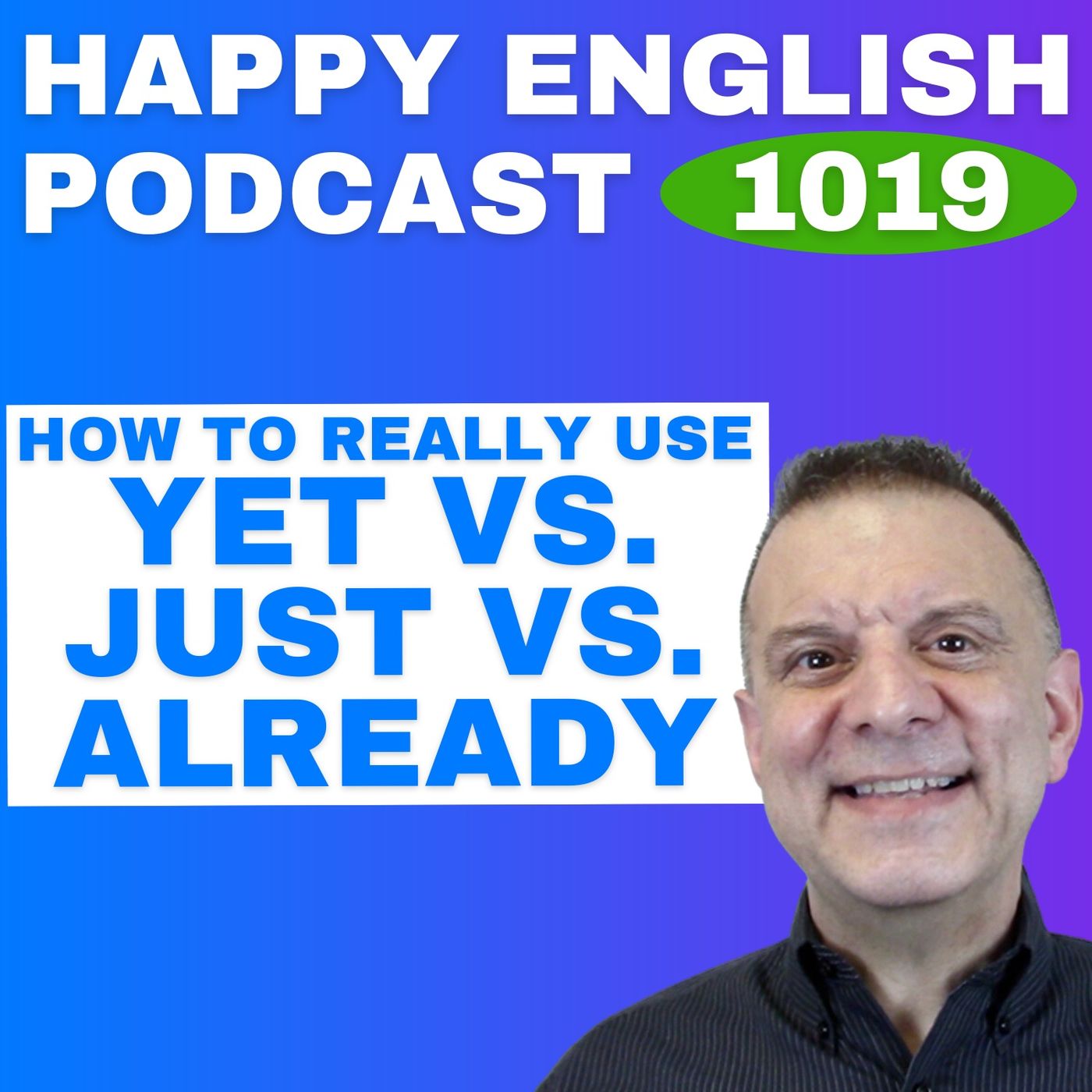
1019 - Just vs Already vs Yet - How to Really Use Them
About this episode
But then when you try to use them in conversation, you’re not really sure which one sounds right.
Should you say, “I just finished”? Or “I already finished”? Or “I haven’t finished yet”?
These are small words, but they can be kind of confusing. So for today’s podcast English lesson, we’re going to look at how you can actually use just, already, and yet in everyday conversation.
The Happy English Podcast
Helping people speak English better since 2014
Over 1,000 episodes • 8 million downloads
📘 Build your vocabulary with my free Vocabulary Workshop
https://learn.myhappyenglish.com/vocabulary-workshop-signup
🎥 Watch video versions of the Happy English Podcast on YouTube
https://www.youtube.com/@HappyEnglishNY/podcasts
🌐 Learn more about my English lessons and courses
https://www.myhappyenglish.com
Get every episode summarized
Each time Happy English Podcast publishes, we email you a written briefing from the transcript — the topics, who appeared, and any specific claims, with the ad reads skipped.
Email me new episodesFree for 3 shows. No card needed.
Hosts & guests
Transcript ready
175 searchable segments. Every word is indexed and playable.
Full transcript
Happy English Podcast — 1019 - Just vs Already vs Yet - How to Really Use Them. Machine-transcribed; use the interactive transcript above to jump the player to any line.
Crashers can happen to even the safest of drivers. Sometimes this is because of situations out of the driver's control. That's why driver assistance technologies can help reduce the human factors involved in crashes. Features like blind spot intervention, lane keeping assistance, rear automatic braking, and automatic high beams all have the potential to save lives. And one of those lives could be yours. Learn more about driver assistance technologies at nhtsa.gov slash driver tech. Paid for it by the US Department of Transportation's National Highway Traffic Safety Administration. Tyler Reddick here from 2311 Racing. Victory Lane? Yeah, it's even better with Chumba by my side. Race to chumpacaceno.com. Let's Chumba. No purchase necessary. VTW Group. Void we're prohibited by law. CTNCs. 21 Plus. Sponsored by Chumba Casino. Just. Already. Yet. Three little words. They should be simple, right? But then, when you try to use them in conversation, maybe sometimes you're not really sure which one sounds right.
Should you say, I just finished, or I already finished. And what about, I haven't finished yet? These are small words, but they can be kind of confusing. So, for today's podcast English lesson, we're going to look at how you can actually use just already and yet in everyday conversation. Welcome to another Happy English Podcast coming to you from New York City. And here's your English teacher, Michael. All right. Thank you, John, and thanks everyone. It's Michael here from Happy English. And I help people speak English better. And this is Happy English Podcast Episode 2019. Just already and yet, how to really use them. Let's start with just.
We use just to talk about something that happened very recently. Like, imagine your friend calls and says, Oh, hey, what are you doing? You might say, I just got home. That means you arrived a short time ago. Or maybe someone asks you if you've eaten. You might say, yeah, I just had lunch. And by the way, in everyday American English, we often use the simple past with just. Like, I just finished or I just ate. Even though textbooks often teach the present perfect, either way, just shows that the action happened a short time ago. And by the way, just in case, if you want to learn four other ways to use just, check out Podcast Episode 2012. Next up, let's look at already. We use already to show that something happened earlier than expected.
Or sooner than someone thought. Like, imagine your boss asks, did you finish that report? And you can reply, yeah, I already finished it. That suggests that maybe they didn't expect you to be done yet. Or imagine a friend says, oh, you ready to go? You can say, yeah, I'm already ready. That means you finished preparing sooner than expected. So, already often has that feeling of sooner than expected or before now. And here's another very common way we use already in everyday conversation. We also use already to say that we have done something before now, especially when someone suggests an idea or asks about it. Like, imagine your friend says, well, let's watch pirates of the Caribbean. You could reply, nah, I already saw it. In this case, you're not talking about something that happened sooner than expected.
You're simply saying that this is not new for you. You've done it before and you're really not interested in doing it again. Here's another example. Maybe someone says, hey, do you want to try that new restaurant? You could say, I already tried it. So, again, in these situations already just means before now. And I did that so I'm not interested in doing it again. Now, let's look at yet. We use yet in negative sentences and questions to talk about something that we expect to happen. But it hasn't happened up to now. Like, imagine you're waiting for a friend. You could say, oh, he hasn't arrived yet. That means you expect him to arrive, but he hasn't come. Or someone might ask you, did you finish your homework yet? You might answer, no, not yet. So, yet is often connected to expectation.
And did you know? We sometimes use yet before the verb for emphasis, especially in more formal English. Like, I just moved here last year. And one of my friends asked me, how are things going? I replied, everything's good, but I haven't yet found a good place to buy bagels. So, in everyday conversation, most people would say, I haven't found a good place yet, but putting yet before the verb gives it more emphasis and sounds a little bit more formal. And by the way, this usage of yet before a verb often comes up in English exams like the Toework. Now, here's where it gets really interesting. These three words are often used in similar situations, but they change the meaning slightly. Like, imagine someone asks you about your homework. There are three ways you can answer. I just finished.
That means you finished a short time ago. I already finished. That means you finished earlier than expected. I haven't finished yet. That means you still expect to finish, but it hasn't happened so far. The situation is the same, but the feeling is different depending on which word you use. So, let's recap. We use just to talk about something that happened very recently. I just finished. We use already to show something happened earlier than expected. I already finished. We also use already to mean it happened before and I'm not interested in doing it now. Like, I already saw that movie. And we use yet in negative sentences and questions to talk about something we expect to happen. I haven't finished yet. These are small words, but they can make a big difference in how natural your English sounds.
So, here's your challenge. This week, try using these words just already and yet in your English conversations. And also, pay attention to how people use them in movies, TV shows, or in podcasts. And keep in mind, the best way to remember English like this and any other word or phrase in English is to take that word or phrase, write it in a sentence that's true for you or true in your world and then memorize your sentences. Hey, thanks for listening. And remember, learning another language is not easy, but it's not impossible. And I'm here to help you on your journey. This podcast was brought to you by Happy English. Please visit myhappyenglish.com. Show your support for Happy English by leaving us a review. Get English, get happy, happy English.
Drew McIntyre here from WWE. Wheeled in the claymore can be a life of chaos. When I'm not dominating in the ring, Chumba Casino is how this warrior takes a wee break. With hundreds of online social games and new weekly releases, there's always something fresh to try. And those daily boosts next level, even my free time feels like foul-halla. So when life feels like a battle, kick up your feet, have some fun. And let's Chumba. No purchase necessary. VGW Group Boyd we're prohibited by law, CTs and Cs, 21 plus sponsored by Chumba Casino. Abercrombie's active brand, your personal best is built for every part of your workout routine. The YPB neonate hoodies and sweatpants are soft, breathable, and moisture wicking. Your perfect warm-up layers. And for leg day or any lifting day, pair YPB motion tech shorts with their active teas and tanks. Level up your workout routine with all new active by Abercrombie. Shop YPB in the app, online, and in stores.
More episodes
More from Happy English Podcast

1032 - AT vs. IN - What’s the Difference?
Happy English Podcast

1031 - Good At vs. Good In - What’s the Difference?
Happy English Podcast

1030 - Have to → Hafta Speak Naturally in a Minute | Happy English
Happy English Podcast

1029 - Hit Means Go TO - English Tips in a Minute | Happy English
Happy English Podcast